Key Points
- Application Refusal: Lewisham Council’s Strategic Planning Committee has formally refused planning permission for 548 homes forming the Lewisham portion of a major cross-boundary redevelopment.
- Cross-Boundary Masterplan: The wider scheme at 1 Deptford Bridge spans both Lewisham and Greenwich, proposing a total of 802 homes across eight buildings ranging from seven to 30 storeys.
- Core Grounds for Refusal: Councillors rejected the application due to harm to heritage assets, excessive height, scale, and massing, and the lack of a completed Section 106 planning agreement.
- Impact on Houseboats: A specific concern was added during the debate regarding daylight loss and additional overshadowing on solar panels serving houseboats moored along Deptford Creek.
- Greenwich Deferred: Greenwich Council’s planning board considered its part of the proposal—comprising 254 homes across four buildings up to 19 storeys—on the same evening but deferred its decision.
- Low Affordable Housing Provision: Across the entire 802-home proposal, only 24 units were designated as affordable housing, representing approximately 3 per cent of the total delivery.
Lewisham (South London News) September 26, 2026 – Lewisham Council has officially refused planning permission for the Lewisham component of a major residential-led redevelopment at 1 Deptford Bridge, leaving the future of an 802-home masterplan spanning two London boroughs in complete uncertainty.
The Strategic Planning Committee determined the application on Thursday evening, voting to reject the construction of 548 homes distributed across four buildings ranging between seven and 30 storeys. The decision confirms the position set out in pre-meeting documentation, where planning officers had recommended refusal, and brings a definitive halt to the proposal in its current iteration.
Because the former Lewisham College campus sits directly adjacent to Deptford Creek—where the administrative boundary between the London Borough of Lewisham and the Royal Borough of Greenwich runs through the site—the development required two independent planning consents. On the same evening, the Greenwich planning board considered the remaining 254 homes across four buildings up to 19 storeys but chose to defer its decision. The split outcome leaves the overall cross-boundary vision stalled without a unified consent.
What Are the Core Reasons Behind Lewisham Council’s Refusal?
Members of Lewisham’s Strategic Planning Committee cited three primary planning objections when formalising their refusal: the degree of harm inflicted on nearby heritage assets, the unacceptable height, scale, and massing of the proposed structures, and the absence of a completed planning obligation agreement to secure essential mitigation measures.
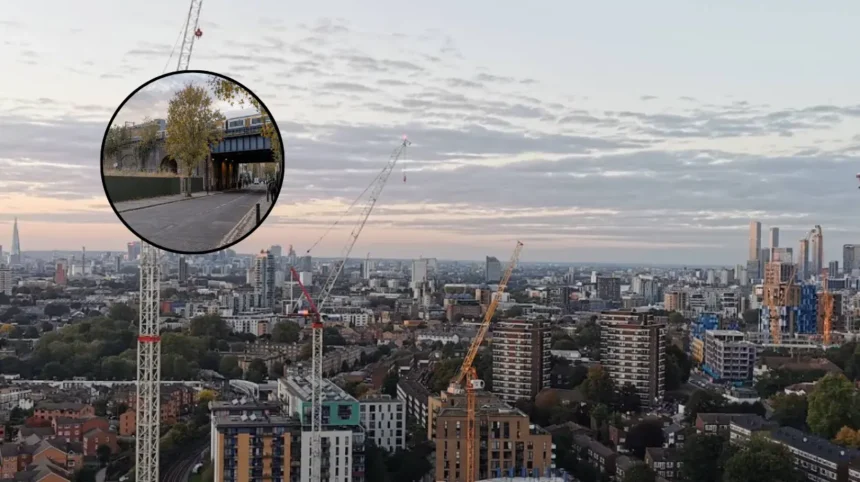
Townscape and heritage considerations proved decisive during the committee’s debate. Council planning officers highlighted that the proposed 30-storey skyscraper would serve as an overly dominant feature in both immediate local streetscapes and longer-distance views across South East London. The assessment identified substantial harm to the settings of adjacent conservation areas, listed structures, and designated townscape views.
While acknowledging that the brownfield location presents a clear opportunity for urban renewal, committee members concluded that the public benefits offered by the applicant did not outweigh the severe planning harm. The scheme had proposed mixed uses, including commercial workspace, retail, food-and-drink outlets, education facilities, and public realm improvements along Deptford Creek. However, with only 24 of the total 802 proposed homes across both boroughs designated as affordable housing—a rate of approximately 3 per cent—the community yield was deemed insufficient to justify the scale of development.
How Did the Deptford Creek Houseboat Community Factor Into the Decision?
During the committee proceedings, councillors introduced an additional, specific ground for refusal centered on the local waterside community. Members expressed strong concern over the effect of additional overshadowing caused by the tall buildings on the houseboats moored within Deptford Creek.
The committee noted that the taller structures, positioned in close proximity to the waterway, would significantly reduce natural light and obstruct sunlight reaching solar panels installed on the residential vessels. Houseboat owners rely on these solar setups as a primary source of renewable energy.
This addition expands the council’s refusal beyond standard townscape and legal objections. It reflects the distinctive environmental context of Deptford Creek, where high-density land proposals directly interface with long-established maritime and off-grid residential communities.
What Is the Current Status of the Greenwich Application?
The rejection by Lewisham leaves the masterplan divided, as Greenwich Council has yet to reach a definitive position on its half of the site. While Lewisham members moved straight to refusal, Greenwich’s planning board opted to defer its assessment of the four buildings proposed on its side of the creek.
The Greenwich element comprises 254 residential units within structures reaching up to 19 storeys. Because the masterplan was conceived as an integrated development with shared infrastructure, public spaces, and access points along the creek, Greenwich cannot approve the comprehensive vision as originally submitted.
Without corresponding approval from Lewisham, any isolated consent granted by Greenwich would apply solely to its portion of the land, requiring significant revisions to access routes, building layouts, and spatial integration around the creek.
Background of the Particular Development
The site at 1 Deptford Bridge carries a long history of institutional use, having previously operated as an educational campus for Lewisham College before becoming surplus to operational requirements. Located directly adjacent to Deptford Bridge DLR station, the plot sits at a key public transport node connecting Lewisham, Greenwich, and Central London.
Over the past decade, the surrounding Deptford Creek area has undergone rapid urban transformation. Historically characterised by industrial wharves, boatyards, and commercial warehousing, the tidal creek has progressively converted into a high-density residential corridor. This evolution has created a sensitive urban grain where tall modern apartment blocks sit immediately beside historic conservation areas, listed victorian infrastructure, and active residential boat moorings.
The recent application represents a revised version of an earlier, even larger masterplan that had drawn criticism from local amenity groups and heritage bodies regarding density and site coverage. Despite reductions in total footprint and height adjustments prior to the committee meeting, the project retained a 30-storey focal point. The minimal provision of affordable housing—just 3 per cent across the entire cross-boundary proposal—became a central point of friction for local representatives, given Lewisham’s strict local planning policies requiring significantly higher ratios of affordable homes on major developments.
Explore More Lewisham Council News
Lewisham Council Launches Rogue Landlords Taskforce to Enforce Standards Lewisham 2026
Lewisham Officers Reject Deptford Bridge Tower as Greenwich Signals Support 2026
Prediction: How This Development Can Affect Stakeholders
The refusal by Lewisham Council and the deferral by Greenwich will reverberate across several key stakeholder groups:
- For the Developer and Investors: The rejection creates significant financial and operational delay. The applicant now faces three distinct choices: launch a costly and lengthy planning appeal to the Planning Inspectorate, submit a substantially scaled-back application featuring reduced building heights and higher affordable housing yields, or sell the site to another developer. Given the explicit refusal grounds regarding massing and heritage, any revised design will likely require a significant reduction in overall residential density, directly lowering the project’s projected gross development value.
- For Local Residents and the Houseboat Community: In the short to medium term, neighbouring residents obtain immediate relief from construction impacts, traffic congestion, and loss of daylight. For the houseboat community on Deptford Creek, the inclusion of solar panel overshadowing in the formal refusal sets an encouraging precedent. Local waterside residents can expect future planning submissions along the creek to pay far greater regard to microclimate impacts, renewable energy access, and daylight preservation.
- For the Regional Housing Market and Local Infrastructure: The decision creates a temporary shortfall in local housing supply targets, holding back the delivery of 802 planned market-rate homes. However, it sends a clear signal to land buyers and developers across London that density and transport connectivity alone will not override strict heritage protections, townscape limits, and local planning requirements for genuine affordable housing. Future schemes submitted for brownfield sites in South East London will likely adopt more moderate height profiles and offer improved public benefits to secure approval.