Key Points
- A host of historic sites and landmarks across the London Borough of Southwark have officially been designated on Historic England’s ‘Heritage at Risk’ register.
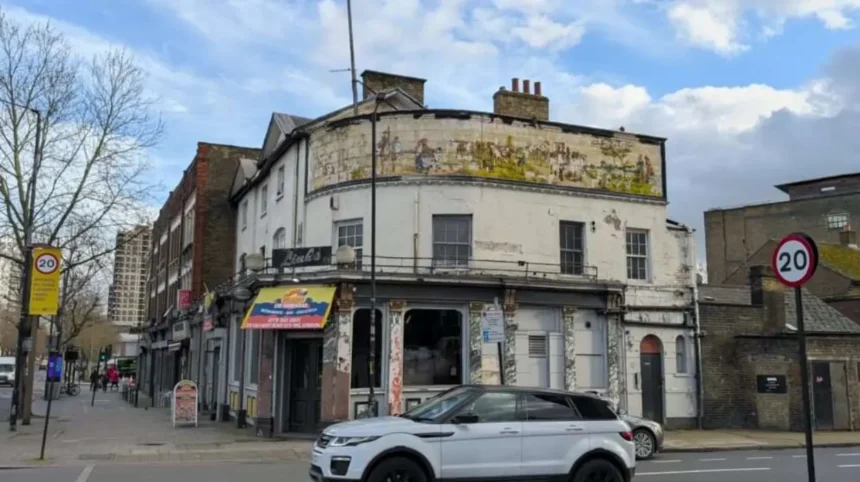
- The former Kentish Drovers public house, situated at 720–722 Old Kent Road at the junction with Commercial Way, has been identified by the conservation body as suffering from “slow decay”.
- Listed as a Grade II building since September 1972, the historic structure dates back to approximately 1840 and features late 19th-century interior details alongside a prominent exterior signboard depicting drovers.
- Official records categorize the pub’s overall condition as fair, its vulnerability as low, and its priority level as D, indicating that a preservation solution has been agreed upon but not yet fully implemented.
- The inclusion highlights ongoing concerns over architectural decay and structural maintenance along major historical arterial routes in South East London.
Southwark (South London News) November 11, 2026 – A host of historic structures across the London Borough of Southwark have formally been included on the official ‘Heritage at Risk’ register, following growing concerns regarding physical deterioration and long-term structural maintenance. As reported by Omar Kalam of Southwark News, the former Kentish Drovers public house, located at 720–722 Old Kent Road at its prominent junction with Commercial Way, has been formally identified by the conservation organisation ‘Heritage at Risk’ as demonstrating distinct signs of “slow decay”.
- Key Points
- What Architectural Features Make 720–722 Old Kent Road Historically Significant?
- What Details Are Outlined in the Official Heritage Assessment?
- Background of the Particular Development
- Prediction: How This Development Can Affect Local Communities, Property Owners, and Conservation Stakeholders
The landmark building represents one of several local properties highlighted in the latest heritage assessment, raising wider awareness regarding the physical state of historic built environments within the South East London area.
What Architectural Features Make 720–722 Old Kent Road Historically Significant?
According to historical designation records maintained by Historic England, the former public house at 720–722 Old Kent Road is a Grade II listed structure that first received statutory protection on 27 September 1972 under List Entry Number 1385740. Constructed in approximately 1840, the building forms a key part of the 19th-century streetscape along the historic Old Kent Road thoroughfare.
The exterior structure features a painted brick façade with polished stone and timber enhancements across the ground floor level. Architecturally, the elevation facing Old Kent Road extends three storeys high across three bays, incorporating slightly projecting side sections topped with low, pediment-like gables set over deep eaves soffit detailing. A distinctive rounded corner sweeps above the ground floor to form a returning elevation along Commercial Way, punctuated by a prominent second-floor signboard illustrating traditional drovers within a rural landscape.
Internally, historic structural documentation notes that the building retains composite columns supporting the first-floor framework, alongside surviving late 19th-century carved mahogany bar fittings and detailed engraved glass elements.
What Details Are Outlined in the Official Heritage Assessment?
Official assessment entries published within the Heritage at Risk documentation classify the former Kentish Drovers public house under the category of commercial eating and drinking establishments. The physical condition of the site is formally registered as “fair,” whilst its overall operational vulnerability is assessed as “low.”
Furthermore, the publication assigns the structure a Priority D designation. Under standard Heritage at Risk criteria, Priority D confirms that a formal preservation solution has already been agreed upon between relevant authorities and the property owner, though the necessary structural works and remediation measures have not yet been fully implemented on site.
Background of the Particular Development
The inclusion of the former Kentish Drovers public house on the Heritage at Risk register reflects broader urban conservation and planning developments across South East London. The Old Kent Road corridor forms one of the oldest thoroughfares in Greater London, historically serving as a key trade route between London and the South East coast. Public houses established along this route during the 18th and 19th centuries catered directly to agricultural drovers transporting livestock into London markets, giving rise to names such as the Kentish Drovers.
In recent years, the surrounding district of Southwark has undergone significant urban regeneration, infrastructure proposals, and redevelopment strategies outlined within local planning frameworks. While numerous modern developments have emerged, older commercial structures have frequently faced changing economic uses, alterations, or periods of reduced maintenance. The Heritage at Risk register, maintained nationally by Historic England, serves as an analytical instrument to monitor designated listed buildings, scheduled monuments, and conservation areas that are subject to neglect, structural decay, or inappropriate development. By listing 720–722 Old Kent Road, heritage authorities aim to ensure that planned repairs and long-term management strategies are systematically executed to preserve the building’s historical integrity within the community.
Prediction: How This Development Can Affect Local Communities, Property Owners, and Conservation Stakeholders
The formal designation of the former Kentish Drovers public house on the ‘Heritage at Risk’ register is anticipated to create direct and indirect effects across several key audience groups within the local borough:
Impact on Local Residents and Community Groups
For local residents and civic heritage advocates in Southwark, the public identification of “slow decay” will likely spur increased community oversight and public interest regarding the building’s future maintenance. Local history groups and neighborhood forums frequently utilize official ‘At Risk’ status to campaign for sensitive restoration, ensuring that iconic cultural landmarks are preserved rather than subjected to intrusive modern alterations or prolonged physical neglect.
Impact on Property Owners and Commercial Developers
For current and future commercial owners of 720–722 Old Kent Road, the Priority D status imposes specific planning expectations. While a solution is officially noted as agreed upon, property owners will remain under technical oversight from Southwark Council planning officers and Historic England specialists. Any subsequent building works, interior alterations, or structural stabilization efforts must strictly comply with Grade II listing guidelines, potentially altering renovation timelines and requiring specialized heritage materials or craftsmanship.
Impact on Planning Authorities and Urban Regeneration Plans
For urban planners and conservation officers managing the Old Kent Road regeneration scheme, the inclusion highlights the necessity of balancing high-density modern developments with heritage retention. Planners will be required to ensure that nearby construction activities do not negatively impact the structural stability of older brickwork, whilst ensuring that surrounding commercial uses remain viable and complementary to the historical streetscape.