Key Points
- New Co-Living Proposal: A planning application has been submitted for a 395-home shared living scheme at 38 – 48 Southwark Bridge Road.
- Developer Partnership: The project is being spearheaded by a joint partnership between developer HUB and Bridges Fund Management.
- Architectural Pivot: Architecture practice Morris + Company has taken over the design role, replacing Lifschutz Davidson Sandilands (LDS).
- Refurbishment Strategy: Instead of complete demolition, the new scheme will retroactively refurbish and extend the existing 1960s and 1980s vacant buildings.
- Site Transition: The previous 2023 approved plan under a different client, UBS Asset Management, called for full demolition to build new commercial office space.
- Scope of Works: The proposal includes adding four storeys to the existing five- to six-storey structures, creating 395 co-living units alongside 1,900 square metres of commercial space.
Southwark (South London News) June 18, 2026 — Plans have been officially submitted to Southwark Council for the transformation of a long-vacant commercial complex near the Tate Modern into a major co-living development. The project, brought forward by a partnership between developer HUB and Bridges Fund Management, seeks to deliver 395 shared living homes and 1,900 square metres of updated commercial space. This planning submission represents a significant departure from previous arrangements for the site, as architecture firm Morris + Company has been appointed to oversee the project, replacing Lifschutz Davidson Sandilands, who designed a prior, now-abandoned commercial scheme for a different client.
- Key Points
- What Are the Details of the New Southwark Bridge Road Co-Living Scheme?
- Why Did the Design and Objectives for the Site Change?
- What Is the Current Condition of the Existing Buildings?
- Background of the Southwark Bridge Road Property Development
- Prediction: How Will This Development Affect Local Renters and the Southwark Community?
- Impact on the Local Economy and Urban Environment
What Are the Details of the New Southwark Bridge Road Co-Living Scheme?
As reported by Tom Lowe of Building Design and Housing Today, the fresh proposals submitted to Southwark Council outline a comprehensive retention and extension strategy for the complex at 38 – 48 Southwark Bridge Road.
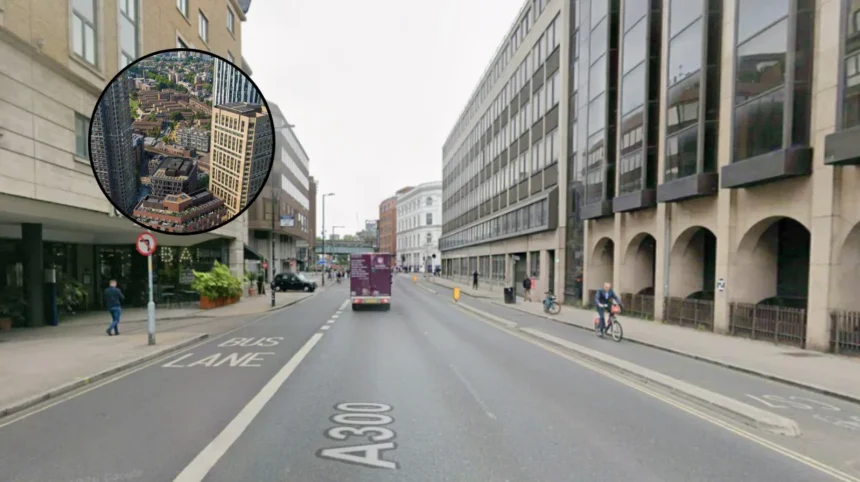
The physical structures, which were constructed in phases between the 1960s and 1980s, currently stand at five to six storeys in height. Under the newly designed scheme by Morris + Company, these buildings will undergo structural refurbishment rather than being torn down.
To accommodate the 395 planned co-living homes, the architectural plans propose adding four additional storeys to the existing built volume.
Alongside the residential units, the development will integrate 1,900 square metres of ground-level and lower-level commercial space intended to animate the local streetscape.
The site itself occupies a prominent corner position at the junction of Southwark Street and Southwark Bridge Road, placing it geographically between two major London landmarks: the Tate Modern and Borough Market.
Why Did the Design and Objectives for the Site Change?
The evolution of the site reflects a change in both ownership and development philosophy. As detailed by Tom Lowe of Building Design, the complex was previously under the control of UBS Asset Management.
In 2023, UBS Asset Management secured planning permission for a scheme designed by Lifschutz Davidson Sandilands (LDS) that would have seen the 1960s and 1980s buildings completely demolished. The 2023 approval was strictly for a replacement building dedicated to modern commercial office space.
However, after a new client partnership consisting of HUB and Bridges Fund Management acquired the site, the prior commercial demolition strategy was entirely replaced. The joint venture chose to pivot from an all-office development to a high-density residential co-living model.
According to journalistic reports from the industry titles, Morris + Company was brought in to replace LDS to execute this shift toward a shared-living layout that prioritises the adaptive reuse of the existing building fabric.
What Is the Current Condition of the Existing Buildings?
The justification for moving away from traditional office space relates directly to the physical limitations of the current structures.
As noted in the reporting by Tom Lowe of Building Design, both the previous architects, Lifschutz Davidson Sandilands, and the incoming team at Morris + Company reached a consensus regarding the limitations of the existing properties. Both firms described the structures as fundamentally unfit for modern office requirements.
Among the primary technical deficiencies highlighted by the architects were low floor-to-ceiling heights, poorly illuminated internal floorplates, inadequate thermal insulation performance, and generally poor architectural quality.
Despite these deficiencies preventing an optimal modern office layout, the current design team views the spatial characteristics differently for residential purposes. Writing on the architectural assessment, Tom Lowe reported that Morris + Company stated that the site was “well-suited” to a co-living arrangement, where smaller private spaces are balanced by extensive communal amenities.
Background of the Southwark Bridge Road Property Development
The property complex at 38 – 48 Southwark Bridge Road has experienced a prolonged period of underutilisation, stretching back more than two decades. Local real estate records show that the buildings have not been in full-time, stable use since the year 2000.
For the past 26 years, the complex primarily functioned as a short-term contingency asset. It served as emergency disaster-recovery office space for corporate entities that needed to temporarily evacuate their primary London premises due to sudden safety, operational, or technical concerns elsewhere.
Following the onset of the COVID-19 pandemic and the subsequent widespread shift toward hybrid working models, this emergency usage declined further, leaving the buildings almost entirely vacant in recent years.
The approval of the 2023 demolition plan was an initial attempt by UBS Asset Management to resolve this vacancy by building a brand-new corporate headquarters style development, an objective that has now been overtaken by HUB and Bridges Fund Management’s residential focus.
Explore More Southwark News
Banook Bagels Opens in South London 2026
Southwark Council Seeks Developer For £160m Housing Scheme: Rotherhithe 2026
Prediction: How Will This Development Affect Local Renters and the Southwark Community?
If Southwark Council grants planning permission for this amended scheme, the development is expected to alter the local demographic and housing dynamics within the borough, particularly impacting young professionals and key workers looking to reside in Central London.
The addition of 395 co-living units will introduce a substantial volume of single-occupancy housing supply into the absolute heart of Southwark. For local renters, co-living options typically offer fully inclusive monthly fees covering rent, utilities, high-speed internet, and access to shared gyms or workspaces.
This model is likely to attract younger corporate professionals, digital nomads, and single renters who are priced out of standard one-bedroom flats in the immediate vicinity of Bankside and Borough.
However, because co-living units do not constitute traditional self-contained affordable housing, the impact will be felt primarily within the market-rate fractional rental sector rather than addressing low-income social housing waiting lists.
Impact on the Local Economy and Urban Environment
For the broader Southwark community, the activation of 1,900 square metres of commercial space on a prominent corner that has sat mostly dark since 2000 will increase foot traffic between Borough Market and the Tate Modern.
Local retail businesses, cafes, and hospitality venues are expected to experience a sustained increase in weekday and weekend patronage from the influx of nearly 400 new permanent residents. Furthermore, by opting for structural refurbishment and an extension rather than a complete knockdown-and-rebuild, the project will generate significantly fewer heavy demolition vehicle movements and lower localized particulate emissions during its construction phase, reducing the immediate disruption to neighbouring residents and businesses.