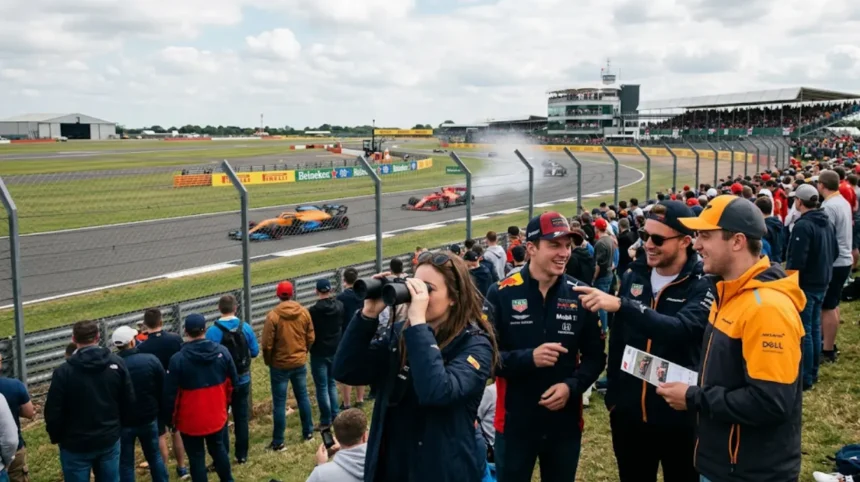
The British Grand Prix is the oldest and most historic Formula 1 race on the current calendar, first held in 1950 as the inaugural World Championship event and always run on British soil. It is currently hosted at Silverstone in Northamptonshire, a permanent circuit built on a former WWII airfield that has been home to the race since 1987 and measures 5.891 km with 52 laps for a total official distance of 306.198 km.
- What is the British Grand Prix?
- Where is the British Grand Prix held?
- How long has the British Grand Prix existed?
- Who has won the most British Grand Prix titles?
- Which teams have the most British Grand Prix wins?
- What is the history of the British Grand Prix?
- How has Silverstone changed over time?
- What is the race format and distance of the British Grand Prix?
- What makes the British Grand Prix unique?
- How do South London fans attend the British Grand Prix?
- What is the future of the British Grand Prix?
What is the British Grand Prix?
The British Grand Prix is the Formula 1 race that represents the United Kingdom on the FIA World Championship calendar, held annually in Britain and currently run at Silverstone, a 5.891 km track with 52 laps and a 306.198 km race distance.
The British Grand Prix is one of the “classic” races, alongside the Monaco Grand Prix and the Italian Grand Prix at Monza, that have been part of almost every F1 season since the championship began in 1950. It is defined by the FIA as the national race of the United Kingdom and is therefore always run on British territory, though the venue has changed over time: Silverstone, Aintree, Brands Hatch, and Silverstone again.
The race is officially known as the “Formula 1 British Grand Prix” in modern F1 branding, and it is governed by the FIA’s sporting regulations and the UK’s Motorsport UK safety framework, which sets standards for track design, safety barriers, and medical provision.
Where is the British Grand Prix held?
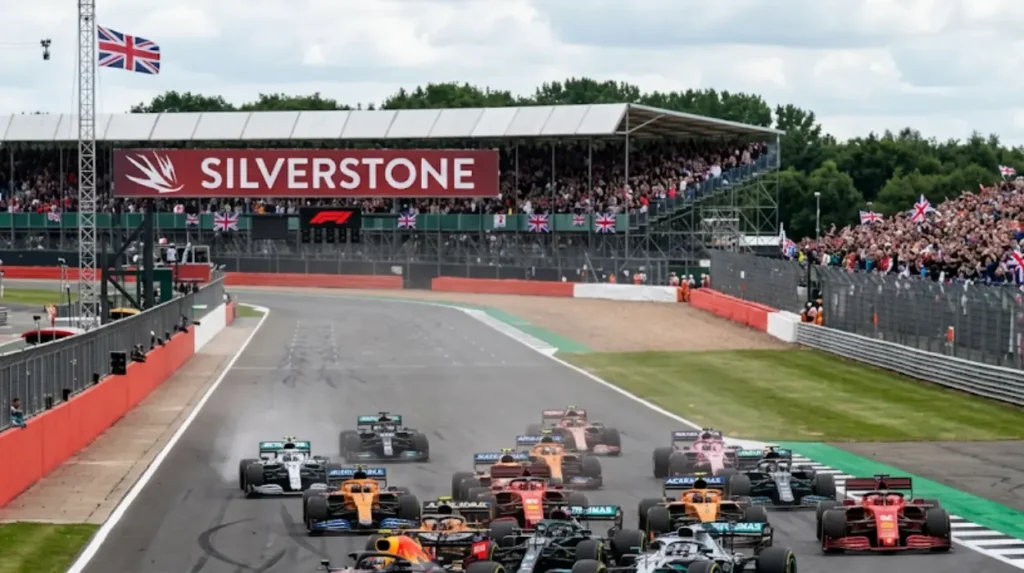
The British Grand Prix is currently held at Silverstone Circuit in Northamptonshire, a 5.891 km track with 18 turns, 52 laps, and a 306.198 km race distance, located about 90 minutes from South London by car.
Silverstone is built on the site of a former Royal Air Force bomber base from World War II, with its original layout following the perimeter roads of the airfield. The circuit has been continuously modified since the 1970s, adding run-off areas, reshaping corners such as the “Stowe” and “Villa” complexes, and upgrading facilities to meet modern F1 safety standards.
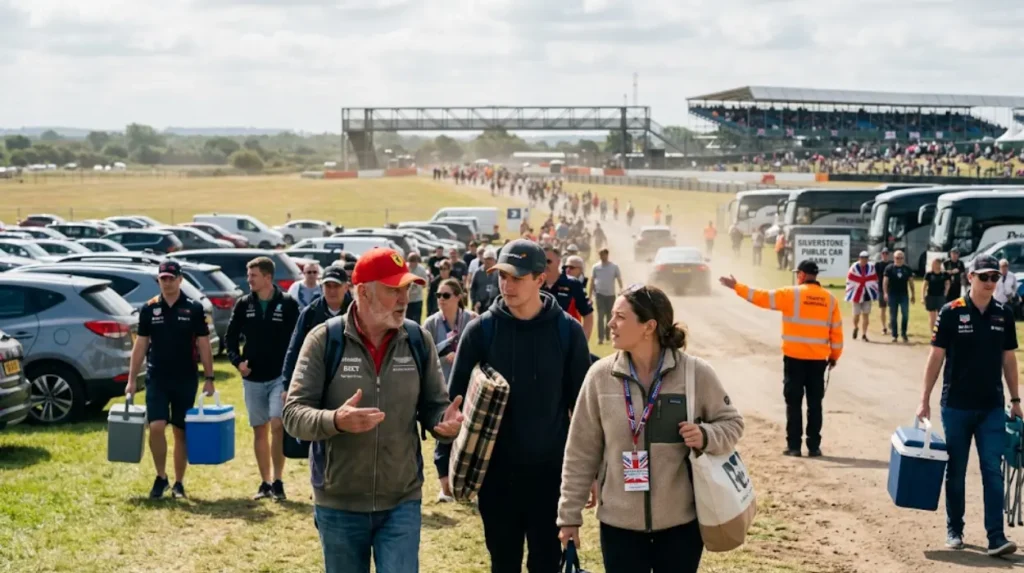
For fans in South London, Silverstone is reachable via the M1 and A34 roads, with typical drive times of around 1.5 to 2 hours depending on traffic, and the circuit offers large public parking areas, coach parks, and on-site campgrounds for race weekends.
How long has the British Grand Prix existed?
The British Grand Prix first ran in 1950 as the very first Formula 1 World Championship race, meaning the event has existed for 76 years by 2026 and has been held 75 times as a World Championship round.
The 1950 race was held at Silverstone and was won by Giuseppe “Nino” Farina in an Alfa Romeo, with the event attended by Queen Elizabeth, King George VI, and Princess Margaret, marking its status as a national occasion. From 1950 to 1986, the race intermittently moved between Silverstone, Aintree, and Brands Hatch, before returning permanently to Silverstone in 1987.
By 2025, the British Grand Prix had been held 74 times as part of the World Championship, and with the 2026 race included, the total count reaches 75 Championship rounds, making it one of only three races still on the calendar that were part of the 1950 inaugural season alongside Monza and Monte Carlo.
Who has won the most British Grand Prix titles?
Lewis Hamilton holds the record for the most British Grand Prix wins with nine victories (2008, 2014, 2015, 2016, 2017, 2019, 2020, 2021, 2024), followed by Jim Clark and Alain Prost with five each.
Hamilton’s wins span 16 years, showing his sustained dominance at Silverstone, while his first victory in 2008 came in a McLaren, and his later wins came in Mercedes, making him the only driver to win the British Grand Prix with two different top teams. Clark’s five wins all came in the 1960s with Lotus-Climax, establishing him as the most successful driver of that era on home soil, while Prost’s five victories were spread across the 1980s and 1990s with McLaren and Ferrari.
Other multiple winners include Nigel Mansell (4), Niki Lauda (3), Michael Schumacher (3), Jack Brabham (3), and José Froilán González and Alberto Ascari (2 each), illustrating the race’s mix of British and international success over decades.
Which teams have the most British Grand Prix wins?
Ferrari holds the record for the most constructor wins at the British Grand Prix with 16 victories, followed by McLaren with 14 and Williams with 10, reflecting the race’s long history and Italian, British, and American team dominance.
Ferrari’s first World Championship win came at the 1951 British Grand Prix with José Froilán González, and the team has since won 13 times at Silverstone, plus three more at Aintree and Brands Hatch, making it the most successful constructor in British Grand Prix history overall. McLaren’s 14 wins include multiple victories in the 1970s, 1980s, and 1990s with drivers such as Peter Revson, Niki Lauda, and Alain Prost, while Williams’ 10 wins came largely in the 1980s and 1990s with Nigel Mansell, Damon Hill, and David Coulthard.
Other successful constructors include Lotus (with multiple wins in the 1960s and 1970s), Mercedes, and Tyrrell, showing that British-designed cars have also played a major role in the race’s history.
What is the history of the British Grand Prix?
The British Grand Prix began in 1950 at Silverstone as the first Formula 1 World Championship race, then alternated between Silverstone, Aintree, and Brands Hatch until settling permanently at Silverstone in 1987, creating a continuous 76-year history.
From 1950 to 1954, early races were dominated by Italian manufacturers Alfa Romeo and Ferrari, with drivers such as Giuseppe Farina, Alberto Ascari, and José Froilán González setting the tone for the event’s international prestige. The 1958 race saw the first British winner at Silverstone, Peter Collins, while the 1960s became known as the “British era” with Jim Clark, Graham Hill, and Jackie Stewart repeatedly winning with British teams such as Lotus and BRM.
The 1970s and 1980s featured a mix of British and foreign drivers, with notable wins by Emerson Fittipaldi, Niki Lauda, and Alain Prost, while the 1990s and 2000s saw Jacques Villeneuve, David Coulthard, and Michael Schumacher add to the race’s global appeal. The 2010s and 2020s defined the Lewis Hamilton era, with nine wins and multiple dramatic races, including a 2021 collision with Max Verstappen and a 2020 victory under changed conditions due to the pandemic.
How has Silverstone changed over time?
Silverstone has evolved from a basic WWII airfield circuit to a modern 5.891 km F1 track with 18 corners, extensive run-off areas, and upgraded safety, medical, and spectator facilities, reflecting continuous adaptation since the 1970s.
The original 1950 layout followed the perimeter roads of the airfield, with minimal barriers and run-off, and early races were characterised by high speeds and limited safety provisions typical of the era. In the 1970s and 1980s, corners such as “Maggotts,” “Becketts,” and “Chapel” were created or reprofiled to increase technical challenge and reduce speeds, while additional run-off and gravel traps were added to improve driver safety.
From the 1990s onward, Silverstone underwent major redevelopments, including the construction of a new pit and paddock complex, better spectator viewings, and significant upgrades to medical centres and crash containment, bringing the circuit in line with modern FIA requirements.
What is the race format and distance of the British Grand Prix?
The British Grand Prix is run over 52 laps of the 5.891 km Silverstone circuit, for a total race distance of 306.198 km, with standard F1 rules for qualifying, sprint races (if scheduled), and safety car procedures.
Qualifying determines the starting order for the race, with a three-part format (Q1, Q2, Q3) under FIA regulations, and on some years a sprint event may be held on Saturday to determine a separate sprint race and adjust the main race grid. The race itself follows the standard F1 format of 52 laps, with mandatory pit stops for tyre changes, use of safety car or virtual safety car when required, and strict rules on overtaking and track limits.
Rain has played a major role in several British Grand Prix races, with drivers such as Jim Clark, Lewis Hamilton, and Fernando Alonso benefiting from changing conditions that create unpredictable tyre strategies and race outcomes.
What makes the British Grand Prix unique?
The British Grand Prix is unique because it is the oldest continuing F1 race, always held in Britain, hosted at a historic circuit with strong national identity, and frequently featuring dramatic weather, high-speed corners, and intense British fan support.
Unlike many modern races held in neutral locations, the British Grand Prix maintains a strong cultural connection to the UK, with huge crowds of British fans, multiple British drivers on the grid, and a tradition of celebrating British motorsport heritage throughout the weekend. The circuit’s long straights, high-speed “Maggotts–Becketts” complex, and technical final sector create a mix of outright speed and precision that tests both car performance and driver skill.
The race also frequently sees changing weather, with rain turning the track into a strategic battleground where tyre choice, caution, and aggression must be balanced, leading to some of the most memorable moments in F1 history.
How do South London fans attend the British Grand Prix?
South London fans typically travel to Silverstone by car via the M1 and A34, by coach from major London stations, or by train to nearby towns and then a shuttle bus, with race-day traffic and parking requiring advance planning.
Driving from South London (such as areas like Wimbledon, Kingston, or Richmond) to Silverstone usually takes around 1.5 to 2 hours without heavy traffic, but race-day congestion on the M1 and local roads can significantly increase this time, so arriving early and using designated car parks is essential. Coach services often run from London Victoria and other central points, offering a direct route to the circuit and avoiding parking issues, while train options include services to nearby stations such as Rugby or Coventry, followed by official shuttle buses to Silverstone.
Fans should check the official Silverstone website for updated travel advice, parking maps, and coach schedules, and consider booking tickets and accommodation early, as the British Grand Prix is one of the most attended events on the F1 calendar and accommodation near the circuit fills quickly.
What is the future of the British Grand Prix?
The British Grand Prix remains a core fixture of the F1 calendar with a long-term contract at Silverstone, and plans for continued circuit upgrades, expanded fan zones, and enhanced sustainability measures to keep the race competitive and relevant in the 2020s and beyond.
Silverstone has committed to ongoing infrastructure investment, including new spectator areas, improved accessibility, and enhanced environmental standards, to meet F1’s sustainability goals and improve the experience for international and domestic fans. The race’s historic status, combined with its strong British fanbase and regular presence of British drivers, gives it a stable position on the calendar, ensuring it will continue as a flagship event for many years.
For South London motorsport fans, the British Grand Prix will remain the closest major F1 race, maintaining its role as the national highlight of the season and a key destination for weekend travel, hospitality, and fan engagement.
What is the British Grand Prix?
The British Grand Prix is the United Kingdom’s Formula 1 World Championship race. First held in 1950 as the opening event of the inaugural Formula 1 World Championship, it is the oldest race on the current F1 calendar and is now held annually at Silverstone Circuit in Northamptonshire.