Key Points
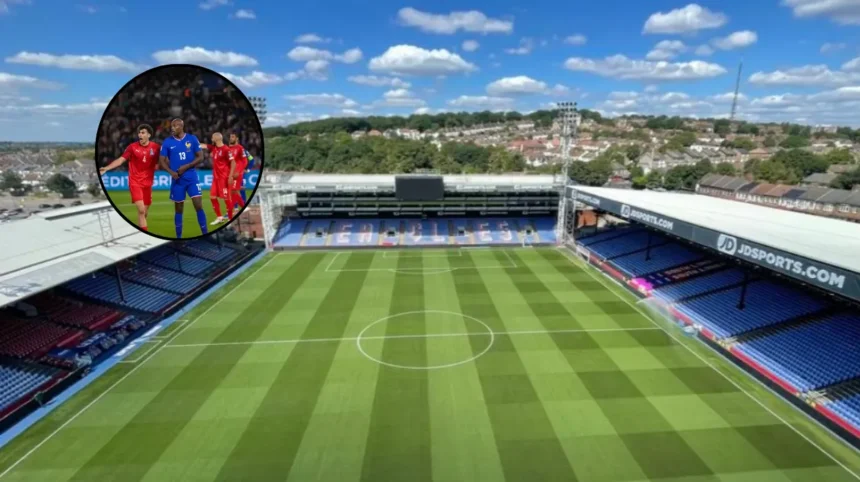
- Crystal Palace defenders Maxence Lacroix and forward Jean-Philippe Mateta are one game away from reaching the 2026 FIFA World Cup final after France secured their spot in the semi-finals.
- France will compete against Spain in the semi-final match scheduled for Tuesday, 14 July 2026, in Dallas, Texas.
- Spain advanced to the last four following a dramatic 2-1 victory over Belgium at SoFi Stadium in Los Angeles, California.
- The decisive goal came in the 88th minute when Spain’s Mikel Merino capitalised on a handling error by substitute Belgian goalkeeper Senne Lammens.
- The prolonged international run presents a tactical dilemma for new Crystal Palace manager Pierre Sage, who faces delayed pre-season integrations at Selhurst Park.
- The tournament progression elevates the global market visibility of Lacroix, who is currently drawing significant transfer interest from Chelsea.
Crystal Palace (South London News) July 11, 2026 –The 2026 FIFA World Cup quarter-final stage concluded in dramatic fashion in the United States, positioning two marquee European heavyweights against each other while handing Crystal Palace an intriguing logistical and financial development.
- Key Points
- What were the critical match events that defined Spain’s victory over Belgium?
- How does the international success of France affect Crystal Palace’s pre-season planning?
- What is the background of the international rise of Lacroix and Mateta?
- Prediction: How will this development affect Crystal Palace, its management, and its supporters?
As reported by Andrew Fletcher of Read Crystal Palace, the French senior national team secured their place in the final four via a 2-0 victory over Morocco at Gillette Stadium in Foxborough on Thursday night.
This victory keeps Didier Deschamps’ side on course for a third consecutive World Cup final, following their 2018 triumph in Russia and their runners-up finish in Qatar in 2022.
The identity of France’s semi-final opponents was determined less than 24 hours later in Southern California. In a detailed match breakdown published by Al Jazeera, Spain earned a narrow 2-1 victory over Belgium to book their ticket to the semi-final encounter, which FIFA has scheduled for Tuesday, 14 July 2026, at the AT&T Stadium in Dallas.
The fixture was deadlocked until the 88th minute when Spanish midfielder Mikel Merino scored from inside the penalty area, capitalizing on a significant handling error by Belgium’s substitute goalkeeper Senne Lammens, who had failed to cleanly collect a long-range effort from defender Pau Cubarsí.
What were the critical match events that defined Spain’s victory over Belgium?
The encounter between Spain and Belgium was heavily shaped by unexpected personnel changes and late-game adjustments. An analytical report by the Indian Express highlighted that substitutes have scored 52 of the 250 goals recorded at this World Cup tournament, accounting for 18.6 per cent of the overall scoring output. This tactical pattern was fully realized when Mikel Merino entered the pitch as an 86th-minute substitute for Luis de la Fuente’s Spanish side.
According to data provided by Opta and published by the Indian Express, Merino had been on the pitch for a mere one minute and fifty-seven seconds, scoring the definitive goal on just his second touch of the match.
The goal directly resulted from an injury crisis within the Belgian camp. Longtime first-choice goalkeeper Thibaut Courtois was forced off the pitch in the 71st minute due to an apparent thigh injury. His replacement, Manchester United goalkeeper Senne Lammens, faced immediate pressure.
When Spain’s 19-year-old central defender Pau Cubarsí unleashed a powerful strike from outside the penalty area, Lammens spilled the ball directly into the path of the oncoming Merino.
Following the final whistle, the emotional toll on the Belgian camp was evident. As reported by Free Malaysia Today, Thibaut Courtois offered immediate public support to his young teammate. Courtois stated to reporters:
“I gave him a big hug. He’s a great goalkeeper. You only get stronger from this. Eventually, you cannot say much more to him or give him much more advice. But yeah, sometimes it is what it is. You can’t change it.”
Further defensive perspectives came from Belgian centre-back Brandon Mechele, who contextualised the mistake for reporters. As quoted by Free Malaysia Today, Mechele stated:
“It’s a learning moment for him. It was not the easiest ball. I think it bounces just in front of him. And we as defenders could have helped him by following up maybe more.”
How does the international success of France affect Crystal Palace’s pre-season planning?
For Crystal Palace, the continued progression of the French national team creates a distinct club-level narrative. Central defender Maxence Lacroix and centre-forward Jean-Philippe Mateta remain fully embedded in Didier Deschamps’ 26-man squad in North America.
Lineup reports published across the United States and compiled by Read Crystal Palace confirmed that both Palace players were named among the substitutes for the quarter-final victory against Morocco, as Deschamps elected to maintain continuity with the starting eleven that had previously defeated Paraguay in the Round of 16.
While having two squad members representing their nation at the penultimate stage of a World Cup is a prestigious accolade for the South London club, it introduces immediate scheduling complexities. Andrew Fletcher of Read Crystal Palace noted that FIFA and domestic regulatory guidelines entitle players to a mandatory three-week holiday period immediately following the conclusion of their international tournament obligations.
Because France will remain in North America until at least the third-place play-off or the World Cup final itself, both Lacroix and Mateta are mathematically ruled out of the initial phases of Crystal Palace’s domestic pre-season schedule.
The timing of this delay is particularly sensitive due to recent managerial changes at Selhurst Park. The club recently confirmed the appointment of 47-year-old French tactician Pierre Sage on a three-year contract, replacing the outgoing Oliver Glasner.
As detailed in an official briefing by Crystal Palace FC, Sage arrived in London following a highly successful campaign with RC Lens, where he secured a second-place finish in Ligue 1 and won the Coupe de France.
Sage is scheduled to oversee his first pre-season training blocks, which include localized friendly fixtures against Bromley FC and a summer trip for the Como Cup.
Due to their extended stay in the United States, Lacroix and Mateta will be among the very last first-team players to report back to the training ground, denying the new manager crucial early weeks to integrate two of his most valuable assets into his tactical systems.
What is the background of the international rise of Lacroix and Mateta?
The inclusion of Maxence Lacroix and Jean-Philippe Mateta in a major tournament squad represents a remarkably rapid ascent in international football. According to an official player profile published by Crystal Palace FC, neither player had earned a senior international cap for France at this exact time last year.
Both players forced their way into Didier Deschamps’ plans entirely on the basis of their exceptional domestic performances in the Premier League for the Eagles.
Mateta’s journey to the senior French setup was accelerated by his standout performance as an overage player under Thierry Henry during the Paris 2024 Olympic Games, where he scored five goals to help France secure a silver medal.
His senior debut followed in October 2025 against Azerbaijan, and he scored his first senior international goal shortly after in a 2-2 draw against Iceland.
When Deschamps finalized his 26-man World Cup squad in May 2026, he explicitly selected Mateta ahead of alternative high-profile options like Randal Kolo Muani. As reported by SuperSport, Deschamps justified the selection during a live television broadcast on France’s TF1 channel, stating:
“He has a different profile to other strikers.”
Concurrently, Maxence Lacroix earned his international recognition following a commanding defensive campaign in the Premier League. Despite having not represented France since his youth appearance at the Under-17 World Cup in 2017, Lacroix received his maiden senior call-up in March 2026 for high-profile friendlies against Brazil and Colombia.
His impressive debut against Brazil cemented his spot in the final tournament squad over established alternatives. As covered by SuperSport, Deschamps addressed the difficult omission of Real Madrid’s Eduardo Camavinga in favour of retaining Lacroix, stating:
“I would imagine it is a huge disappointment for him but he has had a tough season with injury as well.”
Prediction: How will this development affect Crystal Palace, its management, and its supporters?
The ongoing participation of Maxence Lacroix and Jean-Philippe Mateta in the final week of the World Cup will heavily influence Crystal Palace’s sporting and economic landscape for the 2026/27 Premier League season.
For the club’s sporting director and board, the situation creates an immediate financial catalyst regarding Maxence Lacroix.
The defender’s elite exposure on the world stage directly strengthens Crystal Palace’s leverage in ongoing transfer negotiations. With Chelsea actively registering concrete interest in the centre-back, his participation in a World Cup semi-final validates the high asking price set by the hierarchy at Selhurst Park.
A successful showing against Spain could drive a highly lucrative bidding war, maximizing the club’s capital return if they choose to sell.
Conversely, for the newly appointed manager Pierre Sage and his coaching staff, the development presents a challenging tactical hurdle. Sage traditionally utilizes a demanding 3-4-2-1 system that relies heavily on synchronized defensive movements and a physical, high-pressing spearhead.
Because Mateta is projected to be the focal point of Palace’s attack, and Lacroix is a vital component of the defensive line, their extended absence means Sage must conduct the core of his tactical installation without them.
The management will be forced to rely on secondary squad options during the initial weeks of the Premier League campaign, potentially leading to a slower, disjointed start to the domestic season as the returning finalists catch up on physical conditioning and tactical shape.
For the Crystal Palace supporters, the situation offers a mixture of immense pride and anxiety. Fans will experience a significant boost in global prestige seeing their club’s players compete in the latter stages of football’s ultimate tournament alongside superstars like Kylian Mbappé. However, this pride is balanced by the realistic concern of player burnout.
Having logged an exhausting number of competitive minutes over the past calendar year across domestic, Olympic, and World Cup campaigns, both players face an elevated risk of soft-tissue injuries and fatigue, which could impact their availability and form for Crystal Palace deep into the winter months.