Key Points
- Reverend Peter Ratcliff, of St John’s Continuing Church in Wimbledon, successfully overturned a £160 penalty charge for driving through a Low Traffic Neighbourhood (LTN) restriction in South Wimbledon.
- The case centred on the LTN at the Abbey Road and High Path junction, where ANPR cameras recorded him passing through the street on 30 November last year.
- An independent adjudicator found the road signage at the junction was obscured, meaning the restriction was not clearly visible to motorists.
- Rev Ratcliff is now calling on Merton Council to “do the honourable thing” and refund other residents who have been issued similar fines for the same location.
- The case highlights wider concerns about how LTN schemes are enforced, particularly where signage or layout may cause confusion rather than cut through traffic.
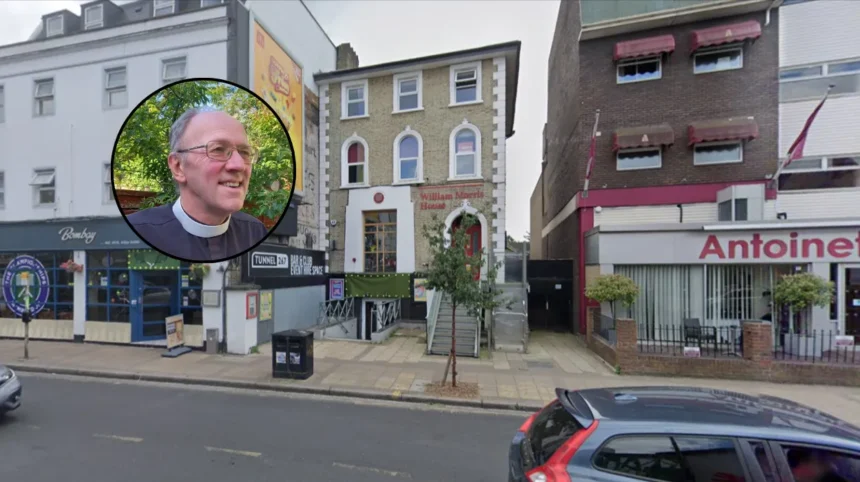
South Wimbledon (South London News) – May 2, 2026South Wimbledon, Wimbledon – Reverend Peter Ratcliff of St John’s Continuing Church has successfully overturned a £160 penalty charge for driving through a Low Traffic Neighbourhood (LTN) after an independent adjudicator found the road signage at the Abbey Road and High Path junction was obscured. The ruling has prompted the South London reverend to urge Merton Council to review and refund other motorists who may have been caught in the same circumstances.
- Key Points
- How did the case begin?
- What did the adjudicator decide?
- What is Rev Ratcliff now calling for?
- How does this fit into wider LTN debates in London?
- What could this mean for local drivers?
- How has Merton Council responded so far?
- Background of LTN enforcement in South London
- Prediction: How this case could affect local drivers and councils
How did the case begin?
Rev Peter Ratcliff was recorded by ANPR cameras driving through a restricted section of road at the Abbey Road and High Path junction in South Wimbledon on 30 November last year.
As reported by Harrison Galliven of MyLondon’s Local Democracy Reporting Service, he was issued a £160 penalty charge notice (PCN) for entering a Low Traffic Neighbourhood where through‑traffic is not permitted.
Rev Ratcliff, who lives near the restricted road, told Galliven that he felt the penalty was unfair and that he had not been able to clearly see the restriction signage while driving.
He said he believed the same issue could easily catch out other local drivers, prompting him to launch a formal appeal against the fine.
What did the adjudicator decide?
After Rev Ratcliff’s appeal, an independent adjudicator examined evidence from both the motorist and Merton Council’s enforcement team. As reported by MyLondon’s Local Democracy Reporting Service, the adjudicator found that the road signage controlling through‑traffic at the Abbey Road and High Path junction was obscured, meaning the restriction was not clearly visible to drivers approaching the point.
Because the restriction was not properly signposted, the adjudicator concluded that the penalty charge could not be upheld and ordered it to be cancelled.
The decision effectively treated the LTN restriction at that precise junction as inadequately signposted, even though the broader scheme remained in place.
What is Rev Ratcliff now calling for?
In the wake of the ruling, Rev Ratcliff has publicly called on Merton Council to “do the honourable thing” and review other fines issued at the same location.
He argues that if the signage was obscured for him, it may have been similarly unclear for a significant number of other motorists, particularly those unfamiliar with the area.
As reported by MyLondon, he has said that other residents who have already paid or are considering challenging similar PCNs at Abbey Road and High Path should have their cases reconsidered, especially where visibility of the restriction signs was limited.
His comments echo a broader debate across London about how councils enforce LTNs and whether signage is always sufficient to meet legal standards for traffic orders.
How does this fit into wider LTN debates in London?
Rev Ratcliff’s successful appeal sits alongside several other high‑profile LTN disputes in south and inner London. In West Dulwich, for example, Lambeth Council was ordered by the High Court to remove an LTN scheme that had taken more than £1 million in fines from motorists, after the court found the scheme unlawful.
That ruling forced the council to refund PCNs and dismantle the restriction, prompting renewed scrutiny of how LTNs are designed and enforced.
Elsewhere, motoring organisations such as the AA have warned that thousands of drivers across London may have paid invalid penalty charge notices due to enforcement and restriction cameras, particularly where signage or layout is unclear or newly introduced.
Those organisations have urged councils and adjudicators to review cases where drivers contest fines on the basis that the restriction was not properly communicated.
What could this mean for local drivers?
What practical implications does this ruling have for South Wimbledon motorists?
For drivers in South Wimbledon and nearby estates, the key implication is that penalties issued at the Abbey Road and High Path junction may be open to review if the apparent problem was the visibility of the signage rather than the driver’s intent.
As MyLondon’s Local Democracy Reporting Service notes, the case reinforces the importance of clear, visible signage when councils introduce LTNs or similar traffic restrictions.
The decision could encourage other motorists who feel fines were issued in ambiguous circumstances to lodge appeals or seek clarification from Merton Council before paying. Some local residents’ groups and online forums have also suggested that anyone who received a PCN at Abbey Road before recent checks of the signage may have grounds to challenge the fine, even if they have already paid.
How has Merton Council responded so far?
As reported by MyLondon, Merton Council has not yet issued a formal, detailed statement specifically addressing Rev Ratcliff’s individual case or committing to a blanket refund at the Abbey Road and High Path junction.
The council continues to defend its broader LTN schemes as part of efforts to reduce through‑traffic and improve air quality in residential areas, pointing to improvements in local safety and lower volumes of rat‑running traffic where the schemes are fully implemented.
However, the council has acknowledged that each PCN appeal is reviewed on its own merits and that decisions can be overturned if the signage or road layout is found to be inadequate. The outcome of Rev Ratcliff’s appeal may now prompt the council to carry out an audit of signage at other LTN pinch points across its borough, particularly at junctions where fines have been contested.
Background of LTN enforcement in South London
Low Traffic Neighbourhoods (LTNs) in south London typically involve one‑way or filtered junctions, bollards, planters, and signage that discourage through‑traffic while allowing residents, emergency vehicles, and certain service vehicles to pass.
Where cameras such as ANPR are used, drivers who enter a restricted “through‑traffic prohibited” section can be issued penalty charge notices, often around £130–£160 if unpaid within the initial period.
Courts and independent adjudicators have repeatedly stressed that such restrictions must be clearly signposted and legally compliant. PCNs can be overturned and, in some cases, entire schemes declared unlawful. In West Dulwich, Lambeth’s LTN was quashed after campaigners argued that the council had not followed proper procedure, while in other parts of London, residents have won refunds or scheme changes after highlighting signage or layout defects.
In Merton, the Abbey Road and High Path junction has been described by local residents’ groups as a key pinch‑point where occasional confusion over signage and permitted routes has led to a steady stream of PCNs. Some campaigners have called for the council either to improve signage, adjust the LTN layout, or, in more extreme cases, to reconsider the scheme itself if large numbers of motorists continue to be caught.
Prediction: How this case could affect local drivers and councils
Rev Ratcliff’s successful appeal is likely to increase pressure on Merton Council to review how LTN restrictions are signposted and enforced at this and other junctions. If the council chooses to reassess signage at Abbey Road and High Path, or offer refunds in similar cases, it could effectively reduce the total income from PCNs at that location while also reducing the risk of further contested appeals.
For South Wimbledon motorists, the ruling may encourage more drivers to appeal fines where they genuinely believed they could not see the restriction, rather than paying out of frustration or confusion. Over time, such outcomes could push councils across London to adopt stricter design standards for LTNs, including better‑lit or more prominent signs, clearer advance warning boards, and more responsive appeals processes, so that enforcement is seen as fair and transparent.
In the longer term, this case may contribute to a tightening of how LTNs are both legally framed and practically rolled out, with councils facing greater scrutiny over signage, consultation, and the proportionality of fines collected from often‑confused local drivers.