South London residents track Lambeth election results to understand local council control in this key South London borough. The London Borough of Lambeth spans 26 square kilometers and houses 316,000 people across diverse wards like Brixton, Clapham, and Streatham.
- What are Lambeth election results?
- When did Lambeth hold its latest election?
- Who won the 2026 Lambeth election?
- How did Lambeth election results change from 2022?
- Which wards did Greens win in Lambeth 2026?
- Which parties performed best in Lambeth elections historically?
- What is the Lambeth Council election process?
- Why did Greens gain seats in Lambeth 2026?
- What do Lambeth election results mean for South London?
- Who are key Lambeth councillors elected in 2026?
- How does Lambeth compare to other South London elections?
- What happens after Lambeth election results?
What are Lambeth election results?
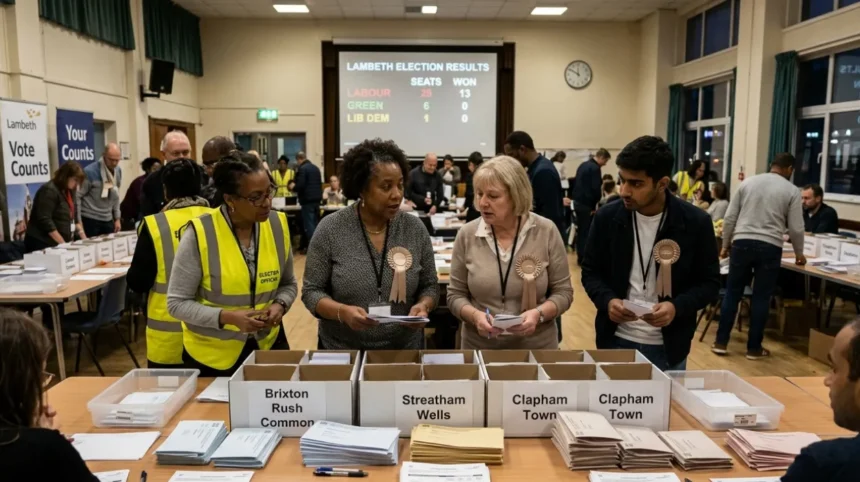
The 2026 Lambeth election results show the Green Party won 29 of 63 seats on Lambeth Council, Labour secured 26 seats, and Liberal Democrats gained 8 seats, ending Labour’s majority control in this South London borough after their 58-seat hold in 2022.
Lambeth Council elections occur every four years on the first Thursday in May. The 2026 election took place on May 7, 2026. All 63 councillors represent 25 wards, with most wards electing two or three members.
Voter turnout reached 31.5% in the prior 2022 election, a figure that guides expectations for civic engagement. Results shifted power dynamics as Greens capitalized on local issues like housing and environment.
These outcomes determine council leadership, budget allocation for services such as housing and waste management, and policy on South London priorities like transport links to central London.
When did Lambeth hold its latest election?
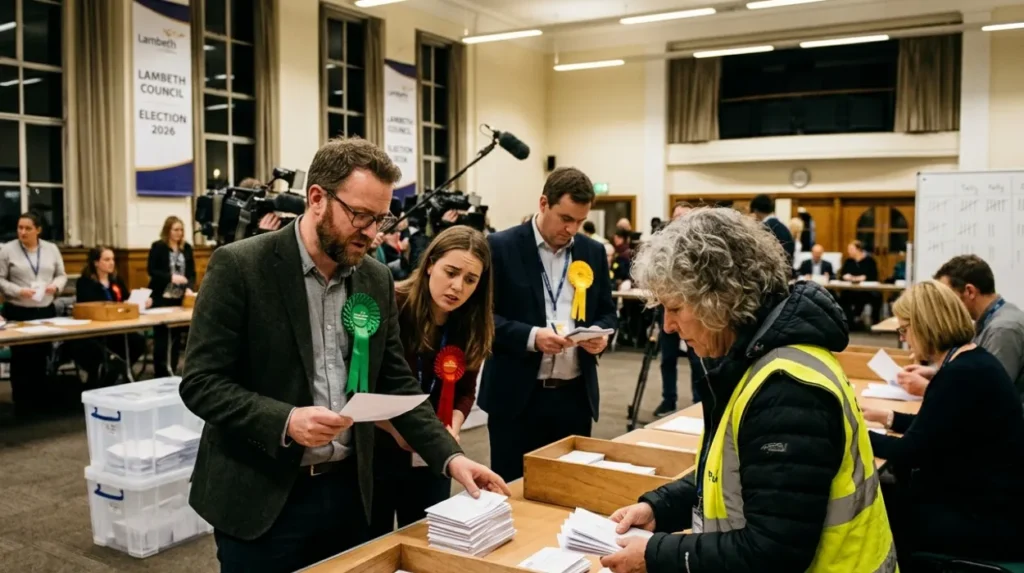
Lambeth Council held its latest election on Thursday, May 7, 2026, with counting starting that night and final results declared by May 9, 2026, across 25 wards in South London.
Elections align with the national local election cycle under the Local Government Act 1972. Lambeth, as a London borough, elects all councillors simultaneously every four years.
The 2026 vote followed boundary reviews that maintained 63 seats since 1978 expansions. Polling stations operated from 7am to 10pm, requiring photo ID per the Elections Act 2022.
Delays in counting, due to 309 candidates from seven parties including Reform UK and independents, pushed declarations to May 8-9. This timeline matches South London borough patterns like Wandsworth.
Who won the 2026 Lambeth election?
The Green Party won the most seats with 29 in the 2026 Lambeth election, Labour took 26, and Liberal Democrats claimed 8, creating no overall control as no party reached the 32-seat majority threshold.
Pre-election, Labour controlled 58 seats from 2022. Greens surged from 2 seats, reflecting voter shifts on climate and cost-of-living issues. Liberal Democrats rose from 3 seats.
No single party formed a majority government. Coalition talks followed, impacting South London services like parks in Brockwell and housing in Oval.
This mirrors broader 2026 London trends where Labour lost ground in boroughs like Lambeth and Lewisham. Greens’ gains stemmed from 22.3% vote share projections.
How did Lambeth election results change from 2022?
Lambeth 2026 results marked a -32 seat loss for Labour to 26 seats, +27 gain for Greens to 29 seats, and +5 gain for Liberal Democrats to 8 seats, flipping control in South London.
In 2022, Labour held 58 seats with 54.2% vote share, Liberal Democrats 3 seats at 11.4%, and Greens 2 seats at 22.3%. Conservatives dropped to zero.
The shift equaled an 81% probability of control change per projections. Key factors included Greens targeting Brixton and Streatham wards with environmental pledges.
Implications include policy pivots on South London housing waits, which exceed 20,000 households, and bus route funding tied to council budgets.
Which wards did Greens win in Lambeth 2026?
Greens won full control in Brixton Rush Common, Herne Hill and Loughborough Junction, Knight’s Hill, and Streatham St Leonard’s, plus seats in nine other wards like Brixton Acre Lane and Clapham Town in 2026.
Brixton Acre Lane elected Natalie Denise Kane and Michael Chessum (Green), with David John Bridson (Labour). Brixton Rush Common swept Zvikomborero Chihoro, Sacha Takyi-Berko, and Viktor Westerdahl (all Green).
Herne Hill and Loughborough Junction went to Ciara Alleyne, Paul Valentine, and Alan Andrews (Green). Knight’s Hill elected Elizabeth Ann Fraser, Lisa Schulkind, and Matt Wilcock (Green).
Streatham St Leonard’s chose Scott John Ainslie, Alice Weavers, and Saiqa Ali (Green). Partial wins included Gipsy Hill with Pete Elliott and Chloe Hawryluk (Green).
These victories cluster in central-south Lambeth, boosting Green influence on local green spaces and cycle lanes.
Which parties performed best in Lambeth elections historically?
Labour dominated Lambeth elections historically with 58 seats in 2022 and 57 in 2018, while Greens peaked at 29 in 2026; Liberal Democrats held peaks like 15 in 2010.
Lambeth Council formed in 1964 under the London Government Act 1963, merging Clapham, Lambeth, and parts of Wandsworth. Labour gained control in 1937, holding through 2022 except brief Conservative periods pre-1945.
Post-1945, Labour won 57 seats in 1945, 51 in 1953. 1990s saw rate-capping protests under Ted Knight, disqualifying 32 Labour councillors in 1985.
2010 results: Labour 42, Lib Dems 15. 2014: Labour majority. Greens entered with 1 seat in 2014, 5 in 2018, 2 in 2022. Conservatives faded post-2018.
Historical data shows Labour’s 80% control span, disrupted in 2026 by progressive voter splits.
What is the Lambeth Council election process?
Lambeth Council elections use first-past-the-post voting where voters mark one candidate per seat in multi-member wards, with winners declared by highest votes on May 7, 2026.
Candidates register 19 days pre-election via Lambeth’s electoral services. Nomination requires 10 proposer-seconder signatures and a £250 deposit, refunded at 5% vote share.
Voters receive poll cards listing stations. First Preference (FPTP) tallies votes electronically or by hand, with recounts if margins under 100 votes.
Returning Officer, the council’s chief executive, declares results at counts in Stockwell. By-elections fill vacancies via same process.
This system elects 63 councillors for four-year terms, governing £500 million annual budget for South London services.
Why did Greens gain seats in Lambeth 2026?
Greens gained 27 seats in Lambeth 2026 by targeting housing, climate, and anti-austerity platforms in diverse wards, drawing 22-30% projected vote shares amid Labour’s national losses.
Campaigns focused on 20,000+ housing waitlist and net-zero goals by 2030. Manifesto pledged rent controls and park investments in Brockwell and Ruskin.
Projections showed Greens leading in Brixton Acre Lane by 0.5pp, Vauxhall by 2.4pp. 309 candidates diluted Labour votes.
South London youth turnout favored Greens, echoing 2022’s 1.5% shift. No-overall-control forces cross-party deals on budgets.
What do Lambeth election results mean for South London?
2026 Lambeth results end Labour dominance, requiring Green-Labour or Green-Lib Dem coalitions to pass South London budgets for housing, schools, and transport serving 316,000 residents.
Council controls planning for 10,000 annual units, social care for 5,000 elderly, and waste collection for 100,000 bins weekly. No majority delays decisions.
Implications include stalled £100 million library upgrades and cycle superhighways. Residents face potential tax rises of 4.99% band D council tax.
Future relevance ties to 2030 elections; coalitions test stability on Thameslink funding and Clapham Common events.
Who are key Lambeth councillors elected in 2026?
Key 2026 Lambeth councillors include Green leaders Michael Chessum (Brixton Acre Lane), Jonathan Bartley (Clapham Town), and Labour’s Claire Kathleen Holland (Oval), shaping South London policy.
Jonathan Bartley, former Green co-leader, won Clapham Town with Linda Bray and Patrick O’Donnell (Labour). Pete Elliott and Chloe Hawryluk took Gipsy Hill (Green).
Labour’s David Robert Amos, Dominic John Lynch, and Joanne Naomi Simpson swept Kennington. Liberal Democrats like Chris Nicholson held Clapham Common and Abbeville.
These figures, defined as elected representatives under Local Government Act, influence committees on finance and environment.
How does Lambeth compare to other South London elections?
In 2026, Lambeth’s Green surge to 29 seats contrasts Wandsworth’s no-control (Cons 29, Lab 28), Merton’s Labour hold (32 seats), mirroring South London volatility unlike Lib Dem Sutton (51 seats).
Lambeth’s 63 seats exceed Merton’s 57. All used FPTP. South London totals show progressive gains.
What happens after Lambeth election results?
Post-2026 Lambeth results, councillors convene for annual meeting by May 25 to elect mayor and leader, forming administration via coalition agreement for South London governance.
Acting leader manages until vote. Cabinet of 10 posts allocates portfolios like housing. Scrutiny committees review decisions.
Budget sets July 10, funding £1.2 billion services. Residents contact via lambeth.gov.uk for updates.
What are the latest Lambeth election results?
The 2026 Lambeth local election results show the Green Party of England and Wales became the largest party with 29 seats, while the Labour Party won 26 seats and the Liberal Democrats secured 8 seats. No party reached the 32-seat majority needed to control the council outright, creating a no overall control situation.