A Southwark parking permit is a legal digital authorization issued by Southwark Council that allows vehicle owners to park within specific Controlled Parking Zones. The permit system regulates kerbside space, manages traffic congestion, and prioritizes parking access for local residents.
- How do you access the online Southwark parking permit system?
- What are the eligibility requirements for a 2026 resident permit?
- What documentation must you upload during the renewal process?
- What are the permit fees and structure for 2026?
- What is the step-by-step process to complete the online renewal?
- What are the rules and restrictions governing permit usage?
- What are the future trends and policy implications for Southwark parking?
The London Borough of Southwark operates a comprehensive parking management framework under the statutory powers granted by the Road Traffic Regulation Act 1984. This framework divides the borough into various geographic sectors designated as Controlled Parking Zones. A Controlled Parking Zone restricts vehicle parking during specified operational hours to ensure that local residents, businesses, and essential visitors possess adequate access to the limited public highway network.
The primary regulatory instrument governing these designations is the Southwark Controlled Parking Zone Order. This local legislation establishes the legal boundaries for enforcement and dictates that any motor vehicle stationary within a designated permit bay during restricted hours must hold a valid, active electronic permit linked to the vehicle registration mark.
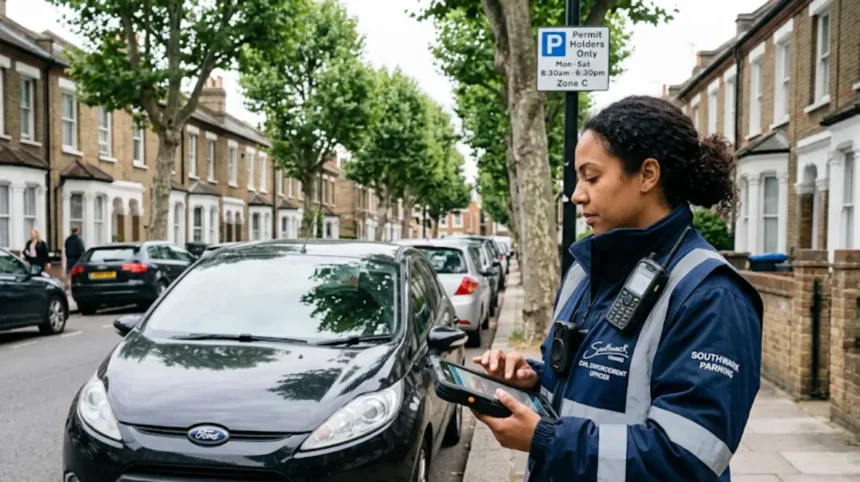
The administrative history of parking control in Southwark reveals an evolution from physical paper discs to a completely unified cloud-based virtual infrastructure. Southwark Council completed the migration of its parking administrative apparatus to the Taranto digital permit system to eliminate physical documentation, reduce administrative overhead, and mitigate fraud. The current digital ecosystem utilizes automated vehicle registration mark scanning, which allows Civil Enforcement Officers to instantly verify the compliance status of any parked vehicle via handheld electronic units connected directly to the central ledger.
The operational necessity of the permit mechanism addresses the distinct urban planning pressures of an inner London borough. Without systemic parking controls, high-density areas experience severe traffic displacement from commuters entering the central London Ultra Low Emission Zone and adjacent commercial centers. The implementation of the permit system acts as an environmental and logistical barrier. The framework ensures that public highway usage aligns directly with the environmental targets of the borough, including air quality strategies and carbon reduction initiatives.
How do you access the online Southwark parking permit system?
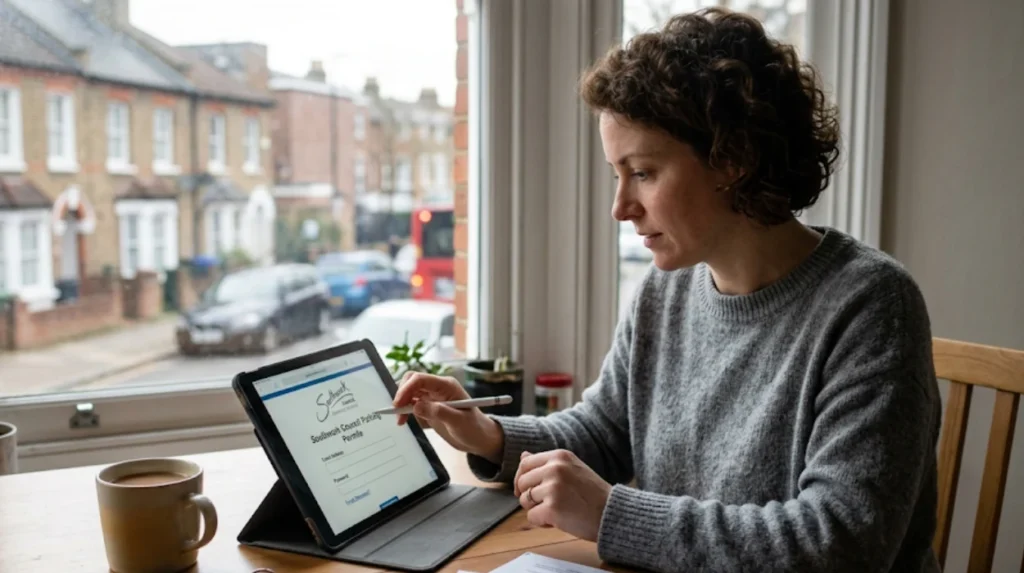
You can access the online Southwark parking permit system by navigating to the official Southwark Council Taranto portal using an internet browser. Users must input verified credentials or execute a secure password reset to initialize their migrated cloud-based digital accounts.
The primary portal for all parking permit transactions is the Southwark Council Taranto permit management interface. This specific web application operates independently from the main municipal services website but integrates with the central residency verification databases of the council. To initialize the process, an applicant must visit the designated secure Uniform Resource Locator hosted by the software provider.
For motorists who previously possessed valid access permissions under the legacy database architecture, the council requires an explicit account synchronization step. The transition to the updated platform necessitates that existing users select the standard password recovery option during their initial interaction with the system. The platform uses the previously registered email address as the primary unique identifier. The system transmits an automated cryptographic token via email, enabling the user to establish secure, compliant credentials.
New applicants or residents who have recently relocated to the borough must execute a complete registration protocol. The registration phase demands the creation of a unique username, which typically defaults to the primary electronic mail address of the applicant, alongside a secure alphanumeric password string. The platform employs instant field validation to confirm that the selected credentials satisfy modern internet security standards.
The interface incorporates responsive design elements, allowing the entire validation and access procedure to occur across multiple device architectures, including desktop systems, tablets, and smartphones. Upon successful authentication, the system directs the user to a centralized digital dashboard. This dashboard presents a comprehensive overview of all historical, current, and pending parking permissions associated with the validated individual.
What are the eligibility requirements for a 2026 resident permit?
Eligibility for a 2026 Southwark resident parking permit requires proof of principal residence within an active Controlled Parking Zone, valid vehicle registration at that address, and freedom from planning-enforced car-free property developments or structural height restrictions.
The foundational criterion for securing a resident parking permit centers entirely on establishing lawful, primary residency within the geographic boundaries of a Southwark Controlled Parking Zone. The London Borough of Southwark enforces strict verification standards to ensure that individuals do not obtain permits for secondary properties or commercial addresses under residential pretenses. The applicant must physically occupy the property as their main home for a minimum of four nights per week.
The second core element dictates that the vehicle requiring the permit must be registered directly to the applicant at the specific Southwark address. The system validates this link by evaluating the V5C vehicle registration certificate issued by the Driver and Vehicle Licensing Agency. The name and address field on the V5C document must match the identity and address details provided on the council application form exactly.
Certain properties within the borough are legally excluded from participating in the residential parking scheme. Under Section 106 of the Town and Country Planning Act 1990, Southwark Council frequently imposes “car-free” conditions on new residential developments, tower blocks, and extensive property conversions. If a resident occupies an address bound by a car-free planning agreement, the online system automatically blocks the issuance of an on-street permit, unless the applicant holds a valid, government-issued Blue Badge.
Physical vehicle dimensions provide an additional boundary for eligibility. The local traffic orders restrict on-street permit issuance to conventional passenger and light goods transport. The online system explicitly requires confirmation that the vehicle does not exceed a maximum height boundary of 2.286 meters, which is equivalent to 7 feet and 6 inches. Any vehicle exceeding these physical parameters, or failing to maintain standard vehicle tax and statutory third-party insurance, is excluded under the local operational regulations.
What documentation must you upload during the renewal process?
Motorists must upload digital proof of residency, such as a recent utility bill or council tax statement, alongside vehicle ownership documentation including the V5C logbook or an official employer vehicle authorization letter.
The digital permit platform utilizes an automated electronic verification network to cross-reference applicant data against the active Southwark Council Tax register. If the system establishes an immediate, unambiguous match between the applicant’s name, address, and council tax status, the requirement for manual document uploading is waived. However, if the automated check fails, or if the resident is a new registrant, manual document submission becomes mandatory.
To satisfy the proof of residency requirements, applicants must provide clear digital copies of official correspondence. The acceptable options include a current Council Tax demand notice for the active financial year, a utility statement from providers of electricity, gas, or landline water infrastructure dated within the previous three months, or a formal tenancy agreement executed by a licensed estate agency. The council explicitly rejects mobile telephone invoices, credit card statements, and general marketing correspondence as valid evidence of local habitation.
Vehicle validation demands precise documentation indicating that the applicant has the legal right to operate the asset. The primary document is the DVLA V5C registration certificate, showing pages two and three clearly. For individuals utilizing a company-allocated vehicle, the platform requires an official letter issued by the company secretary or fleet manager on company-headed paper. This document must explicitly state the vehicle registration, the employee’s name, and confirm that the employee maintains exclusive, long-term use of the vehicle at their residential Southwark address.
For motorists who have recently acquired a vehicle and have not yet received the updated V5C logbook from the DVLA, temporary provisions apply. The system accepts the completed V5C/2 green new keeper slip, supplemented by an official bill of sale or invoice from a registered motor dealership. All uploaded files must be in clear, legible digital formats, with the system optimized to process standard file extensions including Portable Document Format, Joint Photographic Experts Group, and Portable Network Graphics.
What are the permit fees and structure for 2026?
Southwark parking permit fees for 2026 follow a tiered pricing model structured around vehicle propulsion types, emissions standards, and Ultra Low Emission Zone compliance, with distinct rates for standard, diesel, hybrid, and electric powertrains.
Southwark Council adjusted its statutory parking permit pricing structure under the provisions of Sections 35C and 46A of the Road Traffic Regulation Act 1984. The current financial framework uses environmental criteria to determine the exact cost of parking access, explicitly penalizing high-emission vehicles while offering structural discounts to zero-emission alternatives. The cost structure breaks down into four primary vehicular categories based on propulsion systems.
For standard internal combustion engines that satisfy the London Ultra Low Emission Zone compliance criteria, a 12-month residential permit costs £285.90. Shorter durations are available for motorists seeking flexible terms, with a 6-month permit priced at £143.00, a 3-month permit at £71.50, and a 1-month baseline option at £23.80. These tiers ensure that standard petrol and compliant Euro 6 vehicles pay a baseline fee that reflects their conventional environmental footprint.
Vehicles powered by diesel propulsion systems that fail to meet modern ULEZ emissions standards incur a financial penalty. The 12-month permit for a non-compliant diesel vehicle is set at £352.90. The shorter operational periods mirror this elevated pricing structure, costing £176.60 for 6 months, £88.30 for 3 months, and £29.40 for a single month. This surcharged structure deliberately disincentivizes the long-term storage of high-particulate diesel vehicles on the public roads of the borough.
Low-emission and alternative fuel vehicles receive significant cost reductions. Hybrid vehicle permits cost £199.65 for a full year, £99.85 for 6 months, £49.90 for 3 months, and £16.65 for 1 month. Fully electric zero-emission vehicles receive the maximum environmental discount, with an annual permit fee of £99.90, a 6-month fee of £49.95, a 3-month fee of £25.00, and a monthly fee of £8.35. Specialized categories, including powered two-wheel vehicles such as motorbikes and mopeds, pay a flat annual rate of £35.45, while registered Blue Badge holders qualify for a concessionary flat rate of £31.50 for a 12-month period.
Explore More Help & Resources
How to apply for a Merton parking permit under 2026 rules
How to use the Sutton parking portal for resident permits
What is the step-by-step process to complete the online renewal?
The step-by-step renewal process requires logging into the Taranto system, selecting your active permit, verifying your vehicle and residential data, uploading necessary electronic documentation, and completing a secure payment using a debit or credit card.
The formal online renewal process begins when the user logs into their validated account on the Southwark Taranto permit portal. The system dashboard presents an immediate view of all active authorizations. The motorist must locate the specific permit scheduled for expiration and select the designated renewal action link. This action prompts the database to generate a renewal application flow pre-populated with the user’s historical registration data.
The second step involves validating the pre-existing address and vehicle details. The applicant must review the displayed data fields to ensure that no structural changes have occurred since the last issuance cycle. If the resident has changed vehicles, the interface requires the selection of a vehicle amendment toggle, which prompts fields for the input of the new registration mark, make, model, and engine characteristics.
The third step requires managing documentation. If the automated council database check fails to verify residency status immediately, the user must use the drag-and-drop file upload interface. The user attaches the digital files containing their proof of residency and V5C registration details. The system runs an automated virus scan and file integrity check on the uploaded assets before storing them in the verification queue.
The final phase involves calculating the fee and submitting payment. The software calculates the precise permit fee by cross-referencing the vehicle’s DVLA-registered emissions data with the 2026 council pricing structure. The portal then redirects the user to an integrated, secure payment gateway. The user inputs their debit or credit card credentials to settle the balance. Once the transaction clears, the system issues an automated receipt via email and updates the virtual permit status to active, removing any need to display a physical permit in the vehicle.
What are the rules and restrictions governing permit usage?
Permits are strictly bound to a designated Controlled Parking Zone and vehicle registration mark, do not guarantee a specific parking space, and become invalid if the vehicle dimensions or usage terms violate local traffic orders.
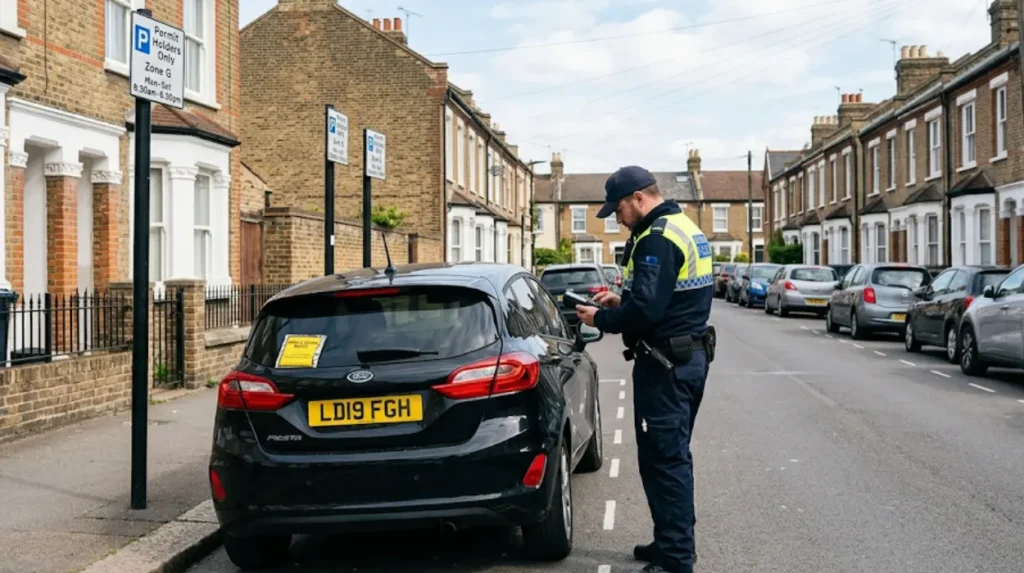
A Southwark parking permit is strictly non-transferable between different individual vehicles or distinct geographic zones. The authorization remains bound to the specific vehicle registration mark provided during the online submission process. If a resident operates an alternative vehicle, such as a temporary courtesy car or a rental asset, they must log into the portal to secure a temporary registration amendment. Parking an unregistered vehicle in a permit bay will result in a Penalty Charge Notice issued by enforcement teams.
The permit grants authorization to park only within the designated boundary lines of the specific Controlled Parking Zone indicated on the digital account certificate. The boundaries are clearly indicated on physical street signage throughout the borough. A permit for Zone ‘G’, for example, provides no parking rights within Zone ‘H’ or Zone ‘EC’. The vehicle must park within designated resident permit bays or shared-use bays that explicitly list the corresponding zone identifier on the adjacent roadside sign posts.
Possession of a valid virtual permit does not guarantee that a parking space will be available outside a specific residence or anywhere within the designated zone. The council manages highway space on a communal, non-reserved allocation model. Furthermore, permits do not grant exemptions from other parking controls, such as yellow line restrictions, loading bay blockages, suspended parking bays, or doctor and disabled parking bays.
The permit remains valid only as long as the underlying eligibility criteria are maintained. If a resident relocates outside the boundaries of the London Borough of Southwark, or transfers ownership of the vehicle, the permit must be cancelled immediately through the online portal. The council monitoring teams run regular database audits. If they find an account holder no longer resides at the registered address, the virtual permit is cancelled, and the vehicle becomes subject to immediate enforcement action.
What are the future trends and policy implications for Southwark parking?
Future parking policies in Southwark focus on expanding Controlled Parking Zones borough-wide, increasing financial surcharges on fossil-fuel vehicles, and integrating parking controls with broader London environmental initiatives.
Southwark Council’s long-term transport strategy involves expanding Controlled Parking Zones across the remaining unrestricted areas of the borough. The municipal assembly aims to create a continuous parking management environment to prevent parking displacement from neighboring boroughs. This systematic expansion means that areas previously free from parking restrictions will transition into regulated zones, requiring residents to use the digital portal to secure their parking access.
The pricing structure for parking permits will continue to shift toward emission-based models. In line with the Southwark Climate Change Strategy and Air Quality Action Plan, future fee structures will likely increase the financial penalties on vehicles with high carbon outputs. The council plans to gradually reduce the subsidies given to hybrid options, moving toward a system where only fully electric, zero-emission vehicles receive lower rates, encouraging a faster transition to sustainable transport alternatives.
The infrastructure supporting parking administration is moving toward integrated, smart-city data networks. Future updates to the Taranto platform will link directly with wider London transport systems, allowing real-time tracking of parking availability and automated permit adjustments based on temporary air quality emergencies. These changes will help align local parking controls with regional transport goals, including Transport for London’s Ultra Low Emission Zone requirements and strategic target frameworks.
Finally, the physical space allocated to traditional private vehicle storage is undergoing a policy re-evaluation. Southwark Council is actively repurposing a percentage of standard kerbside permit bays into sustainable transport infrastructure. This includes converting spaces into dedicated electric vehicle charging points, secure cycle hangars, and commercial cargo bike delivery bays. Consequently, the total volume of available on-street residential permit bays will decrease over the coming decade, reflecting a broader urban planning shift toward active travel and shared transit networks.