
The management of kerbside space remains a primary regulatory responsibility for municipal authorities across Greater London. In the London Borough of Sutton, situated in South London, the control of on-street automotive storage is executed through Controlled Parking Zones (CPZs). A Controlled Parking Zone is a geographically defined regulatory sector where vehicle parking is restricted to specific hours, requiring designated permissions for occupancy. The mechanism through which citizens secure these permissions is the Sutton digital parking portal.
- What Is the Sutton Parking Portal and How Does It Operate?
- Who Is Classified as an Eligible Resident for a Sutton Parking Permit?
- What Documents Are Required to Submit a Permit Application?
- How Long Do Virtual Resident Permits Remain Valid in Sutton?
- What Is the Cost Structure for a Sutton Resident Parking Permit?
- How Do You Apply for a New Permit via the Digital Portal?
- How Can a Resident Modify Account Details or Vehicle Registration Marks?
- What Are the Enforcement Policies and Consequences of Non-Compliance?
- How Does the Portal Integrate with Wider South London Urban Governance?
Historically, local government entities in the United Kingdom managed roadside parking via physical, paper-based permitting mechanisms under the legislative powers granted by the Road Traffic Regulation Act 1984. The modern transition toward digital administrative systems across London boroughs addresses the operational costs and enforcement inefficiencies associated with physical permits (Gray, 1996). In the current operational landscape, the London Borough of Sutton utilizes an online administrative interface to process, issue, and verify virtual parking entitlements for eligible individuals residing within regulated municipal zones.
Understanding the structural configuration of this online platform, the evidentiary benchmarks required for registration, the financial fee schedules, and the specific step-by-step transaction pathways is essential for South London residents seeking to park an automobile adjacent to their domicile.
What Is the Sutton Parking Portal and How Does It Operate?
The Sutton parking portal is a centralized digital transaction network used by the London Borough of Sutton to administer, monitor, and enforce virtual residential parking permits across all Controlled Parking Zones, eliminating the structural need for paper physical permits.
The operational framework of the digital portal relies heavily on integrated database verification architecture. When a resident registers a vehicle profile on the platform, the infrastructure cross-references the submitted data inputs with municipal mapping frameworks and localized enforcement systems. This digitised approach completely alters how local councils manage curbside demand, moving the administrative burden away from manual validation toward automated processing.
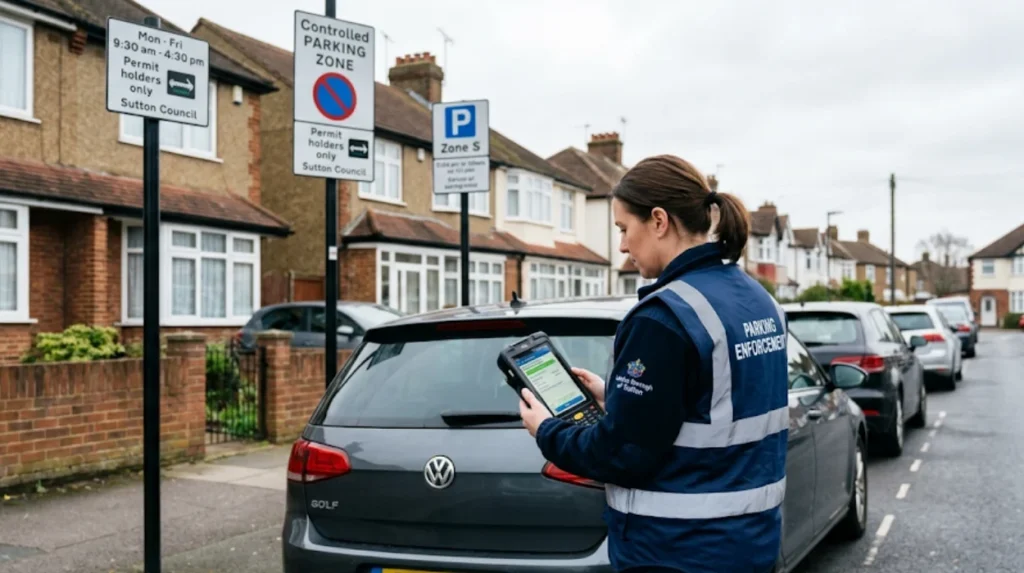
Automotive storage permissions issued via the web interface are categorized as virtual entitlements, which means there is no physical ticket, sticker, or paper document displayed on the vehicle windscreen. Instead, the municipal enforcement framework relies on Civil Enforcement Officers (CEOs) equipped with handheld digital terminals. These terminals feature integrated Automatic Number Plate Recognition (ANPR) systems. When a Civil Enforcement Officer scans a vehicle registration mark, the handheld device queries the central portal database in real time to establish whether a valid virtual resident permit is active for that specific Controlled Parking Zone.
The implementation of this digital architecture directly aligns with broader urban mobility patterns across South London. Local authorities use parking pricing structures and access controls as active levers to manage environmental impact and traffic congestion (Centre for London, 2020). By centralizing all transactions on a single electronic network, the local authority can adjust boundary rules, process renewals immediately, and reduce the processing timelines previously required by legacy postal application models.
Who Is Classified as an Eligible Resident for a Sutton Parking Permit?
An eligible resident is an individual whose primary legal domicile is physically located within the defined geographic boundaries of an active Sutton Controlled Parking Zone, and who owns or operates a qualifying motor vehicle registered to that specific address.
Municipal regulations restrict eligibility to individuals who maintain a permanent residential presence within a designated zone. To prevent the commercial abuse of residential bays, the local authority applies specific legal criteria to establish residency. A person who owns a property within a Controlled Parking Zone but primarily resides outside the zone boundaries is legally excluded from obtaining a resident permit. Furthermore, residents living in specific modern housing developments may be subject to section 106 agreements under the Town and Country Planning Act 1990. These planning obligations classify certain properties as permit-free developments, legally preventing occupiers from obtaining parking entitlements.
Vehicle eligibility criteria represent another core component of the municipal regulatory framework. To qualify for a virtual permit via the portal, the vehicle must meet specific physical dimensional and weight limitations. The local authority restricts permits to passenger vehicles, dual-purpose vehicles, and light goods vehicles. The vehicle weight must not exceed 3.5 tonnes (3,500 kilograms). Large commercial transport vehicles, trailers, caravans, and heavy freight units are entirely prohibited from obtaining residential roadside permissions within these zones.
Residents must also demonstrate true legal custody of the vehicle. This means the applicant must be named as the primary registered keeper on the official registration documentation, or must provide verifiable legal proof of vehicle custody, such as an active corporate lease agreement or an official employment car scheme document.
What Documents Are Required to Submit a Permit Application?
Applicants must provide separate, verifiable digital evidence establishing their residential identity inside the Controlled Parking Zone and their legal custody of the vehicle, using official government, utility, or vehicle registration documents uploaded directly to the platform.
To satisfy the strict anti-fraud verification protocols embedded within the digital portal infrastructure, applicants must supply specific documentary evidence. The submission process mandates two distinct categories of documentation: proof of residency and proof of vehicle ownership. Failure to produce matching address details across these document categories results in an automatic system rejection of the permit application.
For the proof of residency component, the online platform accepts specific items, provided they are clearly dated within specified compliance windows. The primary document accepted is a current, valid Council Tax statement for the property in question. If a Council Tax statement is unavailable due to a recent change of address, the system accepts a signed legal tenancy agreement or an official utility bill, such as electricity, gas, or landline water services, dated within the preceding three months (Ofwat, 2015). Digital scans or high-resolution photographic captures of these paper documents must clearly display the applicant’s full name, the complete zone address, and the document issue date.
For the proof of vehicle ownership component, the standard document required is the V5C vehicle registration certificate, commonly referred to as the logbook, issued by the Driver and Vehicle Licensing Agency (DVLA). The V5C document must explicitly display the name of the applicant and the exact address within the Controlled Parking Zone. For residents operating corporate vehicles or long-term lease units where the logbook remains with the financing institution, alternative documentation is required. The portal accepts an official lease agreement showing the vehicle registration mark, alongside a formal letter on company letterhead from the employer confirming the resident is the sole, designated driver of the vehicle.
How Long Do Virtual Resident Permits Remain Valid in Sutton?
Virtual resident permits in the London Borough of Sutton are issued for standard operational durations of either six months or twelve months, counting from the specific activation date selected by the resident during the application process.
The temporal framework of the permit system allows residents to choose between these two distinct validity windows based on their financial preferences or tenancy lengths. A twelve-month permit provides long-term regulatory coverage and minimizes administrative overhead, whereas a six-month permit offers flexibility for short-term residents or individuals planning vehicle changes. The digital infrastructure tracks the exact expiration time down to the minute, corresponding to the conclusion of the final operational day of the selected period.
The management of expiration tracking is entirely automated within the online application matrix. The portal architecture automatically generates automated electronic reminders via email or short message service (SMS) text transmission. These notifications are pushed out to the resident approximately thirty days prior to the official expiration date, with a secondary final alert sent fourteen days out. This proactive alert system reduces the volume of unintentional non-compliance errors that previously occurred under physical paper badge systems, where motorists frequently failed to notice expiration details on physical cards (Gray, 1996).
It remains the legal responsibility of the vehicle operator to monitor their active permit status. If a resident fails to execute a renewal transaction before the chronological expiration boundary passes, the vehicle instantly loses its authorized parking status. Any vehicle found stationary within a Controlled Parking Zone during restricted operational hours without an active, validated digital permit is immediately subject to the issuance of a Penalty Charge Notice (PCN) by the municipal enforcement team.
What Is the Cost Structure for a Sutton Resident Parking Permit?
Sutton applies a progressive, emissions-based pricing structure where the final cost of a resident permit is determined by the vehicle’s carbon dioxide emissions or engine capacity, with rising surcharges applied to subsequent household vehicles.
The financial frameworks governing modern urban parking are increasingly structured around environmental policy goals rather than flat administrative costs (Shoup, 1999). In alignment with greater London air quality directives, the London Borough of Sutton links its permit fee schedule directly to vehicle emissions data compiled by the DVLA. Vehicles that generate higher carbon dioxide ($CO_2$) emissions per kilometer face significantly higher base fees than low-emission or zero-emission electric vehicles. For older vehicles registered before March 2001 where official carbon output data is missing from the logbook, the tariff calculation defaults to engine capacity measured in cubic centimeters ($cc$).
The local authority also enforces a strict escalation multiplier based on the total volume of permits linked to a single residential address. This policy framework is intentionally designed to discourage multi-car ownership per household and reduce overall curbside storage density in densely populated South London neighborhoods (Centre for London, 2020). While the first vehicle registered to an address pays the standard base environmental rate, a second permit application for the same household incurs an explicit surcharge. A third permit application for the same domicile triggers an even higher financial tier, making multi-car roadside storage economically restrictive.
Payment processing on the portal must be executed through digital transaction channels. The platform interface integrates a secure payment gateway that accepts major debit cards and credit cards, including Visa and Mastercard. The financial transaction must be settled in full before the digital permit is officially provisioned into the live ANPR enforcement database.
Explore More Help & Resources
How to report abandoned vehicles using Merton’s new portal
How to report an abandoned car to Sutton Council fast
How Do You Apply for a New Permit via the Digital Portal?
To apply for a new permit, a resident must create a verified user account on the portal, input their vehicle and address details, upload the required evidentiary files, and complete the digital payment process.
The sequence of actions required to establish a new virtual parking entitlement follows a strict structural workflow managed by the platform’s decision logic. Residents must execute each phase of the digital application process precisely to avoid automated system rejections or processing delays.
1.Account Creation:Estimated time: 5 minutes.
Navigate to the official London Borough of Sutton parking services web portal. Select the registration link to initiate account creation. Input a valid personal email address, choose a secure alphanumeric password, and provide your full legal name and telephone contact details.
2.Address Verification:Instant lookup via postcode.
Enter the specific postcode of your residence within the portal interface. Select the exact street address from the automated dropdown address menu populate from the national address database. The system automatically evaluates if the selected address resides within an active Controlled Parking Zone boundary.
3.Vehicle Profile Entry:Requires vehicle registration mark.
Input the exact alphanumeric vehicle registration mark into the vehicle details field. The system queries the DVLA database via an external application programming interface to retrieve the vehicle make, model, fuel type, and official carbon dioxide emissions tier.
4.Document Upload:Supported formats: PDF, JPEG, PNG.
Upload clear, high-resolution digital copies of your mandatory documentation. Attach one valid file demonstrating proof of residency, such as your current Council Tax document, and one valid file demonstrating proof of vehicle custody, such as the V5C logbook.
5.Permit Selection and Payment:Secure checkout interface.
Select the desired operational duration, choosing either a six-month or twelve-month term. Review the automatically calculated fee based on vehicle emissions and household permit volume. Input debit or credit card details into the secure processing screen and submit the payment.
Following the successful execution of this sequence, the system issues an immediate transaction confirmation receipt via email. The application then enters an administrative verification queue. While many applications are processed immediately via automated checks, manual audits by municipal staff can take up to three working days. Residents must monitor their email inbox for any notices regarding document clarity or request rejections.
How Can a Resident Modify Account Details or Vehicle Registration Marks?
Account modifications and vehicle registration changes are processed by logging into the active user dashboard, selecting the specific permit asset, entering the new details, and uploading updated supporting vehicle documentation.
Vehicles are frequently replaced due to sales, leasing terminations, or mechanical failures. When a resident switches their primary vehicle, they must update the active digital parking permit immediately. Because the enforcement framework relies entirely on automated camera scans of number plates, any discrepancy between the vehicle registration mark on the street and the active record in the database results in the immediate generation of a parking fine.
To execute a permanent vehicle change, the resident must upload a new V5C registration certificate or insurance document showing the replacement vehicle registered to the CPZ address. The portal charges a nominal administrative variation fee to process this change. If the replacement vehicle sits within a higher carbon emissions bracket than the previous vehicle, the portal’s pricing logic calculates the pro-rata difference in permit costs for the remaining duration of the term and requires an additional payment. Conversely, if the vehicle sits in a lower emissions bracket, a pro-rata credit may be applied to the account.
For temporary scenarios, such as when a resident’s primary car is undergoing mechanical repair and a courtesy loan vehicle is provided by a garage, the portal features a temporary amendment facility. The account holder logs into the dashboard and inputs the temporary vehicle’s registration mark alongside a defined start time and end time. These temporary switches generally do not require full V5C documentation if the duration remains under a specified threshold, such as fourteen days. However, the resident must remember to switch the permit back to the primary vehicle once the courtesy period concludes.
What Are the Enforcement Policies and Consequences of Non-Compliance?
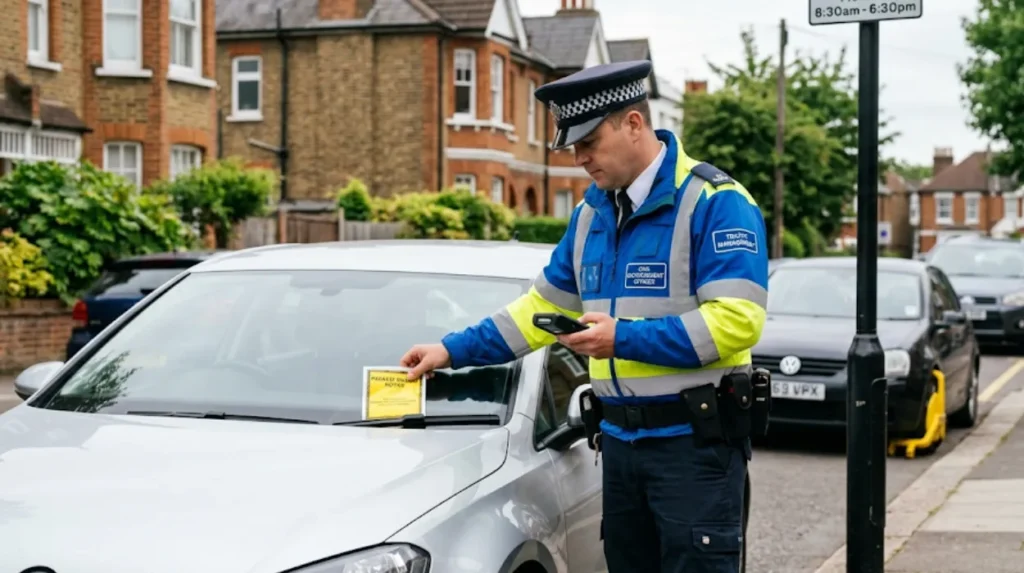
Parking enforcement within Sutton Controlled Parking Zones is governed by the Traffic Management Act 2004, which empowers Civil Enforcement Officers to issue monetary Penalty Charge Notices to non-compliant vehicles.
The regulatory integrity of the parking system depends entirely on consistent enforcement mechanisms. Controlled Parking Zones are established to safeguard local access, improve traffic flow, and ensure road safety for pedestrians and motorists alike (Gray, 1996). When a vehicle is identified stationary within a restricted zone during active enforcement hours without an active virtual permit, it constitutes a civil contravention.
The structural penalties for non-compliance are delivered via a standard Penalty Charge Notice. These charges are split into higher and lower bands depending on the severity of the specific parking infraction. Parking in a designated resident bay without any valid permit active is classified as a higher-level contravention. Under statutory London council frameworks, higher-level notices carry a substantial financial penalty, which is reduced by 50 percent if settled within fourteen days of service.
Persistent non-compliance or the fraudulent use of altered digital parameters triggers more severe municipal interventions. The London Borough of Sutton retains the legal authority to deploy vehicle immobilisation devices, commonly known as wheel clamps, or to order the physical removal and impounding of offending vehicles. This is especially true for vehicles classified as persistent evaders, defined as units with three or more outstanding, unchallenged Penalty Charge Notices. The financial costs to recover an impounded vehicle include the base penalty charge, a release fee, and daily storage accumulation charges.
How Does the Portal Integrate with Wider South London Urban Governance?
The Sutton parking portal functions as a specialized component of the unified digital infrastructure across South London, aligning local traffic management directly with regional air quality and environmental strategy targets.
The administrative shift from localized paper processing to cross-linked digital platforms is an expanding trend across South London local authorities. As boroughs face growing population densities and increasing demands on limited curbside real estate, the digitization of assets becomes a operational necessity (Kythreotis, 2022). By utilizing cloud-hosted database systems, Sutton can integrate its parking asset registers with wider environmental health indexes and urban transport planning platforms.
This technological integration carries significant implications for the future of urban policy execution. The use of real-time parking data allows municipal analysts to precisely evaluate spatial occupancy rates across different neighborhoods. This data provides the empirical foundation required when considering amendments to CPZ operating hours or establishing new zone boundaries to combat vehicle displacement from adjacent boroughs like Merton, Croydon, or Kingston upon Thames.
Furthermore, the data generated by the portal’s emissions-based pricing tiers offers localized insights into the shifting composition of the borough’s automotive fleet. By tracking the declining volume of high-emission diesel permits relative to the growth of zero-emission electric registrations, urban planners can measure the real-world efficacy of environmental surcharges. This empirical approach ensures that parking policy continues to serve as an active tool for achieving broader urban environmental goals across South London.