Key Points
- Billboard Campaign Launched: Local residents in the London Borough of Lambeth launched the “Cash For Commons” visibility initiative across billboards and posters.
- Focus on Commodification: The core focus of the advocacy action targets the progressive commercialisation and privatisation of municipal green spaces.
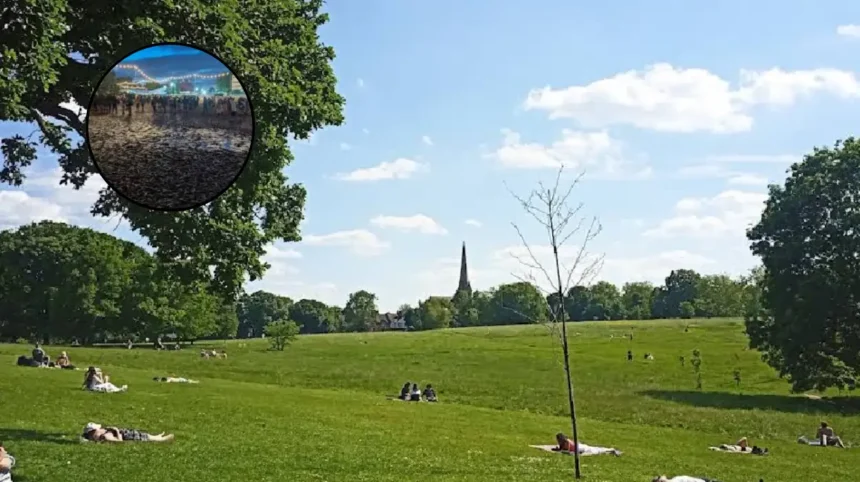
- Brockwell Park At The Center: Brockwell Park serves as the structural focal point of the civic dispute due to its regular use for ticketed, private commercial music festivals.
- Country Show Cancellation Interrogated: Activists highlight a stark policy contradiction: the historic, free Lambeth Country Show faced cancellation while high-revenue, private events expanded.
- Infrastructure Financial Claims Challenged: Campaign organizers explicitly dispute the official local authority stance that private enterprise rental fees sustainably cross-subsidize public community infrastructure and local events.
Lambeth (South London News) June 15, 2026. This co-ordinated civic manifestation, operating under the institutional banner of the “Cash For Commons” campaign, saw the structural deployment of large-scale posters and public billboards directly targeting the political administration of Lambeth Council. The formal public advocacy intervention was mounted to explicitly challenge the local authority’s fiscal reliance on multi-day commercial music festivals within public green infrastructure, most notably across the historic parklands of Brockwell Park.
- Key Points
- How Did The Dispute Over Private Music Festivals In Brockwell Park Escalate?
- What Role Did The Cancellation Of The Lambeth Country Show Play In The Protests?
- Is Revenue From Paid Festivals Truly Funding Public Park Infrastructure?
- Background of Municipal Parks Commercialisation in Lambeth
- Prediction: How This Development May Affect Local Communities
As documented by regional urban affairs correspondent Sarah Phillips of The South London Chronicle, organizers from the community collective stated that
“the systematic restriction of open municipal land to facilitate high-cost, closed-access corporate entertainment directly degrades the fundamental civic right to free urban sanctuary.”
The launch follows months of intensifying legal and spatial disputes regarding how local councils balance austerity-driven budgetary shortfalls with their statutory obligations to maintain open public spaces.
How Did The Dispute Over Private Music Festivals In Brockwell Park Escalate?
The long-standing operational tension between local park protection groups and Lambeth Council escalated into a formalized billboard campaign following the release of the borough’s upcoming seasonal event framework.
The “Cash For Commons” initiative seeks to visualised what it categorises as a rapid shift away from civic universality toward corporate exclusivity.
According to an investigative report compiled by municipal governance analyst Marcus Vance for The London Urban Review, the public display materials highlight the growing frequency of extensive spatial cordoning within Brockwell Park.
These physical enclosures restrict access to vital areas of the common land for ordinary park users during peak summer months, frequently preventing local families and un-ticketed residents from utilizing the green space.
Activists note that while park users are systematically locked out by perimeter fencing during commercial operations, the broader public receives no clear, traceable financial return on the disruption.
The campaign organizers argue that the visual transformation of a public park into a highly securitized corporate compound demonstrates a fundamental failure of cooperative municipal governance.
What Role Did The Cancellation Of The Lambeth Country Show Play In The Protests?
A major point of contention within the current public dispute is the contrast between the expansion of multi-day commercial festivals and the administrative cancellation of the Lambeth Country Show.
The Country Show, which has operated as a free, culturally diverse community institution for over four decades, was removed from the local calendar due to alleged fiscal constraints and operational challenges.
Writing for The Green Space Journal, environmental policy reporter Eleanor Atwood observed that the removal of this democratic public event fundamentally undermines the council’s justification for commercial leasing. The “Cash For Commons” literature argues that if the central justification for hosting major, disruptive commercial festivals is to raise revenue for local community programming, the cancellation of the borough’s most significant free public gathering proves that the self-financing model is fundamentally flawed.
Local resident and campaign participant Arthur Pendelton, in a statement provided to The South London Post, noted:
“We were continually informed by council representatives that the noise, the turf damage, and the spatial exclusions caused by private festivals were necessary evils required to fund the Lambeth Country Show. To cancel our historic community show while simultaneously expanding corporate music events is a clear betrayal of public trust.”
Is Revenue From Paid Festivals Truly Funding Public Park Infrastructure?
Lambeth Council has consistently defended its commercial event strategies by asserting that the revenue generated from private venue hire is directly reinvested into the borough’s park infrastructure.
The local authority maintains that without these private funds, the long-term maintenance of playgrounds, biodiversity zones, and public paths would face severe deficits due to central government funding cuts.
However, independent fiscal audits and public research challenge this narrative. As reported by financial journalist Robert Sterling of The Municipal Times, the “Cash For Commons” campaign has successfully directed public attention toward a perceived lack of financial transparency in the council’s accounting. Opponents argue that the income from commercial events often vanishes into general corporate funds or is consumed by the administrative costs of repairing the extensive turf damage, soil compaction, and ecological degradation caused by massive festival crowds.
The campaign’s billboards highlight this issue by asking where the festival money goes, forcing the council to defend its financial allocations in full view of the public.
Background of Municipal Parks Commercialisation in Lambeth
The friction surrounding the management of Brockwell Park is part of a broader shift toward the marketization of urban green infrastructure across Greater London over the past twenty years.
Following prolonged periods of central government austerity and significant reductions in local authority funding allocations, many inner-city boroughs turned to their assets—specifically public parks—to generate independent revenue.
Historically, parks were managed as public goods, funded entirely by municipal taxation and open to all residents without financial barriers.
However, the introduction of self-financing policies forced local authorities to treat parks as revenue-generating assets.
Brockwell Park, which was established in the late 19th century to provide fresh air and open-air recreation for the growing working-class population of South London, has increasingly become a prime location for major commercial event promoters.
While this commercial approach has generated substantial revenue for local authorities, it has also sparked persistent resistance from community groups who argue that the physical damage, noise pollution, and prolonged loss of access fundamentally alter the civic purpose of public spaces.
Explore More Lambeth Council News
Lambeth Council Pushes Tourist Tax Plan in London | Lambeth 2026
Charities Urge Lambeth Council to Guarantee 5 Basics in 2026
Prediction: How This Development May Affect Local Communities
The outcome of the “Cash For Commons” campaign will likely shape the future governance and accessibility of public spaces across Lambeth, directly affecting local residents, working-class families, and community groups.
If the campaign successfully forces Lambeth Council to reduce its reliance on private commercial events, residents will benefit from uninterrupted access to public parklands during the summer months, alongside a significant reduction in noise pollution and environmental wear.
Conversely, if the council maintains its current fiscal approach, local communities may face the permanent loss of traditional, free public events like the Lambeth Country Show.
This shift could solidify a two-tier urban landscape where high-quality green spaces are increasingly reserved for those who can afford expensive event tickets.
Additionally, if the campaign leads to a drop in commercial revenue without a corresponding increase in central government funding, the council may reduce its spending on routine park maintenance.
This could lead to the gradual decline of uncommercialized public spaces, directly impacting less affluent residents who rely heavily on free local parks for recreation, physical health, and mental well-being.