You report a dead or leaning Croydon Council tree by emailing treesandwoodlands@croydon.gov.uk or using the Love Clean Streets website/app. For urgent dangerous trees threatening life or property, call 020 8726 6000 during office hours (Monday–Friday, 9am–4pm) or 020 8684 3527 out of hours.
- What signs indicate a tree is dead or dangerous in Croydon?
- How do I report a dead or leaning tree to Croydon Council online?
- What email address do I use to contact Croydon Council about trees?
- When should I call Croydon Council instead of emailing about a tree?
- Which trees does Croydon Council actually manage and remove?
- What information must I include when reporting a tree problem?
- How quickly does Croydon Council respond to tree reports?
- What happens after I report a dangerous tree to the council?
- Who are the tree officers for different areas in Croydon?
- What should I do if a private tree is dangerous on my property?
- When do I need to contact emergency services instead of the council for trees?
This guide provides the complete, factual process for South London residents to report unsafe trees managed by Croydon Council. You will learn the exact contact methods, what information to include, which trees the council handles, response timelines, and when to contact emergency services instead.
What signs indicate a tree is dead or dangerous in Croydon?
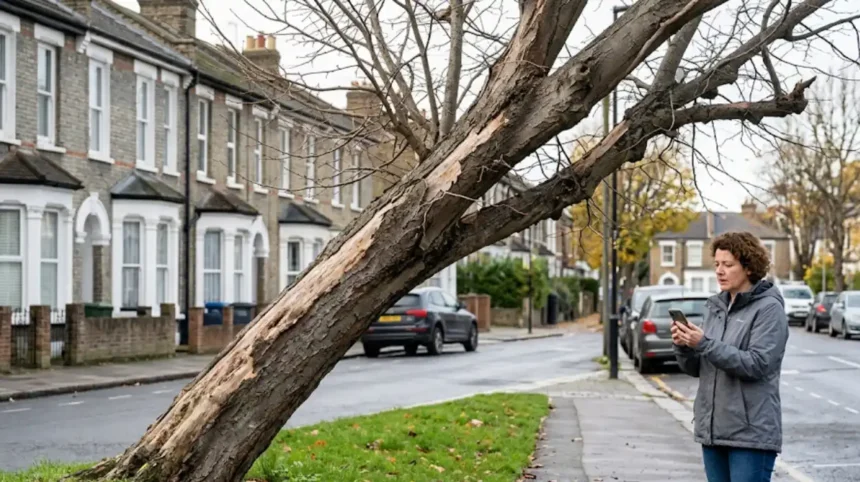
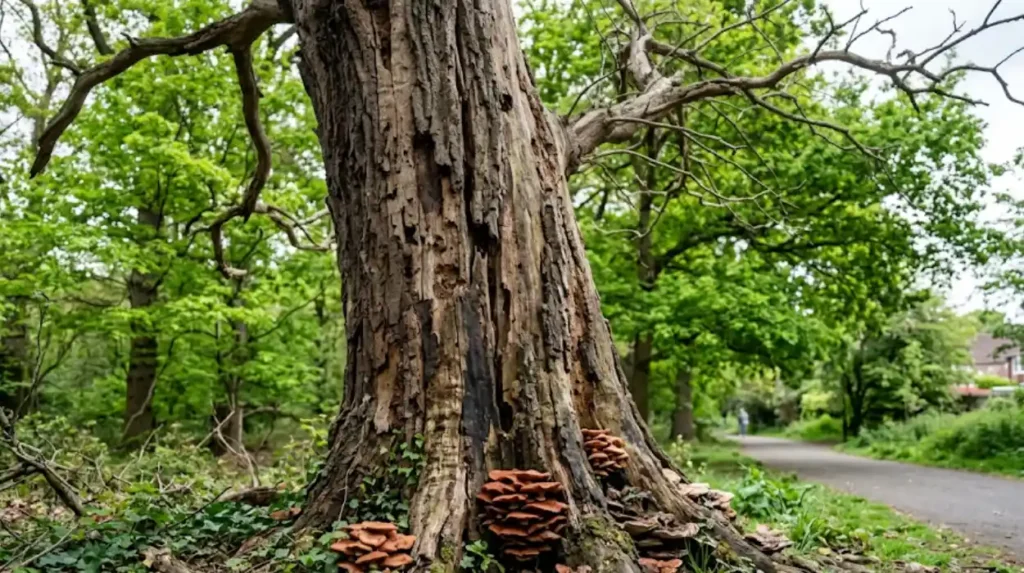
A tree is dangerous if it is completely or almost dead, has lifted out of the ground, shows fungi on roots/base/stem, or has significant cracks/holes on the main stem or branches. These are the specific conditions Croydon Council identifies as unsafe.
Croydon Council does not prune trees simply because they are too big, too small, blocking light, or dropping natural debris. The council only responds to genuine safety risks. Understanding the exact signs prevents unnecessary reports and ensures dangerous trees get priority attention.
Completely dead trees show no leaves during growing seasons, brittle bark that flakes off, and dead wood throughout the canopy. Almost dead trees have less than 25% live foliage. Recently lifted trees have roots exposed above ground level or the entire tree tilted at an angle, indicating ground failure or root damage.
Mushrooms or fungi growing from roots, the base, or stem indicate internal rot. Common species include honeyfungus (Armillaria mellea), which spreads through root systems, and bird’s nest fungi, which signal moisture saturation. Significant cracks appear as deep vertical splits in the main stem, while holes may indicate woodpecker damage or decay cavities.
Other warning signs include deadwood hanging from branches (widowmakers), leaning that has increased recently, and roots damaged by construction work. Trees touching voltage cables require electricity provider contact, not council reporting.
How do I report a dead or leaning tree to Croydon Council online?
Report online through the Love Clean Streets website or mobile app by selecting “tree or high hedge obstruction on public land,” adding your location, attaching a photo, and writing a brief description. Both methods work 24/7 without requiring an account.
The Love Clean Streets platform is Croydon Council’s official online reporting system for street issues including tree obstructions. Two access methods exist: the mobile app (fastest option) and the website.
Download the Love Clean Streets app from Apple iOS or Google Android stores. The app uses your phone’s GPS to pinpoint location automatically. Open the app, select the tree obstruction category, add a photo showing the problem clearly, write a description mentioning “dead” or “leaning,” and submit.
The website alternative works at www.croydon.gov.uk/lovecleanstreets. Click the “Report Now” button below the login box to report without creating an account. Enter the exact address or landmark near the tree, upload a photo, describe the issue as dead/leaning/dangerous, and submit.
Both methods send your report to Croydon Council’s central inbox. The system automatically assigns it to the tree officer for your specific zone. You receive email updates if you created an account or enabled notifications in the app.
Include precise location details: street name, house number, nearest landmark, or GPS coordinates. Photos showing the full tree, the dead/leaning section, and any ground lifting help officers assess urgency. Describe when you first noticed the problem and whether it has worsened.
What email address do I use to contact Croydon Council about trees?
Email treesandwoodlands@croydon.gov.uk for all tree issues. This central inbox goes to the Tree Service team and gets assigned to your zone’s tree officer. For urgent help, contact Tree Service Manager Paul Dalton at Paul.Dalton@croydon.gov.uk.
The treesandwoodlands email address is the most effective contact method according to Friends of Selsdon Wood, a community group working with Croydon’s tree team. All Tree Service team members access this inbox, ensuring coverage when staff are on annual leave or sick.
Emails automatically get assigned to the tree officer responsible for your specific ward or zone. Croydon has multiple tree officers covering different areas. Your email reaches the correct person without you needing to know their name.
Include these details in your email:
- Exact location (street, number, landmark)
- Tree description (species if known, size, height)
- Specific problem (dead, leaning, lifted, fungi, cracks)
- When you first noticed it
- Whether it has worsened
- Photo attachments showing the issue
Richard Edwards serves as Trees & Woodland Officer for public realm areas. Contact him at Richard.Edwards@croydon.gov.uk or 020 8726 6000 ext 62387 for trees in streets. Simon Kaye handles trees in gardens at 020 8726 6800 ext 62048.
For urgent requests during office hours (Monday–Friday, 9am–4pm), call 020 8726 6000. Out of hours, call 020 8684 3527. You can also email contact@croydon.gov.uk for general inquiries.
When should I call Croydon Council instead of emailing about a tree?
Call immediately when a tree threatens life or property—such as a fallen tree blocking a road, a leaning tree about to drop on a house, or branches blocking visibility at a junction. Use 020 8726 6000 during office hours or 020 8684 3527 out of hours for emergency tree situations.
Email works for non-emergency reports where the tree is dangerous but not actively threatening. Phone calls trigger faster response times for genuine emergencies. Croydon Council distinguishes between urgent safety risks and standard maintenance requests.
Emergency scenarios include:
- Fallen trees or large branches blocking roads or footpaths
- Trees leaning dangerously toward houses, cars, or power lines
- Large deadwood hanging above pedestrian areas
- Trees that have lifted completely and could fall immediately
- Branches obstructing road signs or traffic visibility
Call 020 8726 6000 Monday through Friday, 9am to 4pm. This is the main contact centre for urgent tree issues. Operators dispatch contractors or tree officers immediately for life-threatening situations.
Out of hours (outside 9am–4pm Monday–Friday, plus weekends and public holidays), call 020 8684 3527. The out-of-hours team handles emergency tree responses when the main office is closed.
Do not call for non-emergency issues like overhanging branches, debris dropping, or trees blocking light. These require email reporting. Calling for non-emergencies delays response to genuine dangers.
If trees touch voltage cables, contact your electricity provider immediately, not the council. This is a utility company responsibility due to electrocution risk.
Which trees does Croydon Council actually manage and remove?
Croydon Council manages trees on public land including streets, parks, footpaths, and council-owned properties. The council does not remove private trees in gardens, trees belonging to schools, or trees on housing estates managed by the Homes and Housing team.
Understanding council responsibility prevents wasted reports. Croydon only handles trees on land it owns or manages. Private trees remain the responsibility of landowners.
Council-managed trees include:
- Street trees along-streets and roads
- Trees in parks and open spaces
- Trees on footpaths and verges
- Trees in council housing garden areas (shared spaces only)
- Trees on public recreation ground
The council does not carry out work for:
- Private garden trees (owner’s responsibility)
- Trees blocking light (no legal right to light exists)
- Overhanging branches (you may prune sections within your boundary)
- Natural debris like leaves, fruit, or twigs (not a legal nuisance)
- Bird droppings from nesting birds (protected under Wildlife and Countryside Act 1981)
- Pollen or allergies (natural processes, not legal nuisances)
- Trees touching telephone wires (service provider’s responsibility)
- Sticky honeydew on cars (seasonal nuisance, washes off)
- TV aerial interference (not a legal nuisance)
- Solar panel shading (installer’s pre-installation responsibility)
- Presumed drain damage (requires engineer’s report for insurance claims)
- Trees deemed too big or too small (height doesn’t increase danger)
- School trees (headteacher arranges maintenance)
- Council tenant garden trees (tenant’s responsibility per tenancy agreement)
Council housing tenants must contact their Tenancy Officer for garden tree concerns. Tenants maintain gardens including saplings, hedges, and trees as part of their tenancy agreement. Help may exist for genuinely dangerous trees.
Schools contact their headteacher, who arranges maintenance. The council does not directly manage school grounds.
Explore More Help & Resources
How to use Bromley’s map to report a fallen street tree
How to report overhanging branches in Lewisham for 2026
What information must I include when reporting a tree problem?
Include the exact location (street name, house number, landmark), tree description (size, height, species if known), specific problem (dead, leaning, lifted, fungi, cracks), when you first noticed it, whether it has worsened, and attach clear photos showing the full tree and damaged sections.
Incomplete reports delay assessment. Croydon Council needs specific details to determine urgency and assign the correct tree officer.
Location details must be precise. Provide:
- Full street name
- House or building number nearest the tree
- Nearest landmark (shop, church, bus stop)
- GPS coordinates if available (from phone maps)
- Side of road (north/south, east/west)
Tree description helps officers identify the problem tree among multiple trees:
- Approximate height (meters or number of storeys)
- Width of canopy
- Species if known ( oak, maple, pine, etc.)
- Age estimate (young sapling, mature, old)
- Number of stems or single trunk
Problem description uses Croydon’s official safety criteria:
- “Completely or almost dead” with leafless canopy
- “Recently lifted out of the ground” showing exposed roots
- “Fungi or mushrooms on roots/base/stem”
- “Significant crack in main stem” with depth description
- “Large hole in trunk” with size measurement
- “Leaning at [angle] degrees” with direction
Timing information establishes urgency:
- Date first noticed the problem
- How long it has existed
- Whether it appeared suddenly (storm damage) or gradually
- Recent changes (worsened leaning, new cracks, increased deadwood)
Photo requirements:
- Full tree showing entire height and canopy
- Close-up of dead sections, cracks, or holes
- Root area showing lifting or fungi
- Angle showing lean direction
- Context photo showing proximity to houses, roads, or paths
Take photos in daylight with good visibility. Avoid blurry or dark images. Multiple photos from different angles provide better assessment.
How quickly does Croydon Council respond to tree reports?
Croydon Council assigns reports to your zone’s tree officer within 1–3 business days. Emergency tree situations receive immediate response. Non-emergency dangerous trees typically get inspected within 5–10 working days depending on workload and priority.
Response times vary based on urgency, council workload, and seasonal factors. Storm events significantly increase report volumes and extend response times.
Emergency calls (020 8726 6000 or 020 8684 3527) trigger immediate contractor dispatch. Life-threatening trees get addressed within hours. Property-threatening trees receive 24-hour response.
Email and online reports go through the central inbox first. The system auto-assigns to your zone’s tree officer. Assignment typically occurs within 1–3 business days.
Tree officers inspect assigned reports within 5–10 working days for non-emergencies. High-priority dangerous trees (recently lifted, large deadwood overhead) get inspected faster, often within 3–5 days.
Winter months (November–February) see increased reports due to leaf loss exposing dead trees and storm damage. Response times extend during this period.
Spring and summer offer faster response as workload decreases. However, nesting bird season (March–August) under Wildlife and Countryside Act 1981 may delay work on trees with active nests.
After inspection, the tree officer determines action:
- Immediate removal for life-threatening trees
- Scheduled removal within 1–2 weeks for dangerous trees
- Pruning for partial safety issues
- No action if tree is safe
You receive feedback on your report outcome via email if you provided contact details.
What happens after I report a dangerous tree to the council?
After reporting, the tree officer inspects the tree within days, determines if it’s dangerous, and schedules removal or pruning. You receive outcome feedback. The council removes dangerous council trees but does not compensate for presumed drain damage without an engineer’s report.
The inspection process follows Croydon’s established tree safety protocol. Tree officers assess against the four official danger criteria: complete/almost dead, recently lifted, fungi present, or significant cracks/holes.
Inspection outcomes fall into three categories:
Immediate removal occurs for life-threatening trees. Contractors fell and remove the tree within hours. Large branches get cut first, then the main trunk. Debris clears from public areas.
Scheduled removal happens for dangerous but not immediately threatening trees. The council schedules work within 1–2 weeks. You may receive a notice about upcoming work dates.
Pruning occurs for partial safety issues like large deadwood branches that don’t require full removal. Officers cut and remove hazardous sections while preserving the healthy tree.
No action results if the tree is safe. Officers may explain that size alone doesn’t indicate danger, or that natural processes (debris, pollen, bird droppings) aren’t legal nuisances requiring intervention.
The council does not compensate for presumed drain damage from trees. Insurance claims require an engineer’s report proving the tree is the primary cause. Without this report, claims fail.
For council housing tenant garden trees, the Tenancy Officer handles concerns. Tenants maintain gardens per their tenancy agreement. Dangerous tree help may exist through this channel.
School tree maintenance requires headteacher contact. The council does not directly manage school grounds.
Who are the tree officers for different areas in Croydon?
Richard Edwards is the Trees & Woodland Officer for public realm/street trees at Richard.Edwards@croydon.gov.uk, 020 8726 6000 ext 62387. Simon Kaye handles garden trees at 020 8726 6800 ext 62048. Paul Dalton is the Tree Service Manager at Paul.Dalton@croydon.gov.uk for urgent help.
Croydon divides tree management into zones with dedicated officers. Your report automatically gets assigned to your zone’s officer when you email treesandwoodlands@croydon.gov.uk.
Richard Edwards covers public realm areas including street trees, park trees, and footpath trees. His contact details are:
- Email: Richard.Edwards@croydon.gov.uk
- Phone: 020 8726 6000 extension 62387
- Office location: Public Realm Office, Stubbs Mead Depot, Factory Lane, Croydon CR0 3RL
Simon Kaye handles trees in garden settings, including private garden inquiries and council housing garden tree concerns. Contact him at:
- Phone: 020 8726 6800 extension 62048
- Email available through central inbox (treesandwoodlands@croydon.gov.uk)
Paul Dalton serves as Tree Service Manager, overseeing the entire tree team. Contact him directly at Paul.Dalton@croydon.gov.uk for urgent assistance or when standard channels fail. He invites residents to contact him for help.
The central inbox treesandwoodlands@croydon.gov.uk reaches all team members. This ensures coverage when specific officers are on annual leave, sick, or unavailable. Multiple staff access this inbox and handle zone-specific assignments.
Tree officers work Monday through Friday, 9am to 4pm. Out-of-hours emergency coverage uses 020 8684 3527.
What should I do if a private tree is dangerous on my property?
Private trees on your property are your responsibility, not Croydon Council’s. Hire a qualified tree surgeon to assess and remove dangerous private trees. The council only intervenes if a private tree threatens public safety like blocking a road or footpath.
Croydon Council explicitly does not manage private garden trees. Tenants maintain gardens including trees as part of their tenancy agreement. Homeowners bear full responsibility for private tree safety.
hire a qualified tree surgeon who holds:
- Professional tree industry certification (PTI, NPTC qualifications)
- Insurance covering tree work and property damage
- Experience with dangerous tree removal
Request a safety assessment before removal. The surgeon identifies danger signs matching council criteria: deadness, lifting, fungi, cracks. Professional assessment determines if removal is necessary.
Remove dangerous private trees promptly to prevent property damage or injury. Delay increases risk, especially during storm season.
If a private tree blocks a road, footpath, or alleyway, you have rights to prune encroaching branches. Prune rules include:
- Do not unbalance the tree’s shape
- Avoid unnecessary wounding or splitting
- Dispose of all pruned twigs/branches
- Keep cuts within your private boundary
For alleyway obstruction, prune branches encroaching your access while following the same rules.
If you suspect a private tree damaged drains, contact a plumber first. For insurance claims, obtain an engineer’s report proving the tree is the primary cause. Without this report, claims fail.
School trees require headteacher contact. The headteacher arranges maintenance, not the council.
When do I need to contact emergency services instead of the council for trees?
Contact emergency services (999) when a tree has caused immediate life threat like trapping someone, blocking an emergency route, or causing power line explosions. Call your electricity provider for trees touching voltage cables. The council handles dangerous trees but not active emergencies involving injury or utility failure.
Emergency services respond to active life threats requiring police, fire, or ambulance. Tree-related emergencies include:
- Tree trapping a person under branches
- Fallen tree blocking emergency vehicle access
- Tree causing power line explosion or fire
- Tree damaging structural elements with people inside
Call 999 for these scenarios. Emergency services coordinate with utility companies and tree contractors for immediate safety.
Trees touching voltage cables require electricity provider contact, not council or emergency services (unless active fire/explosion occurs). Electrocutution risk makes this a utility company responsibility. Contact your local electricity distributor immediately.
fallen trees blocking roads but not causing injury require council emergency response (020 8726 6000 or 020 8684 3527), not 999. The council dispatches contractors for road clearance.
Property damage from falling trees without injury also uses council emergency contact, not 999. Document damage for insurance claims with photos and dates.
Storm damage creating multiple dangerous trees uses council emergency channels. 999 is only for immediate life threats, not property damage or general danger.
How do I report a dead or dangerous tree in Croydon?
You can report a dead, leaning, or dangerous council-managed tree by emailing treesandwoodlands@croydon.gov.uk or submitting a report through the Love Clean Streets website or mobile app. For emergencies, call 020 8726 6000 during office hours or 020 8684 3527 outside office hours.