Requesting tree pruning in Richmond upon Thames depends on whether the tree is council-owned or privately owned. For council trees obstructing highways or footpaths, submit an online report at richmond.gov.uk/report_a_problem_with_a_tree or call 020 8891 1411. For private trees, you must check for Tree Preservation Orders (TPOs) or conservation area status, then submit a tree works application through the Planning Portal with at least 6 weeks notice if in a conservation area, or up to 8 weeks processing time for TPO applications.
- What is tree pruning and when do you need to request it in Richmond upon Thames?
- How do you request pruning for council-owned trees in Richmond upon Thames?
- What steps must you follow to prune protected private trees with Tree Preservation Orders?
- How do you request pruning for trees in Richmond upon Thames conservation areas?
- What information must you include when submitting a tree pruning request?
- How much does private tree pruning cost in Richmond upon Thames and when should you hire a tree surgeon?
- What happens if you prune trees without permission in Richmond upon Thames?
- When does the council refuse tree pruning requests and what are your alternatives?
What is tree pruning and when do you need to request it in Richmond upon Thames?
Tree pruning is the selective removal of branches to maintain health, safety, or appearance. You need to request it when council trees obstruct highways, private trees pose safety risks, or protected trees require work under TPO or conservation area rules. The London Borough of Richmond upon Thames manages all trees on council land through qualified arboriculturalists who conduct scheduled surveys every 3–5 years per industry standards.
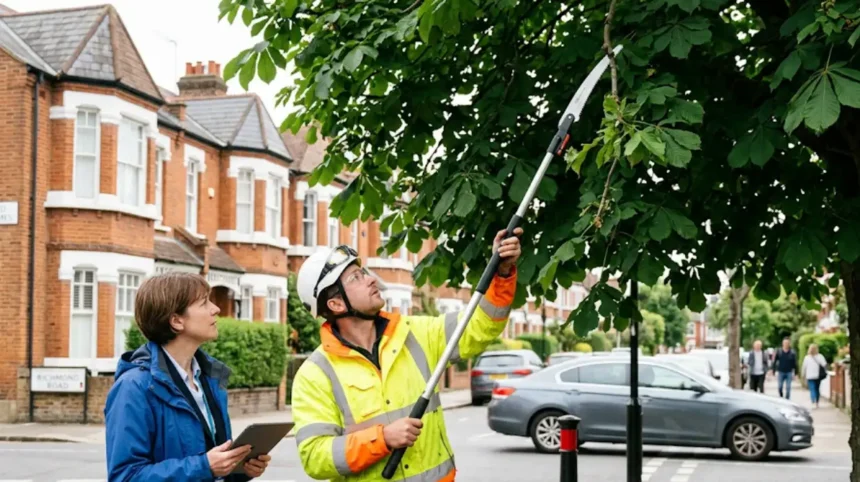
Tree pruning serves multiple purposes including removing low branches over public highways, eliminating epicormic (basal) growth, maintaining vital root balance, and preventing obstruction of footpaths. The council’s annual Clear Highways and Paths Schedule (CHAPS) specifically targets low branches over highways or footways, removing basal growth, and adjusting stakes on newly planted trees. Private tree owners must follow different procedures depending on legal protections.
Richmond upon Thames contains 85 designated conservation areas including Richmond Park, Kew Gardens, Hampton Common, and Twickenham Riverside, plus numerous trees subject to Tree Preservation Orders covering single trees to woodlands. Trees with trunk diameter greater than 7.5cm measured at 1.5m above ground generally require applications for any work.
How do you request pruning for council-owned trees in Richmond upon Thames?
Submit an online report through richmond.gov.uk/report_a_problem_with_a_tree for dead, dying, dangerous trees, root damage, or obstructed signs. Call 020 8891 1411 during office hours (9am–5pm, Monday–Friday) or 020 8891 7999 for emergencies after 5pm or on weekends. The Tree Section, Parks and Open Spaces at Civic Centre, 44 York Street, Twickenham, TW1 3BZ handles all enquiries.
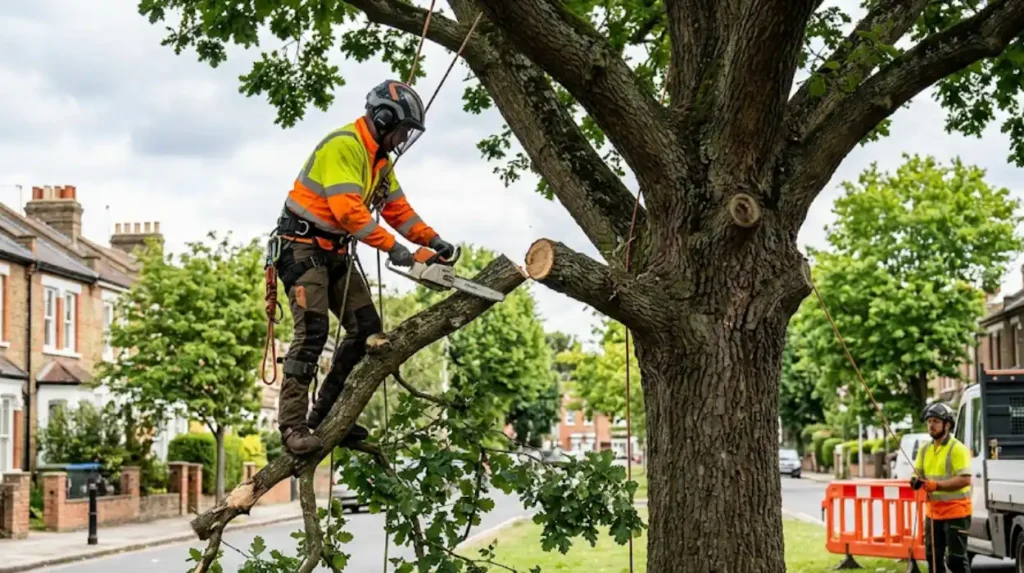
The council employs arboriculture experts conducting scheduled surveys of trees in highways, allotments, cemeteries, parks, and open spaces at reasonable intervals. These surveys produce work schedules executed over many months, timing work for appropriate seasons and environmental conditions. London plane trees are typically pruned during winter dormancy when out of leaf due to respiratory irritants in their leaves, though contractors now reduce them in leaf with increased PPE and reduced weekly volumes.
Lime trees produce large epicormic growth at bases during summer months, requiring removal twice yearly: round one in May–June and round two in August–September. The council cannot prune or remove trees for cosmetic reasons, personal preference, or if pruning would damage the tree. Trees are only removed when posing unacceptable injury risks, causing significant structural damage, creating overpopulation, or when deemed inappropriate for their setting.
For emergency situations involving fallen trees or branches obstructing pavements/roads after 5pm Monday–Friday or on weekends/holidays, call 020 8891 7999 immediately. The Duty to Consult legislation under Section 115 of the Environment Act 2021 requires highway authorities to consult residents before felling street trees, though exemptions apply for dangerous trees, classified roads, and park trees.
What steps must you follow to prune protected private trees with Tree Preservation Orders?
Apply for planning permission through the Planning Portal website or download a paper tree works application form. Applications take up to 8 weeks to process, and you must specify proposed work details precisely to avoid form rejection. If the protected tree’s trunk diameter exceeds 7.5cm at 1.5m above ground, you need completion of a tree work application for any work.
Tree Preservation Orders aim to protect trees making significant impact on local surroundings, particularly those immediately endangered. TPOs remain in force indefinitely once confirmed. It is an offence to cut down, top, lop, uproot, wilfully damage, or destroy TPO trees without permission. Deliberate destruction or damage likely to cause destruction can result in fines up to £20,000, with Crown Court considering financial gain for unlimited fines.
Five days written notice by post or email is required for exceptions: trees presenting imminent serious safety risks (with proof the tree was dead/dangerous), dead tree removal (with photographic evidence), nuisance prevention/control (with photographs, site plan, and work specification), statutory obligation under Acts of Parliament, or pruning fruit trees in commercial orchards following good horticultural practice.
The Planning Portal website provides guidance on completing the tree works form (pdf, 184 KB). Forms often get rejected for insufficient detail, wasting significant time. The Arboricultural Association website lists approved contractors for professional specification advice. Tree owners remain responsible for protected trees’ condition and any damage caused.
If applications get refused or conditions imposed, you can appeal in writing within 28 days of receiving the decision. Appeals normally decided without formal hearings based on written statements followed by site visits. The Secretary of State may allow, dismiss, or vary original decisions.
How do you request pruning for trees in Richmond upon Thames conservation areas?
Give the Council at least 6 weeks prior notice using a tree works application form submitted online or as a paper download. Section 211 notification gets considered within 6 weeks, and it’s an offence to prune, fell, or damage conservation area trees without notice. This applies to standalone trees with stem diameter over 7.5cm at 1.5m above ground, or group trees over 10cm.
Richmond upon Thames contains 85 conservation areas including Barnes Green, Kew Green, Richmond Green, Richmond Riverside, Richmond Hill, Petersham, Ham Common, Twickenham Riverside, Hampton Court Green, and Kew Gardens. If a conservation area tree already has a TPO, normal TPO procedures apply. If not covered by TPO, Section 211 notification applies per Government guidelines.
The tree works application form (pdf, 266 KB) template is encouraged for Section 211 notifications虽 not mandatory. Council decisions arrive within 6 weeks from validation date. Applications require specific proposed work details to prevent rejection.
For conservation area tree work consent, apply online or download application forms. The notice allows council assessment of whether works harm the area’s character. Unapproved work can trigger prosecution under Town and Country Planning Act 1990, with owners liable for replanting appropriate size/species trees.
What information must you include when submitting a tree pruning request?
Include precise location details, photographs taken from public places, tree species, trunk diameter measured at 1.5m above ground, specific work specification, and site plans for nuisance cases. For TPO copy requests with known numbers, pay £40.50 including postage. Applications must specify proposed work precisely to avoid rejection delays.
The report form for council tree problems requires indicating whether the tree is dead, dying, dangerous, causing root damage, obstructing signs, or has other faults. For TPO requests, include photographs from public places to help decide whether creation is warranted. Requests must be clearly justified showing specific threat to appearance/existence or detrimental removal impact.
Tree work applications need professional specification from qualified arborists. The Arboricultural Association website lists approved contractors. Forms frequently get returned for insufficient detail, causing significant time waste. For nuisance prevention cases, submit photographs, site plan, and work specification specification alongside 5 days written notice.
Contact details include email trees&parks@richmond.gov.uk, telephone 020 8891 1411 during 9am–5pm Monday–Friday office hours, or post to Tree Section, Parks and Open Spaces, Civic Centre, 44 York Street, Twickenham, TW1 3BZ. Emergency calls after hours use 020 8891 7999.
How much does private tree pruning cost in Richmond upon Thames and when should you hire a tree surgeon?
Private tree pruning costs £100–£500 for trimming services, £300–£900+ depending on tree size for reduction/thinning/lifting, with hourly rates around £40 per person or £120 for three-person teams. Hire qualified tree surgeons for protected trees, large trees, dangerous situations, or when professional specification is required for applications.
Average Richmond upon Thames tree surgeon prices include tree felling (£300–£3,000), medium birch tree with 2-person team (£500–£800), large oak removal with full team (£1,000–£3,000), stump grinding (£60–£150), and debris removal (£50–£100). Daily rates typically cost £250–£400 per person or £700–£950 for full teams.
Hire professional tree surgeons when dealing with TPO trees, conservation area trees requiring applications, large trees needing climbing equipment, dangerous trees presenting safety risks, or when applications require professional specification. The Arboricultural Association provides approved contractor lists for qualified arborists.
Richmond upon Thames has 39 recommended tree surgeons available through platforms like Checkatrade. Use Request a Quote features to automatically contact up to 3 companies for competitive pricing. Professional advice from qualified arborists is strongly recommended before contacting council about protected tree work.
Explore More Help & Resources
How to report a dead or leaning tree to Croydon Council
How to use Bromley’s map to report a fallen street tree
What happens if you prune trees without permission in Richmond upon Thames?
You face fines up to £20,000 for deliberate destruction or damage likely to destroy trees, with Crown Court considering financial gain for unlimited fines. Other offences carry £2,500 maximum fines. You must normally plant replacement trees if cut down or destroyed. Prosecution occurs under Town and Country Planning Act 1990 for unapproved conservation area work.
It is criminal offence to carry out works on TPO trees or conservation area trees without permission. Unauthorized work triggers prosecution liability with owners required to replant appropriate size/species trees unless 6 weeks notice was given. The Crown Court assesses financial gain from offences when determining fines, potentially making them unlimited.
Tree owners remain responsible for protected trees’ condition and any damage caused regardless of unauthorized work. Replacement tree planting obligations apply when trees get cut down or destroyed. Planning permission may be required for tree work on private properties, especially with TPOs or conservation areas.
Avoid offences by checking TPO status through Civic Centre or Customer Services (0208 891 1411), verifying conservation area status when purchasing properties through local land charges register, and ensuring solicitors identify protected trees. Always obtain written permission before working on protected trees unless dead/dangerous exemptions apply with proper notice.
When does the council refuse tree pruning requests and what are your alternatives?
The council refuses pruning for cosmetic reasons, personal preference, or when pruning would damage trees. Alternatives include hiring private tree surgeons for protected trees (with proper permissions), submitting nuisance claims with 5 days notice, or requesting emergency assessments for dangerous trees. Council trees only get removed when posing unacceptable risks, causing structural damage, creating overpopulation, or being inappropriate for setting.
For private tree issues the council won’t address, hire qualified tree surgeons with proper TPO/conservation area permissions. Obtain professional specifications for applications through Arboricultural Association approved contractors. For nuisance prevention, submit 5 days written notice with photographs, site plans, and work specifications.
Dangerous private trees presenting imminent serious safety risks allow work with 5 days written notice and proof the tree was dead/dangerous. Dead tree removal requires 5 working days notice with photographic evidence. Emergency tree surgeons handle dangerous situations faster than council processes.
If council applications get refused, appeal in writing within 28 days. Appeals decided on written statements with site visits. Secretary of State may allow, dismiss, or vary decisions. Consider alternative solutions like branch lifting instead of reduction, or timing work for appropriate seasons when council might approve.
How do I request tree pruning in Richmond upon Thames?
For council-owned trees, submit an online report through Richmond Council’s tree reporting service or call the council during office hours. For privately owned protected trees, submit a tree works application before carrying out any pruning.