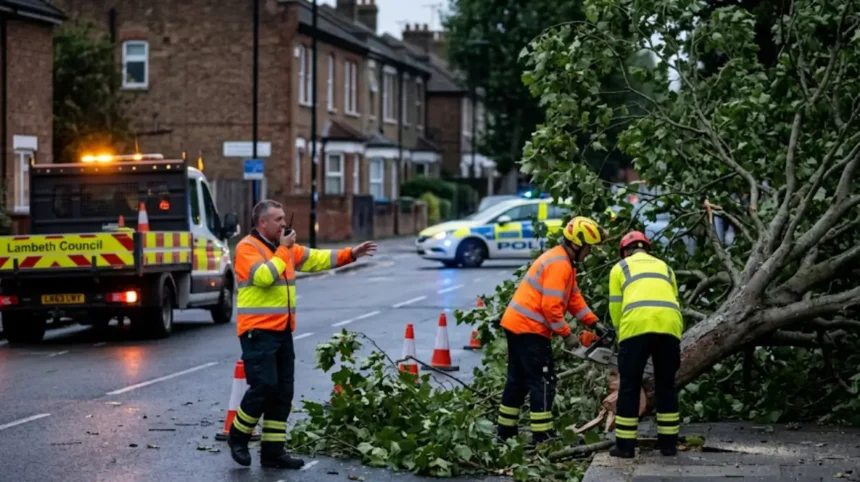
Call 020 7926 1000 for dangerous tree emergencies in Lambeth after 5pm, on weekends, and during bank holidays. This is Lambeth Council’s official 24-hour emergency number for fallen trees, storm damage, and trees blocking roads or highways.
- What qualifies as a dangerous tree that requires emergency reporting?
- How do you report a dangerous tree on public land versus private property?
- What information must you provide when reporting a dangerous tree?
- What happens after you call Lambeth’s dangerous tree hotline?
- Who manages trees on red route main roads in Lambeth?
- What is Lambeth’s tree inventory and inspection system?
- When should you contact the regular trees team instead of the 24-hour emergency hotline?
- What are Lambeth’s tree protection laws and how do they affect reporting?
- How can South London residents help protect public trees in Lambeth?
- What should you do if a dangerous tree blocks your road after a storm?
- What contact options exist beyond the phone hotline for tree problems?
Lambeth Council operates a dedicated emergency response system for tree safety across the borough. The 24-hour hotline connects callers directly to emergency responders who coordinate with tree contractors, police, and Fire Services to clear dangerous trees from public spaces. During office hours (Monday–Friday, 9:00am–5:00pm), call 020 7926 1150 for dangerous structure reports, or 020 7926 9000 for the call centre that transfers to Tree Officers in the Parks Team.
The emergency number handles critical situations including trees that have fallen due to high winds, trees blocking roadways, low-hanging branches threatening public safety, and storm damage requiring immediate clearance. Lambeth has 19,000 street trees and more than 15,000 trees in its parks, all recorded on the council’s tree management database with location, species, size, and condition details.
What qualifies as a dangerous tree that requires emergency reporting?
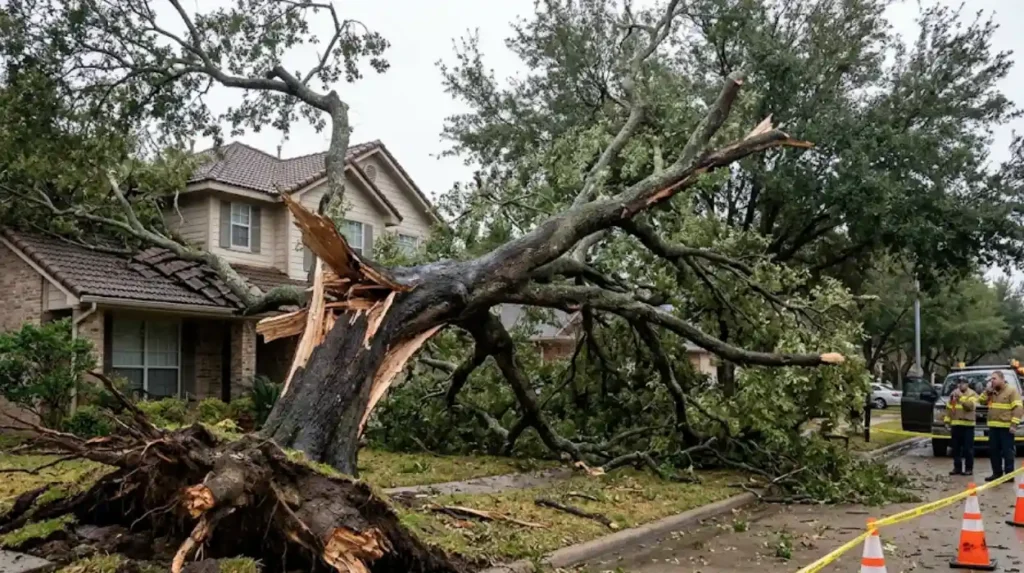
A dangerous tree qualifies for emergency reporting when it presents imminent life-threatening danger: fallen trees blocking roads, large broken hanging branches, extensive decay in the main stem, severed roots allowing the tree to rock, or trees that have partially fallen after storms. Perceived dangers like tall trees or trees swaying in wind do not qualify.
The Council investigates complaints only for imminently dangerous trees at risk of causing life-threatening injury. Trees become imminently dangerous through singular events like storms, floods, or vehicular accidents resulting in partial or complete collapse. Alternatively, trees reach dangerous states through ongoing decay, disease, or structural unsoundness from improper growth patterns.
Specific examples of qualifying dangerous conditions include:
- Large broken branches hanging in the crown of the tree
- Extensive decay present in the main stem or larger branches
- The tree has fallen or partially fallen
- Severed roots allowing an entire tree to rock at soil level
- Branches or branch forks split and unstable due to failure or high winds
- Fungal fruiting bodies present on the tree or around the base
- The tree is clearly dead with severe dieback appearing stag-headed
- Large amounts of deadwood over 50mm in diameter throughout the crown
The Council will not deal with trees where there is only perceived danger, such as tall trees, trees close to buildings, or trees that sway in wind. These trees pose no imminent danger and do not qualify for emergency council intervention.
How do you report a dangerous tree on public land versus private property?
Report dangerous trees on public land (streets, parks, housing estates) directly to Lambeth Council using the emergency hotline. For trees on private property, you must first write to the occupier and tree owner requesting an arboriculturist inspection, then seek mediation or legal advice if they refuse—council does not handle private tree emergencies.
Trees on public property follow distinct reporting paths based on location. For problem trees on streets, contact Lambeth Council’s trees team directly. For trees in parks, use the same reporting system. When reporting emergencies like storm damage, fallen trees, or low-hanging branches on public land, call 020 7926 3542 for the trees team during operational hours.
For trees on housing estates in communal areas used by multiple tenants (communal front/rear gardens, open land surrounding housing blocks), contact the appropriate area housing office with detailed information about the tree location and condition. Tree officers inspect all trees on council-owned housing estates in communal areas and perform necessary maintenance on regular works cycles.
Trees on private land follow a completely different process under the duty of care. Landowners (or sometimes tenants) are responsible for tree safety. The recommended steps are:
- Write to the occupier and tree owner sharing concerns and requesting an arboriculturist inspection
- If that fails, seek advice from an independent arboriculturist or third-party mediation
- If mediation fails, consider legal advice including potential court injunctions requiring the owner to deal with the tree
You can obtain landowner details from the Land Registry. The Council is not responsible for any trees on non-council-owned or private land, and neighbour tree problems must be taken up directly with the neighbour.
What information must you provide when reporting a dangerous tree?
You must provide three essential pieces of information: what the problem with the tree is, the exact location of the tree, and your contact details (telephone number or email address). Include specific details about the danger, precise street/address location, and how responders can reach you for follow-up.
Lambeth Council requires specific information to process dangerous tree reports effectively. The council’s reporting system needs clear problem descriptions including the type of damage, decay, or obstruction. Exact location details must include street name, nearest address, park name, or specific landmark for accurate responder dispatch.
Your contact information enables the council to confirm receipt of your report, provide updates on response timelines, and request additional information if needed. Include both telephone number and email address for maximum contact flexibility.
Additional helpful information includes:
- Time of day the problem was observed
- Whether the tree is blocking a road, highway, or pedestrian path
- Size and species of the tree if known
- Whether the tree fell during recent storm conditions
- Any visible injuries or property damage already caused
- Photos of the dangerous condition (if reporting online)
For emergency situations involving protected trees with Tree Preservation Orders (TPO), written notice must include the location, species of the tree, TPO number, the threat, and justification for work. This notice requires five days advance written communication emailed to planningconservation@lambeth.gov.uk.
What happens after you call Lambeth’s dangerous tree hotline?
After calling the hotline, Lambeth Council works closely with tree contractors, police, and Fire Services to clear the tree from roads and maintain traffic flow. Emergency responders assess the situation, coordinate removal operations, and ensure public safety during clearance operations.
The emergency response process follows a coordinated sequence. When you call the 24-hour number (020 7926 1000) after 5pm, the call connects to emergency responders who immediately assess the situation’s severity. For calls during office hours before 5pm, the call centre (020 7926 9000) transfers you to Tree Officers in the Parks Team who evaluate the emergency.
Response teams work with multiple agencies:
- Tree contractors perform the physical removal and clearance work
- Police manage traffic control and road safety during operations
- Fire Services assist with complex removals or situations involving property damage
The council clears fallen trees blocking roads or highways to keep traffic moving. For large fallen trees, the trunk transports to one of Lambeth’s parks. Tree timber serves as important habitat for rare UK wildlife including stag beetles. Smaller branches are chipped into mulch for parks or reused by contractors.
Lambeth Council ensures fallen trees are cleared from public highways, recycled appropriately, and replaced as part of storm season management. The council’s Urban Forest Strategy outlines measures to plant more than 5,000 trees in highways, estates, parks, open spaces, and churchyards over three years to increase canopy cover by 5% as advised by the Mayor of London.
Who manages trees on red route main roads in Lambeth?
Trees on red route main roads in Lambeth are managed by Transport for London (TfL), not Lambeth Council. Call TfL on 0343 222 1234 or submit an online enquiry to report dangerous trees on these main roads marked with red line markings.
Red routes are certain main roads in Lambeth identified by red line markings along them. Lambeth Council explicitly does not maintain trees on red routes. This responsibility falls entirely to Transport for London as part of their main road management duties.
When you identify a dangerous tree on a red route, contact TfL directly using their dedicated phone number 0343 222 1234. Alternatively, submit an online enquiry through TfL’s website system. Provide the same essential information: problem description, exact location, and your contact details.
Common red route roads in Lambeth include major thoroughfares that connect central London with outer boroughs. These roads receive higher traffic volumes and require specialized maintenance coordination. The red line markings indicate no-stopping zones and signify TfL jurisdiction over street infrastructure including trees.
What is Lambeth’s tree inventory and inspection system?
Lambeth maintains 19,000 street trees and over 15,000 park trees, plus 24,000 trees on housing estates. All trees are recorded on the council’s tree management database and inspected on cyclical basis by skilled tree officers who manage risk through pruning when necessary.
The borough’s tree inventory represents significant urban forest assets. Street trees total 19,000 across all Lambeth roads. Park trees exceed 15,000 in the council’s park system. Housing estates contain over 24,000 trees in communal areas.
Each tree is recorded on the council’s tree management database listing location, species, size, and condition. This comprehensive database enables systematic cyclical inspection programs. Tree officers inspect all trees on council-owned housing estates in communal areas used by multiple tenants. All trees receive necessary maintenance on regular works cycles.
The council prefers leaving trees to grow to full height and maturity where possible. Pruning occurs to manage risk, deal with statutory nuisance, or benefit tree health. This approach supports the Urban Forest Strategy’s goal of increasing canopy cover by 5%, with benefits valued at £132 million including air pollution absorption, storm water runoff reduction, and carbon storage.
During the winter planting season, Lambeth planted 1,728 trees from various species to boost biodiversity and increase canopy cover. By April 2025, the council planted more than 1,700 new trees in parks, estates, and neighbourhoods. By the start of National Tree Week 2025, 11,809 trees were planted including 4,500 mature trees (3–4 meters tall) and 7,300 young trees or whips, exceeding the 5,000 tree target more than double.
When should you contact the regular trees team instead of the 24-hour emergency hotline?
Contact the regular trees team on 020 7926 3542 for non-emergency tree maintenance needs like low-hanging branches requiring routine trimming, trees needing general maintenance assessment, or concerns about council-owned tree condition. Use the 24-hour emergency hotline only for immediate dangers: fallen trees blocking roads, storm damage, or life-threatening situations.
The regular trees team handles routine maintenance requests and non-emergency concerns. Call 020 7926 3542 when you need to report emergencies like storm damage, fallen trees, or low-hanging branches during operational hours. This number connects directly to the trees team for faster response than the general call centre.
For non-emergency tree concerns, contact the council providing detailed information including location and tree size. A team member will investigate your concern.Examples of appropriate regular team calls include:
- Trees needing routine maintenance assessment
- Low-hanging branches not posing immediate danger
- General concerns about tree condition requiring inspection
- Trees needing pruning for health benefits rather than risk management
The 24-hour emergency hotline (020 7926 1000) serves only after 5pm, on weekends, and during bank holidays for critical situations requiring immediate response. Daytime emergency calls before 5pm go through the call centre (020 7926 9000) which transfers to Tree Officers.
For general park enquiries, use telephone 020 7926 9000. This connects to the Parks and Green Spaces team for non-emergency park-related tree issues.
What are Lambeth’s tree protection laws and how do they affect reporting?
Some trees are legally protected by Tree Preservation Orders (TPO) or conservation area designations. For emergency work on protected trees, the council requires five days written notice including location, species, TPO number, threat, and justification emailed to planningconservation@lambeth.gov.uk. Check for TPO protection before proposing any tree work.
Tree Preservation Orders legally protect specific trees from unauthorized felling or work. Trees within conservation areas also receive legal protection. These protections apply regardless of whether trees are on public or private land. Before proposing felling or work on any tree, check whether protections exist.
For emergency situations involving protected trees, regulations require the council receives five days notice in writing of any emergency TPO works. This written notice must include:
- Location of the tree
- Species of the tree
- TPO number (if applicable)
- The threat posed by the tree
- Justification for the work
Email this notice to planningconservation@lambeth.gov.uk.
Lambeth maintains records of all trees covered by Tree Preservation Orders. These records are accessible through the council’s planning pages. Protected trees receive the same inspection and maintenance cycles as unprotected trees, but work authorization requires additional approval steps.
The Arboriculture Association provides online guidance on trees and the law, including TPO regulations and legal requirements for tree work. Landowners should consult this guidance before undertaking any tree work on protected trees.
Explore More Help & Resources
How to report a tree blocking street lights in Kingston
How to report overhanging vegetation in Greenwich online
How can South London residents help protect public trees in Lambeth?
Residents must not attach or hang anything on street, park, or housing estate trees including posters, banners, decorations, lights, swings, or ropes. These items damage bark, bend branches and trunks, increase disease vulnerability, and can make trees unstable or kill them. Attachment without permission violates Lambeth Parks Byelaws.
Public trees belong to the community and require collective protection. Attachments damage tree bark or bend branches and trunks, making trees more vulnerable to disease and potentially causing instability or death. Seemingly innocent items like posters, banners, decorations, lights, swings, or ropes (including tightropes or flatlines for climbing) all cause harm.
Attaching anything to council trees without prior permission violates Lambeth Parks Byelaws. Only authorized council officers or contractors can attach items like tree work notices. Any unauthorized items attached to or hanging from public trees will be removed without notice and disposed of.
Helping trees prosper supports Lambeth’s environmental goals. The urban forest canopy provides benefits valued at £132 million through air pollution absorption, storm water runoff reduction, and carbon storage. Native species are most wildlife-friendly—London native trees and wildlife share relationships going back hundreds of years.
Volunteers, staff, and partners can participate in tree guardianship programs. Email treeguardians@lambeth.gov.uk to get involved in tree planting and maintenance initiatives. The council celebrated National Tree Week by inviting primary school pupils to plant new trees in Brockwell Park, demonstrating community engagement in urban forest expansion.
What should you do if a dangerous tree blocks your road after a storm?
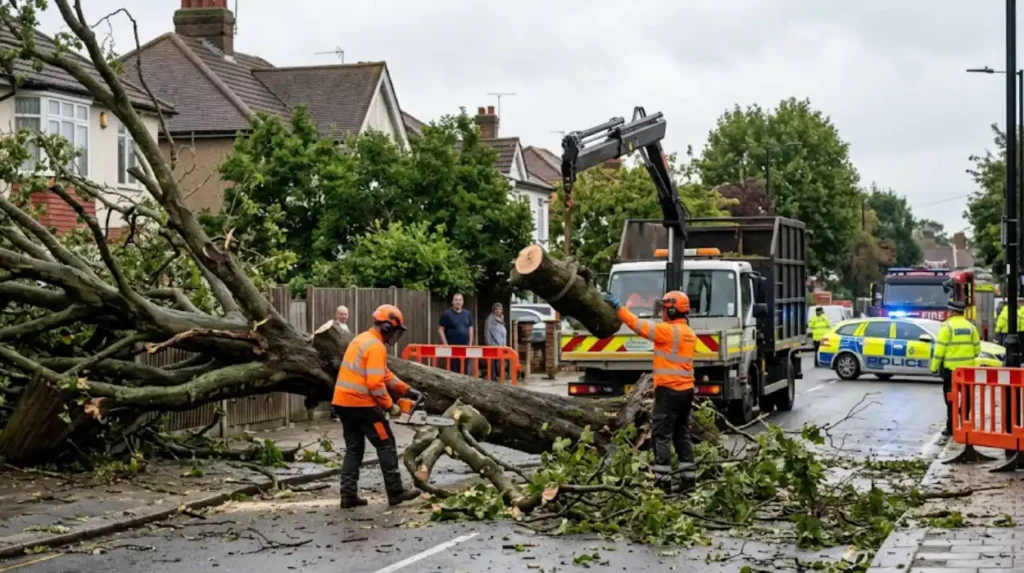
Call Lambeth’s 24-hour emergency number 020 7926 1000 immediately if a storm-fallen tree blocks your road. After 5pm, weekends, or bank holidays, this number connects directly to emergency responders. Before 5pm, call 020 7926 9000 for call centre transfer to Tree Officers. Work crews coordinate with police and Fire Services to clear the tree and maintain traffic flow.
Storm season brings fallen trees requiring emergency clearance. When high winds cause trees to fall blocking roads or highways, this constitutes an emergency requiring immediate council response. The emergency team works closely with tree contractors, police, and Fire Services to clear trees from roads and keep traffic moving.
Recent storms have caused significant tree damage across the UK. Storms Arwen and Barra (2021), Darragh (2024), and Éowyn (2025) damaged millions of trees resulting over 1 million m³ timber loss. Storm Bert in November 2024 caused over 150mm rainfall in upland south Wales and Dartmoor, with widespread road flooding and numerous fallen trees reported.
Lambeth Council’s storm response includes clearing fallen trees from public highways, recycling tree material, and replacing lost trees. Large tree trunks transport to parks where timber serves as wildlife habitat. Smaller branches become mulch for parks or contractor reuse. This year alone, Lambeth plants around 500 trees to help meet the Mayor of London’s 5% canopy cover increase target.
The council plants trees from various species to boost biodiversity. During winter 2024 planting season, 1,728 trees were planted. By November 2025, 11,809 trees exceeded the 5,000 target more than double, including 4,500 mature trees and 7,300 young trees.
What contact options exist beyond the phone hotline for tree problems?
Beyond phone contact, report tree problems online through Lambeth Council’s website using “Problem with tree on a street” or “Problem with tree in a park” links. For protected tree emergencies, email planningconservation@lambeth.gov.uk with five days written notice. General park enquiries use 020 7926 9000 or online contact forms.
Lambeth Council provides multiple contact channels for tree-related issues. The primary online reporting system includes dedicated links for street tree problems and park tree problems. These online forms capture the required information: problem description, exact location, and contact details.
For tree guardianship program participation, email treeguardians@lambeth.gov.uk. This connects volunteers with tree planting and maintenance opportunities. The council invites community members to participate in National Tree Week events and regular planting activities.
For general park enquiries regarding maintenance or operational issues, contact Lambeth Landscapes via parks@lambeth.gov.uk or telephone 020 7926 9000. This handles non-emergency park tree concerns.
Protected tree emergency notices require email submission to planningconservation@lambeth.gov.uk with the mandatory five-day written notice including location, species, TPO number, threat, and justification.
For dangerous structures (separate from trees), call 020 7926 1150 Monday–Friday 9:00am–5:00pm, or 020 7926 1000 for all other times. This same 24-hour number serves both dangerous structures and tree emergencies after business hours.
Transport for London manages red route tree problems. Contact TfL at 0343 222 1234 or submit online enquiries through their website for trees on main roads with red line markings.
What is Lambeth Council’s emergency number for dangerous trees?
Call 020 7926 1000 after 5:00pm, on weekends, and during bank holidays to report dangerous trees requiring an emergency response.