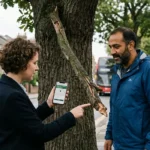
You report tree damage to pavements in Merton by submitting an online report at merton.gov.uk/reportsort or calling 020 8274 4901 (option 6). The report goes to Merton Council’s Highways team, which inspects and repairs council-owned tree root damage to footways.
- What is tree damage to pavements and why does it matter in Merton?
- Who is responsible for tree damage to pavements in Merton?
- How do you report tree damage to pavements in Merton?
- What information do you need to report tree damage successfully?
- What happens after you report tree damage to pavements?
- How long does it take to repair tree damage to pavements in Merton?
- What repair methods does Merton Council use for tree root pavement damage?
- Can you claim compensation for tree damage to pavements in Merton?
- What examples show tree root pavement damage in Merton?
- How do you prevent future tree damage to pavements in Merton?
- When should you contact Merton Council’s Street Trees team instead of Highways?
Tree roots lifting pavement creates trip hazards for pedestrians in South London. Merton Council manages street trees across borough areas including Mitcham, Morden, Raynes Park, South Wimbledon, and Collier’s Wood. Understanding the correct reporting procedure ensures your safety concern gets addressed by the responsible team.
What is tree damage to pavements and why does it matter in Merton?
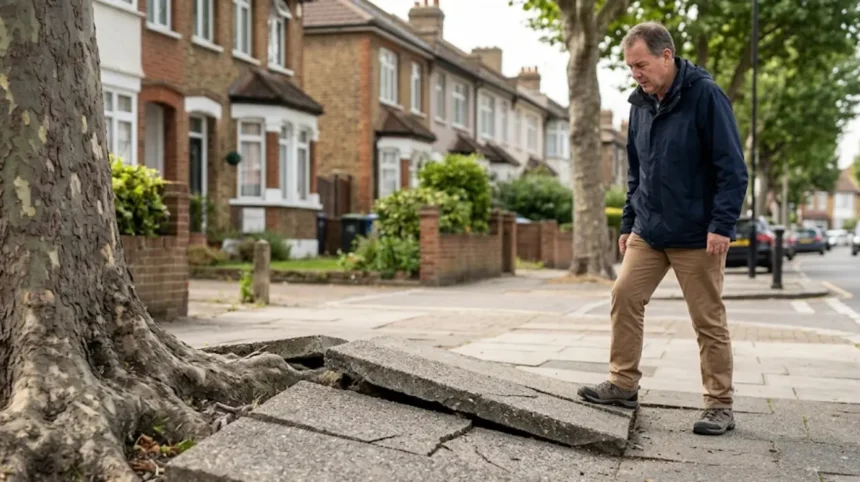
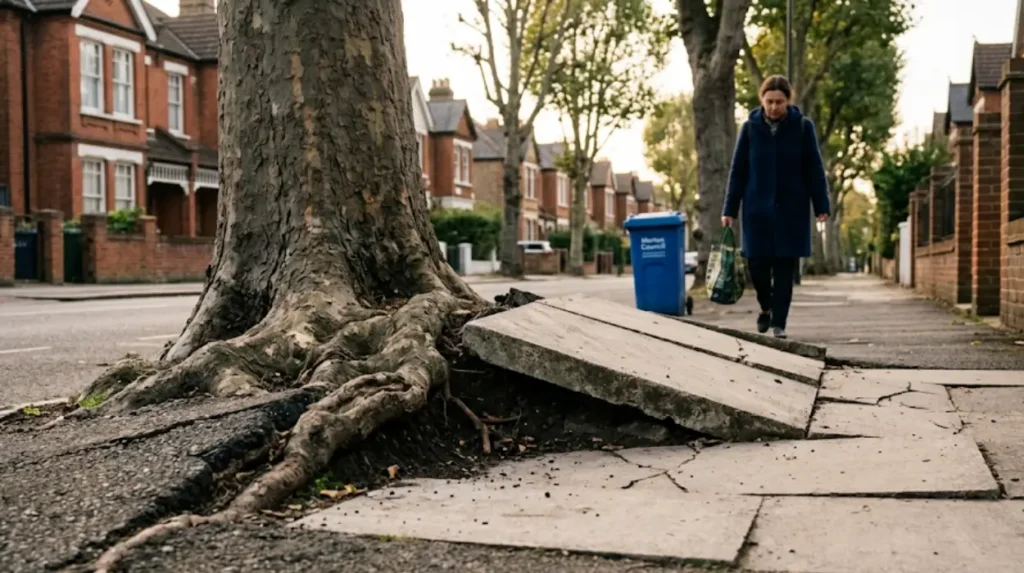
Tree damage to pavements occurs when tree roots grow beneath footways and lift, crack, or break the surface. This creates trip hazards that endanger pedestrians, including elderly residents and people with mobility devices. Merton Council treats this as a highways safety issue requiring repair.
Tree roots follow water and soil nutrients, often spreading wider than the tree’s canopy. When roots encounter pavement substrates, they grow upward and exert pressure that fractures tarmac and concrete. The London Borough of Merton contains thousands of street trees planted over decades. Older trees without root barriers pose higher pavement damage risk.
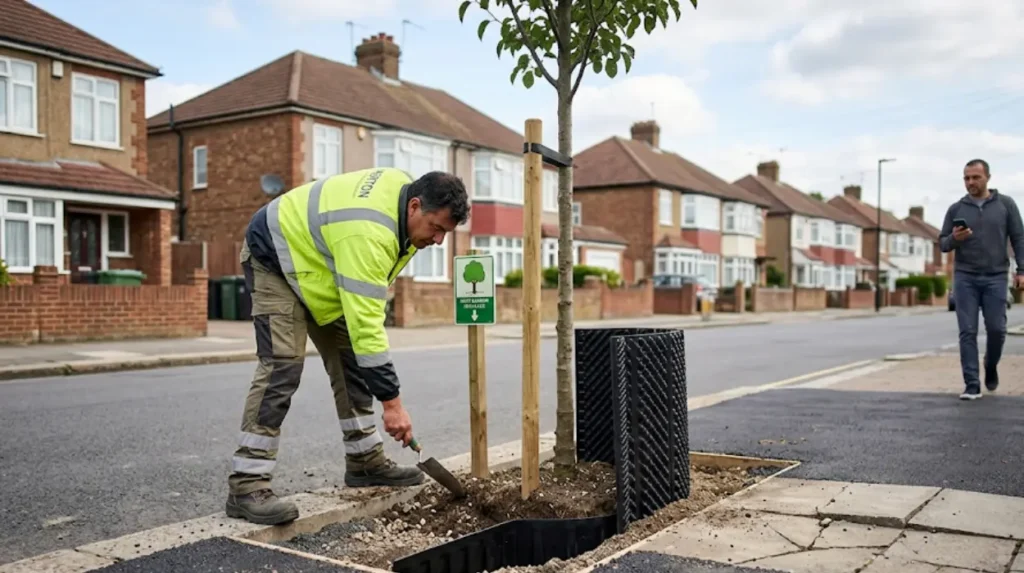
The council installed root barriers when planting new street trees to prevent future damage. Root barriers guide roots downward instead of sideways. This practice began as standard procedure for new tree planting across Merton. Existing older trees lack this protection, making their root systems more likely to damage pavements.
Pavement damage from tree roots creates measurable safety risks. Pedestrians face increased fall probability on uneven surfaces. Wheelchair users and mobility scooter riders encounter navigation barriers. The council’s access issues guidance identifies pavement damage as a critical accessibility problem requiring reporting and repair.
Who is responsible for tree damage to pavements in Merton?
Merton Council’s Highways team owns responsibility for repairing pavement damage caused by council-owned street trees. Private tree owners pay for repairs when their trees damage public pavements. The council does not compensate for damage from private trees.
The London Borough of Merton manages street trees as public infrastructure. Council-owned trees include those planted along roads, in parks, and on public land. The Highways team maintains footways and handles root-related pavement repairs.
Private tree owners hold liability for pavement damage from their trees. When roots from a garden tree cross property boundaries and damage public footways, the property owner pays repair costs. This applies to roots accessing drains, sidewalks, and roads adjacent to private properties.
The council does not accept responsibility for roots accessing drains within adjacent gardens. Services deemed unfit for purpose accept root ingress without compensation. This policy excludes the council from liability for drainage damage from street tree roots.
Transport for London (TfL) manages Red Route trees including A316 and A205. Reports about trees on Red Routes get passed to TfL. Merton Council does not handle pavement damage on these designated roads.
How do you report tree damage to pavements in Merton?
Report tree damage to pavements online at merton.gov.uk/reportsort or call 020 8274 4901 and select option 6. The “Report it! Sort it!” system launched in September 2025 combines all neighbourhood issue reporting into one platform. Your report goes directly to the Highways team for investigation.
The online reporting process requires four steps. First, enter your postcode, street name, or area. Second, locate the problem on the interactive map. Third, enter detailed problem description including tree location and pavement damage type. Fourth, confirm the report for council investigation.
You should provide specific location details when reporting. Include the street name, nearest house number, and exact pavement section. Describe the damage type: lifting, cracking, breaking, or uneven surfaces. Mention visible tree roots if present.
Photos strengthen your report significantly. The council’s access issues page requests photos, videos, or voice messages with details. Clear images show damage severity and help prioritise repair work. Take photos from multiple angles showing the affected pavement section.
The phone alternative works for residents without internet access. Call 020 8274 4901 and choose option 6 for neighbourhood issues. The operator records your report and forwards it to the Highways team. Provide the same location and damage details as the online form.
FixMyStreet offers an alternative reporting platform for Merton Council. This independent service connects residents with local councils for street problem reporting. You locate the problem on a map and enter details. Merton Council investigates reports submitted through this platform.
What information do you need to report tree damage successfully?
You need the exact location (postcode or street name), damage description (lifting, cracking, root visibility), and photos of the affected pavement. Include your contact details for follow-up. Specific location details help the Highways team find and assess the problem quickly.
Precise location information prevents inspection delays. Provide the street name, nearest address, and specific pavement section. Mark the location on the map during online reporting. Include postcode details if available.
Damage description details help prioritise repairs. Specify whether pavement is lifting, cracking, breaking, or creating uneven surfaces. Note visible roots protruding above the surface. Mention trip hazard severity for pedestrians.
Contact details enable council follow-up. Include your name, phone number, and email address. The Highways team may contact you for additional information or to confirm inspection timing.
Photos provide visual evidence of damage severity. Capture multiple angles showing the full affected area. Include close-ups of visible roots and wider shots showing pavement context. Clear images help assessors determine repair urgency.
What happens after you report tree damage to pavements?
After reporting, Merton Council’s Highways team investigates your report. They inspect the site to confirm tree ownership and damage cause. If the tree is council-owned and roots caused damage, the council arranges repairs. You may receive contact via email or phone for additional information.
The inspection process follows standard timelines. The Highways team visits the reported location to assess damage. Inspectors verify tree ownership and confirm root-caused damage. They determine whether remedial action is required under health and safety guidelines.
Tree inspection outcomes determine next steps. If the tree requires remedial action, the council schedules root pruning or pavement modification. The council may mark tree pits larger or install flexible surfaces around trees. These measures stop further pavement damage.
When root pruning and surface modifications fail, the council considers tree removal. This occurs only when all other options fail to make the pavement safe. Tree removal happens to maintain pedestrian safety and pavement usability.
Report status tracking works through the online platform. You use merton.gov.uk/reportsort to check your report’s progress. The system shows investigation status and repair scheduling. Update notifications appear when the council completes work.
Emergency situations receive faster response. Trees or branches blocking pavements after 5pm Monday-Friday, or on weekends and public holidays, require emergency calls. Contact the emergency number for immediate pavement obstruction removal.
How long does it take to repair tree damage to pavements in Merton?
Repair timelines vary based on damage severity and council workload. Non-emergency tree inspections occur within 28 days. If work is necessary, the council informs you of a completion timeframe. Emergency pavement obstructions get dealt with quickly after emergency calls.
The 28-day inspection standard applies to non-emergency tree problems. The council inspects reported trees within this period when no immediate risk exists. After inspection, work necessity determines scheduling. Required work gets a completion timeframe notification.
Emergency responses happen faster than standard inspections. Pavement-blocking trees or branches after 5pm or on weekends trigger emergency protocols. The emergency number ensures quick dealing with obstructions.
Root pruning permit processes add time when required. Some sidewalk repairs need root pruning permits before root exposure. Tree inspectors visit within two full business days after permit application to mark cuttable roots.
Council workload affects repair scheduling. The Highways team handles multiple neighbourhood issues simultaneously. Street cleaning services, safer neighbourhood teams, and pavement repair teams work across the borough. Peak periods may extend waiting times.
Seasonal factors influence repair timing. Autumn leaf fall and spring conditions affect pavement visibility and worker safety. The council may schedule repairs during favourable weather conditions.
What repair methods does Merton Council use for tree root pavement damage?
The council uses root pruning, marking larger tree pits, installing flexible surfaces around trees, and pavement modification. When these methods fail, tree removal occurs. Root barriers prevent future damage when planting new trees.
Root pruning removes specific roots causing pavement damage. Tree inspectors mark roots for cutting with orange spray paint before removal. This method targets problematic roots while maintaining tree health.
Marking tree pits larger creates space around tree bases. This reduces root pressure on adjacent pavement sections. Larger pits accommodate root growth without upward pavement displacement.
Flexible surfaces around trees replace rigid pavement materials. These surfaces accommodate root movement without cracking. Flexible materials reduce trip hazards while maintaining tree access to soil.
Pavement modification changes the surface to eliminate tripping hazards. The council adjusts pavement height or texture around root areas. This maintains pedestrian access while accommodating existing roots.
Tree removal occurs when all other methods fail. The council removes trees only to make pavements safe and usable. This represents the final option when root damage cannot be managed otherwise.
Root barriers prevent future damage in new tree planting. These barriers guide roots downward instead of sideways. The council now installs root barriers as standard practice for new street trees.
Can you claim compensation for tree damage to pavements in Merton?
The council does not compensate for pavement damage from street tree roots unless they prove fault. You must provide evidence including repair quotations and prove council fault under Public Liability Insurance. No automatic right to compensation exists.
Compensation claims require substantial evidence submission. You need two repair quotations ideally to proceed with claims. Proof of council fault is mandatory under Public Liability Insurance policy.
Evidence requirements include photographs of damage, exposed tree roots, and botanical analysis. You excavate inspection pits adjacent to damage to reveal tree roots. Botanical identification establishes whether roots come from council-owned trees.
The council does not compensate for specific damage types. Root access to drains receives no compensation due to unfit service purpose. Autumn leaf fall, spring petals, fruit fall, seed deposits, and sap droppings receive no compensation as natural seasonal occurrences.
Shade or loss of light caused by trees does not qualify as legal nuisance. Damage to privately owned vegetation receives no compensation. The council cannot remediate growth causing private vegetation damage.
Private tree owners hold full liability for their tree damage. The council does not compensate or remediate damage from private trees. Property owners pay all repair costs for their tree’s pavement damage.
What examples show tree root pavement damage in Merton?
Real Merton examples include tree roots lifting pavement on Aragon Road in Lower Morden, creating dangerous trip hazards. Residents reported the dangerous root for weeks before removal made the area safer. Claremont Avenue in West Barnes shows loose street tree support causing pavement issues.
Aragon Road in Lower Morden experienced significant root damage. Tree roots lifted pavement creating dangerous walking conditions. Residents made multiple requests over weeks before the dangerous root got removed. The removal improved safety for that pavement section.
Claremont Avenue in West Barnes shows new street tree support problems. The support at address 39 became loose, affecting pavement conditions. This report received updates showing council investigation progress.
FixMyStreet contains multiple Merton tree root reports. One 2021 report documented tree roots lifting pavement and damaging private property. The council inspected the tree and added it to ongoing pruning programme. Remedial action wasn’t deemed necessary under health and safety guidelines, but pruning scheduled within three months.
South London areas show similar patterns. Richmond upon Thames Council confirms pavement damage from tree roots gets reported to Highways teams. Root barriers now install with new tree planting to prevent future damage. This practice matches Merton’s approach.
Lewisham Council reports tree roots damaging public footpaths get sent to highways teams. Housing estate footpaths within Lewisham get reported on resident portals. This shows consistent Highways team responsibility across South London councils.
Explore More Help & Resources
How to report a dangerous tree to Lambeth’s 24hr hotline
How to report a tree blocking street lights in Kingston
How do you prevent future tree damage to pavements in Merton?
New street trees in Merton now include root barriers that guide roots downward. For existing trees, the council monitors through ward-by-ward surveys to mitigate root damage risk. Residents report新问题 immediately when they appear to enable faster response.
Root barriers represent the primary prevention method. These barriers installed during new tree planting guide root growth downward. This prevents sideways root expansion that lifts pavements. The council now installs root barriers as standard procedure.
Ward-by-ward surveys monitor existing tree risks. These surveys assess street trees for potential property and infrastructure damage. The council uses survey data to prioritise pruning programmes and preventive maintenance.
Ongoing pruning programmes address identified risks. Trees added to pruning schedules receive scheduled works within specified timeframes. This proactive approach prevents damage escalation.
Immediate reporting enables faster council response. Residents should report new pavement damage when they notice it. Early reporting prevents damage worsening and reduces trip hazard duration.
Regular pavement inspection by residents helps identify early problems. Look for lifting edges, cracks, or visible roots. Report problems before they become severe trip hazards.
Community awareness reduces damage severity. Residents who understand tree root behaviour recognise early warning signs. Sharing knowledge about reporting procedures helps neighbouring residents act quickly.
When should you contact Merton Council’s Street Trees team instead of Highways?
Contact the Street Trees team at StreetTrees@merton.gov.uk or the Report It page for fallen trees on roads or parks. The Highways team handles pavement damage from tree roots. Different tree problems require different council teams for proper response.
The Street Trees team manages fallen and damaged trees after storms. Storm Henk response in January 2024 showed Street Trees handling road and motorway trees. They prioritised trees on roads and motorways for quick removal.
Fallen tree reporting uses Street Trees contact details. Email StreetTrees@merton.gov.uk with location and damage description. Visit the Report It page for online fallen tree reporting.
Highways team handles footway damage from living tree roots. Root-lifting pavement, cracking surfaces, and trip hazards go to Highways. This distinction ensures proper team assignment.
Emergency pavement obstructions after 5pm or on weekends require emergency calls. The emergency number ensures quick obstruction removal regardless of team assignment.
Red Route trees on A316 and A205 go to Transport for London. Reports about these roads get passed to TfL with contact details. Merton Council does not handle Red Route tree problems.
Social housing development trees contact housing associations directly. Council reports about these trees get passed to relevant housing associations. Residents contact housing associations for estate tree problems.
Reporting tree damage to pavements in Merton requires using the correct council channel. The “Report it! Sort it!” system at merton.gov.uk/reportsort provides the simplest online method. Phone reporting through 020 8274 4901 (option 6) works for residents without internet access. The Highways team investigates all pavement damage reports and arranges repairs for council-owned tree root damage.
Understanding the reporting process ensures your safety concern gets addressed promptly. Provide specific location details, clear damage descriptions, and photos when reporting. Track your report status through the online platform. The council’s root barrier installation for new trees prevents future damage, while ongoing surveys monitor existing tree risks. Report problems immediately when they appear to enable faster council response and reduced trip hazard duration.
How do I report tree damage to pavements in Merton?
You can report tree damage to pavements by using Merton Council’s online “Report it! Sort it!” service or by calling 020 8274 4901 and selecting option 6. Reports are sent to the Highways team for inspection.