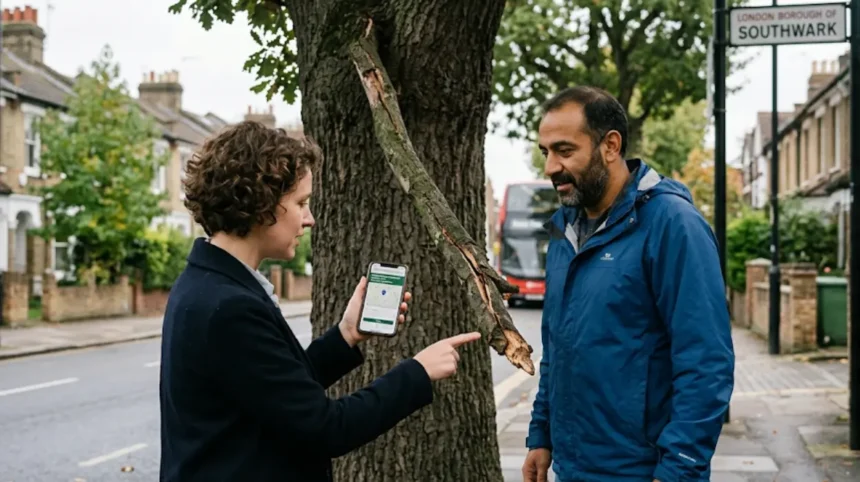
The management of urban forestry within the London Borough of Southwark requires consistent public oversight to mitigate structural risks and preserve public safety. Southwark Council maintains an digital reporting infrastructure specifically designed to process notifications regarding hazardous, diseased, or damaged trees across South London. This public portal serves as the primary mechanism for environmental risk management, enabling residents to submit precise geospatial data, photographic evidence, and structural descriptions directly to municipal arboricultural officers. Navigating this framework efficiently ensures that dangerous biological assets are inspected and remediated in accordance with statutory local government timelines.
Understanding the specific operational boundaries of the Southwark tree hazard portal is essential for community-led asset protection. The system distinguishes strictly between emergency infrastructure failures, standard maintenance requests, and private property liabilities. By using this platform correctly, residents in areas such as Peckham, Bermondsey, Camberwell, and Dulwich actively contribute to the maintenance of the borough’s canopy while keeping public highways, parks, and housing estates safe from preventable tree failures.
What Is the Southwark Tree Hazard Reporting Portal?
The Southwark tree hazard reporting portal is a dedicated digital public infrastructure designed to collect, categorize, and track public reports of structural tree defects within the borough. It serves as the primary mechanism for urban canopy risk assessment.
Definition and Core Infrastructure
The portal is an online transactional interface hosted by Southwark Council. It acts as a direct communications channel to the municipal Trees and Ecology Service team. The backend system functions as a digital triage console, allowing administrative personnel to assign risk categories to reported trees based on user-provided descriptions and visual evidence. The platform forms part of the broader Southwark digital services strategy, which aims to move traditional telephone and paper-based public reporting into automated, geolocated cloud systems.
Historical Context of Urban Forestry in Southwark
Historically, tree management in South London relied on scheduled physical surveys conducted by municipal workers on fixed three-to-five-year cycles. As the urban canopy of Southwark expanded to include more than 85,000 distinct trees across public highways, open spaces, and housing estates, this reactive framework became insufficient. The launch of the digital portal in the 21st century shifted the borough toward a crowd-sourced, real-time monitoring model, lowering administrative response times from weeks to hours during severe weather events.
When Should You Use the Online Reporting Portal?
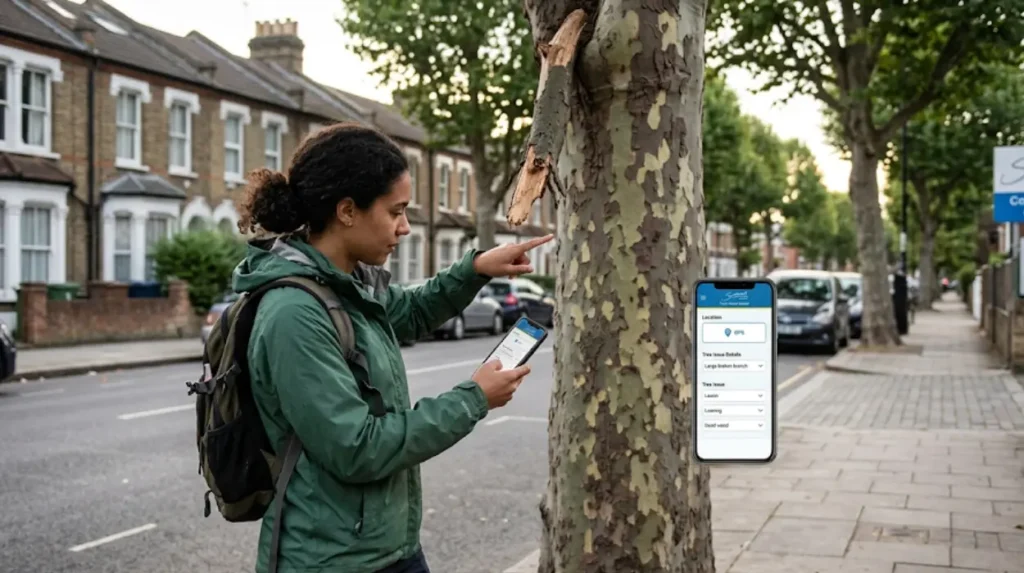
The online reporting portal must be used exclusively for non-emergency tree issues on council-managed land, such as diseased bark, structural cracks, or low-hanging branches. Immediate dangers require telephone reporting instead of the online interface.
Differentiating Emergency Hazards from Standard Issues
The system operates on strict safety parameters. Immediate threats to life or property—such as a completely uprooted tree blocking a main road, hanging limbs caught in overhead power lines, or trunks actively splitting during a storm—must not be reported via the online form. These incidents require an immediate telephone call to the Southwark 24-hour environment hotline on 020 7525 5000. The online portal is designed for issues where a delay of 24 to 72 hours for an initial inspection will not result in imminent physical harm or structural collapse.
Examples of Eligible Tree Hazards
Residents should log an online report when they observe specific biological or mechanical defects on public trees. These include:
- Structural instability: Trees showing ground heave, soil cracking around the root plate, or a sudden, unexplained lean.
- Physical decay: Deep trunk cavities, fungal fruiting bodies (such as bracket fungi growing at the base), or large sections of peeling bark.
- Obstructions: Overgrown low canopy foliage blocking street lighting, obscurement of regulatory traffic signs, or branches physically touching building facades.
- Invasive pests: Visible infestations of dangerous species, specifically Oak Processionary Moth (OPM) nests, which feature distinct white silken webbing webbing and present public health risks.
Explore More Help & Resources
How to report overhanging vegetation in Greenwich online
How to report a dead or leaning tree to Croydon Council
How Do You Determine Tree Ownership and Council Responsibility?
Southwark Council only holds legal responsibility for trees growing on public highways, council housing estates, parks, and schools. Private landowners must manage hazards on their own properties.
Council-Managed Land Categories
Before initiating a report through the digital portal, users must verify that the target tree occupies public land. Southwark Council maintains legal liability for assets within four distinct spaces:
- Public Highways: Trees planted in pavements, pedestrianized streets, and central reservations along borough-maintained roads.
- Parks and Open Spaces: Vegetation located within public recreational areas, including Burgess Park, Peckham Rye Park, and Southwark Park.
- Council Housing Estates: Trees situated within the boundaries of local authority residential complexes, managed in coordination with estate housing teams.
- Learning Institutions: Trees positioned inside the perimeters of community schools and local authority nurseries.
Private Land Regulations
If a hazardous tree is rooted within a private garden, commercial property, or land owned by housing associations, Southwark Council cannot perform direct maintenance. The legal responsibility rests with the freeholder or tenant under the Occupiers’ Liability Act 1984. When an overhanging tree from private land blocks public rights of way, the council can issue a formal notice under Section 154 of the Highways Act 1980, legally compelling the property owner to remove the hazard within a specified timeframe.
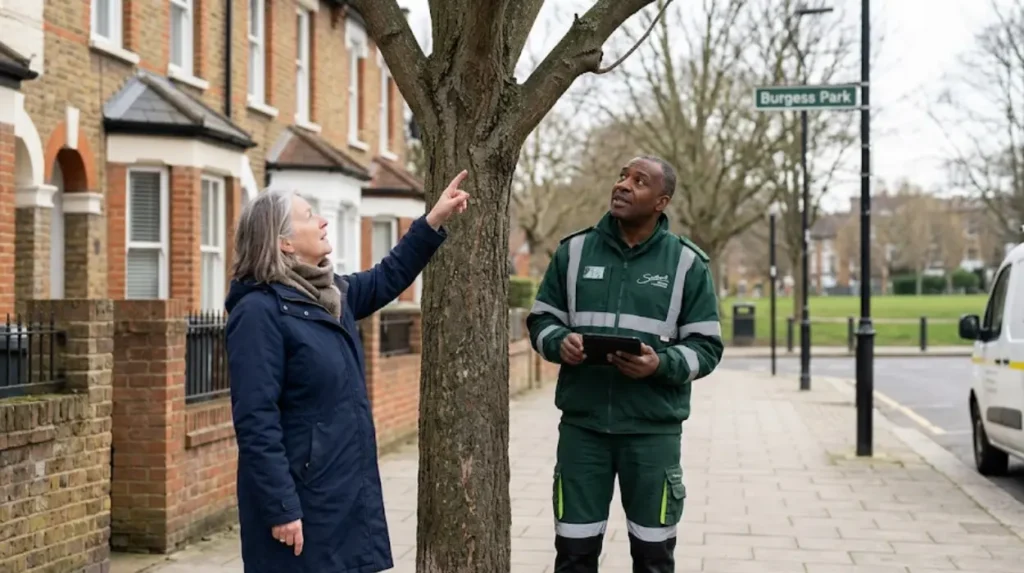
Step-by-Step: How to Submit a Report on the Portal
Submitting a report requires users to log into the Southwark platform, pin the precise location on a map, describe the specific defect, and upload photographic evidence. This structured data enables efficient triage by arboricultural officers.