Key Points
- Legal Challenge Signalled: Lambeth Council has formally expressed its intention to resist the Equality and Human Rights Commission’s (EHRC) updated draft guidance on single-sex spaces, pending legal advice.
- Concerns Over Discrimination: Senior councillors argue that the proposed rules risk leaving transgender, intersex, and gender non-conforming individuals vulnerable to prejudice and exclusion in public facilities.
- Call for Non-Implementation: A motion approved at a Full Council meeting instructed council officers to determine if refusing to implement the guidelines is legally viable.
- Focus on Workplace Policy: Alongside potential non-implementation, the council pledged to draft an internal policy safeguarding dignity and privacy for trans workers and service users.
- Follows Supreme Court Ruling: The draft guidance stems from a Supreme Court judgment determining that “sex” under the Equality Act 2010 refers to biological sex at birth.
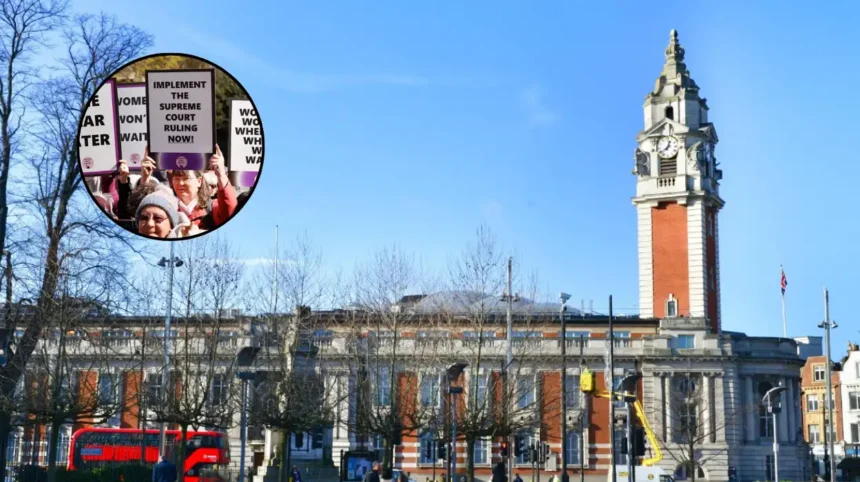
Lambeth (South London News) July 27, 2027 – Lambeth Council has signalled it will resist new guidance on access to single-sex spaces, over fears that it risked “leaving trans people open to discrimination”.Councillors backed a call for the council to refuse to implement the
“Draft Code of Practice on Services, public functions and associations”,
if the council’s legal team confirms the move would be lawful.
The Equality and Human Rights Commission (EHRC) published the updated code following a Supreme Court judgment last year, ruling that “sex” in the Equality Act 2010 refers to sex assigned at birth.
The draft clarifies that service providers may legally restrict single-sex spaces, including changing rooms, to biological sex.
However, as detailed in reports, a motion presented to a Full Council meeting condemned the draft code as
“incoherent and self-contradictory, discriminatory, and impossible to implement in a reasonable and proportionate manner”.
The approved motion formally called on the local authority to “protect LGBTQIA+ workers and service users” by refusing to implement the updated national guidelines.
Why is Lambeth Council objecting to the EHRC draft guidelines?
According to statements released by the local authority, senior council leadership believes the proposed restrictions could lead to severe harm for marginalized communities using local services.
As reported by Love Lambeth, Cllr Natalie Kane, Deputy Leader and Cabinet Member for Inclusion, Democracy and Culture, stated that the guidelines would have
“significant negative impacts for many across the borough, in the first instance the LGBTQIA+ community”.
Expanding on these concerns, Cllr Kane stated:
“For trans, intersex and gender non-conforming individuals, as well as those men and women who do not fit normative social representations of gender, these guidelines present the danger of discrimination and prejudice in the spaces where we should be prioritizing care, support and service provision.
“When residents access our public services, they should not be concerned about how their gender is perceived, but how we provide the very best service for them, every step of the way.
“Trans women are women, trans men are men, Trans rights are human rights. Let us work together to build a Lambeth that is fair, equitable, and just.”
The formal motion instructed council officers to examine the legality of withholding implementation. Specifically, officers were directed
“to proceed with non-implementation should officers advise that this is a lawful option”.
In addition to challenging the external guidance, elected members endorsed a plan for Lambeth Council to construct its own dedicated workplace and service provision framework.
This local policy will be designed to “protect and champion transgender and non-conforming people’s right to basic dignity and respect for their private life” across all council facilities.
Background of the particular development
The dispute originates from long-standing legal debates surrounding the Equality Act 2010 and the definition of single-sex exceptions.
In a landmark judgment, the Supreme Court ruled that the term “sex” within the Equality Act 2010 refers specifically to biological sex determined at birth.
Following the judicial outcome, the EHRC was tasked with updating its statutory Code of Practice for Services, Public Functions and Associations to align with the court’s interpretation.
The updated draft code provides guidance for service providers—including local authorities, leisure centres, healthcare facilities, and public venues—on how they can lawfully operate single-sex spaces such as toilets, changing rooms, and shelters.
While supporters of the draft code argue that it establishes vital clarity for maintaining biological single-sex spaces for women, LGBTQIA+ advocacy groups and several public sector organisations have expressed concerns over potential social exclusion.
Lambeth Council’s formal challenge represents one of the first major local authority responses seeking to test whether individual municipalities can legally opt out of implementing the statutory guidance.
Explore More Lambeth Council News
Why Has Lambeth Council Allowed Freight Brixton Unauthorised Operation? Brixton 2026
Lambeth Council and Airbnb Tackle Illegal Subletting, London 2026
Prediction: How can this development affect local authorities, service users, and LGBTQIA+ communities?
If Lambeth Council’s legal team advises that non-implementation is legally permissible, it could create a precedent for other progressive local authorities across the United Kingdom seeking to bypass the EHRC guidance.
This may lead to a fragmented landscape where access rules to public facilities vary significantly by geographical region or local council boundaries.
For service users—particularly trans, intersex, and non-binary individuals—Lambeth’s stance could offer continued access to municipal facilities corresponding with their gender identity.
Conversely, if legal advisers determine that municipal non-implementation breaches statutory duties under national law, the council could face administrative challenges or judicial review actions brought by policy groups seeking strict enforcement of biological single-sex spaces.
Public sector providers nationwide will be closely monitoring the legal outcome in Lambeth to determine the operational viability of local equality policies versus centralized EHRC guidelines.