Lambeth blends history, culture, and modern living through its riverside heritage landmarks, globally influential music and market scenes, and dense network of parks, transport hubs, and work-friendly spaces. The borough stretches from the South Bank cultural quarter down through Brixton, Clapham, and Streatham, offering tourists, residents, digital nomads, and business travellers a compact but varied South London experience.
- What defines Lambeth’s character for visitors and residents?
- Which historic landmarks anchor Lambeth’s identity?
- How does the South Bank express Lambeth’s cultural role?
- What makes Brixton central to Lambeth’s contemporary culture?
- Which museums and galleries showcase Lambeth’s stories?
- How do Lambeth’s parks and commons support everyday life?
- Where can digital nomads and remote workers base themselves in Lambeth?
- How do transport links connect Lambeth to London and beyond?
- What role do neighbourhoods like Clapham, Streatham, and Vauxhall play?
- How does Lambeth balance heritage with modern development?
- What practical tips help visitors experience Lambeth effectively?
What defines Lambeth’s character for visitors and residents?
Lambeth is an inner-London borough on the south bank of the Thames, known for major cultural venues, historic sites, diverse neighbourhoods, and extensive green spaces. It covers under 27 km², houses over 316,000 residents, and contains some of London’s busiest transport interchanges.
Lambeth sits opposite Westminster and the City, extending from Waterloo and Vauxhall in the north to Streatham and West Norwood in the south. The borough combines high-density urban living with large commons and parks, including Clapham Common, Brockwell Park, and Streatham Common. It is one of the most densely populated inner-London boroughs and home to people from over 40 countries, with around 130 languages spoken locally.
The northern edge functions as a major tourist corridor centred on the South Bank, while the southern districts are more residential and suburban in feel. This north–south gradient underpins Lambeth’s dual identity as both a destination for short-stay visitors and a long-term home for diverse communities.
Which historic landmarks anchor Lambeth’s identity?
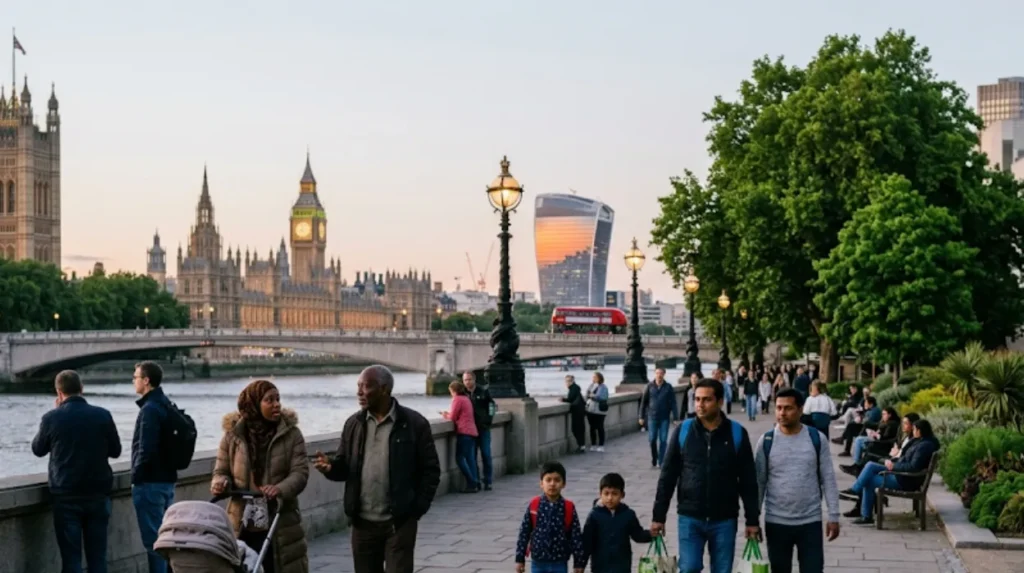
Lambeth’s historic identity centres on Lambeth Palace, the 800-year London residence of the Archbishop of Canterbury, and its riverside setting opposite Parliament. The palace, its gardens, and nearby medieval and Victorian structures form a continuous ecclesiastical and political landscape.
Lambeth Palace occupies a Thames-side plot used by the Archbishop of Canterbury since the 12th century, with the core buildings dating from the 13th century onwards. The Great Gatehouse (Morton’s Tower), built in the 1490s, and the Lollards’ Tower illustrate its layered medieval and early-modern history. The palace library, founded in 1610, holds the principal records of the Anglican Church, and the site hosted the first Lambeth Conference of Anglican bishops in 1867.
Archbishops’ Park, adjacent to the palace, extends this historic setting as public green space managed by Lambeth Council. The palace’s proximity to the Palace of Westminster across the river has made it a venue for royal weddings, treaties, and state ceremonies over centuries. As you explore the modern site, you are crossing land with a deep heritage. Read about the full [history of Lambeth Palace and the Manor of Lambeth] to understand its origins.
Beyond the palace, Lambeth contains historic churches, former market-garden areas, and remnants of riverside industry that shaped its growth from the 18th century onward. Waterloo Station, covering around 10 hectares, is another landmark that defines the borough’s modern identity while sitting on historically significant transport corridors.
How does the South Bank express Lambeth’s cultural role?
The South Bank in Lambeth is London’s densest concentration of public cultural venues, including the Royal Festival Hall, Hayward Gallery, and National Theatre. Developed after the Second World War and expanded for the 1951 Festival of Britain, it functions as a year-round arts and events district.
The Royal Festival Hall, a 2,700-seat concert and talks venue, opened in 1951 as part of the Festival of Britain and remains the flagship building of the Southbank Centre. The Hayward Gallery, Queen Elizabeth Hall, and Purcell Room sit alongside it, hosting visual art, classical music, and contemporary performance. The National Theatre, with its three auditoria, and the BFI Southbank cinema complex extend this cultural cluster into drama and film.
This riverside belt also includes the London Eye, a 135-metre observation wheel that opened in 2000 and has become one of the most visited paid attractions in the UK. The South Bank Centre’s programming, street performances, and seasonal markets create a continuous flow of cultural activity for tourists and Londoners alike.
The Imperial War Museum, located on Lambeth Road, adds a national museum dimension to the borough’s cultural offer, with extensive galleries on the First World War, Second World War, and the Holocaust. Tate Britain, on Millbank, completes the picture by presenting historic and modern British art in a major gallery setting.
What makes Brixton central to Lambeth’s contemporary culture?
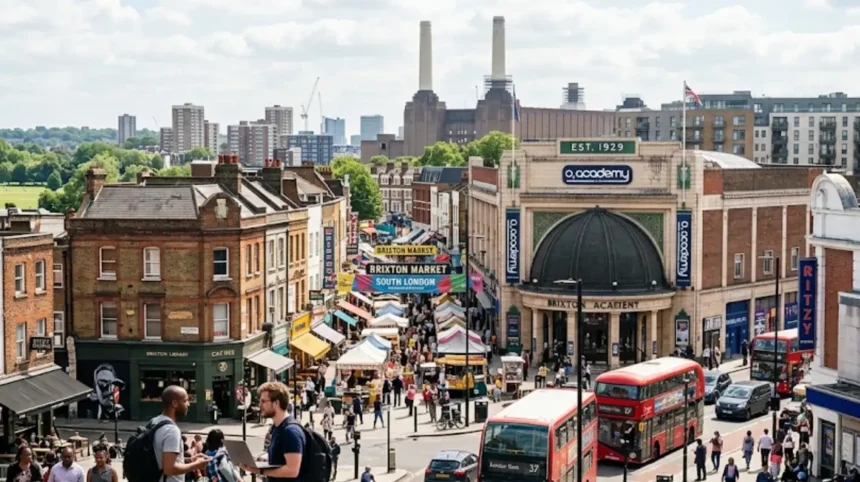
Brixton is Lambeth’s cultural and commercial hub, famous for its market, Afro-Caribbean heritage, music venues, and street art. The area’s identity was transformed by post-war migration, especially after the arrival of the Empire Windrush in 1948.
Brixton Market evolved from a local street market into a covered and semi-covered complex known for Caribbean, African, and global food, fashion, and music. Electric Avenue, one of the first market streets in Europe lit by electricity, remains a focal point, while Brixton Village and Market Row host independent traders and eateries. The Black Cultural Archive and numerous community organisations document and sustain the area’s African and Caribbean history.
Music is integral to Brixton’s identity. The O2 Academy Brixton, originally the Astoria cinema, is one of London’s largest live music venues and has hosted major international acts for decades. Reggae, soul, punk, hip-hop, and electronic scenes have all used Brixton as a base, contributing to its reputation as a birthplace of British urban culture.
Public art and murals, including the David Bowie mural near his birthplace in Station Road, reinforce Brixton’s status as a cultural landmark. The area’s mix of historic buildings, markets, and nightlife makes it a primary destination for tourists seeking an authentic, contemporary South London experience.
Which museums and galleries showcase Lambeth’s stories?
Lambeth’s museums and galleries cover war, art, social history, and specialist topics, with the Imperial War Museum, Tate Britain, and Florence Nightingale Museum as key sites. These institutions provide structured, research-backed narratives for visitors and students.
The Imperial War Museum on Lambeth Road holds over a million collection items and 11 million photographs documenting modern conflict from the First World War to present-day operations. Its recent £30 million redevelopment added extensive Holocaust and Second World War galleries, alongside comprehensive First World War displays featuring weapons, uniforms, diaries, and art.
Tate Britain on Millbank presents the national story of British art from the Tudor period to the present, with rotating exhibitions and a permanent chronological display. The museum’s sculpture garden and riverside setting make it a destination for both art-focused visits and general tourism.
The Florence Nightingale Museum, located within St Thomas’ Hospital near Westminster Bridge, focuses on the life and work of the nursing pioneer and includes artefacts, uniforms, and personal items. Smaller sites, such as the Museum of Garden History in the former St Mary’s Church, Lambeth, add specialist depth on horticulture and local heritage.
How do Lambeth’s parks and commons support everyday life?
Lambeth contains more than 78 parks and open spaces, including Clapham Common, Brockwell Park, and Streatham Common, which support sport, leisure, and nature conservation. These green spaces provide accessible recreation for residents and visitors across the borough.
Clapham Common, at over 85 hectares, is one of London’s largest and oldest public open spaces, with ponds, sports pitches, and tree-lined paths used for jogging, cycling, and team games. Brockwell Park, a Site of Importance for Nature Conservation, features ancient oaks, meadows, a walled flower garden, and Brockwell Lido, an outdoor swimming pool. Streatham Common includes The Rookery, a quiet garden area, and a designated Local Nature Reserve with woodland walks.
Lambeth Council manages numerous smaller parks, such as Kennington Park, Ruskin Park, and Vauxhall Park, many of which have playgrounds, sports facilities, and community gardens. Sixteen Lambeth parks and open spaces have received Green Flag Awards, recognising high standards of maintenance and accessibility.
These spaces are integral to modern living in Lambeth, offering free or low-cost options for exercise, family outings, and community events, and helping to balance the borough’s high urban density.
Where can digital nomads and remote workers base themselves in Lambeth?
Digital nomads and remote workers can use Lambeth’s co-working spaces, cafes, and library hubs near Waterloo, Vauxhall, and Brixton for reliable work environments. The borough’s strong transport links and cultural amenities make it practical for short-term stays and flexible routines.
Co-working venues around Lambeth North, Waterloo, and Vauxhall offer day passes, meeting rooms, and high-speed internet, often with on-site cafes and events for freelancers and startups. Many independent cafes in Brixton, Clapham, and Herne Hill provide Wi-Fi and a quiet atmosphere suitable for laptop work during off-peak hours.
Lambeth Libraries, including the Central Library near Waterloo, provide free Wi-Fi, study spaces, and access to digital resources, supporting students, researchers, and remote professionals. The concentration of transport interchanges means workers can reach central London, the City, or Canary Wharf within minutes, while still basing themselves in a more residential and culturally rich environment.
How do transport links connect Lambeth to London and beyond?
Lambeth is served by major rail and Underground hubs at Waterloo and Vauxhall, plus Overground and National Rail stations across the borough. This network enables fast connections to central London, the South East, and national destinations.
London Waterloo is the largest railway station in the UK by floor area and a key interchange for National Rail services, the Bakerloo, Jubilee, Northern, and Waterloo & City lines, and numerous bus routes. Vauxhall Station provides National Rail, Underground (Victoria line), and bus connections, linking Lambeth directly to Victoria, Oxford Circus, and beyond.
Additional stations such as Brixton, Clapham High Street, Streatham, Herne Hill, and West Norwood connect southern Lambeth to central London and the South Coast. The 77 bus route and other services link Waterloo, Vauxhall, Clapham Junction, and Wandsworth, creating a dense surface transport grid.
This infrastructure supports tourists moving between attractions, commuters living in Lambeth, and business travellers using short breaks between meetings.
What role do neighbourhoods like Clapham, Streatham, and Vauxhall play?
Clapham, Streatham, and Vauxhall provide distinct residential and leisure profiles within Lambeth, from village-like high streets to suburban commons and regenerated riverside quarters. Each area contributes specific amenities and atmospheres to the borough’s overall offer.
Clapham, centred on Clapham Common, is known for its Georgian and Victorian housing, independent shops, and lively high streets such as Clapham High Street and Northcote Road. The common itself supports sports, festivals, and daily recreation, making the area popular with families and young professionals.
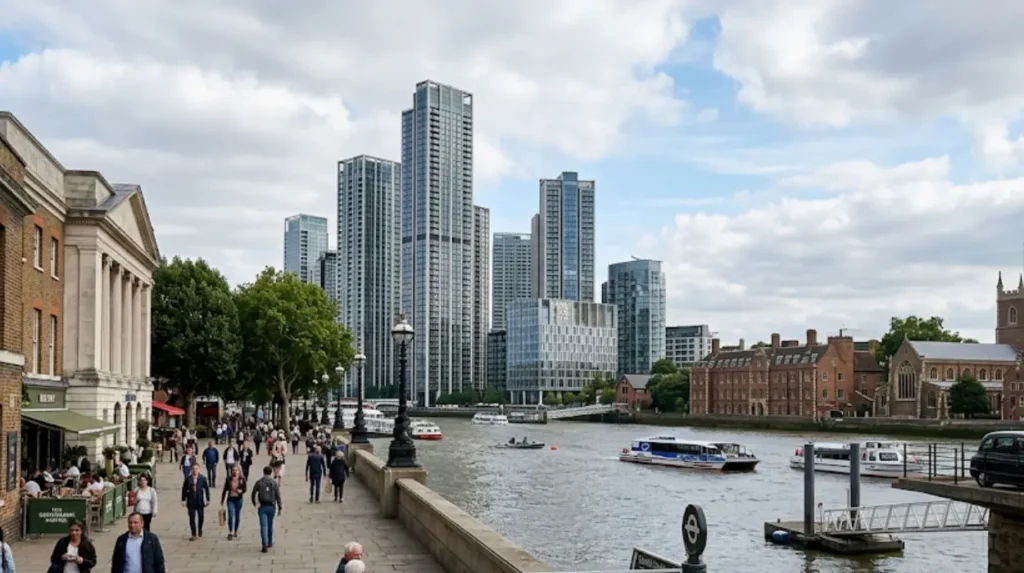
Streatham, further south, combines a busy high street with access to Streatham Common and The Rookery, offering a more suburban feel while retaining strong transport links. Vauxhall has undergone significant regeneration, with new residential towers, office spaces, and public realms around the station and riverside, attracting businesses and short-stay visitors.
These neighbourhoods allow tourists and business travellers to experience different facets of South London within a single borough, from bustling urban centres to quieter, green-fringed districts.
How does Lambeth balance heritage with modern development?
Lambeth balances heritage and modernity by protecting historic sites while delivering new housing, offices, and public spaces, particularly along the Thames and around major stations. Planning policies and community input shape this evolution to retain local character.
Riverside areas such as the South Bank, Vauxhall, and Nine Elms have seen large-scale mixed-use developments, including cultural venues, corporate headquarters, and high-density residential blocks. At the same time, landmarks like Lambeth Palace, historic churches, and conservation areas in Brixton, Clapham, and Herne Hill remain protected and actively used.
Community-led projects, markets, and cultural organisations ensure that new growth does not erase existing identities, particularly in areas with strong Afro-Caribbean and working-class histories. This layered approach allows Lambeth to function as a living document of London’s past and a laboratory for its future.
What practical tips help visitors experience Lambeth effectively?
Visitors should plan routes around the South Bank, Brixton, and one or two parks, using Waterloo or Vauxhall as base points for transport and accommodation. Combining cultural sites with markets and green spaces gives a rounded view of the borough.
A typical one-day itinerary could start at Waterloo, walk the South Bank to the London Eye and Royal Festival Hall, then cross to Lambeth Palace and Archbishops’ Park before heading to Brixton by train or bus. A second day might focus on Clapham Common and Brixton Market, or on the Imperial War Museum and Tate Britain, depending on interests.
For longer stays, basing in Clapham, Herne Hill, or Streatham provides access to local cafes, parks, and community events, while keeping central London within easy reach. Checking opening times for museums, markets, and parks in advance ensures smooth visits, especially at weekends and during festivals.