Key Points
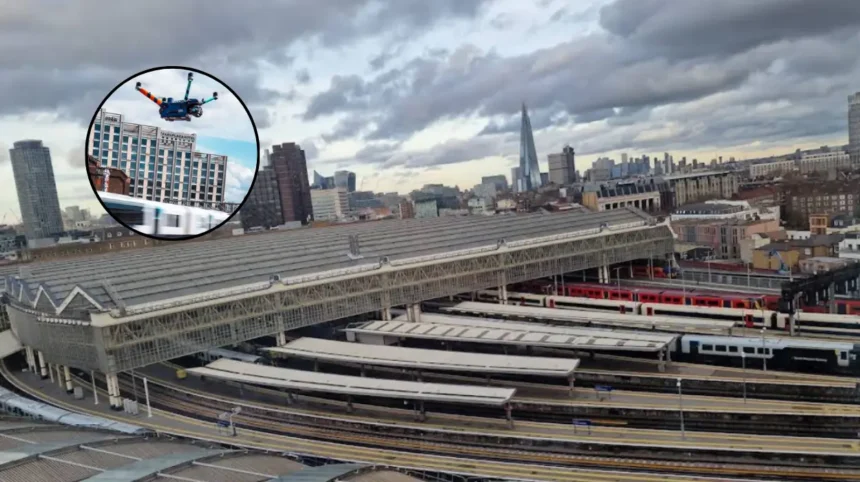
- Automated Surveillance Deployed: South Western Railway (SWR) and Network Rail Wessex (NR Wessex) have launched an automated drone system over London Waterloo station to track trespassers and reduce service delays.
- Remote SkyBound Technology: The unmanned aircraft is operated remotely from Woolston, near Southampton, by UK firm SkyBound, sending live optical and thermal video streams directly to the network control hub in Basingstoke, Hampshire.
- Scale of Disruption: Trespassing and track fatalities account for roughly 14% of overall SWR delays, causing more than 200,000 minutes of lost time between April 2025 and June 2026.
- Severe Electrical Danger: Trains across the SWR and NR Wessex network run on an “always-on” 750-volt conductor third rail, requiring immediate power cut-offs whenever unauthorized individuals are spotted near tracks.
- Network Expansion Planned: The Waterloo unit marks the initial phase of a broader aerial roll-out, with subsequent installations slated for major commuter hubs including Clapham Junction, New Malden, and Walton-on-Thames.
London (South London News) August 4, 2026 —As reported by SWR press communications, South Western Railway and Network Rail Wessex have formally deployed automated drone surveillance into the airspace above London Waterloo station. The aerial initiative is aimed at identifying track trespassers, monitoring sensitive infrastructure, and preventing widespread train cancellations. Operating as part of a post-nationalisation service improvement strategy, the high-tech deployment represents a joint operational effort between public rail authorities and private tech contractor SkyBound.
- Key Points
- How Does the SkyBound Remote Surveillance System Work in Practice?
- How Severe Is the Impact of Track Trespassing on Rail Operations?
- What Are Transport Officials and Ministers Saying About the Deployment?
- Where Will Future Drones Be Stationed Across the Network?
- Background of This Particular Development
- Predictions: How This Development Will Affect Passengers, Operators, and Taxpayers
The primary objective is to drastically cut down on unauthorized track access, which currently represents one of the most severe drivers of network-wide scheduling failures.
Most of SWR’s approximately 1,600 daily train services start or end their routes at London Waterloo. Consequently, an incident on a single section of track at Waterloo causes immediate knock-on delays across southern England.
How Does the SkyBound Remote Surveillance System Work in Practice?
According to SWR technical specifications, the trackside drone is stationed in a dedicated launch unit at London Waterloo. When potential track intrusions or structural faults are flagged, operators based roughly 70 miles away in Woolston, near Southampton, initiate the aircraft remotely.
Equipped with high-resolution visual cameras alongside advanced thermal imaging systems, the drone streams real-time visual feed directly to the joint operational control centre in Basingstoke, Hampshire.
As reported by SWR officials, this aerial perspective allows security, emergency response, and engineering teams to evaluate track conditions and pinpoint human movement prior to ground crews physically reaching the location.
How Severe Is the Impact of Track Trespassing on Rail Operations?
As reported in statistical data released by South Western Railway, trespass incidents and fatalities together account for nearly 14% of all travel delays on their line, costing taxpayers millions of pounds every year. Official performance logs show that between April 2025 and June 2026, track intrusions accumulated more than 200,000 total minutes of service delays across the SWR and NR Wessex networks.
The operational challenge stems directly from safety protocols surrounding traction power systems. Trains on these lines draw energy from an “always-on” electrified third rail carrying 750 volts of direct current—an electrical force sufficient to inflict catastrophic, life-changing injuries or immediate fatality.
As detailed in statements from SWR, whenever a trespasser is sighted on or near the lines, control managers are legally and operationally required to kill traction current across the entire sector.
Trains are brought to an immediate halt until safety teams clear the area and power can be securely restored, stranding thousands of commuters.
Explore More Waterloo News
Mice Plague Traps Disabled Pensioner in Waterloo Home; Southwark 2026
SWR Chessington South to Waterloo Disrupted by Malden Manor Fault South London 2026
What Are Transport Officials and Ministers Saying About the Deployment?
As reported by SWR media relations, Tom Desmond, Operations Director for South Western Railway and Network Rail Wessex, stated that:
“Trespass is one of the leading causes of disruption on our network, delaying our customers’ journeys and costing taxpayers. Every minute of delay at London Waterloo also has a significant impact on our wider network. By providing rapid, live intelligence from the air, this drone helps us respond more quickly to incidents, enhance safety and keep trains moving along one of the country’s more important railway lines.”
Desmond added that the initiative represents
“an exciting use of innovative technology between South Western Railway, Network Rail Wessex and our partners at SkyBound and part of our plan to give customers more reliable journeys.”
As quoted in official government statements, Rail Minister Lord Hendy stated that:
“Publicly owned operators like South Western Railway are utilising the latest tech to prevent disruption. Trespassing on the tracks is dangerous — it puts lives at risk and costs taxpayers money. Under Great British Railways we’re bringing track and train together to tackle this persistent issue and keep journeys running smoothly.”
Where Will Future Drones Be Stationed Across the Network?
As reported by SWR, London Waterloo serves as the initial testing ground for a wider aerial network rollout. Following the trial at Waterloo, additional SkyBound automated drone units are scheduled to be deployed at major bottleneck locations across the Wessex region. The next confirmed locations for permanent drone stations include:
- Clapham Junction: One of Europe’s busiest railway junctions by train throughput.
- New Malden: A key suburban interchange on the main line corridor.
- Walton-on-Thames: A critical point on the outer suburban commuter routes.
Background of This Particular Development
The adoption of automated airborne surveillance comes amid a broader structural transformation of the United Kingdom’s railway network. South Western Railway’s transition into public ownership reflects an ongoing national strategy to consolidate passenger rail services under public management ahead of the formal establishment of Great British Railways (GBR).
Under the former fragmented model, infrastructure management (Network Rail) and train operation (SWR) operated under separate corporate structures, frequently leading to communication delays during emergency line closures.
Trespassing on British railways has historically proven resilient against traditional mitigation techniques such as perimeter fencing, warning signage, and foot patrols.
Urban stations like London Waterloo, surrounded by dense residential and commercial areas, present persistent challenges for physical security teams trying to monitor several miles of open track.
The integration of long-range thermal imagery addresses a long-standing operational blind spot, enabling rapid security assessment without sending personnel onto energized tracks.
Predictions: How This Development Will Affect Passengers, Operators, and Taxpayers
For the millions of suburban commuters using South Western Railway services into London Waterloo, the drone system promises a noticeable reduction in unexplained, mid-journey train holds.
Because thermal imaging allows control centres to verify whether a track is clear in minutes rather than hours, the mandatory power-shutdown window following suspected trespass sightings is likely to shrink significantly. This will directly decrease cumulative delays across peak morning and evening travel periods.
For SWR, Network Rail Wessex, and the British taxpayer, the drone rollout offers direct financial relief. Unscheduled delays cost train operating companies millions in Schedule 8 penalty payments—compensation paid to passengers and other operators when infrastructure failures occur.
By lowering the 200,000+ annual delay minutes logged across the Wessex routes, publicly owned operators can reallocate capital from compensation payouts into infrastructure maintenance and service upgrades.
The continuous presence of thermal-capable drones operating overhead serves as a strong psychological deterrent against urban exploration, shortcutting, and vandalism.
As awareness of real-time aerial tracking grows, trespass incidents are predicted to drop near key hotspots, decreasing third-rail electrocution risks and protecting emergency service personnel from hazardous track inspections.