The August partial solar eclipse in the UK is one of the most significant astronomical events visible from South London in 2026. On Wednesday, 12 August 2026, the Moon will pass between Earth and the Sun, covering a large section of the solar disc.
- What is the August 2026 partial solar eclipse in the UK?
- When will the August 2026 eclipse be visible from South London?
- How much of the Sun will South London see covered?
- Where is the best place to watch the eclipse in South London?
- How should people safely watch the August solar eclipse?
- Why is the August 2026 eclipse different from a total solar eclipse?
- What happens during the different stages of the eclipse?
- What should South London residents prepare before 12 August 2026?
- Why is the 2026 eclipse important for UK astronomy?
- What can observers expect to see during maximum eclipse?
South London will experience a partial solar eclipse, not totality. The eclipse will begin in London at approximately 6:17pm BST, reach maximum eclipse at about 7:13pm, and finish at approximately 8:06pm. Around 91% of the Sun’s disc will be covered at maximum from London.
The event is part of a much larger total solar eclipse crossing Greenland, Iceland, northern Russia, the Atlantic Ocean, Spain and a small part of Portugal. The United Kingdom sits outside the narrow path of totality, so observers across London and South London will see the Moon covering most, but not all, of the Sun.
For South London residents, the event combines a high level of solar coverage with an early-evening viewing window. The Sun will remain relatively low in the western sky, making the choice of an unobstructed viewing location particularly important.
What is the August 2026 partial solar eclipse in the UK?
The August 2026 partial solar eclipse occurs when the Moon passes between Earth and the Sun, covering part of the Sun from the UK. South London will see approximately 91% solar coverage during maximum eclipse on 12 August 2026.
A solar eclipse occurs when the Moon moves between Earth and the Sun. The three bodies become sufficiently aligned for the Moon to block sunlight reaching part of Earth’s surface.
A partial solar eclipse occurs when an observer is positioned within the Moon’s penumbral shadow rather than its central umbral shadow. The penumbra produces incomplete coverage of the Sun.
The 12 August 2026 event is classified globally as a total solar eclipse because totality occurs along a narrow path across selected parts of the Northern Hemisphere. The same astronomical event is partial from the United Kingdom.
South London therefore does not experience darkness associated with totality. Instead, the Moon gradually moves across the visible solar disc. At maximum eclipse, only a small portion of the Sun remains uncovered.
The distinction between the global eclipse classification and local visibility is important. An eclipse can be total somewhere on Earth and partial somewhere else during the same event.
The August eclipse is especially notable for London because approximately 91% of the Sun’s area will be covered at maximum. This makes the event substantially deeper than many ordinary partial eclipses visible from the capital.
The eclipse also occurs during the evening. That timing places the Sun toward the western part of the sky, creating additional requirements for clear horizons and safe viewing equipment.
When will the August 2026 eclipse be visible from South London?
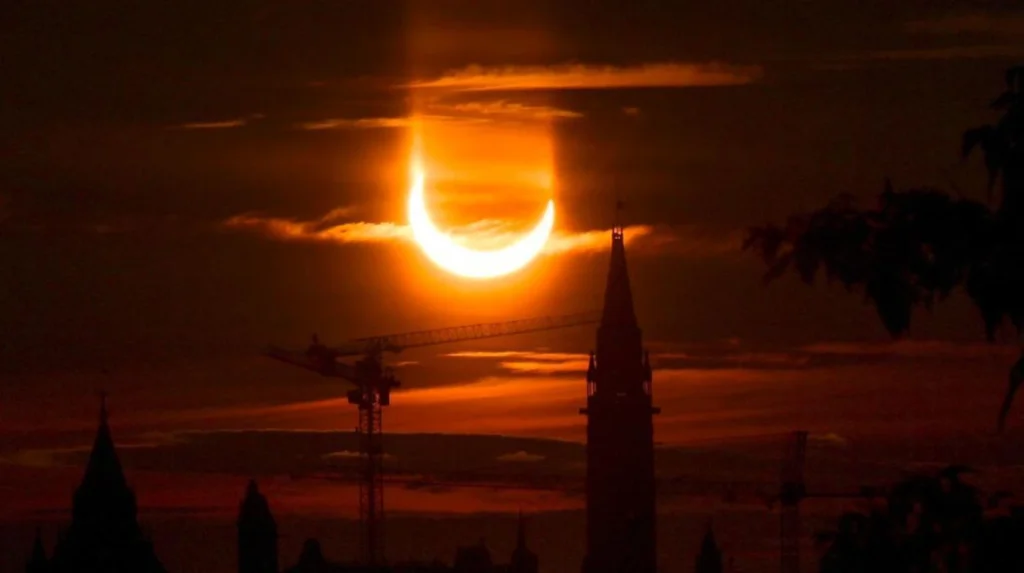
South London will see the eclipse from approximately 6:17pm to 8:06pm BST on Wednesday, 12 August 2026, with maximum eclipse near 7:13pm. The Moon will cover about 91% of the Sun at maximum from London.
The main London timings provide a useful reference for South London observers. Local variations across individual neighbourhoods are small, but the exact position of the Sun changes according to location.
The partial phase begins at approximately 6:17pm BST in London. The Moon then moves progressively across the solar disc.
Maximum eclipse occurs at approximately 7:13pm BST. This is the most important time for observers because the largest portion of the Sun will be covered.
The partial phase ends at approximately 8:06pm BST. After this point, the Moon will have moved away from the Sun’s visible disc.
The entire observable partial phase therefore lasts about 1 hour and 49 minutes in London.
South London follows British Summer Time in August. Observers should therefore use BST rather than Greenwich Mean Time when planning the event.
Exact circumstances vary slightly between locations. A viewing position farther east, west, north or south within Greater London changes the Sun’s altitude and direction by a small amount.
For practical planning, the period between 6:15pm and 8:10pm provides a useful observation window. The maximum around 7:13pm is the key moment for seeing the deepest stage.
The eclipse should not be confused with sunset. The partial eclipse finishes before sunset from London, although the Sun will be considerably lower in the western sky by the final stages.
How much of the Sun will South London see covered?
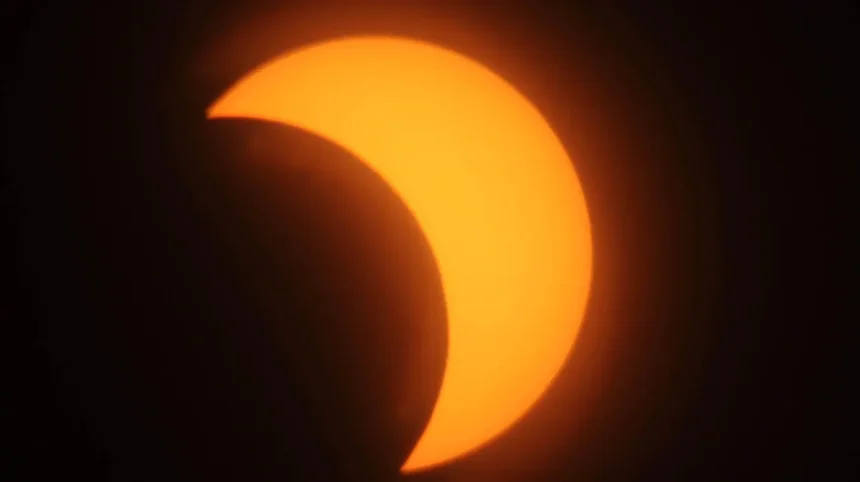
South London will experience approximately 91% coverage of the Sun at maximum eclipse, leaving a bright crescent-shaped section visible. The Moon will not completely cover the solar disc, so South London will not experience totality.
The percentage of solar coverage describes how much of the Sun’s visible area is obscured by the Moon.
A coverage level of approximately 91% means the Moon blocks most of the solar disc. The remaining visible portion forms a narrow crescent-like shape during maximum eclipse.
This does not mean that 91% of sunlight disappears from the environment. The percentage describes the area of the Sun’s disc covered from the observer’s viewpoint. The remaining uncovered section is still intensely bright.
The difference between area coverage and perceived brightness is important for eclipse safety. Even a small visible section of the Sun contains enough intense light to cause serious retinal injury when viewed directly without appropriate protection.
South London sits outside the path of totality. The Moon’s apparent position does not completely cover the Sun from the capital.
The high level of coverage nevertheless makes the eclipse visually distinctive. During maximum eclipse, the Sun will appear dramatically reduced to a bright crescent.
The exact percentage varies by location. London is expected to reach about 91% coverage, while other parts of southern England can experience slightly different values.
The deepest coverage generally occurs closer to the central regions of the partial-eclipse visibility zone. Local geography does not determine the percentage by itself; the Moon’s astronomical alignment determines the eclipse geometry.
Where is the best place to watch the eclipse in South London?
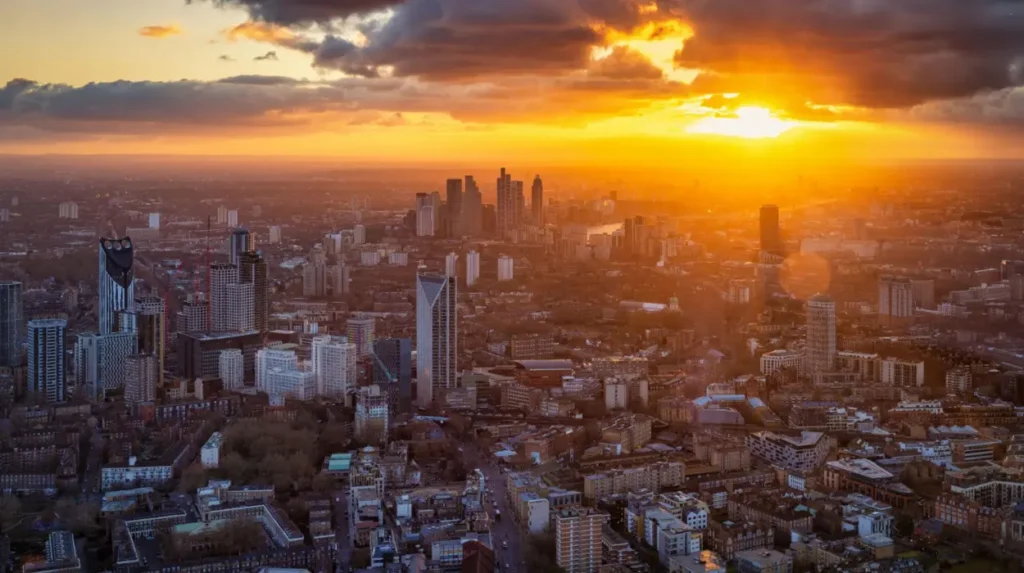
The best South London viewing location is an open site with an unobstructed western horizon, clear sightlines above buildings and trees, and enough space to use certified solar-viewing equipment safely throughout the eclipse.
The most important geographic requirement is a clear view toward the western sky. The eclipse takes place during the evening, when the Sun moves toward the western horizon.
Tall buildings can block the Sun during the later stages. Trees, hills, apartment blocks, railway structures and other large objects can also reduce the available viewing window.
South London contains dense urban areas where horizon visibility varies considerably. A location that appears open at ground level can still have the Sun blocked by nearby buildings.
Open parks, large recreational spaces and elevated viewpoints provide better sightlines when access is permitted. The key factor is not the name of the location but the absence of obstructions in the relevant direction.
Areas around Greenwich, Dulwich, Crystal Palace, Richmond-facing western viewpoints, Wimbledon, Bromley and other open parts of South London can offer different horizon conditions. Exact suitability depends on the observer’s position and local buildings or trees.
A viewing location should also allow the observer to stand or sit comfortably without needing to look through gaps between buildings.
The western horizon becomes increasingly important after maximum eclipse. Because the Sun continues moving lower in the sky, an obstruction that does not matter at 6:20pm can become significant by 7:50pm.
Weather is another practical factor. Clouds can obscure the Sun even when the eclipse itself is occurring correctly. Checking the forecast shortly before the event helps determine whether an alternative open location is useful.
How should people safely watch the August solar eclipse?
People must never look directly at the partially eclipsed Sun without certified solar protection. Safe viewing requires compliant solar eclipse glasses, a suitable solar viewer, or an indirect projection method that prevents concentrated sunlight from reaching the eyes.
Solar viewing safety is the most important consideration during the August eclipse.
Ordinary sunglasses do not provide sufficient protection. Multiple pairs of sunglasses also do not create a safe solar filter.
Certified eclipse glasses are designed specifically for direct solar observation. They must be undamaged and used according to their manufacturer’s instructions.
A handheld solar viewer provides another direct-viewing option when it uses an appropriate solar filter.
Indirect viewing is an alternative. A simple pinhole projection method allows the Sun’s image to be projected onto a separate surface without looking directly through an optical device at the Sun.
Standard cameras, binoculars and telescopes require particular caution. Looking at the Sun through an unfiltered optical system can concentrate intense sunlight and cause severe eye damage.
A solar filter designed specifically for the relevant optical equipment must be securely attached according to the manufacturer’s instructions. Filters intended only for ordinary visual observation are not automatically suitable for telescopes or cameras.
Children should receive clear instructions before the eclipse begins. They should use appropriate solar protection rather than being allowed to experiment with ordinary glasses, cameras or binoculars.
During a partial eclipse, there is no safe moment for direct unaided viewing. The Sun remains bright because part of its surface is still visible.
The brief darkness associated with totality does not occur in South London. Consequently, the special unaided viewing permitted during the short total phase of a total eclipse does not apply in London.
Why is the August 2026 eclipse different from a total solar eclipse?
A total solar eclipse completely covers the Sun along a narrow path, while South London will see only partial coverage. The August 2026 event is total globally but partial locally because London lies outside the path of totality.
The Moon produces two principal shadow regions during a solar eclipse: the umbra and the penumbra.
The umbra is the central part of the Moon’s shadow. Observers inside it can experience total solar eclipse conditions when the Moon completely covers the Sun.
The penumbra surrounds the umbra. Observers within the penumbra see only part of the Sun covered.
The path of totality on 12 August 2026 crosses selected areas of Greenland, Iceland, the North Atlantic region, northern Russia, Spain and a small part of Portugal.
The United Kingdom lies outside this narrow path. Consequently, observers in London remain within the partial-eclipse region.
Totality produces distinctive phenomena, including a darkened sky and visibility of the solar corona. These conditions require the Moon to cover the Sun completely.
South London will not reach that stage. A bright section of the Sun remains visible throughout the local eclipse.
The event therefore requires solar eye protection from beginning to end for direct observation in South London.
The distinction also explains why different reports describe the same date differently. International astronomy sources identify 12 August 2026 as a total solar eclipse because totality occurs somewhere along its global path. UK observers correctly describe what they see as a partial solar eclipse.
What happens during the different stages of the eclipse?
The eclipse progresses from first contact through increasing solar coverage, maximum eclipse and decreasing coverage before ending. In South London, these stages occur during the evening of 12 August, with maximum coverage around 7:13pm.
The first stage is called first contact. This occurs when the Moon’s apparent edge first touches the Sun’s disc.
After first contact, the Moon gradually moves across the Sun. The visible solar shape changes continuously as coverage increases.
The approach to maximum eclipse is the most visually significant portion for London observers. The remaining bright solar area becomes progressively smaller.
Maximum eclipse occurs around 7:13pm BST in London. At this point, approximately 91% of the Sun’s disc is covered.
After maximum, the Moon begins moving away from the Sun’s disc. The visible solar area gradually increases.
The final stage is last contact, when the Moon’s edge leaves the Sun’s visible disc. In London, this occurs at approximately 8:06pm BST.
The sequence results from the relative orbital movement of the Moon and Earth’s rotation. The Moon travels around Earth while Earth rotates, causing the eclipse shadow to move across Earth’s surface.
The changing appearance is therefore a predictable astronomical process rather than a sudden event.
Observers using cameras should also remember that the Sun’s position changes throughout the eclipse. Camera framing that works at maximum can become unsuitable later because the Sun continues moving toward the horizon.
What should South London residents prepare before 12 August 2026?
South London residents should prepare certified solar-viewing equipment, identify a clear western horizon, check the evening weather forecast, confirm local access arrangements and plan to observe between approximately 6:17pm and 8:06pm BST.
Preparation improves the chances of seeing the eclipse safely.
The first requirement is suitable eye protection. Solar eclipse glasses or another appropriate solar-viewing system should be obtained before the event rather than relying on improvised filters.
The second requirement is location planning. South London observers should identify a site with a clear view toward the western sky.
The third requirement is timing. The eclipse begins around 6:17pm, reaches maximum at approximately 7:13pm and ends around 8:06pm.
Arriving before maximum provides an opportunity to observe the Moon’s gradual movement across the Sun. Arriving shortly before 7:13pm still provides access to the deepest stage but reduces the opportunity to observe the complete sequence.
Weather conditions should be checked on the day. Clouds can hide the Sun while the eclipse continues above them.
Photography requires additional preparation. A standard smartphone camera should not be pointed directly at the Sun without suitable protection. Dedicated solar photography equipment requires appropriate filters and careful handling.
A tripod can help maintain stable framing, particularly when photographing the Sun at a relatively low altitude.
Local access should also be checked. Parks, sports grounds and public open spaces can have specific opening times or restrictions.
Observers should avoid unsafe locations such as roadsides, railway areas, private property or elevated edges simply to obtain a clearer horizon.
The safest approach combines good visibility with controlled surroundings and appropriate solar protection.
Explore More UK News
Torsion Construction Limited Ceases Trading Following Administration (2026)
Counter-Terror Police Reopen Nigel Farage Attack Inquiry: Greater London, 2026
Why is the 2026 eclipse important for UK astronomy?
The 2026 eclipse is important for UK astronomy because it delivers exceptionally high partial coverage across London and southern England while a total eclipse occurs elsewhere along the same global path, creating a major Northern Hemisphere observing event.
Solar eclipses provide opportunities to study the interaction between the Sun, Moon and Earth.
The geometry of an eclipse demonstrates the precise alignment of three large astronomical bodies. The Moon’s position relative to Earth and the Sun determines where total and partial phases occur.
The August 2026 event also illustrates the narrow nature of totality. A relatively small region experiences complete solar coverage, while a much larger surrounding region sees a partial eclipse.
For the UK, the event is particularly notable because London reaches approximately 91% solar coverage.
The eclipse also follows a series of recent solar eclipses visible from Britain. London experienced partial solar eclipses in March 2015, June 2021, October 2022 and March 2025.
The 2026 event therefore continues a sequence of observable solar phenomena rather than representing an isolated occurrence.
The following year brings another major eclipse event. On 2 August 2027, a total solar eclipse will cross parts of southern Europe, North Africa and the Middle East. The 2027 event is separate from the 2026 eclipse but demonstrates the continuing sequence of major solar eclipses during the period.
For South London, the 2026 eclipse remains particularly relevant because it is visible locally without requiring international travel.
What can observers expect to see during maximum eclipse?
At maximum eclipse in South London, the Moon will cover approximately 91% of the Sun, leaving a narrow bright section visible. The sky will not become completely dark because London remains outside the path of totality.
The most noticeable visual change is the shape of the Sun.
Instead of appearing circular, the Sun will resemble a bright crescent during the deepest stage. The exact appearance depends on the observer’s location and the eclipse geometry.
The surrounding environment can also appear somewhat different during substantial partial coverage, although the effect is not equivalent to totality.
The Sun remains bright enough to illuminate the landscape. The event does not produce the complete daytime darkness associated with a total solar eclipse.
The Moon’s silhouette will appear sharply defined when viewed through suitable solar protection.
Observers should focus on the progression rather than expecting a sudden change. The Moon moves gradually across the solar disc, creating a sequence that lasts close to two hours in London.
Photography can document the changing shape of the Sun, but safe equipment remains essential.
The most valuable observation period is the complete sequence from the beginning of the partial phase through maximum and toward the end. Maximum eclipse provides the greatest coverage, while the earlier and later phases show the movement of the Moon across the solar disc.
The August 2026 partial solar eclipse therefore provides South London with a significant astronomical event that is both locally visible and part of a much larger total eclipse across the Northern Hemisphere.
For South London residents, the essential information is straightforward: Wednesday, 12 August 2026; approximately 6:17pm to 8:06pm BST; maximum around 7:13pm; approximately 91% coverage from London; partial eclipse only; and certified solar protection required throughout direct observation.
When is the August 2026 solar eclipse visible in South London?
The partial solar eclipse will be visible in South London on Wednesday, 12 August 2026. The eclipse is expected to begin around 6:17pm BST, reach maximum at approximately 7:13pm, and end around 8:06pm.