Key Points
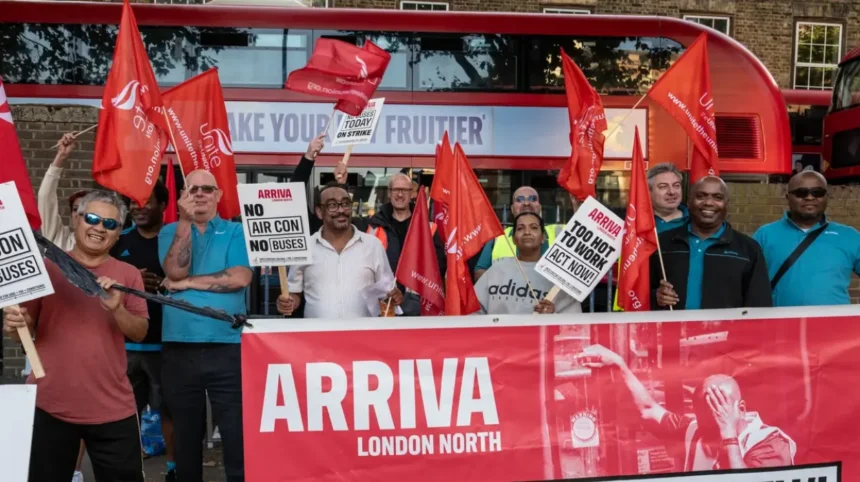
- Over 1,500 bus drivers employed by Arriva London North and represented by the Unite union are taking industrial action over extreme hot weather working conditions and driver safety.
- A four-day walkout took effect from 4:00 am on 18 August through to 4:30 am on 21 August, forming part of a wider campaign encompassing up to ten separate strike periods scheduled through to October.
- The dispute affects key bus depots across North London, East London, Central London, and Essex, including garages at Barking, Edmonton, Enfield, Grays, Palmers Green, Stamford Hill, Tottenham, and Wood Green.
- More than 40 bus routes—including high-capacity routes, Superloop express services, school journeys, and night buses—are subject to cancellations and heavy delays.
- Drivers report in-cab temperatures exceeding 40°C, claiming existing air-cooling systems fail to lower ambient temperatures effectively, increasing risks of heat exhaustion, dehydration, and severe driver fatigue.
- The union has also cited allegations of union-busting and poor management responses as key factors driving the industrial dispute.
South London (South London News) August 28, 2026 — Severe transport disruption has hit commuters across London as more than 1,500 bus drivers commenced a four-day walkout over working conditions, cab temperatures, and workplace safety. The industrial action, coordinated by the trade union Unite, began at 4:00 am on Tuesday, 18 August, and is set to continue until 4:30 am on Friday, 21 August. The stoppage represents the latest escalation in a bitter dispute between frontline public transport staff and bus operator Arriva London North.
- Key Points
- What Is Driving the Arriva Bus Staff to Strike Over Working Conditions?
- How Are London Bus Routes and Passengers Affected by the Industrial Action?
- What Position Have Arriva and Transport Authorities Taken on the Dispute?
- Background of the Particular Development
- Prediction: How This Development Can Affect London Commuters and Transport Workers
The current strike wave forms part of a series of up to ten planned walkouts extending through September and October. Workers based across eight key bus garages—Barking, Edmonton, Enfield, Grays, Palmers Green, Stamford Hill, Tottenham, and Wood Green—have withdrawn their labour. The resulting staff shortages affect more than 40 individual bus lines, encompassing vital trunk routes, Superloop express services, school transport services, and overnight routes. Transport authorities have advised passengers across affected regions to check journey planners and seek alternative transport arrangements throughout the strike periods.
What Is Driving the Arriva Bus Staff to Strike Over Working Conditions?
The primary catalyst for the industrial action centres on driver health and safety during periods of severe weather. According to union officials, drivers have repeatedly raised concerns regarding unbearable operating temperatures inside bus cabs during summer heatwaves.
As reported by Sam Myerson of Workers’ Liberty, Unite representatives indicated that existing air-cooling mechanisms installed across the Arriva London North fleet lower ambient cab temperatures by only two to three degrees Celsius. Consequently, driver cabs frequently reach or exceed 40°C during hot weather periods. Transport union leaders argue that working under such extreme thermal stress causes acute health complications—including heat stroke, dehydration, and heat exhaustion—while significantly increasing driver fatigue and compromising road safety.
In addition to environmental safety concerns, the dispute covers union representations regarding staff treatment. As detailed by transport reporters at Counterfire, union leadership has cited allegations of union-busting tactics by Arriva London North management, including the targeted discipline, suspension, and victimisation of union representatives who raised safety concerns regarding vehicle temperatures.
As reported by Joanna Partridge of The Guardian, Unite General Secretary Sharon Graham stated that “London bus drivers do a vital job, but are putting themselves at risk due to these appalling conditions” and added that “Arriva can fully afford to make meaningful changes our members can accept”.
How Are London Bus Routes and Passengers Affected by the Industrial Action?
The walkouts cause widespread service cancellations across major transport corridors in North, East, and Central London, as well as suburban links into Essex. Key daytime routes facing significant disruption or total cancellation include services 19, 29, 34, 41, 76, 141, 149, 191, and 279. Rapid orbital transit has also been hit, with Superloop routes SL1 and SL2 experiencing severe reductions.
Night-time travel has been similarly curtailed. Essential night bus links, including the N19, N29, N41, and N279, face severe curtailments, leaving overnight workers and late-night travellers dependent on alternative modes of travel.
As reported by Ed Cunningham of Time Out, the timing of the bus strikes intersects with planned maintenance works and partial closures on the London Underground network, including key sections of the Piccadilly line. Transport for London (TfL) has warned that residual congestion on surviving bus routes, parallel Underground lines, and local road networks is likely to increase travel times considerably for hundreds of thousands of daily commuters.
What Position Have Arriva and Transport Authorities Taken on the Dispute?
Arriva London North management maintains that staff welfare remains a key operational priority. Management representatives highlighted that negotiators reached an initial proposal during structured talks with trade union officials, leading to a temporary pause in earlier industrial action to permit a workforce ballot. However, driver majorities across multiple depots voted to reject the terms, arguing that proposed vehicle modifications and retrofitting schedules failed to provide adequate assurances before future summer seasons.
As reported by news correspondents at The Guardian, a spokesperson for Arriva London stated that the company was “disappointed that this strike is going ahead when five out of eight of our north London garages have said they don’t want a strike”. The operator noted it continues to participate in Transport for London’s extreme weather taskforce alongside other transit companies to evaluate long-term technical solutions for fleet cooling systems.
TfL officials have urged both parties to continue negotiations to minimize disruption to the travelling public while supporting health and safety protocols across London’s franchised bus network.
Background of the Particular Development
The current dispute reflects long-standing structural challenges regarding fleet specifications and driver working environments across London’s public bus network. Over the past decade, Transport for London and its private operating contractors have transitioned toward low-emission and electric bus fleets. However, retrofitting legacy bus models with full air-conditioning systems—rather than basic air-cooling or ventilation units—has remained a persistent point of contention between transport operators and trade unions.
Under standard Transport for London franchise agreements, bus operators are responsible for maintenance, working conditions, and vehicle specifications within agreed TfL frameworks. Previous extreme weather events across the UK have led to heightened scrutiny of workplace temperatures for transport workers. In recent years, City Hall motions and union advisory guidance have increasingly focused on maximum working temperatures and driver rights under health and safety legislation.
The decision by Arriva London North drivers to execute a multi-month strike mandate follows several years of formal union representations regarding cab cooling. With high temperatures recurring during peak summer months, union members voted overwhelmingly for strike action, seeking binding commitments to overhaul fleet cooling infrastructure and rectify internal industrial relations practices.
Prediction: How This Development Can Affect London Commuters and Transport Workers
The ongoing industrial action and unresolved dispute over vehicle working conditions will likely produce significant direct and indirect consequences for passengers, transport operators, and public policy makers.
Impact on Commuters and the Local Economy
For daily commuters, students, and shift workers across London and Essex, recurring strike action through October will cause ongoing travel disruption. The reduced availability of primary bus routes will force passengers onto alternative routes, increasing crowding on local rail, London Underground lines, and suburban road networks. Commuters face increased travel costs, longer journey times, and diminished reliability. Commercial sectors relying on night-shift staff—such as hospitality, healthcare, and logistics—may experience increased absenteeism or scheduling friction due to nighttime service reductions.
Impact on Bus Drivers and Workplace Standards
For bus drivers and union members, the outcome of this dispute could set a precedent for working conditions across the wider UK public transport sector. If Unite secures contractual agreements requiring full air-conditioning retrofits and strict cab temperature caps, similar demands are likely to spread to other London bus operating companies and regional transport depots. Conversely, prolonged industrial action without clear concessions could lead to extended wage loss for striking staff and heightened friction between workforce members across participating and non-participating depots.
Impact on Transport Policy and Fleet Infrastructure
For transport authorities and bus operators, the dispute highlights potential risks within current fleet procurement and maintenance standards. Transport for London and private franchisees may face increased pressure from regulatory bodies and local government to establish explicit temperature standards for driver cabs. Meeting these requirements may require accelerated capital investment to upgrade fleet ventilation systems, potentially influencing future franchise tendering costs and contract terms across London’s transport network.