Key Points
- Full Liability Denial: Architectural practice CZWG Architects has formally rejected allegations brought by Southwark Council regarding alleged structural and design defects at the inverted-pyramid Canada Water Library in Surrey Quays.
- Failure to Act Alleged: In a 70-page defence presented at the High Court’s Technology and Construction Court, CZWG maintains that Southwark Council failed to respond to automated leak alerts triggered between December 2014 and August 2015 prior to cladding detachment in late November 2019.
- Scope of Structural Damage: The practice asserts that water ingress was restricted to a minor selection of timber cassettes on the eastern facade, resulting from pre-2012 parapet waterproofing repair failures rather than a systemic design oversight.
- Contractual Design Portions: CZWG argues that specific design duties for roof waterproofing and timber framing belonged to main contractor ISG Jackson (which went into administration in September 2024), supplier Axter, and timber specialist ECC.
- Product Testing Evidence: Analysis by certification body BM Trada indicated timber decay required 48 months to form, which CZWG argues would have been caught early through routine local authority maintenance.
Surrey Quays (South London News) October 22, 2026 – Architectural practice CZWG Architects has formally denied liability in High Court proceedings over alleged design defects at the landmark Canada Water Library, placing responsibility back onto Southwark Council for failing to act on warning signs prior to cladding panels falling from the building. In a detailed 70-page defence submitted to the Technology and Construction Court, the firm rejected claims that its original plans caused pervasive water damage across the structure’s external walls and roofing, insisting that ongoing maintenance failures and unaddressed leak alerts allowed isolated timber decay to escalate unnoticed.
- Key Points
- Why has CZWG Architects rejected Southwark Council’s High Court claims?
- Did Southwark Council ignore automated leak warnings before panels fell?
- Who held design responsibility for the library’s waterproofing and timber elements?
- Background of the Canada Water Library development
- Prediction: How will this legal development affect local authorities and architectural practices?
Why has CZWG Architects rejected Southwark Council’s High Court claims?
As reported by architectural journalists examining court filings, CZWG Architects has presented a rigorous legal rebuttal to claims initiated by the London Borough of Southwark regarding water ingress and structural defects at the civic landmark in Surrey Quays. The practice firmly denies Southwark’s allegations that its design work was fundamentally defective, asserting in formal pleadings that there was “no pervasive design defect or workmanship defect” responsible for water damage to the library’s roofs or external envelopes.
In its legal response presented to the Technology and Construction Court, CZWG acknowledged that while the bronze-clad building experienced minor leaks, the damage was localized rather than widespread. The firm highlighted that the detachment of one cladding panel in late November 2019, followed by the precautionary removal of a second panel, stemmed from localized water entry rather than inherent structural shortcomings in the architectural drawings.
CZWG maintained that the decay was restricted to a small quantity of timber cassettes situated on the civic building’s east elevation. According to the defense pleadings, this localized damage arose because water entered through failed maintenance repairs on the parapet waterproofing—work executed in 2012 or earlier—which fell entirely outside the scope of the architecture firm’s contractual liabilities.
Did Southwark Council ignore automated leak warnings before panels fell?
A central element of CZWG’s defense hinges on the assertion that Southwark Council neglected routine building upkeep and failed to investigate automated warning systems installed inside the envelope. In the legal submission, the practice emphasised that “the inspection and maintenance of the façades following completion was [London Borough of Southwark’s] responsibility,” indicating that long-term care rested squarely with local authority asset management teams.
The defense document outlines how the building’s internal moisture monitors repeatedly flagged issues long before the exterior panels gave way. CZWG noted that the library’s leak detection system recorded water ingress at the eastern parapet on several occasions between December 2014 and August 2015. Addressing these entries, the defense stated that “it is unclear what, if any, steps [the council] took to identify the causes of that water ingress and address them,” pointing to a potential gap in asset monitoring over multiple seasons.
To reinforce this timeline, CZWG cited scientific findings from product certification firm BM Trada, which conducted forensic examination on the damaged structural elements. BM Trada’s analysis concluded that the timber rot observed inside the cassettes would have required a minimum of 48 months of continuous moisture exposure to develop. CZWG contended that had local authority maintenance teams conducted timely inspections following the 2014–2015 leak alerts, “this damage would have been identified at an earlier stage, prior to the detachment of the panels” in November 2019.
Who held design responsibility for the library’s waterproofing and timber elements?
In addressing the division of technical responsibilities, CZWG clarified the boundary between architectural oversight and specialist contractor design portions. The practice explained that specific technical designs for the roof waterproofing and timber cassette components were allocated to main contractor ISG Jackson under contractor’s designed portion (CDP) frameworks.
ISG Jackson, which entered administration in September 2024, had partnered with waterproofing system provider Axter and timber frame specialist ECC to execute these elements. In its High Court defence, CZWG asserted that it was not the practice’s “responsibility to carry out or complete those designs.” However, the architectural firm maintained that it had fully discharged all duties required of an executive architect to properly incorporate and co-ordinate those specialist packages into the broader building scheme.
Background of the Canada Water Library development
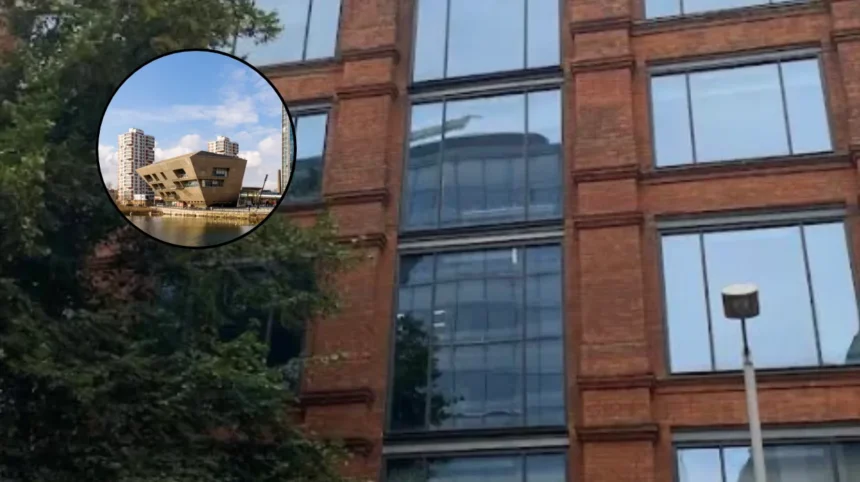
The Canada Water Library opened to the public in November 2011 as a flagship community hub within Southwark Council’s multi-million-pound regeneration scheme for Surrey Quays. Designed by CZWG Architects under lead partner Piers Gough, the award-winning building is distinguished by its striking inverted-pyramid geometry, clad in gold-anodised aluminium panels, and situated directly over the basin at Canada Water.
The building was conceived as a multi-use civic space housing library services, a performance theatre, study areas, and community meeting rooms. Due to its unusual cantilevered shape and exposed dockside orientation, the structural design integrated specialist timber cassette framing and complex perimeter waterproofing assemblies. Over the past decade, managing maintenance across complex modern public architecture has presented challenges for local authorities, particularly when main contractors involved in original construction—such as ISG Jackson—subsequently enter insolvency, shifting technical accountability to high court litigation.
Prediction: How will this legal development affect local authorities and architectural practices?
This High Court defence action carries direct implications for local government authorities, architectural practices, and the UK construction sector.
For Local Authorities and Public Asset Managers
Councils and public sector clients will face stricter scrutiny regarding building maintenance logs and automated monitoring responses. If the Technology and Construction Court rules that unaddressed leak alerts absolve design teams from secondary damage claims, local authorities will no longer be able to rely on architectural liability insurance to cover structural repair costs where internal maintenance protocols were delayed. This will force councils to upgrade routine facility management budgets and maintain strict audit trails for automated sensor notifications.
For Architectural Practices and Specialist Subcontractors
For design practices, CZWG’s robust defense establishes a clear precedent around Contractor’s Designed Portions (CDP). Architects will increasingly insist on strict contractual boundaries, ensuring that technical failures stemming from specialist subcontractors—especially where main contractors have gone into administration—cannot be retroactively assigned to lead designers. This case emphasizes the importance of keeping detailed coordination records to protect design firms against long-term latent defect claims.