Lambeth is one of South London’s most varied boroughs for a slow day. It combines River Thames views, historic gardens, large public parks, museums, heritage buildings, quiet neighbourhood spaces and pedestrian-friendly routes. A slow day here does not require a packed sightseeing schedule. Visitors can choose one or two places, spend longer in each, and move between them at a comfortable pace.
- What makes Lambeth suitable for a slow day?
- Is the Garden Museum a good place for a relaxed day in Lambeth?
- Can you have a slow day around Lambeth Palace and St Mary’s Gardens?
- Is Albert Embankment good for a relaxed riverside walk?
- Can Vauxhall Pleasure Gardens provide a quiet break?
- Is Vauxhall Park suitable for a relaxed afternoon?
- Is Brockwell Park one of the best places for a slow day in Lambeth?
- Can Ruskin Park offer a quieter alternative to larger attractions?
- Which museums are suitable for a slow cultural day in Lambeth?
- Is a Thames-side slow day possible without visiting major attractions?
- Where can visitors combine greenery and history in one Lambeth day?
- What is the best way to plan a slow day in Lambeth?
- Are Lambeth’s slow-day places suitable for tourists and residents?
- When is a slow day in Lambeth most useful?
- What are the best places for a slow day in Lambeth?
The best slow-day locations include the Garden Museum and Lambeth Palace area, St Mary’s Gardens, Albert Embankment, Vauxhall Pleasure Gardens, Vauxhall Park, Brockwell Park, Ruskin Park, and selected cultural venues around Waterloo and Kennington. Each offers a different version of relaxed London: gardens and heritage, riverside views, open green space, art, local history or quiet recreation.
Lambeth’s geography also supports flexible itineraries. The northern part of the borough sits beside Westminster and the South Bank, while Vauxhall, Kennington, Brixton, Herne Hill and other neighbourhoods provide access to parks and local streets. This makes it possible to spend a whole day in one area rather than travelling repeatedly across London.
What makes Lambeth suitable for a slow day?
Lambeth suits a slow day because it combines accessible green spaces, riverside routes, historic sites and cultural attractions within a compact South London setting, allowing visitors to spend several hours in one location instead of following a demanding sequence of major tourist attractions.
The main advantage is variety without excessive travel. A visitor can begin with a garden, continue with a riverside walk and finish with a museum or café. Another visitor can spend most of the day in a single large park.
The borough contains important historic landscapes as well as modern public spaces. Lambeth Council manages parks and open spaces including Brockwell Park, Vauxhall Park and Vauxhall Pleasure Gardens. These locations provide opportunities for walking, sitting, informal recreation and observing the urban landscape.
The River Thames adds another slow-travel option. The Albert Embankment forms part of Lambeth’s riverside frontage and provides views towards Westminster and other central London landmarks. Lambeth planning documents identify the Thames frontage and continuous riverside access as important elements of the borough’s public realm.
Slow travel in Lambeth therefore works through time rather than quantity. The objective is to reduce the number of destinations and increase the amount of time spent experiencing each place.
Is the Garden Museum a good place for a relaxed day in Lambeth?
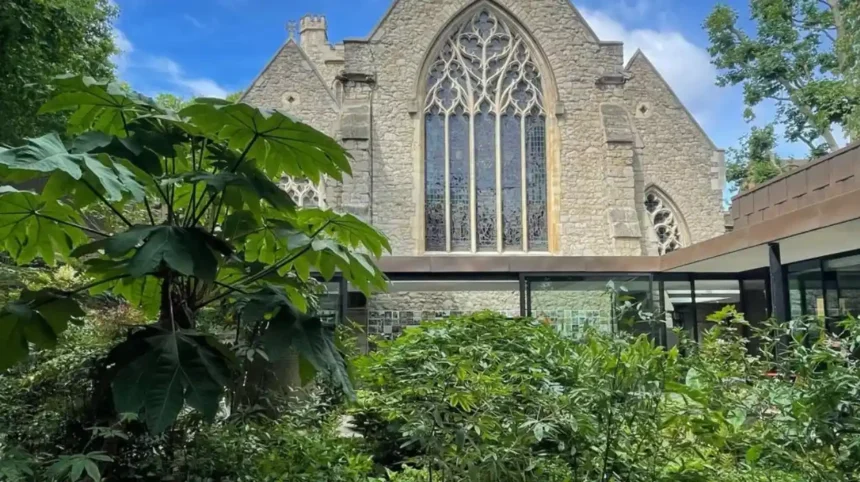
The Garden Museum is one of Lambeth’s strongest slow-day destinations because it combines garden history, art, architecture, a historic church, a courtyard garden, exhibitions and a café beside Lambeth Palace, creating several activities within one compact cultural destination.
The Garden Museum occupies the former St Mary-at-Lambeth Church on Lambeth Palace Road. It is Britain’s only museum dedicated to the art, history and design of gardens.
The building itself provides historical interest. The Garden Museum records the history of the site from the medieval period. A church stood here by 1062, while the Domesday survey of 1086 recorded landholdings associated with the manor.
The museum was founded in 1977 by Rosemary and John Nicholson. Their objective was to save the abandoned church from demolition. The building contains the tomb of John Tradescant, a seventeenth-century gardener and plant collector whose work forms an important part of British garden history.
The museum’s collections cover gardening, landscape design, horticulture, art and related subjects. Its archive also preserves working records of British garden designers.
The courtyard garden provides a quieter part of the visit. Visitors can combine the museum galleries with time outdoors instead of moving immediately to another attraction.
The Garden Museum also has a café, making it practical for a longer visit. Its current published opening information lists regular daytime opening, although visitors should check the museum’s official schedule before travelling because event arrangements can alter hours.
The museum is particularly suitable for visitors who want a cultural activity without the scale of a major national museum.
As you explore the modern museum site, you are crossing land with a deep heritage. Read about the full to understand its origins.
Can you have a slow day around Lambeth Palace and St Mary’s Gardens?
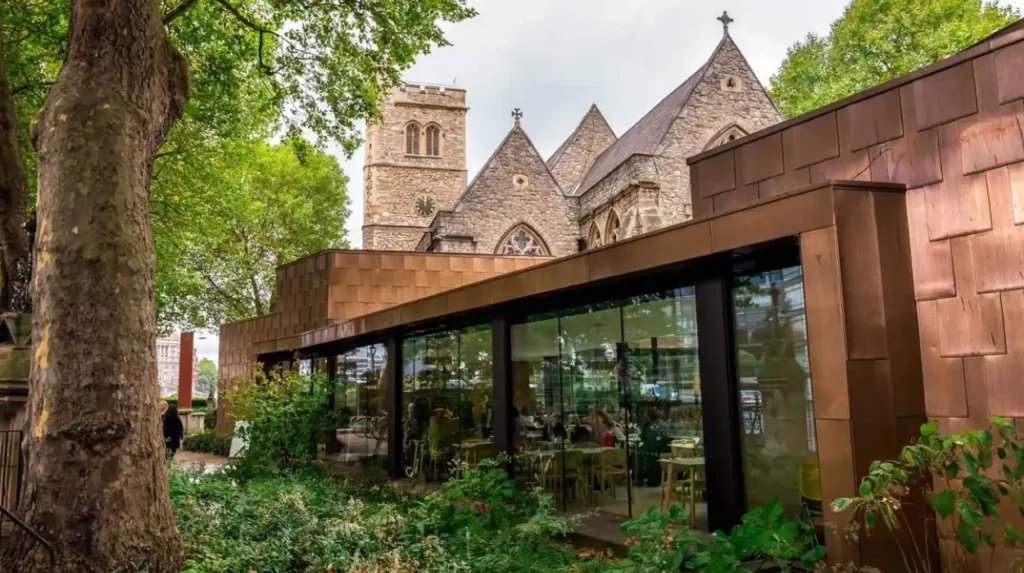
The Lambeth Palace and St Mary’s Gardens area provides a compact slow-day setting where visitors can combine historic architecture, riverside scenery, public seating, small-scale green space and views across the Thames without following a demanding sightseeing route.
Lambeth Palace is the London residence of the Archbishop of Canterbury. Its position beside the Thames gives the surrounding area an unusually strong connection between religious history, architecture and the river.
St Mary’s Gardens sits close to Lambeth Palace, the Garden Museum, Archbishop’s Park and St Thomas’ Hospital. Lambeth Council describes the gardens as a small public open space with seating, planted areas and a fountain.
The gardens were created in the early twentieth century after changes to the local road network. They were laid out as a public garden in 1932–33.
The scale is important for slow travel. St Mary’s Gardens is not designed as a major attraction requiring a long itinerary. It works better as a pause between larger destinations.
A visitor can spend time sitting in the gardens before continuing towards the Thames. The proximity of Lambeth Palace and the Garden Museum means that several points of interest can be experienced within the same local area.
The area also forms part of a Borough Site of Importance for Nature Conservation, reflecting its value for wildlife and access to nature.
Is Albert Embankment good for a relaxed riverside walk?
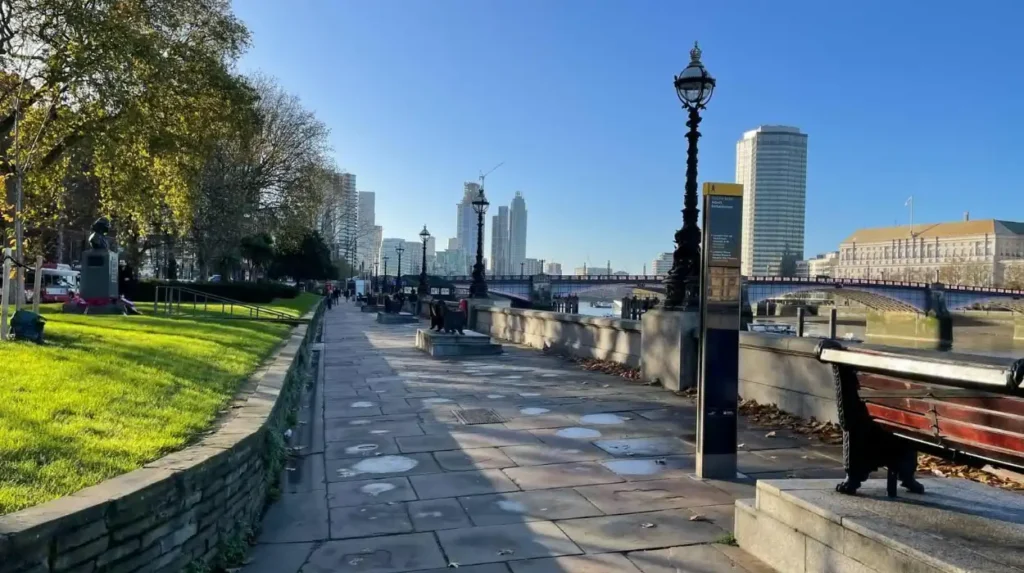
Albert Embankment is well suited to a slow riverside day because its public walkway follows the River Thames and provides open views, historic embankment infrastructure, bridges and views towards Westminster, allowing visitors to walk, pause and observe the central London landscape.
Albert Embankment extends along Lambeth’s Thames frontage. The conservation area includes the embankment walk, retaining walls, open spaces and historic buildings.
The area developed significantly during the nineteenth century as London improved its sewage and flood infrastructure. Joseph Bazalgette’s engineering work formed part of the transformation of the Thames frontage.
The riverside route provides an alternative to conventional sightseeing. Instead of entering a succession of attractions, visitors can follow the river at their own pace.
Views across the Thames are a major feature. Lambeth Council identifies the river as an important environmental, transport and leisure resource. Planning policy also supports publicly accessible riverside routes.
The location provides views towards Westminster and the Palace of Westminster. The relationship between Lambeth Palace and the northern bank of the Thames also has recognised heritage importance.
For a slow afternoon, the route works well with a simple structure: walk beside the river, stop at a suitable seating area, take photographs, and continue only when required.
The route also connects naturally with the Garden Museum, Lambeth Palace area and other central Lambeth destinations.
Can Vauxhall Pleasure Gardens provide a quiet break?
Vauxhall Pleasure Gardens provides a central green space where visitors can walk among trees, meadow planting and landscaped areas while remaining close to Vauxhall station, making it useful for a relaxed urban break with strong historical connections.
The modern Vauxhall Pleasure Gardens occupy part of the historic site of the original Vauxhall Pleasure Gardens.
The original entertainment gardens developed into one of London’s major public entertainment venues. Lambeth Council records the site as having been laid out in the seventeenth century, with its popularity reaching a peak during the eighteenth and early nineteenth centuries.
The historic gardens included landscaped walks, dining, music, visual entertainment and large public events. They finally closed in 1859.
The present public park emerged after later redevelopment and post-war clearance. The modern landscape includes paths, trees, meadow areas and planting designed to support biodiversity.
The entrance from Kennington Lane includes architectural features referencing the historic pleasure gardens.
The site also has a relationship with Vauxhall City Farm, whose outdoor paddocks occupy part of the wider area.
For a slow day, the important distinction is between the historical importance of the original pleasure gardens and the practical function of the present park. Visitors today experience a public green space rather than the eighteenth-century entertainment venue.
Its location beside Vauxhall station also makes it easy to include without creating a complicated travel schedule.
Is Vauxhall Park suitable for a relaxed afternoon?
Vauxhall Park is suitable for a relaxed afternoon because it combines historic landscaping, mature planting, a café, an orchard, a lavender garden, seating and open areas within a neighbourhood park that is designed for everyday recreation rather than intensive sightseeing.
Vauxhall Park opened in 1890. It was officially opened by the Prince of Wales, later King Edward VII.
The park retains historic features while incorporating modern facilities. These include a café, orchard, playground, multi-use games area and dog exercise area.
A lavender garden was created in 2003 on the site of a former bowling green. The garden commemorates the nearby history of the Vauxhall Motor Company.
The park has also received investment to preserve historic features. Lambeth Council records restoration work involving paths, gates, brick piers and views across the landscape.
The Fawcett Sensory Garden provides another feature for visitors seeking a quieter experience.
Vauxhall Park demonstrates why neighbourhood parks are important for slow tourism. They do not require a ticket or a strict schedule. Visitors can arrive, walk, sit, eat or observe the landscape and then continue when convenient.
The park also works well for residents looking for an everyday break from the surrounding urban environment.
Is Brockwell Park one of the best places for a slow day in Lambeth?
Brockwell Park is one of Lambeth’s largest and most varied green spaces, combining open meadows, ponds, mature trees, a walled garden, historic Brockwell Hall, sports facilities and long walking routes suitable for spending several unhurried hours outdoors.
Brockwell Park sits between areas including Brixton, Tulse Hill and Herne Hill. It is characterised by open landscapes, mature trees, ponds and landscaped gardens.
The park originated as private estate land associated with Brockwell House. John Blades, a London glass merchant, owned the estate during the nineteenth century.
Brockwell Hall was built in the early nineteenth century. The Metropolitan Board of Works acquired the estate in the late nineteenth century, and the landscaped public park formally opened in 1892.
The park contains several historic features, including Brockwell Hall, the walled garden and the Tritton Clocktower.
Brockwell Park also contains the Brockwell Lido, sports facilities, a BMX track, tennis courts, a children’s playground and other recreational infrastructure.
For slow travel, the open landscape is more important than trying to experience every facility. A visitor can choose a section of the park, walk through the gardens, sit beside a pond or spend time viewing the surrounding London skyline.
The park normally opens from the morning until shortly before sunset. Visitors should check current opening information, particularly when planning seasonal facilities.
Its size makes Brockwell Park suitable for a half-day visit rather than a brief stop.
Can Ruskin Park offer a quieter alternative to larger attractions?
Ruskin Park offers a quieter green-space experience in Herne Hill, combining landscaped areas, mature planting, recreational facilities and historic connections with John Ruskin, making it suitable for visitors who want a slower park-based activity away from major central London attractions.
Ruskin Park is associated with Herne Hill and forms part of Lambeth’s network of historic public parks.
The park was laid out in the early twentieth century and was named after John Ruskin, the Victorian writer, artist and social critic.
Its location provides a useful alternative for visitors who want to experience a residential side of Lambeth rather than concentrating on the Thames frontage.
A slow visit does not require a fixed route. Visitors can use the park for walking, sitting and observing the landscape.
Ruskin Park is also close to local streets and neighbourhood amenities in Herne Hill. This makes it possible to combine outdoor time with a relaxed café stop without adding several distant destinations.
The park demonstrates the broader character of Lambeth’s green infrastructure. Large attractions are not the only places that provide meaningful visitor experiences. Smaller historic parks also support slower forms of urban recreation.
Which museums are suitable for a slow cultural day in Lambeth?
Lambeth has several museums and cultural venues suitable for slower visits, including the Garden Museum and Imperial War Museum London, allowing visitors to focus on selected galleries instead of attempting to cover an entire collection in one session.
The Imperial War Museum London is on Lambeth Road. The museum documents conflict and its impact on people, society and military history.
General admission to IWM London is free. The museum provides substantial indoor space, making it useful during poor weather as well as on dry days.
A slow museum visit works best when visitors select specific galleries rather than attempting to see everything. The museum’s scale means that a focused visit can be combined with a nearby park or riverside walk.
IWM London also operates sensory-friendly and relaxed sessions at selected times. These arrangements provide quieter conditions for visitors who benefit from reduced sensory stimulation.
The Garden Museum provides a different cultural experience. Its focus is gardens, horticulture, landscape design, art and history.
Together, these institutions demonstrate the range of slow cultural activities available in Lambeth. One focuses on military and social history while the other focuses on gardens and horticultural culture.
Is a Thames-side slow day possible without visiting major attractions?
A Thames-side slow day in Lambeth is possible without entering major attractions because the riverside itself provides publicly accessible walking routes, historic views, bridges, open spaces and places to pause along the borough’s Thames frontage.
The River Thames is one of Lambeth’s defining geographical features.
The borough’s planning framework places importance on public access to the river and continuous riverside routes. The objective is to maintain connections between the urban area and the waterfront.
The Albert Embankment is particularly suitable for this style of visit. It provides a structured riverside environment with views towards Westminster.
Lambeth Bridge and Westminster Bridge provide additional points of reference. Visitors can observe the relationship between bridges, historic buildings and the river without needing to enter a ticketed attraction.
A riverside day also reduces logistical pressure. There is no requirement to arrive at a particular gallery entrance, follow a timed exhibition route or complete a long list of landmarks.
Visitors can instead divide the day into simple sections: riverside walking, a garden stop, lunch and a final period beside the water.
This approach suits leisure travellers with limited energy, visitors with flexible schedules and business travellers looking for several hours of downtime.
Where can visitors combine greenery and history in one Lambeth day?
The strongest combinations of greenery and history include the Garden Museum with St Mary’s Gardens, Vauxhall Pleasure Gardens with Vauxhall’s historic streets, and Brockwell Park with its historic buildings and landscaped features.
The Garden Museum and St Mary’s Gardens provide the most compact combination. Both sit near Lambeth Palace and the Thames.
Vauxhall Pleasure Gardens offers another combination. The current park occupies a site associated with the historic pleasure gardens, while nearby Vauxhall streets retain elements of the area’s nineteenth- and twentieth-century development.
Brockwell Park provides a larger landscape. Its history includes Brockwell Hall, the former private estate and the creation of a public park in the nineteenth century.
These combinations demonstrate the historical depth of Lambeth’s public spaces. Modern parks often occupy land with earlier residential, religious, commercial or entertainment functions.
A visitor who wants a slow day can therefore experience history without spending the entire day inside a museum.
What is the best way to plan a slow day in Lambeth?
The most effective slow-day plan uses one main destination, one nearby outdoor space and one flexible food or riverside stop, keeping travel short and allowing several hours for walking, sitting, exploring exhibits or enjoying the local environment.
A Lambeth Palace and Garden Museum day works well for visitors interested in history, gardens and architecture. The Garden Museum provides the main cultural activity, while St Mary’s Gardens and the riverside provide outdoor time.
A Vauxhall day can centre on Vauxhall Pleasure Gardens and Vauxhall Park. Both provide green space, while the surrounding neighbourhood supplies cafés and local streets for additional exploration.
A Brockwell Park day works for visitors who prefer open space. The park is large enough to support several hours of walking and relaxed outdoor time.
A riverside day can focus on Albert Embankment, Lambeth Bridge and nearby gardens. It requires less advance planning because the main activity is walking and observing the city.
The key planning principle is to avoid excessive movement. A slow day becomes less relaxed when the itinerary contains too many destinations separated by long journeys.
Are Lambeth’s slow-day places suitable for tourists and residents?
Lambeth’s slow-day destinations serve tourists and residents because they combine major heritage sites with everyday parks, riverside routes, museums and neighbourhood spaces that support both short visits and longer periods of unstructured leisure.
Tourists can use Lambeth to experience a different side of central and South London. Instead of moving between famous landmarks, they can focus on local landscapes and heritage.
Residents benefit from the same infrastructure as everyday recreation. Parks such as Brockwell Park and Vauxhall Park are designed for repeated use rather than one-time sightseeing.
Digital nomads can also use the area as a break from intensive city exploration. A slow itinerary provides opportunities for a walk, a café stop and a cultural visit without requiring a full-day excursion outside London.
Domestic business travellers can use the same principle when they have several hours between appointments. The Garden Museum, Albert Embankment and nearby parks provide alternatives to spending all available downtime indoors.
The common factor is flexibility. Each destination can be used for a short stop or incorporated into a longer day.
Explore More Area Guide
Lambeth Sightseeing and Shopping Guide
Best Places for Public Art in Lambeth, South London
When is a slow day in Lambeth most useful?
A slow day in Lambeth is particularly useful when visitors want to reduce travel, avoid a crowded sightseeing schedule, spend more time outdoors or combine one cultural attraction with parks, gardens and riverside walking in a single South London itinerary.
Slow travel is not defined by a particular activity. It is defined by the pace and structure of the visit.
Lambeth supports this approach because its attractions are distributed across connected neighbourhoods rather than concentrated in one large visitor complex.
The borough also provides different types of outdoor environments. The Thames offers riverside scenery, Brockwell Park offers expansive green space, Vauxhall provides historic urban parks, and smaller gardens offer short periods of quiet.
The cultural infrastructure adds another layer. The Garden Museum and Imperial War Museum London provide indoor alternatives when weather conditions are unsuitable for a full outdoor itinerary.
Visitors should check official opening hours and seasonal information before travelling. Parks, museums, gardens and special facilities operate according to different schedules.
What are the best places for a slow day in Lambeth?
The best slow-day options include the Garden Museum, St Mary’s Gardens, Albert Embankment, Vauxhall Pleasure Gardens, Vauxhall Park, Brockwell Park, Ruskin Park and Imperial War Museum London, with each supporting a different relaxed style of visit.
The Garden Museum is suited to visitors seeking gardens, architecture and cultural history.
St Mary’s Gardens provides a small public green space near Lambeth Palace and the Thames.
Albert Embankment suits visitors who want riverside walking and central London views.
Vauxhall Pleasure Gardens combines modern green space with a significant entertainment history.
Vauxhall Park provides a neighbourhood park with gardens, an orchard, café and historic features.
Brockwell Park is suitable for longer outdoor visits because of its size, landscape and historic features.
Ruskin Park offers a quieter Herne Hill setting connected with the history of John Ruskin.
Imperial War Museum London provides a substantial indoor cultural option with free general admission.
Together, these destinations give Lambeth a strong slow-travel profile. Visitors do not need to complete a long checklist of attractions. A carefully selected combination of one cultural site, one green space and one riverside route creates enough structure for a full day while retaining time for rest and independent exploration.
Lambeth’s strongest slow-day quality is therefore its ability to connect heritage, nature, culture and public space without requiring a tightly packed itinerary.
What are the best places for a slow day in Lambeth?
The Garden Museum, St Mary’s Gardens, Albert Embankment, Vauxhall Park, Vauxhall Pleasure Gardens, Brockwell Park and Ruskin Park are strong choices for a relaxed day in Lambeth.