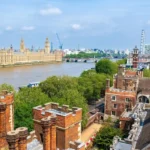
Lambeth’s Thames riverside combines major London landmarks, historic buildings, cultural institutions, bridges, gardens and long-distance walking routes. The riverfront stretches from the Westminster Bridge area through County Hall and the South Bank towards Lambeth Bridge and the historic Lambeth Palace district.
- Why is Lambeth’s Thames Riverside important for visitors?
- What can you see around Westminster Bridge and the London Eye?
- What are the best historic sights near Lambeth Palace?
- What can you see between County Hall and Lambeth Bridge?
- Which bridges are the best landmarks along Lambeth’s riverside?
- What historic landmarks can you see across the Thames from Lambeth?
- Is Lambeth’s Thames Riverside good for walking?
- What is the best way to explore Lambeth’s Thames Riverside in one day?
- Why is Lambeth’s Thames Riverside worth visiting beyond the main attractions?
The area sits directly opposite some of central London’s most recognisable landmarks. The Palace of Westminster, Westminster Hall, Big Ben and Victoria Tower form the northern river panorama. On the Lambeth side, the London Eye, County Hall, SEA LIFE London Aquarium, Jubilee Gardens, the Garden Museum and Lambeth Palace create a concentrated visitor area.
The riverside also forms part of the Thames Path National Trail, a 185-mile (298-kilometre) long-distance route following the River Thames from its source in the Cotswolds to Woolwich. The London section provides a largely flat and accessible walking environment with frequent transport connections.
For visitors, the strongest approach is to treat Lambeth’s riverfront as a connected sightseeing district rather than a collection of isolated attractions. Walking between landmarks provides views of bridges, historic embankments, parliamentary architecture and the river itself.
Why is Lambeth’s Thames Riverside important for visitors?
Lambeth’s Thames Riverside is important because it combines nationally significant heritage, major visitor attractions, public gardens, bridges and the Thames Path within a compact central London area. Visitors can connect Westminster, County Hall, the South Bank, Lambeth Palace and Lambeth Bridge on foot.
The river has shaped Lambeth’s development for centuries. Its position opposite Westminster placed the district close to royal, religious, political and commercial activity.
The riverside remains particularly significant because several major London landmarks stand within walking distance of one another. These include the London Eye, County Hall, Lambeth Palace, Garden Museum, Lambeth Bridge, Westminster Bridge and the Palace of Westminster.
The riverfront also provides direct views across the Thames. This makes the embankment an important public space for sightseeing, walking and photography.
Lambeth Bridge itself demonstrates the historical importance of this crossing point. Historic England records that the present bridge was designed between 1929 and 1932 and opened in 1932. It is a Grade II listed structure with a five-span steel arch design and granite-faced reinforced-concrete piers.
The riverside therefore combines several different forms of heritage. These include medieval religious history, Victorian infrastructure, twentieth-century engineering and contemporary tourism.
What can you see around Westminster Bridge and the London Eye?
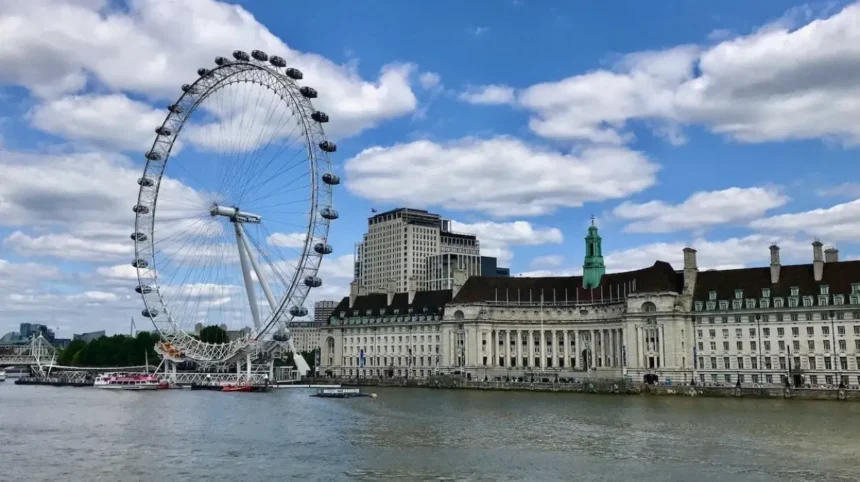
Westminster Bridge and the London Eye provide one of Lambeth’s strongest concentrations of major attractions. From this section of the riverside, visitors can see the Palace of Westminster, Big Ben, County Hall, the Thames and the London Eye within a short walking area.
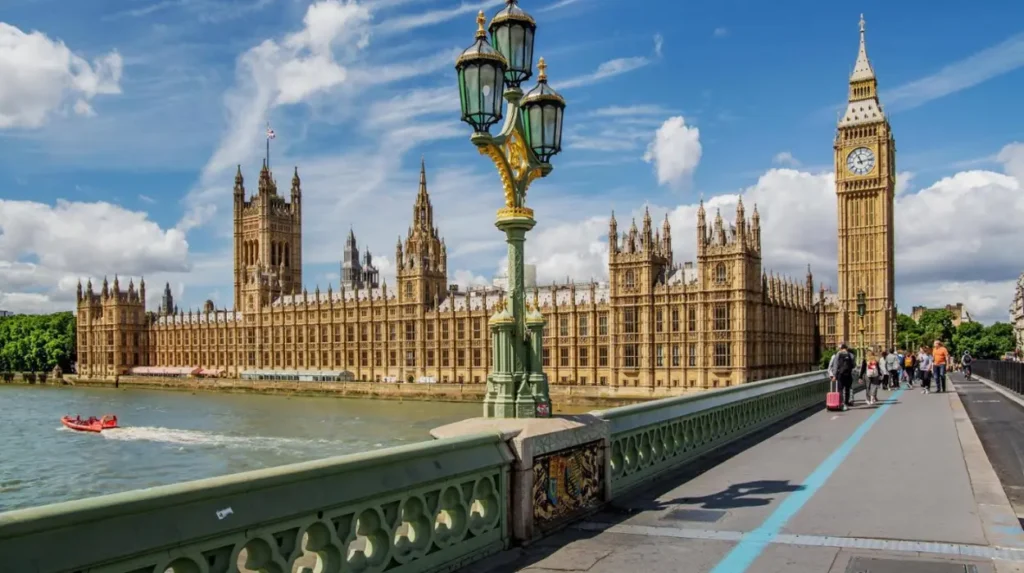
Westminster Bridge provides one of the most recognisable viewpoints over the River Thames. Looking north from the bridge gives a direct view towards the Palace of Westminster and Elizabeth Tower, commonly associated with the name Big Ben.
Looking south brings the London Eye and County Hall into view.
The London Eye is a 135-metre observation wheel on the South Bank. It has 32 passenger pods and provides elevated views across central London. Its official visitor information identifies landmarks such as Buckingham Palace, St Paul’s Cathedral, Tate Modern and Wembley Stadium among the sights visible from the attraction.
County Hall is another important landmark on this section of the river. The historic building occupies the riverside immediately beside the London Eye. It forms part of the architectural setting of the South Bank and provides a useful reference point for exploring the wider riverfront.
The SEA LIFE London Aquarium is located inside County Hall, directly beside the London Eye. Its official visitor information places it on Westminster Bridge Road, SE1 7PB, and states that it is approximately a 5–7 minute walk from Westminster Tube station.
This section is particularly useful for visitors with limited time because several attractions are concentrated within a small area.
The river itself is also an attraction. Westminster Bridge creates a strong foreground for views towards Parliament, while the riverside promenade provides changing perspectives of the bridges, boats and opposite bank.
Visitors should also look across the river towards Westminster. The Palace of Westminster has a history spanning more than 900 years. Westminster Hall dates from 1097–1099 and remains the oldest building on the Parliamentary estate.
The present Palace of Westminster was largely created after the Great Fire of 1834 destroyed most of the earlier palace. Charles Barry’s rebuilding began in 1840, with Augustus Welby Pugin contributing substantially to the Gothic Revival architectural character.
The riverside view therefore connects modern attractions with some of Britain’s most important political and architectural heritage.
What are the best historic sights near Lambeth Palace?
Lambeth Palace and the Garden Museum form the principal historic cluster near the eastern side of Lambeth’s Thames Riverside. The area combines the long-established residence of the Archbishops of Canterbury with a medieval church, historic gardens, John Tradescant’s tomb and riverside heritage.
Lambeth Palace stands close to the Thames and has served as the London residence of the Archbishops of Canterbury for centuries. Its location is central to understanding the historical character of this part of Lambeth.
Immediately beside Lambeth Palace is the Garden Museum, housed in the former St Mary-at-Lambeth Church.
The museum describes itself as Britain’s only museum dedicated to the art, history and design of gardens. Its collection covers gardening history, while its archive preserves working records from leading British garden designers.
The building itself has much older origins than the modern museum. The Garden Museum records a wooden church on the site in 1062. The church later became associated with the Archbishops of Canterbury and their London residence at Lambeth Palace.
One of the site’s most important historical figures is John Tradescant the Elder, a seventeenth-century gardener and plant collector. His tomb remains in the churchyard.
Tradescant settled in Lambeth in 1629 and developed a home and botanical garden known as The Ark. The Garden Museum records that the collection included objects brought together from different parts of the world, including natural history specimens.
The former church was threatened with demolition during the twentieth century. Rosemary and John Nicholson established a campaign to save it, eventually securing a 99-year lease in 1976. The Museum of Garden History was established in 1977, creating the institution that later became the Garden Museum.
As you explore the modern site, you are crossing land with a deep heritage. Read about the full to understand its origins.
The Garden Museum now provides an important cultural stop away from the busiest tourist areas. Its location beside Lambeth Palace makes it especially relevant for visitors interested in architecture, horticulture, historic buildings and London’s religious history.
The surrounding streets also demonstrate how the riverside evolved from a historic religious and industrial district into a modern central London visitor destination.
What can you see between County Hall and Lambeth Bridge?
The stretch between County Hall and Lambeth Bridge contains a continuous sequence of riverside views, public spaces, historic buildings and major bridges. It connects the busy South Bank attractions with the quieter Lambeth Palace area and provides an effective walking route.
Walking east from County Hall takes visitors away from the immediate concentration of the London Eye and towards a more heritage-focused section of Lambeth.
The route provides views towards Westminster and the river while gradually bringing Lambeth Palace and the Garden Museum into focus.
The Thames Path is the natural framework for this journey. The National Trails organisation describes the Thames Path as a 185.2-mile (298-kilometre) route that follows the river through rural and urban landscapes before reaching Woolwich. It is generally flat and designed to be straightforward to navigate.
For visitors, the Lambeth section works well as a short urban walk. It does not require specialist walking equipment or long-distance hiking preparation.
Lambeth Bridge becomes an important landmark as the route continues.
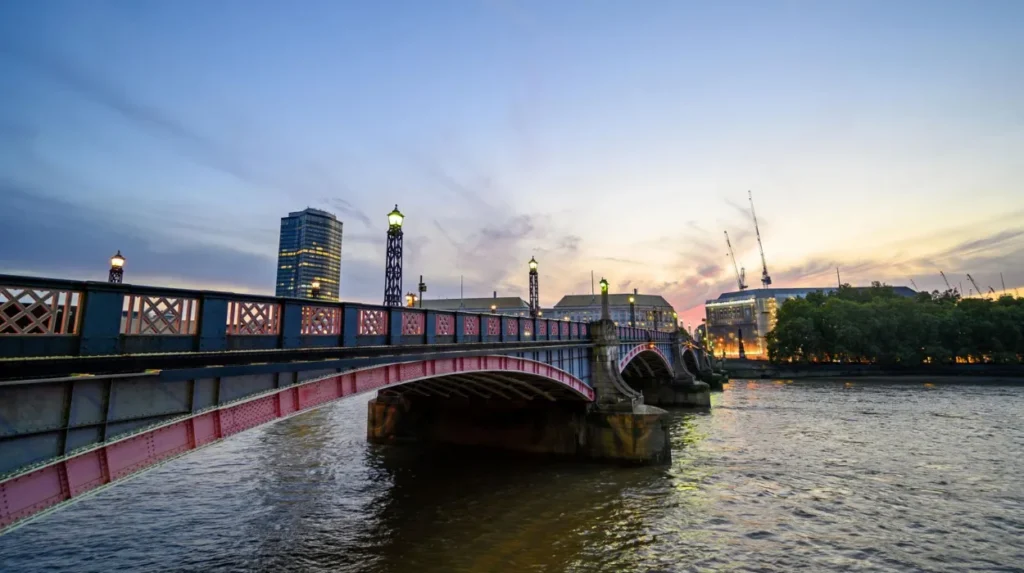
Historic England identifies the present Lambeth Bridge as a Grade II listed structure. The bridge measures 236.5 metres in total length and uses five steel arches supported by granite-faced reinforced-concrete piers.
The bridge opened on 12 July 1932, when it was inaugurated by King George V and Queen Mary. Its red colour also carries symbolic significance because it relates to the red benches of the House of Lords at the nearby Palace of Westminster.
The crossing has much older roots. Historic England records an ancient landing stage at the location dating from the thirteenth century. Before the modern bridges, a horse ferry operated between Lambeth and Millbank under the control of the Archbishop of Canterbury. The name Horseferry Road preserves this historical connection.
This makes Lambeth Bridge more than a transport structure. It represents the continuity of river crossings at this part of the Thames.
The embankment itself also has heritage value. Historic England lists the river embankment between the Houses of Parliament and Lambeth Bridge as a Grade II structure. The embankment wall dates from the mid-nineteenth century and forms part of the historic riverside landscape.
Which bridges are the best landmarks along Lambeth’s riverside?
Westminster Bridge and Lambeth Bridge are the two defining crossings for a Lambeth riverside sightseeing route. Westminster Bridge provides views towards Parliament and the London Eye, while Lambeth Bridge combines twentieth-century engineering with centuries of earlier river-crossing history.
Westminster Bridge is particularly important for first-time visitors because it connects two major sightseeing zones. The bridge stands beside the Palace of Westminster and directly opposite the London Eye and County Hall.
Its location creates a compact visual relationship between Parliament and the South Bank.
Lambeth Bridge has a different architectural character. Historic England describes it as a five-span steel arch bridge with a classical appearance. Its design incorporates stone, steel, decorative lamp standards and obelisks.
The bridge also forms part of a larger heritage group. Historic England identifies group value with nearby Lambeth Palace, the Palace of Westminster, Westminster Bridge and other listed buildings.
The two bridges therefore offer different experiences.
Westminster Bridge is strongly associated with central London’s political and tourist landmarks. Lambeth Bridge provides a more architectural and historical perspective.
For photographers, both bridges provide elevated viewpoints over the Thames. The river creates long sightlines, while the opposite bank provides dense architectural backgrounds.
The bridges also help visitors understand London’s geography. The Thames separates Lambeth from Westminster, but the bridges connect these areas within a short walking distance.
This connection has been important for centuries. Lambeth Bridge’s historical record demonstrates that people crossed the river at this location long before the current structure existed.
What historic landmarks can you see across the Thames from Lambeth?
The Palace of Westminster, Westminster Hall, Elizabeth Tower and Victoria Tower dominate the northern view from Lambeth’s Thames Riverside. These landmarks represent more than nine centuries of political, royal and architectural history and create the defining skyline across the river.
The Palace of Westminster, commonly called the Houses of Parliament, is the most significant landmark visible across the Thames.
UK Parliament states that the history of the Palace spans more than 900 years. The site developed from an Anglo-Saxon royal and religious centre into the home of the modern British Parliament.
Westminster Hall provides the oldest surviving part of the parliamentary complex. William II began constructing the hall in 1097, and it was completed in 1099. The hall measures approximately 73 metres by 20 metres.
The present Gothic Revival palace was constructed after the fire of 1834. Charles Barry won the design competition, and construction started in 1840. The House of Lords moved into its new chamber in 1847, while the House of Commons began using its new chamber in 1852.
Elizabeth Tower is another major visual feature. The name Big Ben properly refers to the Great Bell inside the tower, although the name is widely used for the tower itself. UK Parliament records that the Great Bell was first struck on 7 September 1859.
Victoria Tower stands at the southern end of the Palace. Its position creates a strong vertical counterpoint to Elizabeth Tower.
The view from Lambeth is especially valuable because the Thames separates the viewer from the parliamentary buildings. This creates a broad perspective across the river rather than the closer street-level views available on the Westminster side.
The riverside also reveals how the modern embankment forms part of the historic setting. The listed embankment between Parliament and Lambeth Bridge dates from the mid-nineteenth century and was constructed as part of the development of the Thames waterfront.
Is Lambeth’s Thames Riverside good for walking?
Lambeth’s Thames Riverside is well suited to walking because the Thames Path provides a mostly flat route, public transport connections are frequent, and major attractions are concentrated along a relatively short central London section. Visitors can combine sightseeing with a continuous riverside walk.
The Thames Path provides the principal walking framework.
The National Trails organisation describes the route as easy to reach by public transport and generally flat. Its London section passes through some of the capital’s most important urban landscapes.
A practical sightseeing route starts around Westminster Bridge and County Hall. From there, visitors can follow the riverside towards Lambeth Palace and continue towards Lambeth Bridge.
The route can be divided into several sightseeing sections.
The first section covers Westminster Bridge, County Hall and the London Eye. This is the busiest part and contains the highest concentration of major visitor attractions.
The second section follows the river towards Lambeth Palace. The atmosphere becomes more focused on historic buildings, public space and cultural attractions.
The third section reaches Lambeth Bridge, where the bridge itself becomes the main architectural landmark.
Visitors with more time can continue along the Thames Path beyond Lambeth Bridge. The National Trail extends much farther through London, eventually reaching Woolwich.
Walking also provides a clearer understanding of the relationship between Lambeth and Westminster. The river is not simply a backdrop. It explains the positioning of bridges, embankments, palaces, parliamentary buildings and transport routes.
The route also suits different types of visitors.
Tourists can use it to connect major attractions. Residents can use it for riverside walking and cultural visits. Digital nomads and business travellers can use the riverfront as a downtime route between meetings and central London transport connections.
The main practical consideration is crowd density. The Westminster Bridge and London Eye area attracts substantial visitor traffic. The Lambeth Palace section provides a different pace and a stronger concentration of heritage sites.
Explore More Area Guide
How Much Can You See in Lambeth in One Day? South London 2026
Is Lambeth Worth Visiting? South London Day Trip 2026
What is the best way to explore Lambeth’s Thames Riverside in one day?
A one-day Lambeth riverside itinerary works best when visitors combine Westminster Bridge, the London Eye, County Hall, the Thames Path, Lambeth Palace, the Garden Museum and Lambeth Bridge in a logical west-to-east walking sequence. This avoids unnecessary backtracking and maximises sightseeing time.
Start near Westminster Bridge to establish the geographical context.
From the bridge, look towards the Palace of Westminster and Elizabeth Tower. Then cross towards the Lambeth side and continue towards County Hall.
The London Eye is the most prominent modern landmark on this section. Its 135-metre height provides an elevated perspective over the city.
SEA LIFE London Aquarium provides another indoor attraction within County Hall. Its location directly beside the London Eye makes it easy to combine with the wider South Bank visit.
Continue along the Thames towards Lambeth Palace.
This section changes from a concentrated entertainment and tourism district into a heritage-focused environment. The Garden Museum is the principal cultural attraction near the palace.
The museum occupies the former St Mary-at-Lambeth Church, whose history extends back to the medieval period. Its displays focus on gardens, gardening, design and horticultural history.
After visiting the Garden Museum, continue towards Lambeth Bridge.
The bridge provides a strong endpoint for the central Lambeth riverside route. Its Grade II listing recognises its architectural and historic importance.
The route also provides repeated views across the Thames. This makes the journey itself an important part of the sightseeing experience.
Visitors with additional time can extend the walk beyond Lambeth Bridge along the Thames Path.
The itinerary also works in reverse. Visitors arriving from Vauxhall, Lambeth Palace or the wider South London area can begin at Lambeth Bridge and walk towards Westminster Bridge.
Why is Lambeth’s Thames Riverside worth visiting beyond the main attractions?
Lambeth’s Thames Riverside is worth exploring beyond its famous landmarks because the area combines public walking space, historic infrastructure, religious heritage, museums, bridges and river views. The wider experience reveals how London’s political, cultural and transport history developed around the Thames.
The most important feature of the riverfront is its layered history.
The area contains medieval religious connections around Lambeth Palace and St Mary-at-Lambeth. It contains nineteenth-century embankment engineering and major Victorian urban development. It also contains twentieth-century bridge engineering and contemporary attractions such as the London Eye.
The Garden Museum demonstrates how historic buildings can acquire new cultural functions. The former church was rescued from demolition and transformed into a museum dedicated to gardening history.
Lambeth Bridge demonstrates another aspect of preservation. Its modern structure remains part of a historic river-crossing location that has been used since at least the thirteenth century.
The Palace of Westminster provides the strongest example of long-term institutional continuity. Its history extends from medieval kingship through the development of Parliament and into modern democratic government.
The riverside therefore works as an open-air historical landscape.
Visitors can understand the development of London without moving between widely separated locations. The river provides the organising feature, while bridges and embankments provide the physical infrastructure that connects different historical periods.
The area also remains relevant to contemporary London. The Thames Path continues to function as a long-distance walking route, while the London Eye, County Hall and cultural institutions attract international visitors.
For first-time visitors, the best strategy is to combine the major landmarks with the spaces between them. Westminster Bridge, the London Eye, County Hall, Lambeth Palace, the Garden Museum and Lambeth Bridge form a connected sequence rather than separate destinations.
This approach provides a fuller understanding of Lambeth’s Thames Riverside and its relationship with Westminster, the South Bank and the wider River Thames corridor.
What are the best things to see along Lambeth’s Thames Riverside?
The best sights include the London Eye, County Hall, Westminster Bridge, Lambeth Palace, the Garden Museum and Lambeth Bridge. Visitors also get views of the Palace of Westminster, Elizabeth Tower and the River Thames.