Key Points
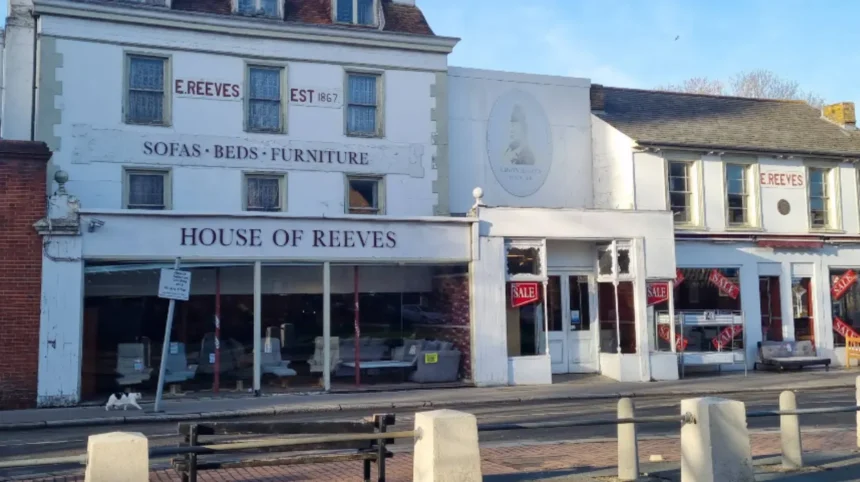
- Heritage Listing: The historic House of Reeves furniture store in Croydon has been officially designated as a site at risk by Historic England.
- Physical Condition: The Grade II-listed early 18th-century structure is currently listed in a “poor” and declining state, facing an ongoing threat of structural decay.
- Historical Significance: Infamously remembered for surviving partial destruction during the 2011 London riots, the establishment remains an iconic independent family business within the borough.
- National Register Overview: The updated 2026 Heritage at Risk Register highlights 197 newly added sites across the nation, including 16 vulnerable monuments and historic buildings located within Greater London.
- Regional Context: Across the capital, a total of 596 historic sites are now monitored on the register, balancing 16 new additions against 24 successful removals over the past year.
Croydon (South London News) November 6, 2026 — Croydon’s iconic House of Reeves furniture store has been added to Historic England’s 2026 Heritage at Risk Register.
As reported by media coverage across London news outlets, the public body for historic places released its annual update on November 5, placing the early 18th-century landmark alongside dozens of designated locations in urgent need of structural preservation. The decision highlights growing concern over the physical degradation of the Grade II-listed site, which operates as an independent, family-run home goods business.
The inclusion comes as part of a wider national survey by Historic England, which identified 197 new sites facing severe threats from neglect, structural decay, or unpromising futures. Within Greater London, 16 buildings and monuments were newly listed, bringing the regional total to 596 endangered assets. Assessors placed the House of Reeves property into the register’s “poor” category, warning that without targeted restoration, the fabric of the historic shopfront and structure will deteriorate further.
The building remains deeply rooted in local memory, having made global headlines in August 2011 when a adjacent portion of the business premises was destroyed by fire during the London riots. While the business persevered and continued trading from its remaining historic premises, the newly published register confirms that environmental wear and physical deterioration have posed fresh challenges to its ongoing survival.
Why was the historic Croydon furniture store included on the risk list?
The heritage designation reflects ongoing concern regarding the maintenance of early 18th-century timber frames and masonry present in commercial heritage properties. According to documentation compiled by Historic England, the structure’s structural envelope requires intervention to prevent long-term decay. The assessment noted that prolonged exposure to weather, alongside normal operational wear on a multi-century-old frame, has contributed to its declining state.
As detailed in reporting by local journalists covering the London heritage sector, the building stands as one of the few surviving representations of pre-industrial retail architecture in the heart of Croydon Old Town. Heritage officers conduct annual visual inspections to judge whether listed buildings meet the threshold for inclusion, focusing on visible neglect, water ingress, and masonry degradation.
The inclusion on the register provides a pathway toward formal conservation strategies. While a “poor” condition rating signals an urgent requirement for maintenance, it also opens opportunities for owners to access technical guidance, planning assistance, and dedicated heritage grant funds to stabilise historic structures.
What is the wider scope of the 2026 Heritage at Risk Register across London?
The addition of the House of Reeves forms part of a broad audit evaluating thousands of listed structures, conservation areas, and scheduled monuments across the country. Historic England confirmed that 16 historic structures in London joined the register this year due to structural instability or decay.
Among the newly added capital sites is Kirkaldy’s Testing Works at 99 Southwark Street, a Grade II*-listed Victorian engineering laboratory suffering from water ingress and damp. Other notable additions include the Tower Hamlets Local History Library and Archives, alongside several municipal structures facing maintenance backlogs.
Despite the new listings, the report noted progress across the region. Twenty-four sites were officially removed from the London register following successful conservation schemes, including a Georgian terraced house in Tottenham repurposed into creative studios and historical structures within Wanstead Park. Nationally, Historic England directed over £1.5 million in repair grants across London during the 2025/2026 financial period to support endangered buildings.
Background of the particular development
The House of Reeves holds a notable position in South London’s commercial history, operating continuously from its site in Church Street since the mid-19th century. Founded in 1867 by Edwin Reeves, the business expanded across multiple generations of the same family, eventually giving its name to the local road intersection, known locally as Reeves Corner.
The premises originally comprised two principal buildings facing the junction. However, during the summer riots of August 2011, a major portion of the complex—a corner building dating from the late 19th century—was completely destroyed by arson. The images of the blaze became one of the defining visual events of the 2011 disturbances across the United Kingdom.
Following the disaster, the Reeves family elected to continue trading from the adjacent, older Grade II-listed building across the street, which survived the fire. This remaining structure dates back to the early 18th century, featuring traditional timber framing, historic brickwork, and period shopfront details. Over the subsequent decade, maintaining an aging, listed commercial structure presented financial and logistical complexities typical of historical timber-framed buildings in dense urban centres.
Historic England’s Heritage at Risk Register is published annually to provide a public ledger of listed buildings, scheduled monuments, battlefield sites, and conservation areas that are at risk of being lost as a result of neglect, decay, or inappropriate development. Buildings placed on the list remain in the hands of their respective private or public owners, but receive priority assessment for technical advice, local authority planning support, and grant funding eligibility.
Prediction: How this development can affect the local community and business owners
The formal addition of the House of Reeves to the Heritage at Risk Register will directly influence several local stakeholder groups, primarily the business owners, local residents, and urban planners within the London Borough of Croydon.
For the family business owners, placement on the register marks a critical juncture. While the classification highlights immediate preservation challenges, it simultaneously opens avenues to specialized heritage funding. Listed status on the register typically grants priority access to Historic England repair grants and heritage capital funds, which can alleviate the financial burden of costly traditional restoration methods. Consequently, the owners may be able to secure matched funding or specialized architectural consultation to restore the timber frame and exterior masonry without diverting core operational capital from their retail business.
For the local Croydon community and heritage advocates, the listing is likely to act as a catalyst for public interest and regeneration focus around Reeves Corner. The area has long served as a visual anchor for Croydon’s historic Old Town. Heightened scrutiny from Historic England often encourages local councils to prioritize surrounding public realm improvements, public safety measures, and heritage-led urban planning policies.
For surrounding commercial operators and property owners, targeted investment in the House of Reeves could generate positive economic spillover effects. Heritage restoration projects frequently boost footfall in historic high streets by improving visual amenity and streetscape cohesion. Conversely, if repairs are delayed, the visible degradation of a prominent gateway building could weigh on local consumer confidence and lower aesthetic standards along the Church Street commercial corridor. The listing thus creates a clear timeline for structured planning enforcement and collaborative conservation efforts over the coming years.