Lambeth is one of South London’s most varied film and television landscapes. The borough combines riverside views, Victorian parks, historic streets, housing estates, markets, cultural venues and distinctive neighbourhoods. Its location library reflects this variety, covering areas from the South Bank and Vauxhall to Brixton and Streatham. Film Lambeth, the London Borough of Lambeth’s official film office, manages professional filming on council land and public roads and maintains a dedicated location library for productions.
- Why is Lambeth important for film and television locations?
- Which Lambeth locations are most recognisable on screen?
- Where can visitors explore Lambeth’s historic film locations?
- What can visitors discover about filming in Brixton?
- Which Lambeth parks and green spaces have filming connections?
- Where can visitors see riverside film and television settings?
- Which Lambeth buildings and housing estates appear in screen productions?
- How can visitors create a Lambeth film-location walking route?
- What should visitors know about filming permissions in Lambeth?
- Why does Lambeth’s screen heritage remain relevant for visitors?
- Where can visitors find reliable information about Lambeth filming locations?
For visitors, Lambeth’s screen heritage is accessible through ordinary streets and public spaces rather than one single attraction. A film-location visit can therefore combine cinema history with walking, architecture, parks, markets and riverside sightseeing. Several locations also have documented connections with important British films and television productions.
The borough has a particularly strong relationship with films that use London as a real setting. Passport to Pimlico, Melody, We Are the Lambeth Boys, My Beautiful Laundrette and more recent television productions demonstrate how Lambeth’s streets have represented different periods, communities and fictional places. The locations also show how production techniques use real urban environments to create settings that remain recognisable after filming ends.
Why is Lambeth important for film and television locations?
Lambeth is important because its geography provides riverside landmarks, historic streets, markets, parks, estates and distinctive urban architecture within one London borough, giving film and television productions varied settings while allowing visitors to explore many screen-associated places during ordinary sightseeing.
Film Lambeth describes the borough as an inner London area with two miles of River Thames frontage extending from the South Bank to Vauxhall. Southwards, the borough includes Brixton and Streatham, alongside substantial green spaces such as Brockwell Park.
This geographical range explains the density of potential filming environments. A production requiring an international-looking cityscape can use the South Bank or Albert Embankment. A production requiring residential streets can use locations such as Roupell Street, Killyon Road or Tunstall Road. Parks provide open landscapes, while housing estates provide distinctive post-war architecture.
Film Lambeth’s current location library is divided into categories including parks and open spaces, city and urban locations, sports and leisure venues, buildings, estates and flats, cemeteries, unit bases, town squares and libraries.
For visitors, this means Lambeth is better understood as a distributed film landscape. The screen heritage is embedded across the borough rather than concentrated inside a single museum.
The range also reflects the development of London filmmaking. Productions can use real streets to establish place, create period settings, represent fictional neighbourhoods or provide backgrounds for individual scenes.
Which Lambeth locations are most recognisable on screen?
The most recognisable Lambeth filming environments include Brixton Market and Electric Avenue, Roupell Street, Lower Marsh, Albert Embankment, Belvedere Road, Brockwell Park, Kennington Park, Vauxhall Pleasure Gardens and several distinctive residential estates.
Film Lambeth’s official location library identifies numerous streets and urban settings across the borough. Its city and urban category includes Brixton Market, Roupell Street, Lower Marsh, Albert Embankment, Tunstall Road, Cornwall Road, Theed Street, Vauxhall Walk, Belvedere Road and The Cut.
These locations offer different visual characteristics.
Riverside areas provide views towards central London landmarks. Albert Embankment gives views across the River Thames towards the Palace of Westminster and Big Ben. Belvedere Road provides views towards the London Eye and incorporates major South Bank buildings such as the Southbank Centre and National Theatre.
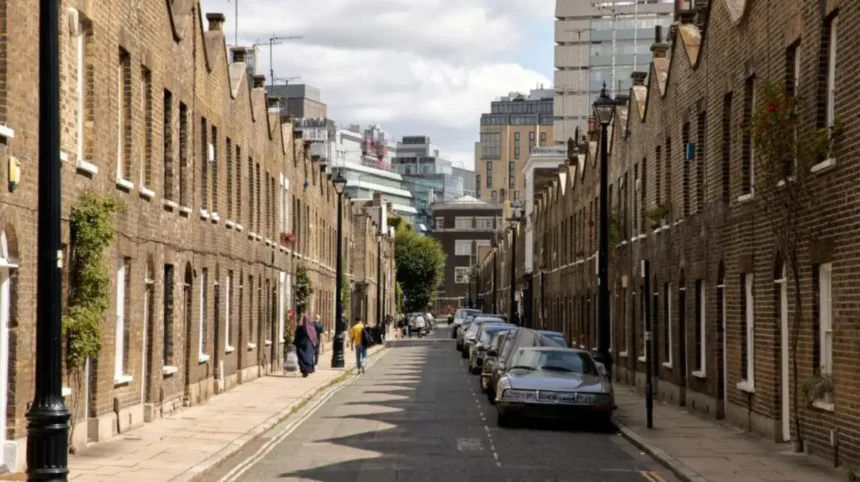
Historic streets create a different screen identity. Roupell Street and nearby Lower Marsh form part of the Waterloo area and provide traditional residential and commercial architecture within walking distance of major cultural attractions.
Brixton provides a contrasting environment. The area combines markets, railway infrastructure, independent businesses, residential streets and distinctive twentieth-century architecture. Film Lambeth specifically lists Brixton Market and several Brixton streets within its location library.
This mixture allows visitors to identify different visual languages within relatively short journeys. A riverside walk can lead into a historic street environment, while a journey south reaches the market streets and parks of Brixton.
Where can visitors explore Lambeth’s historic film locations?
Visitors can explore historic film locations around Kennington, Lambeth Road, Hercules Road and nearby streets, where productions including Passport to Pimlico, Melody and We Are the Lambeth Boys recorded scenes or documented everyday life.
Lambeth has a particularly strong connection with post-war British cinema. The 1949 Ealing comedy Passport to Pimlico is an important example because scenes representing Pimlico were filmed in Lambeth. The British Film Institute explains that much of the apparent Pimlico environment was constructed on a bombsite around Lambeth Road, while surviving buildings and streets also appear in the film.
The film demonstrates an important feature of location cinema. The fictional geography presented on screen does not always match the real administrative geography. Lambeth locations represented another part of London because the production required suitable streets and spaces.
The Kennington area also has a major connection with Melody, the 1971 British film directed by Waris Hussain. Lambeth Council has described a dedicated “Melody Fair” film heritage walk exploring Kennington locations used by the film. The council’s event information records that the film was released in 1971 and that 400 pupils from Archbishop Temple School appeared as extras.
Visitors interested in this history can therefore approach Lambeth through cinema as well as conventional heritage. As you explore the modern locations, you are crossing land with a deep heritage. Read about the full to understand its origins.
We Are the Lambeth Boys, directed by Karel Reisz and released in 1959, provides another perspective. The documentary focuses on young people connected with Alford House Youth Club in Kennington and records aspects of everyday life in South London. Its naturalistic approach makes streets, youth spaces and local activity part of the film’s subject rather than simply a backdrop.
What can visitors discover about filming in Brixton?
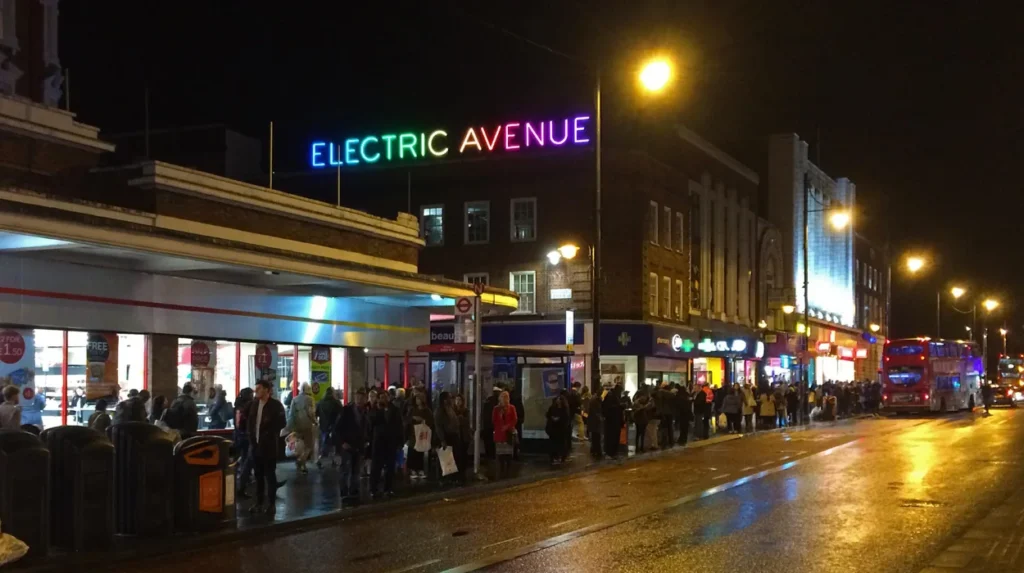
Brixton offers one of Lambeth’s strongest concentrations of screen locations, with Brixton Market, Electric Avenue, local streets and housing estates appearing in films and television productions ranging from historical cinema to contemporary streaming drama.
Brixton’s screen identity is closely connected with its distinctive streets and commercial spaces. Electric Avenue, built in 1888, was among the first streets in Britain to receive electric street lighting. Lambeth’s Active Lambeth programme identifies Electric Avenue as a filming location for Baby Reindeer, Supacell, Queenie and Big Zuu 12 Dishes in 12 Hours.
This gives visitors an especially useful screen-walking area. Electric Avenue connects directly with the wider Brixton Market environment, allowing a visitor to combine filming-related exploration with food, shopping, architecture and public transport.
Brixton has also appeared in earlier productions. Sources documenting local filming identify the 1980 film Babylon as using Atlantic Road beneath the railway bridge. The area has also been used for The Man from U.N.C.L.E., Marcella and other productions.
Queenie, the Channel 4 television adaptation of Candice Carty-Williams’ novel, provides a more recent example. Filming-location reporting identifies Lambeth Town Hall and Mursell Estate among locations used for the series.
The significance of Brixton lies in the combination of commercial streets, public spaces and residential architecture. Productions can use the same neighbourhood to create very different scenes. Visitors can therefore identify filming environments without needing to enter private premises.
Brixton also demonstrates how contemporary television uses established neighbourhood identities. Screen productions can retain real street names and recognisable landmarks, creating a strong connection between the fictional narrative and the physical city.
Which Lambeth parks and green spaces have filming connections?
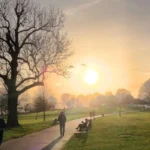
Lambeth’s filming landscape includes Brockwell Park, Kennington Park, Myatt’s Fields Park, Vauxhall Pleasure Gardens, Streatham Common, Ruskin Park and other public green spaces that provide formal gardens, open lawns, mature trees and distinctive urban settings.
Film Lambeth lists a substantial range of parks and open spaces in its official location library. These include Brockwell Park, Kennington Park, Myatt’s Fields Park, Vauxhall Pleasure Gardens, The Rookery at Streatham Common, Ruskin Park, Larkhall Park, Norwood Park, Rush Common and Stockwell Skate Park.
Brockwell Park is one of the borough’s most significant filming environments. It combines large areas of open landscape with Brockwell Hall, a restored Grade II* listed Georgian mansion. Film Lambeth describes Brockwell Hall as an early eighteenth-century building containing ornate rooms, a large hall, courtyard, coach house and stable block.
This architectural combination creates different production possibilities within one site. Exterior scenes can use parkland, trees and open lawns. Interior scenes can use the historic mansion and associated spaces, subject to permissions and availability.
Kennington Park provides another distinct environment. Film Lambeth describes it as a Victorian-era public park with winding paths, mature trees, an old English flower garden and rose beds. The park is located on Kennington Park Road and normally opens from 7.30am until 15 minutes before sunset.
Myatt’s Fields Park has also remained part of Lambeth’s contemporary production economy. Reporting based on Lambeth Council data recorded filming revenue from the park in recent financial years and identified productions including Man vs. Baby and Amandaland as recent users of the location.
For visitors, parks provide a particularly accessible way to explore filming landscapes because their visual characteristics remain visible even when no production is taking place.
Where can visitors see riverside film and television settings?
Visitors can discover riverside screen settings along Albert Embankment, Albert Embankment Gardens and Belvedere Road, where the River Thames, bridges, central London landmarks, public spaces and major cultural buildings create distinctive film and television backgrounds.
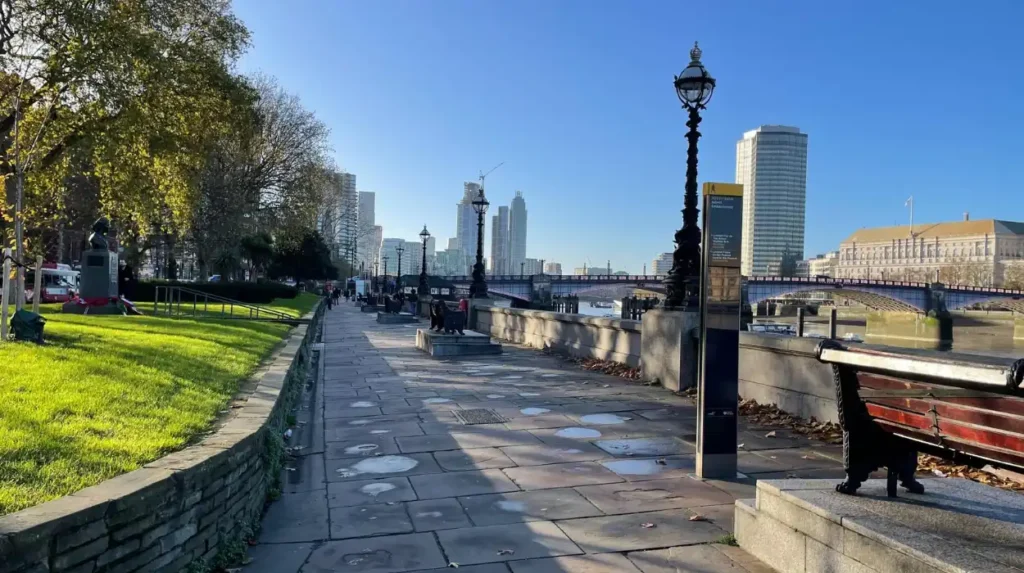
The South Bank is one of Lambeth’s most recognisable visual environments. Film Lambeth lists Albert Embankment and Belvedere Road among its urban filming locations. Albert Embankment provides views across the Thames towards the Palace of Westminster and Big Ben, while Belvedere Road provides views towards the London Eye.
Albert Embankment Gardens forms a chain of small open spaces between Vauxhall and Waterloo. Film Lambeth identifies the gardens as a location with riverside paths and views towards major central London landmarks.
These locations are valuable for screen productions because they establish London immediately. A camera positioned along the river can include bridges, historic buildings, modern architecture, buses and the Thames within one composition.
The South Bank also demonstrates the importance of land ownership in filming. The official South Bank destination organisation explains that the area spans the riverside from Lambeth Bridge to Blackfriars Bridge and contains land controlled by different organisations. Commercial or editorial filming requires permission from the relevant landowner.
Film London similarly identifies the South Bank as an area where filming permission is required because different landowners and agencies manage different sections.
For visitors, this distinction matters. Walking along a public route and filming commercially are separate activities. Casual photography for personal use does not provide the same rights as an organised production.
Which Lambeth buildings and housing estates appear in screen productions?
Lambeth’s buildings and housing estates provide production settings ranging from Georgian architecture and civic buildings to post-war residential estates, Brutalist structures and modern interiors, creating visual environments suited to period drama, contemporary television and urban cinema.
Film Lambeth maintains a dedicated category for estates and flats. The current library includes Larkhall Estate, Loughborough Estate, Mursell Estate, Notre Dame Estate, South Lambeth Estate, Springfield Estate, Central Hill Estate, Southwyck House and Vauxhall Gardens Estate.
Housing estates are particularly significant because they document changing approaches to urban design. Their layouts include blocks, walkways, courtyards, communal areas and distinctive façades. These features provide production designers with authentic environments that differ from conventional Victorian terraces or central London landmarks.
Mursell Estate is associated with Queenie, demonstrating how a contemporary television production used a real Lambeth residential environment.
Kennington also has a long screen history involving residential environments. Melody used locations in the area, while We Are the Lambeth Boys documented local youth culture and everyday environments in the late 1950s.
Historic civic architecture adds another layer. Lambeth Town Hall, located in Brixton, has appeared in screen productions including Queenie. Its Edwardian Baroque architecture provides a strong visual contrast with Brixton’s commercial streets and modern residential buildings.
Visitors should remember that residential estates remain working communities. A filming connection does not turn a private entrance, communal area or resident-only space into a visitor attraction. Responsible film-location tourism keeps public access and residents’ privacy separate.
How can visitors create a Lambeth film-location walking route?
Visitors can create a Lambeth film-location walk by grouping nearby screen sites into South Bank, Kennington, Brixton or southern Lambeth sections, then combining documented filming locations with public streets, parks, markets and transport connections.
A practical route begins around the South Bank. Belvedere Road, Albert Embankment and Albert Embankment Gardens provide riverside scenery and views towards major London landmarks. The area also contains the National Theatre and Southbank Centre, both important cultural reference points.
A second route can focus on Kennington. Visitors can explore Kennington Park and the streets associated with Melody, alongside the wider Lambeth Road and Hercules Road area connected with Passport to Pimlico. The BFI’s research into Passport to Pimlico provides useful historical context for understanding how Lambeth represented another London neighbourhood on screen.
A Brixton route can centre on Brixton Market and Electric Avenue. The Active Lambeth information provides a current connection between Electric Avenue and productions such as Baby Reindeer, Supacell and Queenie.
Visitors interested in parks can add Brockwell Park to a southern route. The park combines extensive green space with Brockwell Hall and offers a different visual environment from central Lambeth.
Transport makes these areas practical to combine, but a full borough-wide route requires planning. Lambeth stretches from the central riverside to Streatham, so attempting every screen location during one short visit creates unnecessary travel.
A themed route therefore works better than a comprehensive checklist. Visitors can choose historic cinema, contemporary television, Brixton screen culture, riverside London or green-space filming.
What should visitors know about filming permissions in Lambeth?
Visitors should distinguish sightseeing from professional filming because Lambeth requires permits for filming on council land and public roads, while other sites such as the South Bank can involve separate landowners and permission requirements.
Film Lambeth states that professional filming and photography on council land or public roads is licensed through the council’s film office. The service coordinates issues involving highways, parking, housing, leisure, traffic management and other relevant stakeholders.
Film Lambeth also states that filming activity must not begin until a filming permit has been granted and relevant terms and conditions have been agreed. Production applicants are required to provide location-specific risk assessments and method statements addressing risks to cast, crew and the public.
The 2026/27 Film Lambeth fee schedule illustrates the scale of this system. Listed charges vary according to crew size, filming duration and location requirements. The published schedule includes separate administrative fees for different crew sizes and separate charges for filming on location, street filming, traffic controls, parking permits and unit bases.
The distinction is important for screen-location visitors. Taking personal photographs while walking through a public place is different from organising a commercial production.
South Bank requires particular attention because different organisations control different sections of land. Film London states that locations such as the South Bank and transport sites require permission for filming.
Private buildings, residential properties, housing estates and interiors also require permission from the relevant owner or managing organisation. Visitors should never assume that a location listed in a film database is automatically open for unrestricted access.
Explore More Area Guide
Lambeth Green Spaces: Best Parks to Visit in London
Best Family Picnic Places in Lambeth: Parks and Green Spaces
Why does Lambeth’s screen heritage remain relevant for visitors?
Lambeth’s screen heritage remains relevant because productions preserve changing images of London, while the real locations continue to function as streets, markets, parks, homes and cultural spaces that visitors can explore without treating them as conventional film attractions.
Film locations provide a record of urban change. A production from 1949 captures a different Lambeth from a documentary made in 1958 or a television drama produced in the 2020s. Buildings, streetscapes, transport infrastructure and public spaces change over time.
Passport to Pimlico demonstrates this historical value through its use of Lambeth locations to represent Pimlico. The BFI’s research shows how production design combined constructed sets with genuine buildings and streets.
We Are the Lambeth Boys provides a different record because its subject was everyday life among young people in Kennington. The film therefore has documentary value as well as screen-location significance.
Contemporary productions provide another layer. Electric Avenue is now documented by Lambeth as a location associated with several recent productions, including Baby Reindeer, Supacell and Queenie.
The continuing use of Lambeth for production also reflects the borough’s formal infrastructure for filming. Film Lambeth maintains a location library covering urban streets, buildings, parks, estates and specialist spaces.
For visitors, this creates an unusual type of cultural experience. The locations are not frozen exhibits. They remain part of everyday South London.
A responsible film-location visit therefore focuses on public viewpoints, historical context and visible architectural features. It avoids trespassing, obstructing residents, entering private spaces or treating active production areas as tourist attractions.
Lambeth’s film heritage is ultimately best understood as part of the borough’s wider cultural geography. Cinema and television have recorded its streets, communities, architecture and landscapes across different decades. Those same environments continue to shape the experience of visiting South London today.
Where can visitors find reliable information about Lambeth filming locations?
The most reliable starting point is Film Lambeth, the official film office of Lambeth Council, supported by the British Film Institute, Lambeth Council heritage information and official location pages for specific parks, streets and buildings.
Film Lambeth provides the borough’s official location library and identifies locations across categories such as parks, urban areas, buildings and estates. It also provides information for professional filming applications and location management.
Lambeth Council provides additional information about filming services and heritage-related activities. Its Melody film heritage walk demonstrates how the council connects screen history with local heritage interpretation.
The British Film Institute is another valuable source for historical screen research. Its work on Passport to Pimlico documents the relationship between the film’s fictional geography and its actual Lambeth filming locations.
Film London provides wider guidance on filming permissions across the capital. This is particularly relevant for locations crossing borough boundaries or involving transport infrastructure, private landowners and major London landmarks.
Visitors should use these sources when a screen location needs verification. Online filming databases and fan-created location maps provide useful leads, but official council and institutional records provide stronger evidence for current access, permissions and location management.
Lambeth’s screen landscape is extensive enough to support several different visitor experiences. Historic film enthusiasts can focus on Kennington and older productions. Television viewers can explore Brixton. Architecture enthusiasts can examine estates and civic buildings. Riverside visitors can combine screen locations with central London landmarks. Park visitors can explore locations such as Brockwell Park and Kennington Park.
The result is a film-location experience integrated into the wider geography of South London rather than separated from it.
For visitors seeking film and television locations, Lambeth offers a rare combination of documented screen history and accessible urban environments. Its streets, parks, markets, estates, riverside spaces and historic buildings continue to function as living parts of London while also preserving connections with British cinema and television.
What are the most famous film locations in Lambeth?
Lambeth has several recognisable filming locations, including Brixton Market, Electric Avenue, Roupell Street, Lower Marsh, Albert Embankment, Belvedere Road, Brockwell Park and Kennington Park. These locations have featured in British films, television series and contemporary productions.