Lambeth contains some of South London’s most important surviving historic structures, ranging from medieval religious buildings to Georgian streetscapes and early industrial landmarks. The strongest concentration of ancient fabric is around Lambeth Palace and St Mary-at-Lambeth, while other surviving heritage sites extend towards Streatham, Clapham and Brixton.
- Where is the oldest surviving building in Lambeth?
- What can visitors see at St Mary-at-Lambeth today?
- Why is Lambeth Palace one of Lambeth’s most important medieval sites?
- How can visitors understand the relationship between St Mary-at-Lambeth and Lambeth Palace?
- Where can visitors see Lambeth’s oldest church outside the central Lambeth area?
- What historic buildings can visitors see in Clapham?
- Where can visitors see Lambeth’s surviving early industrial architecture?
- How should visitors plan a Lambeth historic buildings walk?
- Why do Lambeth’s surviving historic buildings matter today?
Lambeth’s historic buildings are especially significant because the modern borough developed from several older settlements. Medieval Lambeth grew beside the River Thames, while villages such as Streatham and Clapham developed further south. Later expansion added Georgian terraces, Victorian churches, industrial buildings and civic architecture.
Historic England records more than 2,000 statutory listed buildings in the London Borough of Lambeth. These include nationally important structures ranging from individual buildings to architectural groups and historic features.
For visitors searching specifically for Lambeth’s oldest surviving buildings, the most important places are St Mary-at-Lambeth, Lambeth Palace and St Leonard’s Church in Streatham. Brixton Windmill and surviving Georgian buildings in Clapham provide additional evidence of Lambeth’s later development.
Where is the oldest surviving building in Lambeth?
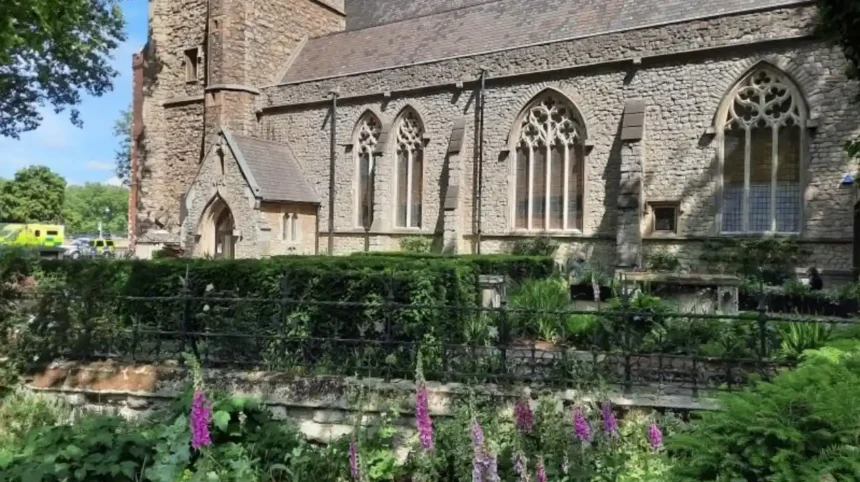
The oldest surviving structure in Lambeth is the medieval tower of St Mary-at-Lambeth, now incorporated into the Garden Museum. Built in 1377, the tower survives from the medieval rebuilding of the church and is identified as Lambeth’s oldest surviving structure.
The St Mary-at-Lambeth site stands on Lambeth Palace Road beside Lambeth Palace and the River Thames. The church itself has much older origins than the surviving tower. The site was associated with a church before the Norman Conquest, and St Mary-at-Lambeth is recorded in the Domesday Survey of 1086.
The present medieval tower dates from 1377, when the church was rebuilt in stone. Repairs took place in 1834–35, but the tower retained its medieval core. The Garden Museum identifies it as the oldest surviving structure in the borough.
The building later ceased to function as a parish church. It now houses the Garden Museum, Britain’s museum dedicated to gardens and gardening history. This gives visitors an opportunity to experience the medieval structure while exploring a modern cultural institution.
The churchyard also retains historic monuments and graves. Among the best-known figures associated with the site are John Tradescant the Elder and John Tradescant the Younger, prominent seventeenth-century gardeners and plant collectors.
The site therefore combines several layers of Lambeth history: medieval religious architecture, the history of the Archbishops of Canterbury, garden history, historic burial monuments and modern museum use.
Visitors should distinguish between the age of the site and the age of the surviving building fabric. The religious site is considerably older than the present tower, while the tower represents the principal surviving medieval structure.
What can visitors see at St Mary-at-Lambeth today?
Visitors can see the medieval tower, historic church fabric, monuments, the former church interior and the surrounding churchyard at the Garden Museum. The site connects a fourteenth-century surviving structure with exhibitions about British gardening, architecture, people and landscape history.
The Garden Museum occupies the former St Mary-at-Lambeth Church. Its location next to Lambeth Palace makes it one of the most historically concentrated visitor areas in South London.
The medieval tower is particularly important. It was constructed in 1377 and repaired during the nineteenth century. The tower has 131 steps, and the Garden Museum describes it as the oldest part of its building.
The tower also has an important connection with the history of London’s visual record. The artist Wenceslaus Hollar is thought to have stood on the tower in 1647 while producing his Prospect of London and Westminster. The elevated position provided views across the River Thames towards Westminster.
The church contains historic monuments associated with notable figures. A particularly important example is the chantry tomb of Hugh Peyntwyn, who died in 1504. The Garden Museum identifies it as the earliest known example of a particular wall-monument design associated with the royal workshops.
The churchyard is also significant. John Tradescant the Elder was buried there in 1638, while his son John Tradescant the Younger was commemorated by a decorated tomb erected by his widow Hester after his death in 1662. Admiral William Bligh, associated with the Bounty mutiny, was also buried in the family tomb at St Mary-at-Lambeth in 1817.
The Garden Museum currently provides access to the former church as a museum and cultural venue. Visitors should check current arrangements before travelling because tower access and individual events can change. The museum states that its medieval tower has been closed temporarily for maintenance, with reopening planned later in 2026.
Why is Lambeth Palace one of Lambeth’s most important medieval sites?
Lambeth Palace is one of Lambeth’s principal medieval survivors and has been the London residence of the Archbishops of Canterbury since 1197. Its surviving complex includes medieval towers, a thirteenth-century chapel, a fifteenth-century crypt and the historic Morton’s Tower gatehouse.
Lambeth Palace is one of the most important historic complexes in South London. The Archbishops of Canterbury first occupied the site in 1197. Historic England records the Palace as a Grade I listed building.
The complex does not represent one single building from one period. It contains structures constructed and altered over several centuries. This makes Lambeth Palace particularly valuable for understanding the architectural development of an important ecclesiastical residence.
The surviving elements include the thirteenth-century chapel, a fifteenth-century crypt, the Lollards’ Tower from 1435, and Morton’s Tower and gatehouse from around 1490. The complex also includes later residential and ceremonial buildings.
The chapel is particularly important because its earlier crypt contains medieval fabric. Historic England describes the chapel as dating from the thirteenth century, with its earlier fifteenth-century crypt retaining some original plaster.
The Lollards’ Tower, also known as the Water Tower, dates from 1435. It was constructed from Kentish Ragstone with ashlar quoins and a brick turret. The building has had different practical functions during its history.
Morton’s Tower provides the principal historic gateway into the Palace complex. It was built around 1490 under Cardinal John Morton, Archbishop of Canterbury from 1486 until 1500. The gatehouse uses red brick, blue diapering and stone dressings.
The Palace also contains the Great Hall, rebuilt by Archbishop William Juxon in the seventeenth century. The present building dates from 1660–63 and incorporates late Gothic and Baroque architectural characteristics.
The Lambeth Palace conservation area reflects this concentration of historic fabric. Lambeth Council identifies the Palace as the heart of a conservation area that also includes St Mary’s former church, historic development along Lambeth Road and parts of the former St Thomas’ Hospital complex.
As you explore the modern site, you are crossing land with a deep heritage. Read about the full to understand its origins.
How can visitors understand the relationship between St Mary-at-Lambeth and Lambeth Palace?
St Mary-at-Lambeth and Lambeth Palace formed a closely connected medieval religious landscape beside the River Thames. The church served the local community while remaining closely associated with the Archbishops of Canterbury and their London residence immediately beside it.
The relationship between the two sites explains why this part of Lambeth contains such a high concentration of historic buildings.
Lambeth was not originally a dense urban district. During the medieval period, much of the Lambeth riverside remained relatively rural. A riverside settlement developed around the church, while Lambeth Palace became an important residence for the Archbishops of Canterbury.
Lambeth Council’s conservation-area assessment records that a church dedicated to St Mary existed in Lambeth before the Norman Conquest. The church was rebuilt between 1374 and 1377, leaving the surviving Ragstone tower as the principal surviving part of that medieval rebuilding.
The Palace developed on the neighbouring site. Historic England records the first occupation of the site by the Archbishops of Canterbury in 1197, followed by the construction of ecclesiastical and residential buildings.
This proximity created a distinctive historic group. The church served parish and burial functions, while the Palace served ecclesiastical, administrative and residential functions.
The relationship continued for centuries. Lambeth Council describes the surviving medieval Palace buildings, St Mary’s Church and the historic route of Lambeth Road as an exceptionally important group of medieval survivors.
For visitors, the advantage is practical. The two sites are next to each other, allowing a compact heritage walk rather than requiring separate journeys across the borough.
The area also demonstrates how Lambeth changed from a riverside settlement into part of metropolitan London. Medieval religious buildings survive beside major roads, public transport infrastructure, museums and modern residential development.
Where can visitors see Lambeth’s oldest church outside the central Lambeth area?
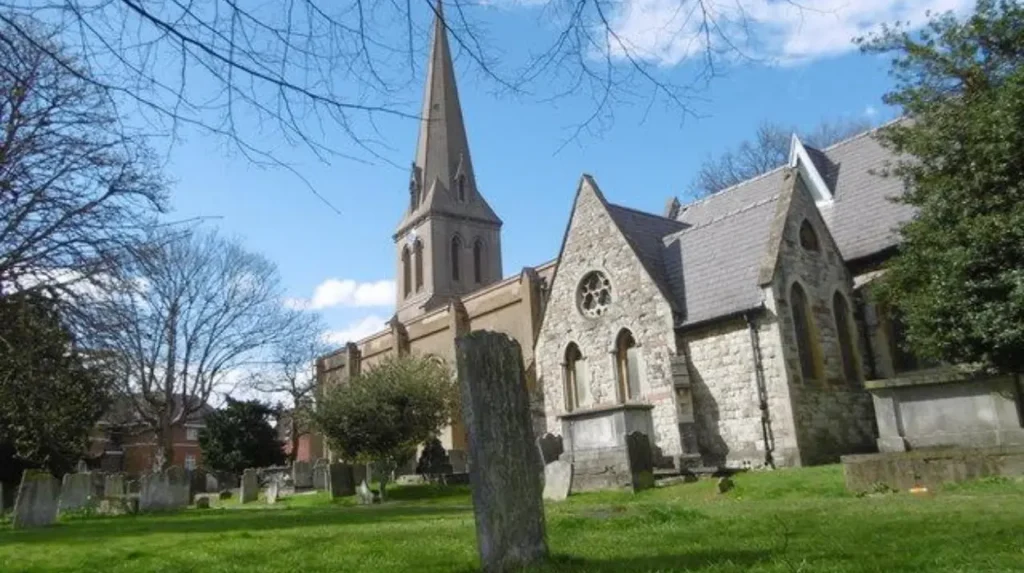
St Leonard’s Church in Streatham is one of Lambeth’s oldest surviving churches and the oldest building in Streatham. Its foundations have Saxon associations, while the surviving medieval tower dates from around the fourteenth century and forms the historic core of the present church.
St Leonard’s Church stands on Streatham High Road at the centre of the historic Streatham settlement. Lambeth Council describes it as one of the oldest churches in Lambeth.
The site has very early origins. A Lambeth Council conservation report identifies the church as Streatham’s oldest building and states that its foundations date back to Saxon times. The surviving tower is from the mid-fourteenth century.
The present church is therefore a combination of different historical periods. The main body was rebuilt around 1832, while the chancel was rebuilt in 1862. A major fire in 1975 caused extensive damage, after which the church was restored during 1975–77.
The medieval tower remains one of the most important historic elements. Historic England dates the church’s medieval origins to approximately 1350, while later architects and restoration campaigns changed much of the structure.
The interior contains historic monuments associated with several prominent local families and figures. These include monuments to Sir Edmund Tilney, Master of the Revels under Elizabeth I, and members of the Thrale family.
The churchyard adds another layer of heritage. Lambeth Council manages it as both a heritage and nature-conservation area. It contains historic tombs and memorials alongside trees, planting and wildlife habitat.
The churchyard is open to the public 24 hours a day, according to Lambeth Council. The church itself has different access arrangements, so visitors should check with the church before planning an interior visit.
This makes St Leonard’s particularly useful for visitors exploring South London beyond the Thames-side historic core. It demonstrates that medieval Lambeth was not limited to the Palace area.
What historic buildings can visitors see in Clapham?
Clapham retains substantial eighteenth-century architectural evidence rather than medieval buildings. Nos. 15 and 16 The Pavement are mid-to-late eighteenth-century listed buildings, while Holy Trinity Clapham dates from 1774–76 and demonstrates the later growth of the historic village.
Clapham’s historic character reflects a later stage of Lambeth’s development. Its surviving buildings are generally younger than the medieval structures around Lambeth Palace and St Mary-at-Lambeth.
One particularly useful example is 15 and 16 The Pavement. Historic England dates these buildings to the mid-to-late eighteenth century. They are three-storey structures built from stock brick, with architectural details including reeded pilasters, shaped brackets and an open pediment.
The buildings demonstrate the importance of historic commercial streets in eighteenth-century London. Their shopfronts and upper-storey architecture preserve evidence of the relationship between residential and commercial uses.
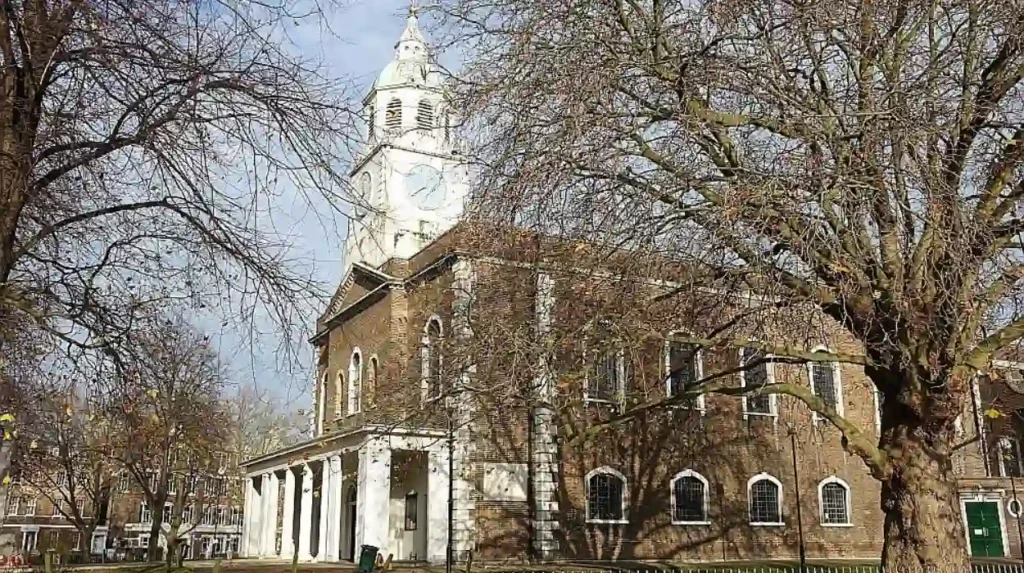
Another important building is Holy Trinity Clapham, located beside Clapham Common. Historic England dates the church to 1774–76 and attributes its design to Kenton Couse. Its west porch was added in 1812 by Francis Hurlbatt.
These buildings are not candidates for Lambeth’s oldest surviving structure. Their importance lies in showing how the borough expanded and changed after the medieval period.
Clapham Common also provides historic context for the area. The open landscape formed part of the setting within which the eighteenth- and nineteenth-century development of Clapham took place.
For visitors interested in architectural history, the area works well as a contrast with Lambeth Palace. The Palace represents medieval and ecclesiastical development, while Clapham’s surviving buildings illustrate Georgian urban growth.
Where can visitors see Lambeth’s surviving early industrial architecture?
Brixton Windmill is Lambeth’s most distinctive surviving early industrial structure. Built in 1816, the Grade II listed windmill is a conical brick tower in Blenheim Gardens and preserves evidence of the agricultural and industrial landscape that preceded modern Brixton.*
Brixton Windmill stands in Blenheim Gardens, close to Brixton Hill. Historic England dates the structure to 1816 and lists it at Grade II*, recognising its special architectural and historic interest.
The windmill has a conical brick structure with small segment-headed windows arranged across four levels. Its restored cap and replacement sails recreate the appearance of a working windmill while preserving the historic building itself.
Its location is important because modern Brixton is highly urbanised. The windmill provides direct physical evidence of an earlier landscape when agricultural production and wind-powered milling formed part of the area’s economy.
The structure also illustrates the difference between oldest and historic. At approximately 210 years old in 2026, Brixton Windmill is considerably younger than the medieval tower at St Mary-at-Lambeth or the medieval fabric of Lambeth Palace.
Nevertheless, it belongs in a Lambeth heritage itinerary because it documents an important period of local development.
Historic England’s National Heritage List records the windmill under the Planning (Listed Buildings and Conservation Areas) Act 1990, which provides statutory protection for listed buildings of special architectural or historic interest.
The windmill is therefore useful for visitors interested in the transition from rural landscapes to industrial and metropolitan South London.
Explore More Area Guide
Best Places to Learn About Lambeth’s Past | South London
Lambeth Industrial Heritage: Doulton, Vauxhall and Albert Embankment
How should visitors plan a Lambeth historic buildings walk?
A practical Lambeth heritage walk starts around Lambeth Palace Road, continues through St Mary-at-Lambeth and Lambeth Palace, then extends towards Streatham or Brixton for later historic buildings. This route moves chronologically from medieval religious architecture towards Georgian, Victorian and industrial heritage.
The most concentrated starting point is Lambeth Palace Road. St Mary-at-Lambeth and Lambeth Palace stand beside one another, creating a compact heritage area.
The Garden Museum is currently open seven days a week according to its published visitor information, although opening arrangements and temporary closures should be checked before travelling. The museum states that it is around a ten-minute walk from Vauxhall, Westminster, Waterloo and Lambeth North stations.
Visitors can begin with St Mary-at-Lambeth and focus on the medieval tower, historic church fabric, monuments and churchyard. The Garden Museum adds historical interpretation to the building and its associated garden heritage.
The next stop is Lambeth Palace. Its medieval towers, chapel, crypt and gatehouse demonstrate the development of an important ecclesiastical residence over several centuries. Because the Palace is an active institutional site, visitor access to individual buildings and areas depends on current arrangements.
The route can then continue southwards according to the visitor’s interests.
St Leonard’s Church in Streatham provides the strongest continuation for medieval and early parish history. Its Saxon associations and fourteenth-century tower extend the historical timeline beyond central Lambeth.
Brixton Windmill provides a different perspective. Its 1816 construction represents early nineteenth-century industry and the rural landscape that existed before Brixton’s later urban expansion.
Clapham provides another alternative. Nos. 15 and 16 The Pavement and Holy Trinity Clapham demonstrate eighteenth-century architectural development and the growth of Clapham as a suburban settlement.
This chronological approach helps visitors understand Lambeth as a changing landscape rather than a collection of isolated buildings.
Why do Lambeth’s surviving historic buildings matter today?
Lambeth’s surviving historic buildings provide physical evidence of more than eight centuries of development, from medieval ecclesiastical settlements to Georgian expansion and nineteenth-century industry. Their continued protection preserves architectural fabric, archaeological evidence, local identity and public understanding of South London’s changing landscape.
The importance of Lambeth’s historic buildings extends beyond individual architectural features.
The surviving medieval structures demonstrate the borough’s connection with the Archbishops of Canterbury and the historic riverside settlement around Lambeth Palace. St Mary-at-Lambeth provides evidence of parish life, burial practices and religious architecture extending back before the Norman Conquest.
The later buildings demonstrate another stage of development. Georgian Clapham records the expansion of suburban London, while Brixton Windmill represents an earlier economic landscape based on agriculture and wind-powered milling.
St Leonard’s Church provides evidence of an older settlement in Streatham, including early foundations and a medieval tower incorporated into a building that was repeatedly reconstructed.
Listed-building protection is an important part of this preservation system. Lambeth Council states that its statutory listed buildings are nationally important and protected by law. Historic England maintains the National Heritage List for England, which records the designation and significance of listed structures.
Lambeth’s historic environment is therefore not limited to museum objects. Visitors can encounter surviving medieval stonework, historic towers, churchyards, Georgian façades and industrial structures within the modern borough.
For tourists, the most significant concentration is around St Mary-at-Lambeth and Lambeth Palace. For visitors exploring further south, St Leonard’s Church, Brixton Windmill and Clapham’s Georgian buildings extend the story across different periods.
Together, these places show how Lambeth developed from medieval riverside and village settlements into a densely built part of modern London while retaining important elements of its earlier landscape.
What is the oldest surviving building in Lambeth?
The medieval tower of St Mary-at-Lambeth, now part of the Garden Museum, is generally identified as Lambeth’s oldest surviving structure. The tower dates from 1377, although the church site itself has much earlier origins.