Key Points
- Proposals to demolish part of the derelict Rose Lodge complex in New Malden to construct 92 new flats have been recommended for approval by local planning officers.
- The application contains zero affordable housing units, with the developer arguing that providing affordable homes would render the scheme financially unviable.
- The site originally belonged to the South West London and St George’s Mental Health NHS Trust before being declared surplus to requirements in 2012.
- South West London and St George’s Mental Health NHS Trust subsequently sold Rose Lodge and the Roseland Resource Centre to developer KK Investment Ltd in 2014 following the closure of services in 2013.
- The existing structures are currently functioning as temporary houses in multiple occupation (HMOs) while awaiting redevelopment decisions.
- Local planning policy generally mandates a minimum proportion of affordable housing on major developments, making the exemption recommendation a point of significant community debate.
New Malden (South London News) November 6, 2026 — Plans to demolish part of the disused Rose Lodge NHS complex in New Malden to construct 92 private flats, completely omitting affordable housing provision, have been formally recommended for approval by planning officers. The redevelopment proposal addresses a site that has stood largely vacant from its original clinical purpose for over a decade, following its identification as surplus to public healthcare operational needs by the NHS.
What are the specific proposals submitted for the Rose Lodge site?
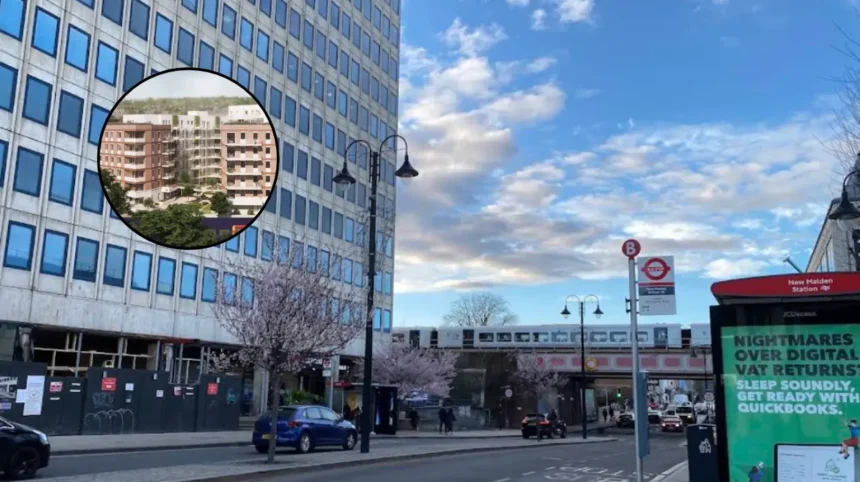
The planning application seeks full permission to clear the existing structures across the site, which includes Rose Lodge and the adjacent Roseland Resource Centre. In their place, the applicant proposes a modern residential block delivering 92 self-contained flats.
The submitted architectural design details a multi-storey development intended to maximise the footprint of the former medical grounds. However, the application specifies that none of the 92 units will be designated as affordable housing, whether through social rent, affordable rent, or shared ownership tenures.
Financial viability assessments submitted alongside the application contend that the costs associated with site clearance, infrastructure upgrades, and construction prevent the inclusion of below-market-rate housing while maintaining commercial feasibility. Planning officers reviewing the scheme accepted these financial arguments, recommending that the local planning authority grant permission despite local policy targets for affordable homes.
What is the history of the former NHS property?
The land was historically owned and operated by the South West London and St George’s Mental Health NHS Trust, serving as a facility for mental health support and outpatient services within the Royal Borough of Kingston upon Thames.
In 2012, following a broader review of its real estate portfolio and operational strategy, the NHS Trust formally declared the Rose Lodge complex surplus to requirements. The operational facilities at both Rose Lodge and the Roseland Resource Centre were officially decommissioned and closed to patients in 2013.
Following the closure, the South West London and St George’s Mental Health NHS Trust entered negotiations to dispose of the asset to generate capital for broader healthcare reinvestment. In 2014, the Trust completed the sale of the land and buildings to private developer KK Investment Ltd. In the years following the transaction, the developer converted the former clinical spaces into temporary houses in multiple occupation (HMOs) to generate rental income while longer-term redevelopment plans were drawn up and submitted.
Why has the lack of affordable housing raised local concern?
The decision to recommend approval for 92 market-rate flats without any affordable contribution has drawn scrutiny due to regional housing shortages and planning guidelines set by both the local council and the Greater London Authority. Typically, major residential developments in London are expected to deliver a minimum target of 35 per cent affordable housing on brownfield sites, unless robust financial evidence demonstrates that doing so would render the project unviable.
Community representatives and local residents have expressed concern over the loss of public land to purely private residential development without yielding affordable accommodation for local workers or lower-income families. Conversely, supporting documents filed with the planning authority argue that bringing a brownfield, derelict site back into active use provides much-needed overall housing stock, mitigates security issues associated with vacant property, and enhances the local urban footprint.
Background of the development
The trajectory of the Rose Lodge complex reflects a broader, decades-long trend across the United Kingdom where public sector bodies, particularly NHS trusts, have rationalised estate holdings to raise funds for modern clinical facilities. Under central government guidance, NHS entities have been encouraged to identify underutilised or obsolete land, declare it surplus, and sell it on the open market.
South West London and St George’s Mental Health NHS Trust has engaged in several similar disposals across its catchment area over the past decade, aiming to consolidate services into updated, centralized healthcare hubs such as those at Springfield University Hospital in Tooting and Tolworth Hospital. The sale of Rose Lodge in 2014 marked the end of direct public ownership for this specific site in New Malden.
When sites are transferred to private developers, local planning authorities must balance municipal housing targets against economic realities. The use of financial viability appraisals has become a standard mechanism in UK planning, allowing developers to demonstrate whether policy requirements—such as affordable housing percentages or community infrastructure levies—would make a project unbankable. In the case of Rose Lodge, the interplay between historic purchase costs, site preparation expenses, and current market conditions resulted in the planning recommendation to waive the standard affordable housing quota.
Prediction: How will this development affect local residents and the housing market?
If the planning committee follows the officers’ recommendation and grants formal approval, the decision will impact several key stakeholder groups in New Malden and the wider borough.
Local housing applicants and low-income residents
For individuals and families currently on the local council housing waiting list, the approval of 92 strictly private flats yields no direct relief. The absence of social or affordable rented units means that local residents requiring subsidized housing will not benefit from the turnover of this substantial plot of land. This may heighten local debate regarding how former public assets are repurposed to meet pressing community needs.
Local homeowners and surrounding neighbourhood
For nearby property owners, the clearance of the deteriorating NHS buildings and the removal of the current HMO arrangements are likely to improve the visual amenity of the immediate streetscape. The construction of a high-density residential block will bring an influx of new residents, potentially increasing demand for local retail, public transport links, and municipal services in New Malden.
Future development precedents
The acceptance of a zero-affordable housing ratio based on viability arguments may serve as a reference point for future planning applications within the borough. Developers proposing to regenerate other brownfield or former public-sector sites in South London may draw upon this decision to support similar viability-tested applications, potentially shifting the balance of new housing delivery further toward market-rate homes.