Key Points
- Demolition Plans Halted: Two architecturally celebrated south London council estates—Cressingham Gardens and Central Hill—have been saved from proposed demolition after a decade-long campaign by local residents.
- Political Shift in Lambeth: The reprieve follows a change in local political leadership in Lambeth, where the Green Party secured the most seats in local elections to form a minority administration, replacing the previous Labour-led council that supported redevelopment.
- Architectural Significance: Both low-density estates were designed in the 1960s by a Lambeth architectural team led by Ted Hollamby, who pioneered low-rise housing featuring shared green spaces and layout designs intended to foster community cohesion.
- Review Findings: A 2022 review led by former civil service chief Sir Bob Kerslake highlighted uniformly negative community feedback, persistent communication failures, and questioned the financial and social logic, showing the net gain in social housing units would be minimal.
- Cabinet Decision Pending: Lambeth Council’s cabinet is expected to formally reverse the demolition orders at an upcoming meeting, marking a definitive shift toward estate refurbishment rather than wholesale clearance.
Lambeth (South London News) October 15, 2026 – As reported by estate correspondents covering the London housing sector, Lambeth Council is expected to formally reverse long-standing plans to demolish the Cressingham Gardens and Central Hill housing estates during a cabinet meeting scheduled for next week. The planned policy shift comes directly after local government elections in May, in which the Green Party secured the largest number of seats to form a minority administration, ousting the Labour leadership that had previously championed the demolition proposals.
Why Did Lambeth Council Intend to Demolish the Estates?
As reported by local authority reporters covering Lambeth Council, previous municipal administrators argued that the 1960s developments had fallen into severe disrepair, making long-term maintenance economically unviable. Council officials maintained that complete demolition and redevelopment presented the most efficient route to build modern, energy-efficient residential structures while increasing overall housing density to meet local waiting list demands.
However, as reported by investigative journalists reviewing municipal housing reports, the fundamental rationale behind the scheme was heavily challenged by independent scrutiny. A comprehensive 2022 review of Homes Lambeth—the now-defunct arm’s-length organization responsible for managing municipal housing—raised serious operational questions regarding the strategy. As reported by legal and housing correspondents examining the review findings, Sir Bob Kerslake, the former head of the Home Civil Service who directed the independent assessment, stated that “feedback was uniformly negative” across affected communities. Sir Bob Kerslake noted that residents living on estates designated for redevelopment faced inconsistent municipal policies, long-term operational delays, and deficient communication channels. Sir Bob Kerslake added: “As a consequence, levels of trust in the council are exceptionally low.” Furthermore, the review determined that the net increase in social rent homes generated through complete redevelopment would have been remarkably small relative to the capital investment and community disruption involved.
How Did Local Residents Campaign Against the Demolition?
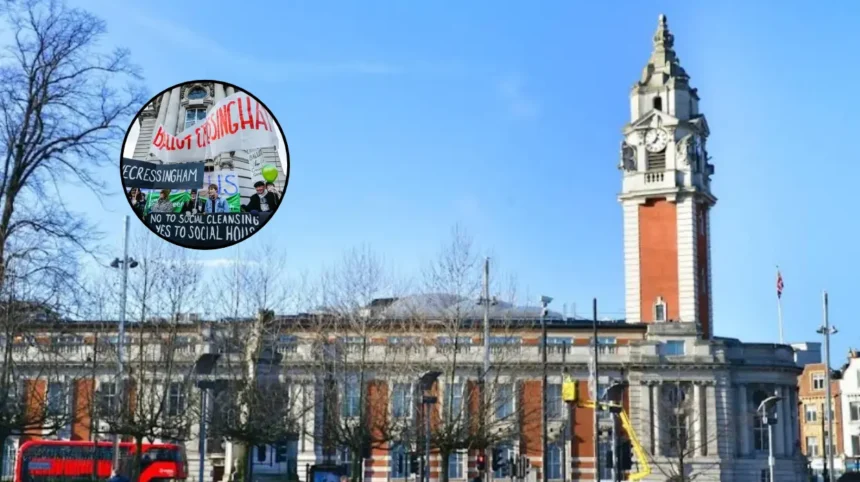
As reported by community news journalists following the decade-long movement, tenants and leaseholders across both Cressingham Gardens and Central Hill organized extensive grass-roots campaigns to resist displacement. Campaigners argued that the estates represented structurally sound, human-scale architectural achievements that provided safe, light-filled, and cohesive living environments for low-income households.
Residents highlighted that the long-standing threat of demolition forced households into a state of prolonged administrative limbo, during which routine maintenance was neglected and structural repairs were repeatedly deferred by municipal authorities. Through formal petitioning, legal challenges, community surveys, and direct political engagement during local elections, resident action groups consistently urged the local authority to abandon total clearance models in favor of sustained maintenance, retrofitting, and direct estate restoration.
What Makes the Architecture of Cressingham Gardens and Central Hill Unique?
As reported by architectural critics and design historians, both developments represent significant exemplars of post-war municipal housing design in Britain. Designed during the 1960s by a team of Lambeth municipal architects under the leadership of Borough Architect Ted Hollamby, the estates deliberately rejected the prevailing contemporary trend toward high-rise tower blocks.
Ted Hollamby championed low-rise, high-density residential layouts designed to integrate naturally into existing urban landscapes and green environments. Cressingham Gardens, situated directly adjacent to Brockwell Park, was purposefully designed to encourage neighbourliness, incorporating pedestrian-focused walkways, front entrances facing one another, and accessible shared green spaces for children to play safely. Central Hill similarly utilized the natural contours of its hillside topography to provide panoramic views and private courtyard access, establishing a model of social housing centered on human scale and environmental integration.
Background of the Particular Development
The dispute surrounding Cressingham Gardens and Central Hill forms part of a broader, decades-long debate across London regarding post-war public housing regeneration. During the 1960s and 1970s, progressive municipal architecture departments, particularly in progressive inner-London boroughs like Lambeth, sought to redefine public housing by creating estates that combined high residential density with low building heights, generous green spaces, and community-centered layouts.
By the early 2010s, many UK local authorities faced severe financial pressures combined with growing social housing waitlists. Across London, several councils adopted estate regeneration strategies reliant on joint ventures with private developers. These models frequently involved demolishing existing municipal housing to construct higher-density private developments, with a proportion of homes designated as social or affordable housing.
In Lambeth, this policy led to the creation of municipal regeneration plans targeting multiple council estates, including Cressingham Gardens and Central Hill. However, the strategy faced mounting opposition from housing scholars, heritage preservation bodies, and resident associations, who argued that regeneration schemes often resulted in a net loss of traditional social-rent homes, disrupted established working-class communities, and ignored the carbon costs associated with razing existing concrete and brick structures. The 2022 review led by Sir Bob Kerslake formally recognized these systemic structural shortcomings, setting the stage for the political shifts that ultimately led to the policy reversal.
Prediction: How This Development Can Affect the Audience
This policy reversal in Lambeth is poised to have notable indirect and direct implications for several primary stakeholder groups across the municipal housing landscape:
Local Estate Residents and Leaseholders
For the immediate community of tenants and owner-occupiers on Cressingham Gardens and Central Hill, the formal reversal of demolition plans removes a decade of housing instability and administrative uncertainty. Residents can expect a shift toward estate investment focused on long-deferred maintenance, structural repairs, and thermal retrofitting to improve energy efficiency. However, leaseholders and tenants may face temporary disruption as the new minority council administration establishes funding mechanisms to clear maintenance backlogs without relying on developer capital from complete redevelopment.
Local Authority Housing Departments across London
For housing planners, elected councillors, and municipal officers across greater London, Lambeth’s decision marks a significant precedent. Local authorities currently pursuing or considering total-demolition estate regeneration models will likely face increased scrutiny from local electorates and activist groups. Municipalities may increasingly pivot away from full-scale demolition toward “retrofit-first” policies, prioritizing the preservation, repair, and environmental upgrading of existing post-war housing stock over large-scale site clearances.
Architectural Preservationists and Public Housing Advocates
For heritage organizations and architectural historians advocating for post-war social housing, the preservation of Ted Hollamby’s work provides a strengthened precedent for protecting mid-century municipal architecture. The decision validates arguments that low-rise, community-focused housing models retain long-term structural and social value, potentially encouraging statutory listing applications and conservation protections for similar post-war council estates across the United Kingdom.