Key Points
- Planning Split: Planning officers from adjacent south London boroughs, Lewisham and Greenwich, have issued conflicting recommendations regarding a major mixed-use proposal by developer RER London.
- Greenwich Endorsement: Jonathan Hartnett, principal planning officer in Greenwich, recommended full planning permission be granted, citing substantial public benefits and residential-led regeneration.
- Lewisham Refusal: Geoff Whitington, principal planning officer in Lewisham, recommended refusal, arguing that the scale, height, and massing inflict harm on local heritage assets and townscape character.
- Development Scale: The proposal entails demolishing existing structures to erect eight new blocks ranging from one to 30 storeys, comprising 802 residential homes.
- Commercial and Educational Provisions: The project includes over 56,000 sq ft of dedicated educational floorspace, alongside workspace, retail, and food and beverage outlets on the ground level.
- Committee Decision: The divergent reports were submitted ahead of formal planning committee meetings scheduled for the evening of 24 September.
Deptford Creek (South London News) September 24, 2026 – Planning officers representing the neighbouring south London councils of Lewisham and Greenwich have reached contrasting conclusions regarding a major 802-home regeneration application submitted by developer RER London along Deptford Creek. Ahead of planning committee meetings scheduled for the evening of 24 September, official officer reports revealed directly opposed recommendations on whether the mixed-use scheme should proceed.
- Key Points
- Why Did Lewisham Planning Officers Recommend Refusal for the RER Scheme?
- Why Did Greenwich Planning Officers Recommend Approval for the Same Development?
- Background of the Deptford Creek Planning Conflict
- Prediction: How Will This Planning Disagreement Affect Local Stakeholders and the Developer?
As reported by Ciaran Nerval of Housing Today, Jonathan Hartnett, the principal planning officer for the Royal Borough of Greenwich, recommended that full planning permission be granted for the application. Conversely, Geoff Whitington, principal planning officer for the London Borough of Lewisham, formally recommended refusal, basing his objection on the proposed development’s urban design and impact on local heritage assets.
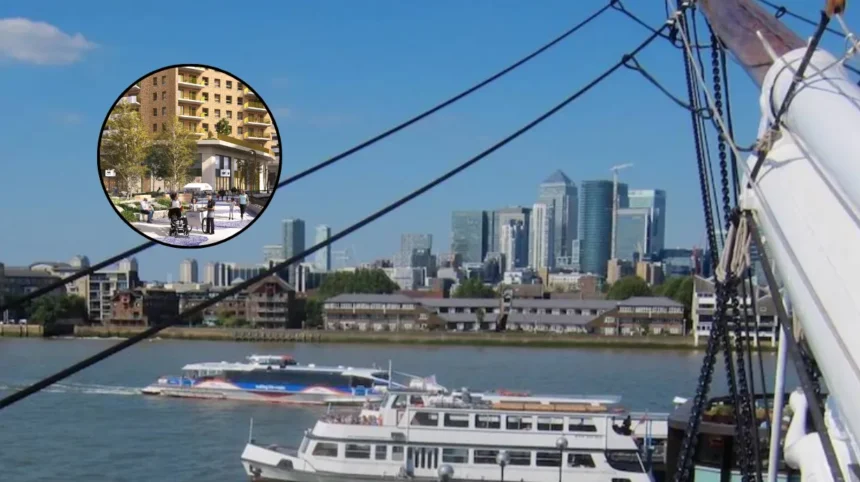
The application site spans boundaries across both boroughs, requiring dual assessment. If granted approval by both authorities, the comprehensive development would involve the total demolition of existing buildings on the parcel. In their place, RER London proposes the construction of eight new building blocks with heights varying from single-storey structures up to 30-storey towers.
Alongside the 802 residential units, the master plan incorporates more than 56,000 sq ft of dedicated educational floorspace. The ground-floor levels are designated to accommodate commercial workspaces, retail premises, and food and beverage establishments intended to activate the waterfront frontage.
Why Did Lewisham Planning Officers Recommend Refusal for the RER Scheme?
In the official assessment compiled for Lewisham Council, planning officers determined that the proposed scale and overall height of the towers would severely impact the surrounding urban environment. The report asserted that the physical footprint failed to integrate with the surrounding architectural identity.
As reported by Ciaran Nerval of Housing Today, the Lewisham planning report stated that:
“Officers conclude that the proposal would result in harm to the significance of designated heritage assets and would fail to achieve the high standard of urban design required by the development plan. In particular, concerns regarding the scale, massing and composition of elements of the development would result in adverse townscape effects and fail to respond appropriately to the character and context of the site and its surroundings.”
While acknowledging the potential social utility of the project, Lewisham officers concluded that planning policy requirements regarding heritage preservation outweighed the proposed delivery of residential units.
As reported by Ciaran Nerval of Housing Today, the Lewisham report further detailed that:
“Whilst substantial weight is afforded to the public benefits of the scheme including the delivery of new housing, officers conclude that these benefits are substantially outweighed by the identified heritage and urban design harm.”
Why Did Greenwich Planning Officers Recommend Approval for the Same Development?
The evaluation prepared by Greenwich planning officers reached the opposite conclusion regarding the balance of public interest and spatial design. Greenwich officers prioritized the redevelopment of brownfield land and the delivery of new residential accommodation in an accessible transport corridor.
As reported by Ciaran Nerval of Housing Today, the Greenwich planning report claimed that the development as a whole:
“supports the residential-led regeneration of this previously developed and highly accessible site.”
Where Lewisham officers found unmitigable harm to heritage context, the Greenwich planning department determined that the overall benefits of the infrastructure investment compensated for any visual or physical impacts.
As reported by Ciaran Nerval of Housing Today, the Greenwich planning officers added that:
“identified harms are outweighed by the substantial public benefits of the proposal.”
Background of the Deptford Creek Planning Conflict
Deptford Creek forms the tidal boundary where the River Ravensbourne meets the River Thames, serving as a historic border between the London Borough of Lewisham and the Royal Borough of Greenwich. Over the past two decades, the industrial riverfront has undergone extensive urban transformation. Former wharves, industrial yards, and low-density warehouses have increasingly given way to high-density residential towers and commercial corridors, driven by London-wide housing targets and local regeneration plans.
Cross-boundary planning applications along Deptford Creek present recurring administrative and design challenges for local authorities. Because administrative borders run down the centre of watercourses or cut across former industrial plots, developers frequently must navigate two distinct local planning authorities simultaneously. Each borough operates under its own specific Local Plan, local conservation policies, and tall building guidelines, despite sharing identical overarching frameworks provided by the London Plan.
The disagreement between Lewisham and Greenwich on the RER London development highlights long-standing policy tensions between maximizing housing delivery on brownfield land and enforcing strict conservation limits on height and massing near established heritage zones.
Prediction: How Will This Planning Disagreement Affect Local Stakeholders and the Developer?
The conflicting recommendations between Lewisham and Greenwich officers create immediate strategic and administrative complications for RER London, local residents, and elected councillors in both boroughs.
Impact on the Developer (RER London)
If Lewisham’s planning committee votes to accept officer advice and refuses the application while Greenwich approves it, the project cannot proceed in its current iteration. RER London would face two main avenues: appealing Lewisham’s refusal to the Planning Inspectorate (or requesting a call-in by the Mayor of London, given the scale of 802 homes), or returning to the drawing board to redesign the massing, height, and layout to satisfy Lewisham’s design criteria. Both paths entail substantial financial costs, extended delays, and prolonged holding costs.
Impact on Local Residents and Community Groups
For local residents and heritage advocacy groups in Deptford and Greenwich, the split recommendation offers a critical opportunity during committee proceedings. Objectors targeting the scale and height of the 30-storey proposals will leverage Lewisham’s formal findings on heritage harm to urge Greenwich councillors to reject their own officers’ advice, or to ensure Lewisham maintains a firm stance against the current designs.
Impact on Housing Delivery and Local Infrastructure
Should the scheme face prolonged delays or restructuring, the immediate delivery of 802 new homes and 56,000 sq ft of educational floorspace will be deferred. Local services and businesses awaiting the economic activity generated by ground-floor retail and workspace tenants will see the commercial activation of this Deptford Creek site put on hold until planning consensus or a legal resolution is achieved.