Key Points
- The modernist house located at number 22, Parkside, Wimbledon, south-west London has now been passed on to the National Trust by the Rogers family.
- It was designed between 1968 and 1970 by the famous British architect Richard Rogers along with his then wife Su Rogers. This house was the home of Richard’s parents, Nino and Dada Rogers.
- Grade II* listed building, it has always been regarded as a model which inspired many globally famous structures such as Centre Pompidou in Paris and the Lloyd’s of London building.
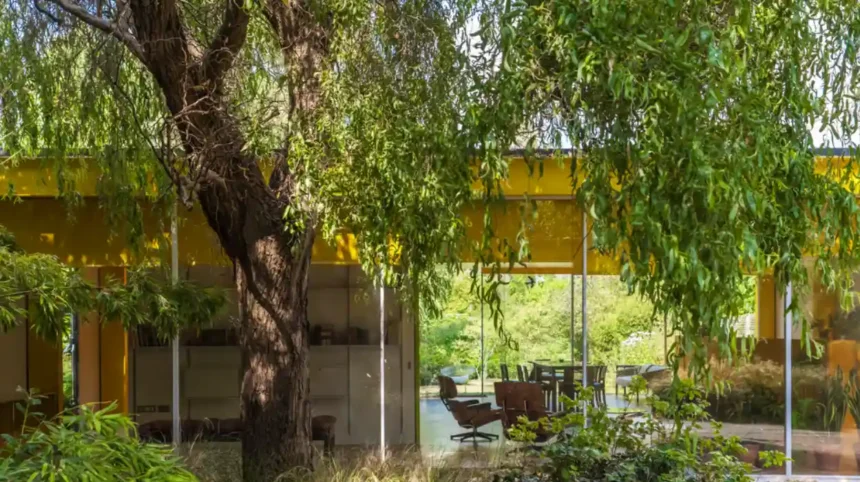
- This house has a unique single-floor plan, yellow steel frame, wall-to-wall glass and sliding internal walls.
- The National Trust intends to arrange visits, collaborations and interactive digital content for this property in order to turn it into an asset for schools and researches.
- The house will be opened for public view as a part of London’s Open House event.
Wimbledon, London (South London News) September 10, 2026 A landmark south-west London home widely credited with helping inspire two of the world’s most celebrated modern buildings has been officially transferred into the care of the National Trust.
The Grade II* listed residential property located at 22 Parkside, Wimbledon, is regarded by architectural historians as one of the most significant homes in British architectural history. Overlooking Wimbledon Common, the single-storey house was conceptualised and designed in 1967 by visionary British architect Richard Rogers alongside his then-wife, Su Rogers, initially built to serve as a retirement residence for his parents, Dr William Nino Rogers and Dada Rogers.
Constructed between 1968 and 1970, the radical design decisively broke away from the traditional architectural conventions of the era. Its signature features included a bright-yellow structural steel frame, full-height floor-to-ceiling glass walls, and flexible, movable internal partitions that allowed the interior spaces to be easily reconfigured. According to architectural experts and preservation bodies, the methodologies, prefabricated components, and spatial concepts tested within this modest residential plot laid the critical groundwork for later monumental international projects, most notably the Centre Pompidou in Paris and the Lloyd’s of London building.
How did the Rogers family describe the transfer of the property?
Speaking on the historic handover of the family asset, Ben Rogers, the son of Richard and Su Rogers, stated that the property is “much more than a family home.” As reported by Pierra Willix of The Standard, Ben Rogers noted that 22 Parkside represents
“one of the most important buildings my father and mother created – a place where many of the ideas that would go on to influence my father’s work and some of the world’s most celebrated architecture were first tested and explored.”
He further emphasised the family’s motivation behind the transfer:
“As a family, we wanted to ensure that this remarkable house would be protected, cared for and shared with future generations, rather than remaining a private asset. The National Trust brings the expertise, public purpose and long-term commitment needed to safeguard its future, while opening up its story to students, researchers and visitors.”
Adding further perspective on her late husband’s vision, Ruthie Rogers, who was married to Richard Rogers until his death at the age of 88 in 2021, highlighted his lifelong dedication to public engagement with culture. As detailed in coverage by media titles, she remarked that her late husband
“regarded public access to culture – whether architecture, art, theatre, music, or design – as one of the great aspirations in life,”
noting that
“it filled him with such joy that the public would have access to this house that was once private, a house that was a prototype for what he thought houses could be for all.”
What are the National Trust’s plans for the modernist landmark?
Following the transfer of ownership from private hands to the heritage conservation charity, the National Trust has outlined extensive plans to preserve and utilise the building. Hilary McGrady, director-general of the National Trust, expressed profound gratitude to the Rogers family for placing the extraordinary house into their care.
As noted in reports across national news outlets, Hilary McGrady stated that
“their generosity means that 22 Parkside will now become part of our shared inheritance, belonging not to a single family but to the people of England, Wales and Northern Ireland.”
She added that
“this extraordinary gift will ensure that a building where world-changing ideas were born continues to inspire new generations of thinkers, makers and creators.”
To fulfill this vision, the conservation charity intends to organise structured guided tours, collaborative educational partnerships, and engaging interactive digital content. The overarching objective is for the site to evolve into a dynamic creative and educational resource accessible to schools, universities, and architectural heritage organisations globally. Marking its transition into public life, the property is scheduled to open its doors to the public during the upcoming weekend as part of London’s Open House festival.
Explore More Wimbledon News
National Trust Acquires Richard Rogers’ Radical High-Tech House in Wimbledon 2026
Community Share Offer Launched to Buy Historic Pub in South Wimbledon 2026
Background of the Particular Development
The transition of 22 Parkside to the National Trust marks the latest chapter in the turbulent yet distinguished lifecycle of a structure that has continually shifted between private family stewardship, academic ownership, and public heritage. Following its construction in the late 1960s, the house remained occupied by members of the Rogers family for over fifty years, witnessing generations of family life while functioning as a living laboratory for high-tech architectural experimentation.
In 2013, the property was briefly placed on the market before being withdrawn. Shortly thereafter, in 2015, Richard Rogers gifted the house to the Harvard Graduate School of Design via the Richard Rogers Charitable Settlement, establishing it as a residential and research base for international architecture doctoral students and fellows under the Richard Rogers Fellowship. During this academic phase, the property underwent a comprehensive restoration led by architect Philip Gumuchdjian and landscape architect Todd Longstaffe-Gowan to return it closely to its original modernist state.
After the Harvard Global UK charity ceased operating at the site, ownership returned to the Richard Rogers Charitable Settlement, eventually culminating in the current permanent agreement with the National Trust to secure its long-term preservation for the British nation.
The integration of 22 Parkside into the National Trust portfolio is expected to profoundly impact architectural historians, students, local residents, and the broader cultural tourism sector. For architecture students, researchers, and academic institutions, the regularized public access and planned educational programming will provide direct, tactile engagement with a foundational monument of 20th-century High-Tech design, offering rare insight into the evolution of modern spatial theory.
For local residents and cultural tourists in London, the opening of the site during events like the Open House festival transforms a previously exclusive private asset into an accessible community and international attraction. However, the National Trust will likely face logistical challenges in managing visitor capacity and foot traffic given the fragile structural nature of a single-storey glass-and-steel building situated on a narrow, sensitive wooded plot adjacent to Wimbledon Common. Successfully balancing public access with rigorous conservation mandates will dictate how effectively this architectural manifesto can inspire future generations without compromising its physical integrity.