Key Points
- Trafalgar pub in South Wimbledon will soon come fully under community ownership following an extended battle against redevelopment.
- Campaigning organisation ‘Save the Traf’ will make a community share offer which will help raise £250,000 for buying the pub’s freehold.
- The members of the general public will be able to buy shares worth between £250 and £50,000 from 9 September till 17 November.
- Freeholder Adenbuild Construction has already offered to provide the community with a protected period for purchasing the building’s freehold along with the lease that barman Oli Carter-Esdale holds.
- The total value of the purchase of the venue is more than £500,000, with the remaining money expected to come from donations and possibly from loans of Merton Council.
- Public meeting to launch the share offer is arranged for 9 September at St John the Divine Church in South Wimbledon.
SOUTH WIMBLEDON, London — (South London News), September 8, 2026 — A campaign to save a historic South Wimbledon pub from total closure appears to have reached a major breakthrough, with local residents launching a formal bid to buy the establishment and bring it into collective community ownership before Christmas.
- Key Points
- Can the South Wimbledon Community Successfully Purchase The Trafalgar Freehouse?
- How Will the Community Share Scheme Work for Local Investors?
- Why Is The Trafalgar Considered a Vital Local “Lynchpin”?
- Background of the Development
- Prediction: How This Development Can Affect the Local Community and Stakeholders
Can the South Wimbledon Community Successfully Purchase The Trafalgar Freehouse?
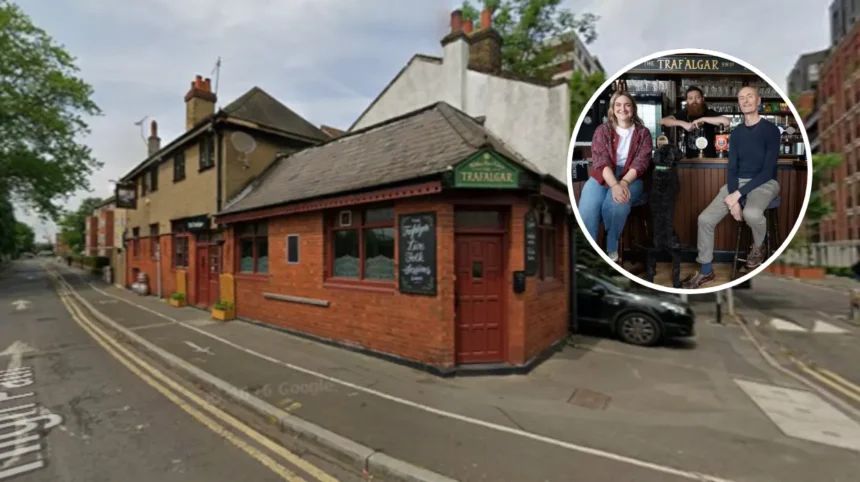
As reported by Harrison Galliven of MyLondon, local residents, beer enthusiasts, and AFC Wimbledon supporters are preparing to buy shares in The Trafalgar freehouse from next week in an ambitious bid to secure the venue’s long-term future. The diminutive venue, often referred to by regulars as “the community’s living room,” has been saved from immediate closure following negotiations with the freeholder, Adenbuild Construction.
As reported by Harrison Galliven of MyLondon, barman Oli Carter-Esdale highlighted the unique appeal of the venture, stating:
“When this opens up you will have this nice cosy part of history you can own a piece of… and it’s got pints.”
The community campaign group, operating under the moniker Save the Traf, plans to launch its share offer on 9 September. The drive aims to raise £250,000 directly from the public to cover roughly half of the total £500,000-plus cost required to acquire the freehold of the venue.
How Will the Community Share Scheme Work for Local Investors?
As reported by Harrison Galliven of MyLondon, Save the Traf committee member Rebecca Coleman explained that after months of “back and forth” and complex legal negotiations, the current freeholder agreed to provide a dedicated window for the community to buy the freehold. Rebecca Coleman stated:
“We were really relieved. It was really lovely to finally say we have an option to buy the pub. It has been a very busy two weeks though.”
Under the structured Community Benefit Society (CBS) model, individual investments will be accepted between 9 September and 17 November. Shares are set at a minimum threshold of £250 up to a maximum of £50,000. To ensure equitable access in an area recognised as one of the more deprived parts of the London Borough of Merton, organizers have structured the investment tiers to remain accessible to everyday residents.
Investors will receive tangible perks including bar discounts, a complimentary birthday pint, and recognition on a planned “wall of honour” inside the premises. To complete the valuation figure above £500,000, the CBS intends to combine the £250,000 share offer with contributions from private donors and a potential commercial loan facilitated through Merton Council.
Explore More wimbledon News
Hall School Wimbledon GCSE Results 2026 Success, Wimbledon 2026
Wimbledon Signalling Fault Causes Major South London Train Disruptions 2026
Why Is The Trafalgar Considered a Vital Local “Lynchpin”?
As reported by Harrison Galliven of MyLondon, the campaign has drawn inspiration from other successfully converted London venues, such as The Antwerp Arms in Tottenham and The White Swan in Charlton.
As reported by Harrison Galliven of MyLondon, Oli Carter-Esdale observed the broader social impact of the initiative, stating:
“So much time has gone into this, but the best thing is that in doing this the community has grown, and friendships have been formed.”
As reported by Harrison Galliven of MyLondon in earlier coverage for the Local Democracy Reporting Service, local regular Peter Fellows remarked on the pub’s daily social value, saying:
“Even in here on a Tuesday afternoon, it is full of people. There is something very healthy and positive about that.”
As reported by Harrison Galliven of MyLondon, long-time patron Lance Murphy, who has frequented the establishment since 1988, expressed the sentiments of many regulars when he stated:
“If it were to shut or if we were to lose the pub in any form I think I would be quite devastated.”
As reported by Harrison Galliven of MyLondon, Oli Carter-Esdale further emphasized the pub’s role in the neighborhood, noting:
“This pub draws people in, it galvanises people. I know so many people on the estate and in the surrounding areas who maybe needed a lynchpin and something to cling on to as everything seems to fall apart and crumble.”
An initial local survey indicated that approximately 200 residents intend to buy into the society, with higher turnouts anticipated following a public meeting at St John the Divine Church on 9 September.
Background of the Development
The Trafalgar pub sits on High Path in South Wimbledon, occupying a prominent red-brick corner plot that has offered hospitality since the nineteenth century. Its name pays homage to Admiral Horatio Nelson, who historically owned property in the local area.
Over recent years, the pub found itself at the epicenter of intense commercial pressure. The building sits directly adjacent to the High Path Estate, an area undergoing extensive urban regeneration led by housing association Clarion Housing Group. The surrounding landscape has seen older housing blocks demolished to make way for modern multi-storey residential flats.
In 2020, property developers Adenbuild Construction acquired the freehold of the site and subsequently submitted planning proposals that included the demolition of the pub to make way for new residential units. The proposal met with immediate resistance from local patrons, community organizers, and regional heritage advocates.
A petition launched by local ward councillors gathered over 500 signatures, leading Merton Council’s planning committee to refuse the demolition application on the grounds of the pub’s social, historic, and cultural significance to the area.
The developer appealed the refusal to the Planning Inspectorate, but the national planning body upheld the council’s decision, protecting the physical structure from immediate destruction. Recognizing that planning protections alone would not guarantee long-term operational survival once lease agreements expired, local patrons formed the Save the Traf campaign group.
In early 2026, the venue received public validation when CAMRA’s South West London branch named The Trafalgar its Pub of the Year 2026. Armed with this recognition, campaign organizers formalized Save the Traf as a registered Community Benefit Society (CBS) with the Financial Conduct Authority (FCA Registration Number 9719), establishing the legal infrastructure needed to negotiate directly with Adenbuild Construction to purchase the freehold.
Prediction: How This Development Can Affect the Local Community and Stakeholders
If the Save the Traf campaign successfully reaches its £250,000 fundraising target by the 17 November deadline, the conversion of The Trafalgar into a community-owned asset will bring distinct long-term effects for local residents, patrons, and the broader hospitality sector in South London.
For local residents and estate tenants on the High Path regeneration site, successful community acquisition secures an established social hub amidst rapid neighborhood transformation. Rather than facing replacement by commercial developments, the venue will remain a fixed public assembly space, counteracting social isolation and preserving local heritage.
For regular patrons and AFC Wimbledon supporters, the CBS structure grants genuine governance rights. Shareholders obtain democratic voting power on key operational decisions regardless of the size of their financial holding, ensuring that venue policies, pricing, and guest ale selections prioritize community service over maximal profit extraction.
For the wider hospitality and property sector across London, the transaction serves as a practical model for heritage preservation under development pressures. A successful outcome demonstrates that community benefit societies can offer commercial freeholders an acceptable exit strategy without resorting to site demolition, potentially encouraging similar community buyouts across the United Kingdom.