Key Points
- Three South London local authorities—Lewisham, Lambeth, and Southwark—have implemented changes in political administration following recent municipal elections.
- Southwark Council is reviewing its ongoing long-term demolition and redevelopment strategy for the Aylesbury Estate in Walworth.
- Lambeth Council has introduced proposals to preserve both the Central Hill estate in Crystal Palace and the Cressingham Gardens estate adjacent to Brockwell Park.
- The newly established policy directions reflect a shift from complete demolition and estate regeneration towards structural maintenance and retrofitting existing housing stock.
Walworth (South London News) October 27, 2026 – Major local housing policies across South London have undergone a central re-evaluation as newly formed council administrations shift focus from large-scale demolition to the preservation and maintenance of social housing estates. In Southwark, municipal officials are reconsidering the long-term demolition trajectory of the Aylesbury Estate in Walworth, more than ten years after original redevelopment plans were initiated. Simultaneously, neighboring Lambeth Council has put forward alternative housing strategies designed to safeguard existing structures at the Central Hill estate in Crystal Palace and Cressingham Gardens near Brockwell Park, prioritizing refurbishment over total site clearance. These administrative shifts follow recent changes in local government leadership across Lewisham, Lambeth, and Southwark.
- Key Points
- Why are South London local councils changing their housing policies?
- How is the future of the Aylesbury Estate in Walworth being reshaped?
- What is happening to Central Hill and Cressingham Gardens in Lambeth?
- Background of Estate Regeneration in South London
- Impact Prediction: How Will This Shift Affect Local Residents and Housing Supply?
Why are South London local councils changing their housing policies?
Political shifts resulting from local municipal elections have led to revised approaches regarding urban renewal and public housing infrastructure. Following administrative changes that saw the Green Party take control in Lewisham and Lambeth, alongside a Green and Liberal Democrat coalition in Southwark, local authorities have begun altering strategies previously adopted under Labour administrations.
The strategic direction of municipal housing departments has focused directly on the management of legacy housing blocks. For over a decade, policy frameworks across several London boroughs prioritized complete site clearance followed by private-public partnerships to construct higher-density housing units. However, current council plans indicate a growing preference for structural maintenance, retrofitting, and preserving original residential footprints.
How is the future of the Aylesbury Estate in Walworth being reshaped?
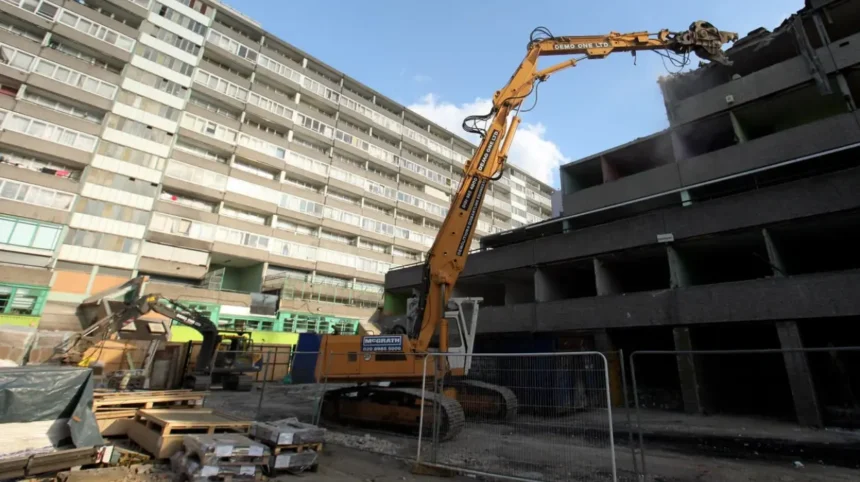
The Aylesbury Estate in Walworth, recognized as one of the largest social housing developments constructed in Europe during the mid-twentieth century, has remained subject to a phased demolition process since its original approval more than ten years ago.
Under current strategic reviews, Southwark Council is reassessing the remaining phases of the master plan. Rather than continuing with full clearance across the un-demolished sections of the estate, council leadership is weighing operational adjustments that could retain remaining residential blocks. This shift signals a departure from past municipal approaches that treated complete site re-development as the standard procedure for estate management.
What is happening to Central Hill and Cressingham Gardens in Lambeth?
In Lambeth, council authorities have introduced updated proposals targeting two major municipal sites: the Central Hill estate in Crystal Palace and the Cressingham Gardens estate located adjacent to Brockwell Park.
Previous council frameworks positioned both sites for full demolition and subsequent redevelopment. Under the newly unveiled proposals, Lambeth Council has opted to maintain and refurbish the existing residential buildings rather than proceeding with teardown projects. The decision prioritizes maintaining existing structural foundations and providing ongoing maintenance to retain the established housing supply.
Background of Estate Regeneration in South London
Post-war urban development in South London led to the construction of large-scale social housing estates throughout the 1960s and 1970s, designed to meet rising residential demand. Over subsequent decades, these developments faced maintenance challenges, structural aging, and evolving regulatory standards concerning energy efficiency and building safety.
By the early 2000s, local authorities increasingly turned to full-scale regeneration projects. These models typically involved flattening existing concrete structures, re-zoning the land, and partnering with housing associations and private developers to build mixed-tenure housing. While proponents highlighted the addition of modernized homes and increased overall density, critics and resident groups frequently highlighted community disruption, long timeline delays, and the loss of original social housing units. The recent administrative transitions across Lewisham, Lambeth, and Southwark mark a formal policy reassessment of these historical regeneration practices.
Impact Prediction: How Will This Shift Affect Local Residents and Housing Supply?
The transition from full-scale estate demolition to structural maintenance and preservation will directly impact social housing tenants, local homeowners, and the broader London housing market.
Impact on Current Estate Residents
For existing tenants on estates such as Aylesbury, Central Hill, and Cressingham Gardens, the shift toward maintenance reduces immediate uncertainty regarding displacement and forced rehousing. Preserving existing structures allows long-standing communities to remain intact without undergoing multi-year relocation processes. However, residents will depend on local councils to secure necessary capital funding to carry out overdue repairs, combat structural decay, and address retrofitting requirements to bring older homes up to current environmental standards.
Impact on Local Housing Availability and Council Budgets
For the wider local population seeking public housing, the policy change prevents the immediate loss of active council housing stock that typically occurs during prolonged multi-phase demolitions. Conversely, choosing refurbishment over high-density redevelopment limits the potential creation of additional new housing units on those specific sites. Financially, local councils will need to balance immediate maintenance and insulation upgrade costs against the long-term capital investments previously underwritten by private developer partnerships.