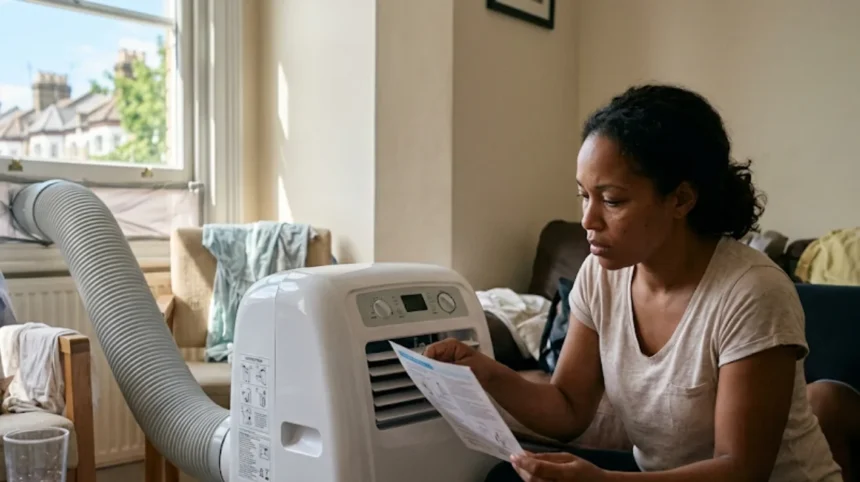
Aldi air conditioner listings usually refer to portable air conditioners, air coolers, or compact cooling appliances sold as limited-run Specialbuys. The key buying issue is performance versus price, because Aldi products often trade long-term availability and premium features for low upfront cost.
- What is an Aldi air conditioner?
- Why do people buy Aldi air conditioners?
- How does portable cooling work?
- What features should you check?
- Are Aldi air conditioners good value?
- What are the main limitations?
- How should South London households use one?
- What does UK guidance say about heat?
- How do you compare Aldi with other brands?
- What should buyers look for in the specifications?
- Is Aldi air conditioning a long-term solution?
- How should buyers decide?
What is an Aldi air conditioner?
An Aldi air conditioner is a budget cooling product sold under Aldi’s own brands or Specialbuys range, usually as a portable unit or air cooler rather than a fixed home installation. These products are limited in stock, sold seasonally, and positioned for quick home cooling in bedrooms, flats, and small rooms.
Aldi does not function like a dedicated air-conditioning specialist. It sells consumer cooling products in short promotional windows, which means the exact model changes by season and region. In June and July 2026, UK coverage focused on Aldi’s £14.99 air cooler, while earlier UK and international listings showed portable air-conditioner style units in the brand’s broader range.
For South London households, that matters because local demand spikes during hot spells, especially in flats and top-floor homes. Government guidance identifies top-floor flats, densely built urban areas, and homes with strong sun exposure as higher-risk overheating environments.

Why do people buy Aldi air conditioners?
People buy Aldi air conditioners for lower upfront cost, simple setup, and temporary summer cooling in small spaces. The products appeal to renters, flat dwellers, and anyone who needs a fast solution without paying for a permanent installation.
Portable cooling suits homes where split-system installation is impractical or restricted. That includes rented accommodation, older buildings, and properties where drilling, pipework, or landlord approval creates friction. GOV.UK advises that overheating risk rises in homes with limited ventilation, little shading, and restricted window opening, all of which are common in urban housing stock.
The attraction is also practical. Aldi’s 2026 air cooler listing included a touch LED display and three speed settings, while other Aldi cooling products have included a remote control, timer, and castor wheels in international product ranges. Those features align with basic consumer needs: cooling, portability, and easy daily use.
How does portable cooling work?
Portable air conditioners cool a room by drawing in warm air, removing heat through a refrigeration cycle, and expelling hot air outside through a hose. Air coolers work differently: they use evaporation with water or ice to make nearby air feel cooler.
This difference matters because shoppers often use “air conditioner” and “air cooler” as the same term even though the technology is not the same. A true portable air conditioner needs an exhaust route for hot air, while an evaporative cooler mainly improves comfort in a small local area.
Cooling performance also depends on room conditions. Portable units work best in enclosed spaces with correct venting and limited heat leakage. Air coolers work best in dry conditions and in close range, but they do not replace full-room refrigeration. For a South London flat during a heatwave, that means product type matters more than brand name.
What features should you check?
Check cooling capacity, energy efficiency, venting method, noise level, tank size, timer controls, and mobility before buying. These features determine whether the unit suits a bedroom, living room, or small office.
Cooling capacity is the first figure to review. Government buying standards for air-conditioning units reference efficiency thresholds for units under 12 kW and larger units from 12 kW to 17 kW, with a strong preference for A++ or better under 12 kW. That standard is for public procurement, but it gives a useful benchmark for consumers comparing products.
Venting is equally important for portable air conditioners. A hose and window kit help remove hot air, and without that exhaust path the unit cannot perform properly. For air coolers, the relevant check is water capacity and ease of filling, because evaporative cooling depends on airflow across a wet medium.
Are Aldi air conditioners good value?
Aldi air conditioners offer strong entry-level value when the goal is short-term cooling in one room. They deliver the lowest purchase price in many cases, but they do not match premium brands on power, longevity, or model choice.
Independent review coverage shows mixed customer satisfaction for Aldi-branded portable cooling products. CHOICE reviewed the Aldi Stirling PA15W1 portable air conditioner in comparison with 46 other models from 19 brands, which indicates Aldi is present in the same mainstream consumer category but sits in a competitive field. ProductReview listings for older Aldi portable air conditioner models show average ratings around the middle of the scale, which suggests variable buyer experience.
Value depends on use case. A buyer wanting a cheap, seasonal device for a bedroom gets more from Aldi than a buyer wanting whole-home cooling or near-silent overnight operation. For South London residents who face a few hot weeks each summer, a budget unit can be sensible, but only if expectations stay realistic.
What are the main limitations?
The main limitations are limited stock, seasonal availability, moderate cooling power, and basic feature sets. Aldi cooling products are designed for affordability and convenience, not for permanent climate control or large homes.
Limited stock is a structural issue. Aldi’s Specialbuys model means once the range sells out, it is unlikely to return in the same form. That makes timing important, especially during the first warm spell when demand rises quickly.
Power is another limit. Review comments on older portable models describe adequate cooling in one room but weaker results when users expect broader coverage. This reflects a common reality of budget portable units: they can lower the temperature in a defined space, but they do not transform an entire flat.
Noise and heat management also matter. Portable air conditioners generate compressor noise and must expel heat outside, which adds complexity. Air coolers avoid a compressor but rely on evaporation, so they often improve comfort rather than delivering genuine air-conditioning performance.
How should South London households use one?
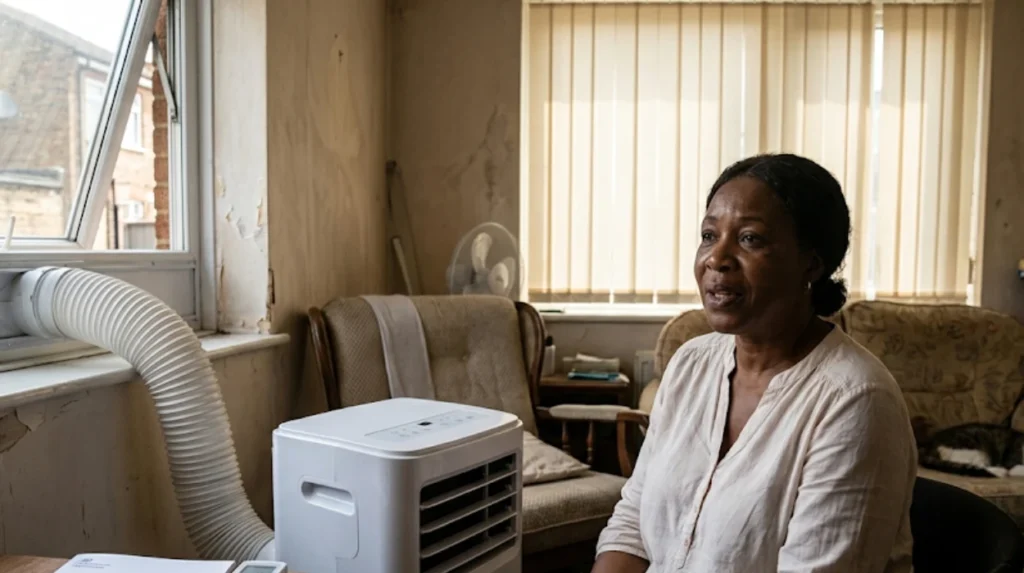
Use an Aldi air conditioner in one enclosed room, seal the exhaust properly, close blinds during the day, and ventilate the property when outdoor air is cooler. This setup reduces overheating and improves performance.
GOV.UK advises keeping windows shaded, opening them when outside air is cooler, turning off unused electrical equipment, and using fans when appropriate. Those same principles improve portable cooling. A unit works harder in a room with open doors, direct sunlight, or a poorly fitted window kit.
South London homes with top-floor exposure benefit most from a focused cooling strategy. That includes keeping heat out during the day, running the unit in the room where people sleep, and moving to a cooler part of the home when possible. In practical terms, one well-used portable unit outperforms a cheap device used in a hot, unshaded room.
What does UK guidance say about heat?
UK guidance treats overheating as a health risk, especially for older people, young children, pregnant women, and people with long-term conditions. Homes with top-floor exposure, weak ventilation, and little shading face higher overheating risk.
GOV.UK states that a hot home can worsen existing health conditions and can be fatal. The same guidance lists residents at higher risk, including people aged 65 and over, children aged 5 and under, pregnant women, and people with heart or breathing problems. That is directly relevant to households in dense boroughs such as Lambeth, Southwark, Lewisham, Croydon, and Bromley, where urban heat and limited airflow are common issues.
The practical advice is simple. Use blinds or curtains, run ventilation at the coolest time of day, and turn off heat-producing appliances when not needed. GOV.UK also notes that air conditioning, if available, is part of a broader home-cooling strategy rather than a standalone solution.
How do you compare Aldi with other brands?
Compare Aldi on three points: price, performance, and support. Aldi usually wins on upfront cost, while specialist brands usually win on model range, efficiency choice, and after-sales ecosystem.
Price is the easiest comparison. Aldi’s 2026 air cooler cost £14.99, while portable air conditioners from specialist retailers usually sit far above impulse-buy territory. The savings are clear, but they come with trade-offs in performance, build quality, and model longevity.
Support matters too. A dedicated air-conditioning brand typically offers more detailed manuals, spare parts, and technical documentation. Public standards also place emphasis on efficiency class and performance metrics, including A++ or better for units under 12 kW in government purchasing rules. That shows how much value the market places on measurable efficiency, not just headline features.
What should buyers look for in the specifications?
Buyers should read the wattage, room-size guidance, energy label, hose setup, water tank capacity, and control options. These details tell you whether the unit handles a bedroom, study, or small living room.
For portable air conditioners, the window kit matters because hot air must leave the room efficiently. For evaporative units, the fill process and water level visibility matter more because the device depends on water evaporation to create a cooling effect. Timer settings, remote control, and adjustable louvres improve daily convenience.
Energy information deserves attention. Government standards for air conditioners use efficiency benchmarks such as A++ and A+++ for smaller units, with a higher class indicating better performance per unit of energy. That does not guarantee perfect consumer results, but it gives a reliable comparison framework.
Is Aldi air conditioning a long-term solution?
Aldi air conditioning is a short-term solution for hot spells, not a permanent answer to overheating or whole-home comfort. It works best as a seasonal appliance for one room and one routine.
Long-term cooling requires a wider plan. GOV.UK recommends shading, ventilation, appliance control, and home adaptations to reduce overheating risk. In many South London homes, especially rented flats, that approach delivers more benefit than relying only on one portable unit.
Aldi works best as part of that plan. A low-cost cooling device, combined with blinds, nighttime ventilation, and reduced indoor heat, provides a practical response to summer heat. For many households, that balance is enough to manage comfort without major expense.
How should buyers decide?
Buy when you need low-cost, seasonal cooling for one room and can set it up correctly. Avoid it when you need whole-home cooling, quiet operation, or long-term technical support.
The best decision framework is simple. If the room is small, the use period is short, and the budget is tight, Aldi fits the brief. If the property is large, top-floor, or occupied by vulnerable residents, a stronger unit or a more permanent cooling strategy becomes more appropriate.assets.publishing.service.
For South London readers, the biggest practical point is timing. Heat arrives fast, stock disappears fast, and overheating risk rises in urban homes with limited shade and ventilation. That makes preparation more important than brand loyalty.
Aldi air conditioners attract attention because they combine low price with immediate summer relevance. The real question is not whether they are premium products, but whether they solve a specific cooling problem at the right moment.
What is an Aldi air conditioner?
An Aldi air conditioner is a seasonal cooling appliance sold through Aldi’s Specialbuys programme. Depending on the promotion, it may be a portable air conditioner, an evaporative air cooler, or another compact cooling device designed for temporary home use.