Key Points
- Pierre Sage faces early internal pressure at Crystal Palace after losing his first two Premier League games in charge.
- Defeats against Everton and Manchester City have left Crystal Palace bottom of the Premier League table with zero points and a -5 goal difference.
- Sage took over at Selhurst Park in June 2026 after winning the Coupe de France and finishing second in Ligue 1 with RC Lens.
- Reporter Sacha Tavolieri stated that internal friction and doubts over Sage’s future led Lyon winger Malick Fofana to choose Sunderland over Palace on deadline day.
- Palace reached the UEFA Europa League league phase after winning the UEFA Conference League under former manager Oliver Glasner last season.
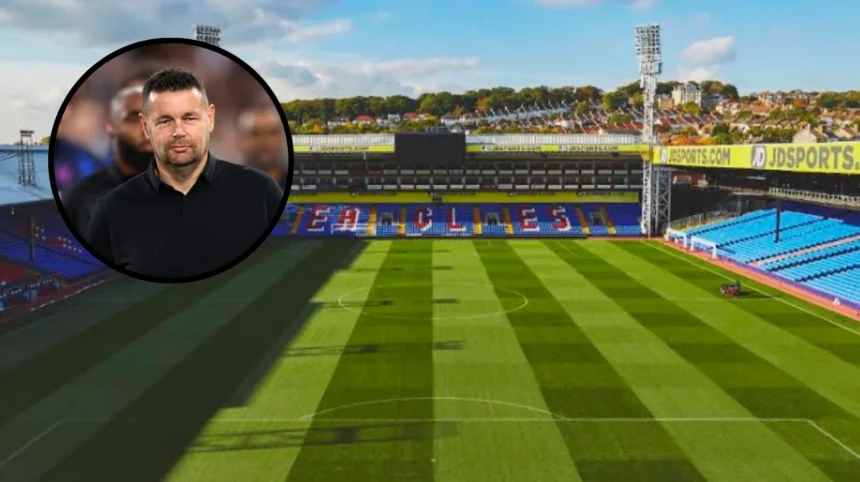
Crystal Palace (South London News) September 3, 2026 —South London News, September 3, 2026 – Pierre Sage has reportedly come under immediate internal pressure at Crystal Palace following a difficult opening to his tenure at Selhurst Park, which has left the Premier League side winless and bottom of the table after two competitive fixtures.
As reported by Sacha Tavolieri of Belgian sports media, Sage is already facing mounting scrutiny from the hierarchy in South London. The 47-year-old French tactical coach, who was appointed as the successor to Oliver Glasner in June 2026, has seen his side suffer back-to-back defeats against Everton and Manchester City. The results leave Crystal Palace as one of five top-flight teams yet to register a point this season, while holding the joint-worst goal difference (-5) in the division alongside early-season struggles.
Why Has Pierre Sage Come Under Immediate Scrutiny?
As reported by Sacha Tavolieri, the early uncertainty surrounding Sage’s managerial footing has already disrupted administrative and recruitment efforts at the club. Tavolieri stated on social media platform X that
“Pierre Sage [is] under pressure, doubts over the club’s future, a potential sale on the horizon, the way the club’s hierarchy blocks their players when they join the Eagles”
were key contributing factors during recent transfer operations.
According to Tavolieri’s report, these combined factors directly influenced transfer deadline day operations on September 1, 2026. Olympique Lyonnais winger Malick Fofana ultimately opted to complete a transfer to Sunderland over Crystal Palace, despite Palace offering a higher financial package of €39m (£33.4m) compared to Sunderland’s €35m (£30m) deal.
As noted by journalists tracking the transfer window, Sage had personally reached out to Fofana—whom he previously coached during his spell at Olympique Lyonnais—to convince the player to move to South London. However, the winger chose a move to the Stadium of Light, with Tavolieri confirming that questions over Sage’s stability and Palace’s broader structural trajectory weighed heavily on the decision.
What Led To Pierre Sage’s Appointment At Selhurst Park?
The managerial transition at Selhurst Park took place following the departure of Oliver Glasner at the end of the 2025/26 campaign. Glasner led Crystal Palace to a UEFA Conference League victory, defeating Rayo Vallecano 1–0 in the final in Leipzig, securing the club’s first major European trophy and a spot in the 2026/27 UEFA Europa League league phase.
Following Glasner’s exit, the Crystal Palace board appointed Pierre Sage on a three-year contract running until June 2029. Sage arrived with a strong reputation from French football. After taking over as interim manager of Olympique Lyonnais in November 2023 and steering them into European qualification, Sage spent the 2025/26 campaign managing RC Lens. During his single season with Lens, Sage led the club to a second-place finish in Ligue 1 and a 3–1 victory over OGC Nice in the Coupe de France final at the Stade de France.
Explore More Crystal Palace FC
Crystal Palace vs Man City Prediction, Odds, Lineups: Selhurst Park 2026
Crystal Palace Block Late Adam Wharton Transfer Exit Amid Liverpool, Man City & Chelsea Interest
What Is The Background Of This Particular Development?
The operational strain currently surfacing at Selhurst Park reflects broader structural changes at Crystal Palace over recent months. Following the high point of their UEFA Conference League triumph in May 2026, the club transitioned to Sage’s preferred 3-4-2-1 tactical system while balancing incoming and outgoing transfer requests.
In addition to pitch results, reporting from Sacha Tavolieri highlights lingering questions surrounding the club’s corporate ownership structure, potential equity sales, and friction regarding player exit strategies. High-profile player valuations and protracted departure negotiations in recent windows—such as historical moves involving Ismaïla Sarr and Michaël Olise—have contributed to external agency perceptions regarding how the club handles squad assets. When combined with two opening Premier League losses, these background administrative factors have intensified focus on Sage’s early handling of first-team duties.
What Is The Prediction For How This Development Affects Crystal Palace Supporters And Squad?
The immediate fallout from early managerial pressure and missed transfer targets presents distinct operational challenges for Crystal Palace’s primary audience: the supporters and first-team squad.
For the playing squad, a lack of early tactical continuity and public reporting regarding managerial uncertainty can disrupt changing-room stability ahead of a busy fixture schedule. With the 2026/27 UEFA Europa League league phase beginning in September, Sage must integrate remaining summer arrivals into his 3-4-2-1 formation without the additional attacking width that targets like Fofana were intended to provide.
For Crystal Palace supporters, the current situation creates immediate tension between high domestic expectations and continental commitments. Having celebrated European silverware three months prior, fan sentiment risks turning if domestic results do not recover before the upcoming international break. If Sage secures immediate positive results in the Premier League, the internal pressure reported by media outlets may abate; conversely, continued setbacks could force the Palace board to address structural and managerial concerns much earlier in the campaign than anticipated.