
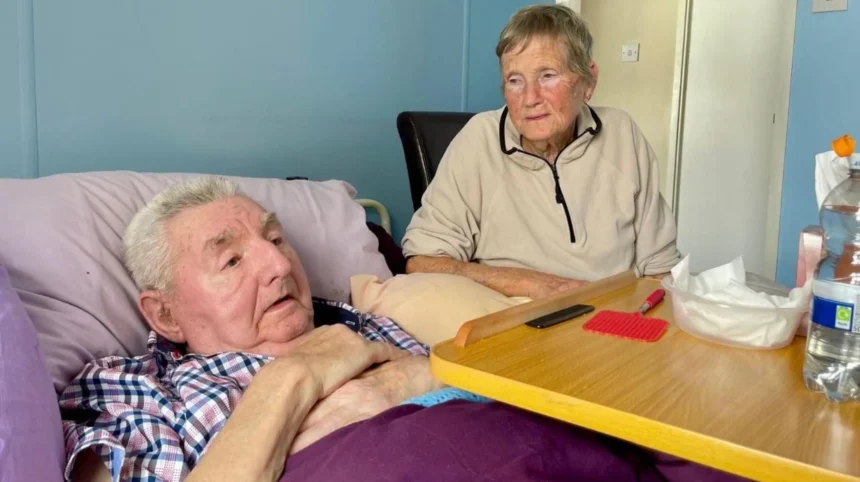
Longevity was supposed to be a triumph, so why does it feel like a bill for families?
A plethora of words that for better or for worse, consistently arise when talking about the elderly social care system in this country. None of which foster an air of hopefulness or positive change; more so, taking on the nature of absolutes from ‘broken, damaged, and in crisis from chronic shortage’. This rhetoric has often surrounded our elderly care, and not too long ago it might have felt like background noise, a headline recycled every winter when hospital wards fill up. But when it becomes your own family navigating it, the abstraction disappears. This is a challenge many of us will face; we can only hope to solve it by acknowledging this crisis, but is there a simple solution?
This year, I found myself on the other side of that rhetoric, helping my own grandmother through a system that seems designed to exhaust rather than support. Millions of families across the country, and no doubt many readers, are navigating through the same maze, one that rarely makes headlines until a crisis forces it into view.
Because the truth is, this is not really a story about individual hardship. It is a story about demographics catching a country unprepared. “Old people are living longer,” my dad told me when I sat down to talk to him about his own experience going through this with his mother earlier this year. “This is the real danger, not being prepared for the ageing population.” This alone boasts a heap of complex thoughts, from the workforce shortages with no young people replacing them to the retirement age, of people having to work longer. It is a simple observation, but one that cuts to the core of the matter. We are living through a demographic shift that has been forecast for decades, and still, the infrastructure meant to meet it lags embarrassingly behind: care home places, trained staff and reliable funding models. The government’s own local authority funding settlement, published earlier this year, sets out around £4.6 billion in additional adult social care funding; but not until the 2028/29 financial year. For families navigating the system today, that is not next year’s problem. It is three winters away. Longevity should be a triumph and a privilege. Instead, for many families, it has become a countdown to a crisis nobody prepared for.
That gap between promise and delivery is not new. It is, if anything, a well-worn feature of how governments have handled this issue for over a decade. In the summer, the Prime Minister announced what was billed as the most significant overhaul of social care policy in a generation: a National Care Service, standardised training, and a commission led by Baroness Louise Casey now tasked with reporting on long-term reform a full year earlier than originally planned, in summer 2027. It sounds decisive. But for families like mine still inside the system now, it is reform on a timeline that belongs to someone else’s crisis, not ours. That unpreparedness is not theoretical; it is felt, daily, by the people trying to work inside it.
If there is one place where that unpreparedness turns into outright unfairness, though, it is funding, what my dad, without hesitation, coined the “sell the house” problem. “Not fair they have to pay out of their own pocket,” he told me, speaking about his own father, a skilled tradesman who worked hard all his life to buy a home, back when that was still held up as the marker of a life well lived. “The social aim was to better yourself,” he said, “the incentive now is no longer there; if you do not own your own home, it is free.” What makes this sting more is that a fix was once on the table. In 2021, the government promised a lifetime cap of £86,000 on personal care costs in England, designed explicitly so families would not be forced to sell a home to fund care. It was delayed again and again, and finally scrapped altogether in 2024, when the Treasury confirmed it could not fund the policy it had inherited, saving an estimated £1.1 billion over two years. For a generation raised on the promise that home ownership was both security and inheritance, discovering that a lifetime of paying into that house now has to fund a stranger’s assessment of what “affordable care” looks like feels less like bad luck and more like betrayal. My dad had hoped that house would be there for his family, for me.
“A lifetime of work… taking the system only six months to dismantle”
There is something devastating in that; it represents an entire generation who did everything they were told would protect them and their families, only to watch the one safeguard built for exactly this scenario disappear before it ever reached them.
Underneath the “sell the house” problem sits another one, just as corrosive: the sheer administrative weight of getting help in the first place. A system defined by the “number of hoops, amount, non-contact from the council, and endless paperwork” – a phrase that, in its exhaustion, says more about the process than any policy document could. It is not simply that the system is difficult; it is that its difficulty seems to function as a kind of filter, wearing families down until they either give up or give in. Care providers themselves are not immune from this squeeze either; rising employer National Insurance contributions alone are estimated to have cost independent social care employers close to £940 million this financial year, pressure that inevitably filters down into staffing, waiting times, and the quality of support families like mine actually receive. This is exactly where we need discussion, not just about the funding crisis, but about what practical change, at ground level, could actually ease that burden. When the money runs out, what happens then, when the families cannot bear the cost of £6000 a month? When all the time, care and money you’ve spent to make them feel secure and safe is exhausted, what happens then?
The irony of a life well lived?
What strikes me most, having lived through even a fraction of this process myself, is how personal and how universal it is. Every family entering this system believes at first, their situation is unique, until they start talking to others and realise the hoops, the costs, the guilt, and the grief are almost identically shared. Government reforms often always come too late battling the fact that short -term injections are not long -term solutions. If no one has property to sell, especially in today’s younger generations, what happens when we run out of things to sell?
Because if an ageing population truly is “the real crisis,” then the question London, and the country, urgently needs to answer is not whether we are ready for it. How many more families are sold out of house and home whilst we decide.