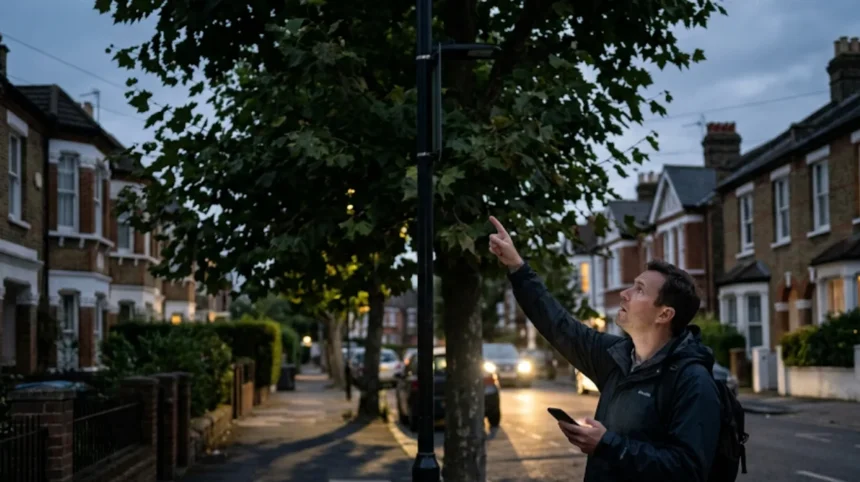
Urban canopy infrastructure requires active municipal management to maintain environmental health and public safety. In the Royal Borough of Kingston upon Thames, situated in South London, the intersection of public highway lighting and street trees falls under specific local government protocols. Residents frequently encounter situations where mature tree branches obscure street lights, creating dark zones on public pavements and roadways. Understanding the precise mechanism to report a tree blocking street lights ensures that local council authorities can deploy arboricultural and highway maintenance teams to rectify the obstruction efficiently.
- What Is the Legal Framework for Street Light Obstructions in South London?
- How Do You Report a Tree Blocking Street Lights to Kingston Council?
- Utilizing the Digital Reporting Portal
- Information Requirements and References
- Telephonic and Emergency Contacts
- What Happens After a Report Is Submitted to the Infrastructure Team?
- Who Is Responsible if the Obstructing Tree Is on Private Land?
- What Types of Trees and Street Lights Are Found in Kingston?
- How Does Tree Obstruction Impact Public Safety and Crime Statistics?
- What Are the Future Trends in Municipal Infrastructure Management?
What Is the Legal Framework for Street Light Obstructions in South London?
The Highways Act 1980 dictates the legal framework governing street light obstructions in South London, empowering local authorities to remove vegetation blocking public highway illumination. The Royal Borough of Kingston upon Thames acts as the statutory highway authority under this legislation.
Statutory Duties of the Council
Under Section 130 of the Highways Act 1980, the local authority has a statutory duty to assert and protect the rights of the public to the use and enjoyment of any highway for which they are the highway authority. This duty includes ensuring that public lighting systems remain functional and unobstructed. Street lighting significantly reduces vehicular accidents and pedestrian casualties.
When a council-owned tree or private vegetation blocks a street light, it compromises the safety standards set out in British Standard BS EN 13201, which governs road lighting design and performance criteria. The Royal Borough of Kingston upon Thames operates an Urban Forest Strategy alongside its Highway Maintenance Plan to balance the ecological preservation of trees with the statutory requirement for well-lit public spaces.
Tree Preservation Orders and Conservation Areas
Kingston contains numerous Conservation Areas, such as the Kingston Old Town, Surbiton Riverside, and New Malden, where trees receive automated legal protections. Furthermore, specific individual trees across the borough are protected by a Tree Preservation Order (TPO) under the Town and Country Planning Act 1990.
When a tree protected by a TPO or located within a designated Conservation Area blocks a street light, the council does not require a standard planning application to execute pruning works, provided the pruning is strictly limited to clearing public highway obstructions or maintaining public safety. The municipal arborists assess the tree to ensure that the required crown reduction or crown lifting does not permanently compromise the health or structural integrity of the specimen.
How Do You Report a Tree Blocking Street Lights to Kingston Council?
You can report a tree blocking street lights to Kingston Council via the official digital reporting portal using their interactive map system. Alternatively, urgent safety hazards can be reported directly by telephone to the council infrastructure customer service team.
Utilizing the Digital Reporting Portal
The primary mechanism for submitting a non-emergency report is the Royal Borough of Kingston upon Thames digital customer portal. The council utilizes an integrated geographical information system (GIS) map interface that allows users to pinpoint the exact location of the problematic tree and the affected street light column.
To submit a report online, you must log on to the official Kingston Council website and navigate to the “Report a tree problem” or “Report a problem with street lights” section. The system prompts you to enter the street name or postcode. Once the map loads, you click on the visual icon representing the specific street light column or tree location to drop a digital pin. You must then complete a short form detailing the nature of the issue, selecting the option for “light blocked by trees” or “overhanging branches obstructing highway infrastructure.”
Information Requirements and References
Providing precise data accelerates the triage process performed by the council environment team. Each street light column in Kingston features a unique alphanumeric identification code painted or stencilled onto the post, usually consisting of letters and numbers such as “K12” or “L05”. Including this specific asset number allows the highway team to identify the exact lamp type and location immediately.
Residents must upload clear digital photographs showing the degree of obstruction during daylight and the resultant shadow zone during hours of darkness. After submitting the online form, the system generates a unique reference number. This reference tracking code allows you to monitor the status of the case via the public dashboard, which categorizes reports into status variants like “open,” “under investigation,” or “resolved.”
Telephonic and Emergency Contacts
When a tree limb poses an imminent risk to public safety, such as a fractured branch hanging directly over a street light or a tree that has partially collapsed onto overhead electrical components, digital reporting is inappropriate. For urgent infrastructure issues during standard operational hours, which are Monday to Friday from 9:00 AM to 5:00 PM, residents must call the central Kingston Council helpline on 020 8547 5002.
For emergencies occurring outside of standard operational hours, including weekends and public bank holidays, the council operates a dedicated out-of-hours response service. Residents must report urgent nighttime street light blockages or fallen limbs by calling the out-of-hours emergency telephone number on 020 8547 5003. These lines connect directly to the municipal emergency duty team, who possess the authority to dispatch emergency tree surgeons and highway engineers within two hours of notification.
What Happens After a Report Is Submitted to the Infrastructure Team?
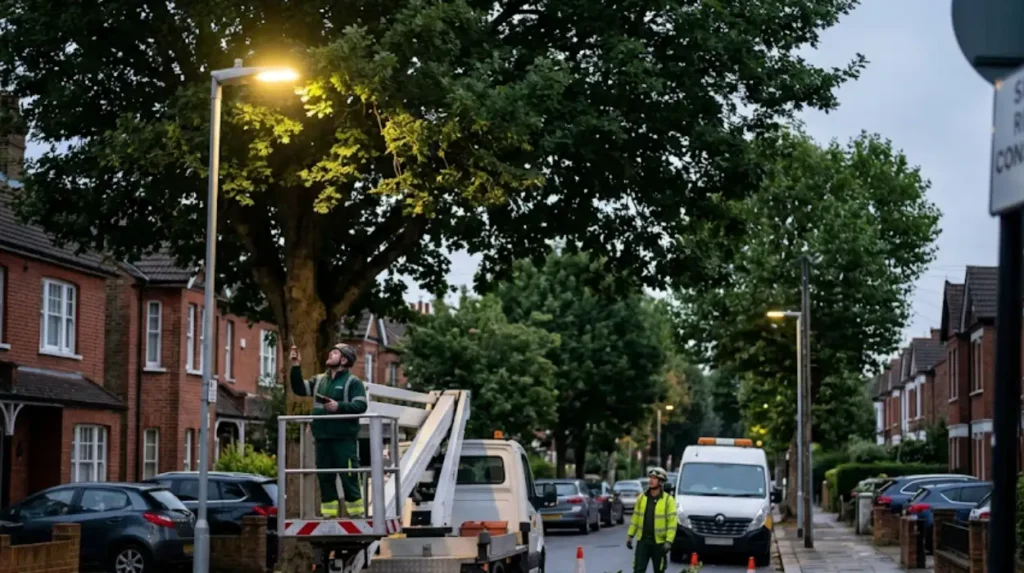
After a report is submitted, Kingston Council arborists and highway engineers conduct a physical site assessment within ten working days to determine ownership and severity. The council then schedules pruning works or issues a formal notice to the private landowner.
The Technical Inspection Process
Upon receipt of the digital or telephonic report, the case is assigned to a qualified arboricultural officer within the council Environmental Services department. The inspector conducts a site visit to evaluate the scenario based on specific municipal risk descriptors. The assessment measures the percentage of light output blocked by the canopy, the species of the tree, and the structural health of the branches.
The inspector also verifies the exact ownership of the land where the tree base is rooted. If the tree sits on a public verge, inside a council-managed park, or within a communal council housing estate, it is classified as municipal property. If the tree trunk originates within a private residential garden or commercial property boundary, it is classified as private vegetation, altering the legal remediation process entirely.
Priority Level Categorization
Kingston Council categorizes infrastructure defects into three distinct priority levels to manage budgets and resource deployment effectively:
- Priority 1 (Emergency): Tree limbs causing immediate physical damage to the lamp head, exposed live electrical wiring, or total blackouts on high-risk public roads. Response time is within two to twenty-four hours.
- Priority 2 (Standard Urgent): Significant obstruction of light on major pedestrian pathways, busy intersections, or areas with documented high crime rates. Intervention occurs within ten to twenty-eight working days.
- Priority 3 (Routine Maintenance): Minor seasonal obstruction where light filtration is reduced but general illumination remains functional. These cases are bundled into the annual cyclic pruning schedule, taking up to six months to resolve.
Execution of Pruning Works
For council-owned trees, works are sub-contracted to approved arboricultural specialists who operate under British Standard BS 3998, which outlines the recommendations for tree work. The contractors utilize selective pruning techniques such as directional pruning, crown lifting, and crown thinning to clear a clear field of illumination around the luminaire.
The standard clearance zone required by Kingston highway specifications is a minimum radius of two meters around the street light lantern. This ensures that seasonal foliage growth over the subsequent twenty-four months will not immediately cause a recurring blockage of the light resource.
Who Is Responsible if the Obstructing Tree Is on Private Land?
The private property owner is legally responsible if the obstructing tree is rooted within their property boundary. Kingston Council possesses statutory powers to force landowners to cut back vegetation that compromises public highway lighting safety.
Section 154 of the Highways Act 1980
When the council inspector determines that an obstructing tree is located on private land, the responsibility shifts away from the municipal taxpayer to the individual property owner. Under Section 154 of the Highways Act 1980, local authorities can protect public infrastructure by serving a formal legal notice on the owner of the land where the vegetation grows.
The Section 154 notice mandates that the property owner execute specific pruning or cutting works to remove the obstruction within a clearly defined statutory timeframe, which is typically fourteen calendar days from the date of service. The notice specifies the exact dimensions of the clearance required, such as pruning branches back to the property boundary line or clearing a vertical clearance zone over the pavement.
Consequences of Non-Compliance
If the private landowner fails to comply with the statutory notice within the designated fourteen-day period, the Royal Borough of Kingston upon Thames exercises its legal right to execute default action. This means the council dispatches its own approved arboricultural contractors onto the edge of the property to cut back the offending vegetation to the public boundary line.
The costs incurred by the council to execute these default works are legally recovered from the private property owner. The council sends a detailed financial invoice covering contractor hourly rates, administrative processing fees, and green waste disposal costs. Persistent non-compliance or refusal to pay these charges can result in a local land charge being registered against the property title, which complicates future sale or refinancing of the estate, or direct prosecution in the Magistrates’ Court.
What Types of Trees and Street Lights Are Found in Kingston?
Three main types of street lights and four common urban tree species populate the Kingston transport network, each interacting differently regarding canopy density and light obstruction. Municipal teams adapt their maintenance strategies to these specific physical assets.
Common Urban Tree Species in Kingston
The urban forest of the Royal Borough of Kingston upon Thames features a diverse array of mature deciduous and evergreen trees. The specific species determines the density of the canopy and how severely it obscures public illumination systems during the spring and summer months.
- London Plane (Platanus x acerifolia): These large, broad-leaved deciduous trees are highly prevalent along major Kingston corridors like the A307 Portsmouth Road and near Kingston Town Centre. They possess rapid growth rates and large leaves that create dense visual blockages when planted adjacent to old six-meter lighting columns.
- Lime (Tilia cordata): Common in residential areas of Surbiton and Chessington, Lime trees produce dense clusters of twigs and sucker growth along their trunks and lower branches. This characteristic growth pattern frequently envelopes lower-level pedestrian street lights.
- Horse Chestnut (Aesculus hippocastanum): Located frequently near parks and older residential streets, these specimens have heavy, spreading canopies that cause substantial physical shading over wide areas.
- Silver Birch (Betula pendula): A slender tree with a lighter canopy structure, often planted in newer developments. It causes minimal light blockage but its whippy branches can physically strike light casings during heavy winds.
Public Street Lighting Infrastructure
Kingston Council maintains an inventory of over twelve thousand lighting assets across the borough. The infrastructure has undergone a modernization program to replace older lighting technologies with energy-efficient alternatives.
| Light Type | Average Column Height | Typical Location | Obstruction Vulnerability |
| LED Luminaires | 6 to 10 Meters | Major Traffic Routes & Link Roads | Moderate; high mounting reduces minor branch interference. |
| High-Pressure Sodium (SON) | 5 to 8 Meters | Suburban Residential Streets | High; lower mounting heights sit within the middle crown zone. |
| Low-Pressure Sodium (SOX) | 4 to 5 Meters | Pedestrian Pathways & Alleys | Critical; low positions are easily enveloped by unmanaged shrubs. |
The transition to Light Emitting Diode (LED) luminaires alters how tree obstructions impact ground-level visibility. Older sodium lights emit a wide, diffused amber glow that can bleed through light foliage. Modern LED lights are highly directional, projecting a precise cone of white light downward to minimize light pollution. Consequently, when a single dense tree branch intersects this directional beam, it casts a sharp, complete shadow over the pavement below, creating immediate dark zones that compromise public safety.
Explore More Help & Resources
How to renew your Southwark parking permit for 2026 online
How to apply for a Merton parking permit under 2026 rules
How Does Tree Obstruction Impact Public Safety and Crime Statistics?
Tree obstructions impacting street lights directly correlate with increased vehicular accidents, reduced pedestrian mobility, and higher local crime rates. Maintaining unobstructed illumination is a critical component of municipal risk management and community policing.
Traffic Safety and Pedestrian Mobility
Data from the Department for Transport (DfT) demonstrates that the risk of fatal road traffic accidents doubles during hours of darkness compared to daylight hours. In urban areas like South London, functional street lighting is essential for illuminating pedestrian crossings, traffic islands, and road signage.
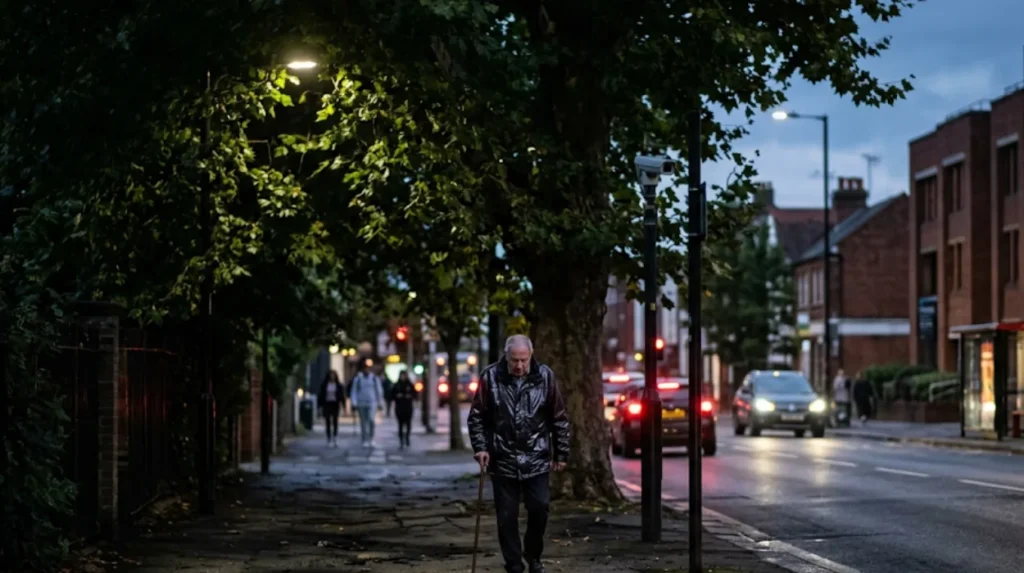
When a London Plane or Lime tree obscures a street lamp at a busy junction, such as those along the A308 or near Kingston University campuses, vehicular stopping distances are compromised because hazards remain unlit. For elderly individuals or those with visual impairments, dark patches on sidewalks caused by tree shadows conceal pavement defects, tree root trips, and pooling water, leading to increased personal injury claims against the local authority.
Impact on Crime and Public Perception
The relationship between ambient street lighting and criminal activity is documented by criminological research compiled by the College of Policing. Well-lit urban environments act as a deterrent to opportunistic crimes such as street robberies, vehicle break-ins, and criminal damage.
In dark zones created by overgrown tree canopies, the effectiveness of municipal closed-circuit television (CCTV) cameras drops significantly, as the lack of ambient light prevents the capture of identifiable facial features or clothing details. In addition to actual crime metrics, the perception of public safety decreases in poorly lit neighborhoods. The Royal Borough of Kingston upon Thames utilizes the principles of Secured by Design (SBD), a police initiative focused on crime prevention through environmental design, which mandates a clear, unobstructed line of sight between public light sources and public footpaths to eliminate natural concealment points for offenders.
What Are the Future Trends in Municipal Infrastructure Management?
Future trends in municipal infrastructure involve integrating Smart City technologies, geographic information system data forecasting, and advanced satellite monitoring. Kingston Council continues to digitize its asset tracking systems to automate tree and light maintenance coordination.
Smart Street Lighting Systems
The Royal Borough of Kingston upon Thames is continually upgrading its infrastructure to incorporate Smart City components. Modern street lights are being fitted with Central Management System (CMS) nodes. These wireless nodes communicate real-time operational data back to a central maintenance hub.
While CMS nodes primarily report electrical failures or bulb expirations, future software iterations can monitor surrounding environmental data. Sensor arrays can detect light bounce-back caused by thick foliage encasing the luminaire head, allowing the system to log an automated maintenance request before a resident notices the blockage.
Predictive Arboricultural Planning
By integrating council arboricultural databases with highway lighting maps, spatial planners can utilize predictive modeling software. When planning new winter tree planting programs, arborists use species-specific growth rate metrics to ensure that saplings are positioned at a safe distance from existing lighting columns.
This geospatial planning prevents the replication of legacy infrastructure conflicts, ensuring that future generations benefit from an expanding urban forest canopy without sacrificing the safety of lit public highways across South London.
How do I report a tree blocking a street light in Kingston upon Thames?
You can report a tree obstructing a street light through Kingston Council’s online reporting portal by selecting the tree or street lighting category, pinpointing the location on the interactive map, describing the issue, and uploading supporting photographs.