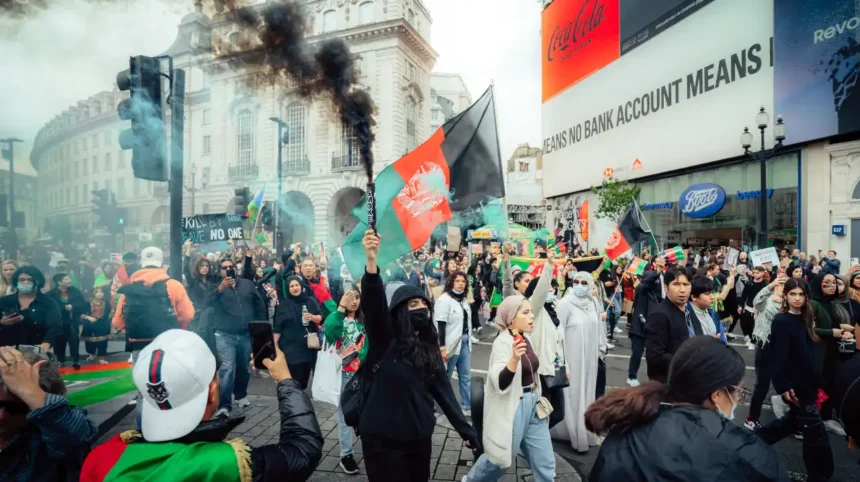
As Afghanistan approaches five years since the Taliban seized Kabul on 15 August 2021, the Afghanistan and Central Asian Association (ACAA) is calling on the UK Government and international community to confront the deepening human rights, humanitarian and regional security crisis facing the Afghan people. The Afghanistan and Central Asian Association (ACAA) is an award-winning UK-based refugee charity headquartered in London and the largest charity supporting Afghan and Central Asian communities in the United Kingdom.
Five years is not simply an anniversary. It represents five years in which millions of Afghans have watched fundamental freedoms disappear, women and girls have been systematically pushed out of education, employment and public life, ethnic and religious minorities have faced discrimination and insecurity, and routes available to Afghans seeking safety overseas have narrowed dramatically.
The situation has continued to deteriorate during 2026.
Women and girls face an escalating assault on their rights
The Taliban’s latest measures have further undermined the rights and autonomy of Afghan women and girls.
Recent Taliban measures concerning marriage have raised serious concerns about the protection of girls from child and forced marriage and the ability of women and girls to challenge marriages arranged for them during childhood.
For Afghan girls already prohibited from secondary education, these developments create an increasingly frightening reality: denied the classroom, denied independence and, in some cases, denied meaningful control over whether and whom they marry.
The Taliban’s Criminal Procedure Regulation of the Courts has also prompted grave human rights concerns, including over fair-trial protections, corporal punishment and discrimination.
The cumulative effect of these measures is the further institutionalisation of a system in which women and girls are denied fundamental freedoms and meaningful participation in Afghan society.
Afghanistan’s ethnic minorities must not be forgotten
ACAA is particularly concerned about the position of Afghanistan’s ethnic communities, including Tajiks, Hazaras and Uzbeks, amid a political and judicial system in which meaningful representation, accountability and protection against discrimination remain severely weakened.
The international response to Afghanistan must recognise that the country’s human rights crisis extends beyond the devastating persecution of women and girls.
Afghanistan is a multi-ethnic country. Its Tajik, Hazara, Uzbek and other communities must have an equal stake in its future, and allegations of discrimination, arbitrary detention, displacement and abuses against minority communities must be properly documented and investigated.
A durable future for Afghanistan cannot be constructed through the domination of one group over others. It requires representative government, equality before the law and genuine protection for every Afghan regardless of ethnicity, gender, language or religious belief.
Regional conflict is putting civilians at further risk
Afghanistan’s instability is also increasingly inseparable from tensions with neighbouring Pakistan.
Cross-border violence and strikes involving Pakistan and the Taliban authorities have added another layer of insecurity to a population that has endured decades of war. Continuing confrontation risks civilian casualties, displacement and further disruption to trade and humanitarian assistance.
Afghanistan cannot afford another conflict. Regional governments and the international community must pursue diplomacy and ensure that Afghan civilians do not once again become casualties of geopolitical confrontation.
A humanitarian disaster continues
Afghanistan remains in the grip of one of the world’s largest humanitarian emergencies.
Millions of people require humanitarian assistance, while hunger, malnutrition, drought, unemployment, displacement and the return of large numbers of Afghans from neighbouring countries continue to place extraordinary pressure on families and communities.
Behind every statistic is a family deciding whether it can afford food, medicine or shelter; a child whose future is being damaged by hunger and malnutrition; or a parent who sees migration as the only remaining possibility for survival.
Humanitarian assistance must not be allowed to become collateral damage from political disagreements with the Taliban.
Britain must restore meaningful routes to safety
Five years after the evacuation from Kabul, Britain must also confront the reality facing Afghans who remain at risk.
Dedicated UK schemes established following the fall of Kabul are no longer generally open to new applicants or referrals, leaving many Afghans who now face persecution without a realistic new dedicated pathway through which to seek protection in Britain.
This is particularly troubling for women and girls, human rights defenders, journalists, former public servants and members of vulnerable ethnic and religious communities whose circumstances may have changed dramatically since 2021.
ACAA is calling for a renewed UK strategy for Afghanistan which combines humanitarian assistance, protection of human rights and meaningful safe pathways for Afghans facing persecution.
Darius Nasimi, Head of Funding and Partnerships at The Afghanistan and Central Asian Association (ACAA) said:
“Five years after the Taliban returned to power, we cannot allow Afghanistan to disappear from the world’s conscience. For millions of Afghans, these have been five years of shrinking freedom, deepening poverty and growing fear about what the future holds.
For women and girls, the situation is especially devastating. Girls who were beginning secondary school when Kabul fell have now spent five formative years denied an education. The Taliban’s latest measures affecting marriage and the justice system show us that this repression is not temporary – it is becoming embedded in the institutions governing everyday life.
We must also speak about Afghanistan’s ethnic minorities. Tajiks, Hazaras, Uzbeks and other communities deserve equality, representation and protection. Their experiences cannot become a footnote to the international discussion about Afghanistan.
Meanwhile, humanitarian need remains enormous, confrontation with Pakistan threatens further instability, and the safe routes once promised to vulnerable Afghans have largely closed to new applicants.
Britain made commitments to the Afghan people. Five years later, those commitments still matter. We are asking the UK Government to show leadership: defend the rights of Afghan women and minorities, maintain humanitarian support, create meaningful routes to safety for people facing persecution, and refuse to normalise a system that strips millions of Afghans of their fundamental rights.
Afghanistan’s people have not given up on their country. The international community must not give up on them.”