Lambeth’s political history is visible in its royal buildings, parliamentary connections, religious institutions, public squares and monuments. From the authority of the Archbishop of Canterbury at Lambeth Palace to the democratic significance of Brixton and the South Bank, the borough reveals how power, protest and public life have shaped London.
- Why does Lambeth matter in London’s political history?
- How does Lambeth Palace reveal the relationship between religion and political power?
- What does Morton’s Tower tell visitors about Tudor authority?
- How does Lambeth Palace connect medieval history with modern Britain?
- What does Lambeth Town Hall reveal about the growth of local democracy?
- How does Kennington Park connect Lambeth with nineteenth-century protest movements?
- Why was the Chartist gathering of 1848 significant?
- What does Kennington Park teach visitors about democratic change?
- What does County Hall reveal about London’s regional government?
- How does the Imperial War Museum explain the political consequences of war?
- How does the museum connect military history with political decisions?
- Why is the Imperial War Museum relevant to modern political history?
- What does Brixton reveal about race, policing and political accountability?
- What was the significance of the Scarman Report?
- How can visitors explore Brixton’s political legacy?
- How does Archbishop’s Park reveal changing ideas about public welfare?
- What does the park reveal about the changing role of institutions?
- Why is Archbishop’s Park useful on a political-history walk?
- How can visitors explore Lambeth’s political landmarks in one day?
- What do Lambeth’s landmarks reveal about the future of political heritage?
Why does Lambeth matter in London’s political history?
Lambeth matters because its landmarks record the changing relationship between religious authority, royal government, elected councils and public movements. Its position opposite Westminster connects the borough to national politics, while Brixton, Kennington and Waterloo reveal the local consequences of political reform, migration and civic activism.
Lambeth occupies the south bank of the River Thames, directly opposite important centres of national government. Its history reflects the development of London from a medieval religious centre into a modern metropolitan area governed through elected institutions.
Political history describes the ways societies organise authority, make laws, distribute power and challenge established systems. In Lambeth, this history is preserved through buildings, monuments, parks and public spaces rather than through parliamentary buildings alone.
The borough’s landmarks represent several stages of British political development. Lambeth Palace illustrates the influence of the Church of England. Kennington Park connects the area to nineteenth-century working-class protest. Lambeth Town Hall represents local democracy, while the Imperial War Museum examines the relationship between conflict, government and society.
These locations also reveal how political participation expanded. Authority once concentrated among religious leaders, monarchs and property-owning elites gradually faced pressure from campaigners, workers, elected representatives and community organisations.
How does Lambeth Palace reveal the relationship between religion and political power?
Lambeth Palace reveals the historical influence of religious institutions on British government and public life. It has served as the London residence of the Archbishop of Canterbury for more than 800 years, connecting the Church of England with national leadership, diplomacy, education and debates about social responsibility.
Lambeth Palace is one of the borough’s most significant historic landmarks. The Archbishop of Canterbury is the senior bishop of the Church of England and the symbolic spiritual leader of the worldwide Anglican Communion. The palace provides the Archbishop’s London residence and an important base for religious leadership.
The oldest parts of the site date to the medieval period. The palace’s long history reflects the close relationship between the Church and the English state, particularly before modern ideas of religious freedom and the separation of religious and political authority developed.
What does Morton’s Tower tell visitors about Tudor authority?
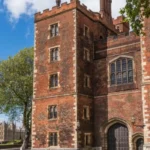
Morton’s Tower is the red-brick Tudor gatehouse at the palace entrance. Built around 1490 under Cardinal John Morton, it demonstrates the status and security associated with an important ecclesiastical residence. Its architecture provides a physical record of the wealth and institutional influence of the late medieval Church.
The palace also contains the historic Great Hall, a chapel and Lollards Tower. These structures reflect different periods of religious administration, worship and political change. The Great Hall was rebuilt by Archbishop William Juxon after the Restoration of the monarchy in 1660, following its demolition during the Commonwealth period.
This rebuilding connects the palace to one of Britain’s major constitutional turning points: the restoration of Charles II after the republic established following the English Civil War.
How does Lambeth Palace connect medieval history with modern Britain?
The palace remains a working institution rather than a preserved medieval residence. Its continuing religious and administrative functions show how historic institutions adapt while retaining their identity.
Visitors can explore the palace during selected tours and open days, subject to the published schedule. The official visitor information identifies historic rooms, the Great Hall, the Guard Room and the Crypt Chapel among the areas available on selected occasions.
As you explore this landmark, you are crossing a site shaped by centuries of religious and political change. The wider story is explored in the history of Lambeth and its transformation from a historic parish into an urban borough.
What does Lambeth Town Hall reveal about the growth of local democracy?
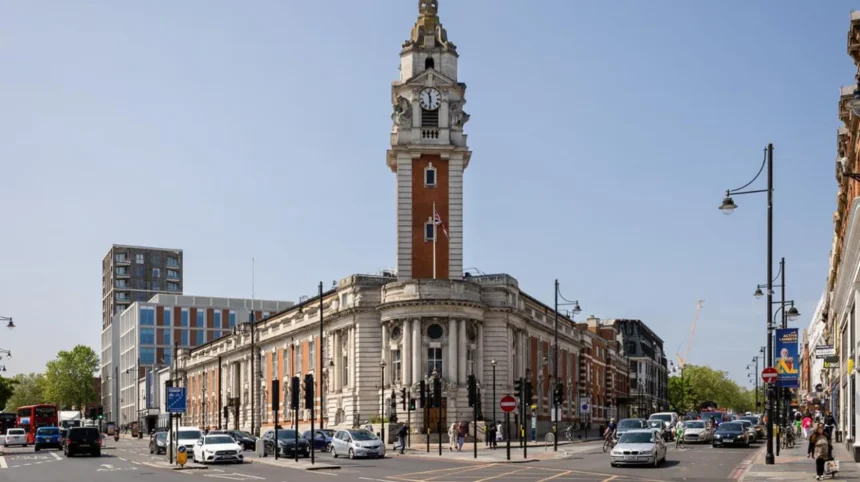
Lambeth Town Hall reveals how local government developed into a permanent civic institution. Opened in Brixton in 1908, the building became the headquarters of the borough’s elected representatives and administrative services, demonstrating the growing importance of municipal decision-making in an expanding London.
Lambeth Town Hall stands at the junction of Brixton Hill and Acre Lane. Its Edwardian Baroque architecture communicates the authority and civic ambitions of early twentieth-century local government.
The building was designed by architects Septimus Warwick and H. Austen Hall. Construction followed a competition that attracted 143 entries, and the foundation stone was laid in July 1906. The town hall officially opened on 29 April 1908.
Its establishment reflected London’s rapid population growth and the need for larger public institutions. Councils dealt with responsibilities such as local services, public health, housing, roads and the management of public spaces. These functions directly affected residents’ daily lives.
Why did Lambeth need a new town hall?
Before the Brixton building opened, the council used an older town hall on Kennington Road. As the borough expanded, the existing premises no longer met its administrative needs. The move to Brixton reflected the growing importance of the district within local government.
The building was extended between 1935 and 1938, including the addition of an assembly hall. This expansion illustrates how municipal institutions developed alongside the borough’s population and public responsibilities.
The distinction between the old Kennington Road town hall and the Brixton building is important for visitors researching Lambeth’s political geography. They are separate historic buildings associated with different stages of the borough’s civic administration.
How did Lambeth Town Hall reflect changing social attitudes?
Lambeth Town Hall was also a setting for changes in public attitudes. In 1955, a civic dance held in its Assembly Room became known as the “No Colour Bar Dance”. The event challenged racial discrimination at a time when equality was an increasingly important issue in British public life.
This episode demonstrates that political history includes more than elections and formal legislation. Public events, institutional decisions and community pressure also influence how equality is understood and practised.
The town hall remains a prominent landmark in Brixton. Its significance lies in both its architecture and its association with the practical work of local democracy.
How does Kennington Park connect Lambeth with nineteenth-century protest movements?
Kennington Park connects Lambeth with the Chartist movement, a national campaign for political reform that sought to extend democratic representation in nineteenth-century Britain. The park’s association with the mass gathering of 10 April 1848 makes it an important location for understanding working-class political mobilisation.
Kennington Park developed from common land into a public green space during the nineteenth century. Its location made it accessible to people travelling from different parts of London, helping it become a significant gathering place during an era of political agitation.
The Chartists campaigned for the People’s Charter of 1838, which set out six demands for parliamentary reform. These included votes for men aged 21 and over, secret ballots, equal electoral districts, payment for Members of Parliament, the removal of property qualifications for MPs and annual parliamentary elections.
The movement argued that the political system excluded much of the working population. Although several Chartist petitions failed to secure immediate adoption of the Charter, the campaign helped sustain public pressure for democratic reform.
Why was the Chartist gathering of 1848 significant?
On 10 April 1848, Chartists assembled at Kennington Common before a planned procession to present a petition to Parliament. The gathering took place during a period of revolutionary movements and political instability across Europe.
Authorities prepared for possible disorder, but the anticipated confrontation did not develop into the large-scale uprising some officials feared. The event became a major episode in the history of British mass politics.
Kennington’s association with the gathering shows how public spaces served as political infrastructure. Before modern mass media and digital campaigning, open land, streets and meeting places enabled campaigners to assemble, deliver speeches and demonstrate the scale of public support.
What does Kennington Park teach visitors about democratic change?
The park helps explain that political reform developed through sustained pressure rather than a single decisive event. Chartism did not achieve all its demands in 1848, but several of its objectives were incorporated into later reforms.
The secret ballot became law in 1872. Payment for MPs followed in 1911, while equalising constituency representation developed through later electoral reforms. The extension of voting rights to women and broader sections of the population also transformed British democracy over time.
Kennington Park is therefore more than a green space. It provides a setting for understanding the relationship between public assembly, political rights and gradual constitutional change.
What does County Hall reveal about London’s regional government?
County Hall reveals how London developed a regional layer of elected government during the twentieth century. Located on the South Bank opposite the Palace of Westminster, the building served as the headquarters of the London County Council and later the Greater London Council, linking Lambeth’s riverside landscape with citywide political administration.
County Hall is a major landmark on the South Bank, beside Westminster Bridge. Although it is associated with the wider history of London rather than only the present-day borough, its location makes it relevant to Lambeth’s political landscape.
The London County Council (LCC) was established in 1889. It introduced a more comprehensive elected authority for London’s growing urban area, with responsibilities covering issues such as housing, transport, public health and urban development.
County Hall became the council’s headquarters in the early twentieth century. Its scale and riverside position reflected the expanding responsibilities of London’s regional administration.
How did County Hall shape London’s political administration?
County Hall represented a move beyond the governance of individual parishes and metropolitan boroughs. Citywide challenges required coordination across local boundaries, particularly as London’s population and built-up area expanded.
The Greater London Council (GLC) replaced the LCC in 1965 as the principal elected authority for strategic government across Greater London. It operated from County Hall until its abolition in 1986.
The building therefore connects two important stages of London’s administration: the establishment of county-level government in 1889 and the creation of the Greater London Council in 1965.
Why does County Hall matter today?
County Hall’s former government role provides a useful context for understanding how London’s political priorities changed. Housing provision, transport infrastructure, planning and public services became major issues requiring decisions across borough boundaries.
Its later use for other activities also illustrates how political buildings acquire new functions when institutions move or disappear. The building remains part of the South Bank’s historic landscape, close to the national institutions across the Thames.
For visitors, the contrast between County Hall and the Palace of Westminster helps explain the difference between local or regional government and national parliamentary government. Both shaped London’s development, but their responsibilities and political structures were distinct.
How does the Imperial War Museum explain the political consequences of war?
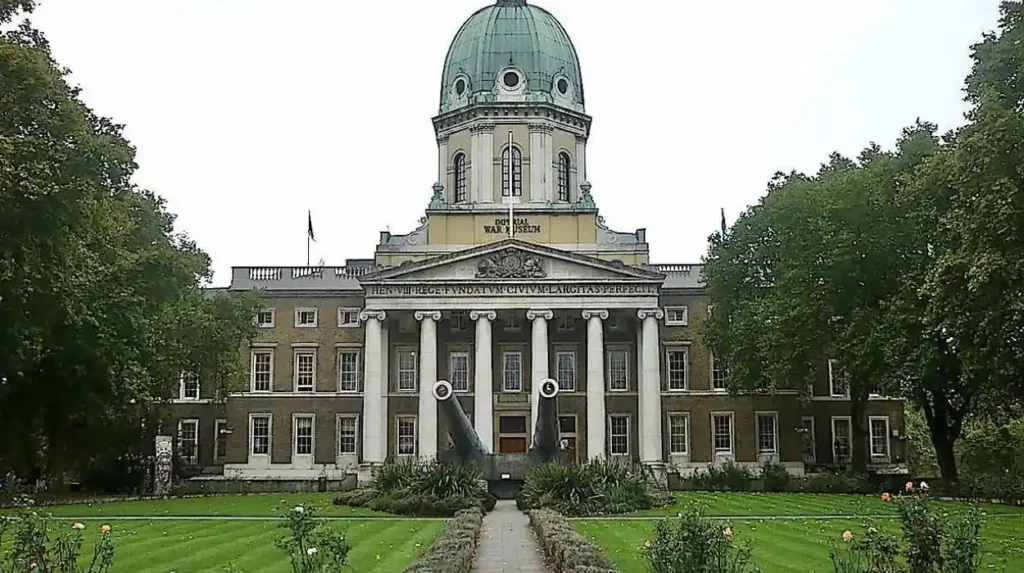
The Imperial War Museum in Lambeth examines how wars influence government decisions, civil liberties, international relations and civilian life. Established during the First World War, it preserves evidence of conflict involving Britain and the Commonwealth, helping visitors understand the relationship between military events and political decisions.
The Imperial War Museum (IWM) is on Lambeth Road, near the South Bank. Its present building originally formed part of Bethlem Royal Hospital, a historic psychiatric institution. The museum moved to the site in 1936.
The museum was established on 5 March 1917, while the First World War was still being fought. The War Cabinet approved its creation to record the conflict and the experiences of the people affected by it. Parliament formally established the institution in 1920.
How does the museum connect military history with political decisions?
War affects more than armed forces. Governments make decisions about taxation, military recruitment, industrial production, civil defence and international alliances. Conflicts also influence public attitudes towards national security, individual freedom and the responsibilities of the state.
The museum’s collections document the experiences of military personnel and civilians. They provide evidence for examining how government policies affect ordinary people during periods of national emergency.
Its location in Lambeth places these national and international histories within a borough closely connected to Westminster and London’s political institutions.
Why is the Imperial War Museum relevant to modern political history?
The museum’s coverage extends beyond the First and Second World Wars to later conflicts involving Britain and the Commonwealth. Its collections help visitors examine the long-term consequences of military intervention, the development of modern warfare and the changing relationship between governments and citizens.
For tourists, the museum offers a way to understand political decisions through documentary evidence, personal accounts and historical objects. It complements Lambeth’s civic buildings and protest sites by showing how national policy operates during conflict.
What does Brixton reveal about race, policing and political accountability?
Brixton reveals how disputes over policing, racial inequality and public authority became central to modern British political debate. The disturbances of April 1981 prompted a government inquiry led by Lord Scarman, making the area an important location for understanding accountability, community relations and institutional reform.
Brixton is one of Lambeth’s most recognisable neighbourhoods. Its social and political history reflects migration, cultural diversity, economic change and debates about the treatment of minority communities.
The disturbances of 10–12 April 1981 followed longstanding tensions between local residents and the Metropolitan Police. Heavy use of stop-and-search powers, particularly against young Black people, contributed to distrust. The events became a major national issue and prompted scrutiny of policing practices.
What was the significance of the Scarman Report?
Following the disturbances, the Home Secretary commissioned Lord Justice Leslie Scarman to investigate the causes of the disorder and make recommendations. The report was published on 25 November 1981.
The inquiry examined policing, racial disadvantage and social and economic conditions. It identified racial disadvantage as a significant factor in the disturbances and called for more direct action to address inequality. Its conclusions also attracted criticism, particularly over its treatment of institutional racism.
The report demonstrates how public disorder can trigger formal political investigation. It also shows the limits of official inquiries: documenting a problem does not automatically resolve the disagreements surrounding its causes or the adequacy of the proposed remedies.
How can visitors explore Brixton’s political legacy?
Brixton’s streets and public spaces provide context for understanding the area’s development, but the events of 1981 are best studied alongside documentary records and community perspectives.
The National Archives preserves material relating to the disturbances, including evidence submitted to the inquiry and records about policing practices. These documents help visitors distinguish contemporary accounts, official findings and later interpretations.
Brixton’s political significance continues to extend beyond one historical event. Its public life reflects ongoing questions about equality, representation, policing and the relationship between local communities and public institutions.
How does Archbishop’s Park reveal changing ideas about public welfare?
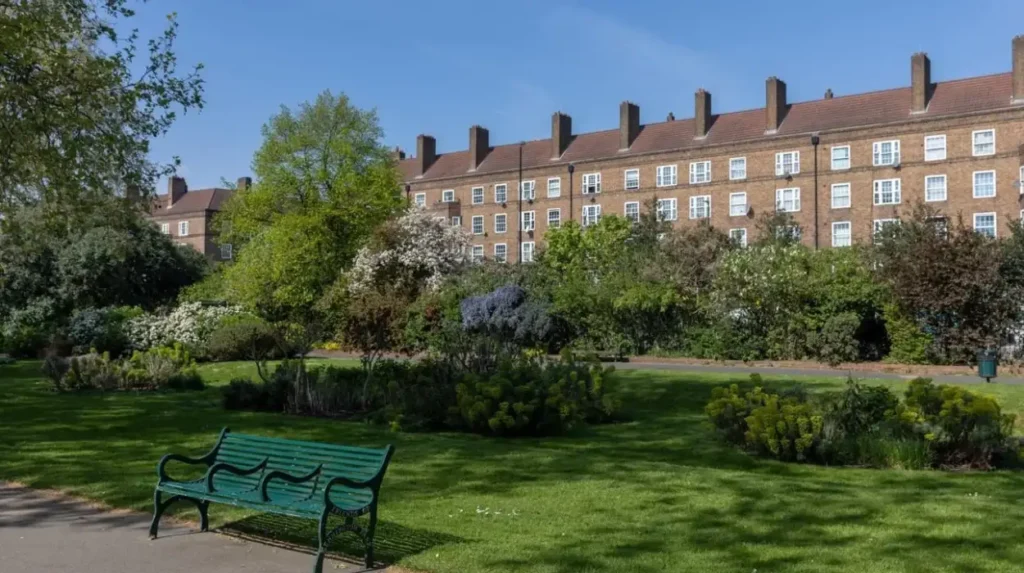
Archbishop’s Park reveals how land once associated with religious institutions became part of London’s public infrastructure. Opened in 1901, the park reflects growing recognition that accessible green space, recreation and community welfare formed important responsibilities within an increasingly urban society.
Archbishop’s Park lies beside Lambeth Palace. Its history connects religious landownership with the development of public recreation and urban planning.
In the nineteenth century, Archbishop Archibald Campbell Tait was concerned about poverty in London. Land associated with the palace gardens was opened for the benefit of local residents, providing access to outdoor space in a densely populated area. A campaign for permanent public access followed, and the park opened in 1901.
What does the park reveal about the changing role of institutions?
The development of Archbishop’s Park illustrates a gradual shift in expectations about the use of urban land. Private estates, institutional grounds and common land increasingly became subjects of public discussion as London grew.
Campaigners argued that access to open space benefited local communities. The resulting park provided facilities for recreation and sport, demonstrating how civic welfare extended beyond formal political representation.
This history connects with wider debates about public health, urban poverty and the responsibilities of local authorities. Access to green space became part of the broader discussion about what residents should expect from a modern city.
Why is Archbishop’s Park useful on a political-history walk?
The park offers a visible connection between Lambeth Palace and the development of public amenities. Visitors can examine how a site beside a powerful religious institution became a public resource.
Its history also adds a local dimension to the story of political reform. Changes in public access, land management and recreation reflect decisions about whose needs urban institutions should serve.
Explore More Area Guide
Lambeth History: From Parish to Urban Borough | South London
Lambeth Architecture Guide: Buildings for Students to Study
How can visitors explore Lambeth’s political landmarks in one day?
Visitors can explore Lambeth’s political history through a route linking Lambeth Palace, Archbishop’s Park, County Hall, the Imperial War Museum, Kennington Park and Brixton. Grouping the landmarks geographically creates a coherent journey from religious authority and regional government to protest, social reform and public accountability.
A practical itinerary begins at Lambeth Palace, where visitors can examine the historical relationship between religious leadership and national authority. Check the official website for tour dates and access arrangements before travelling, as the palace is not continuously open to the public.
Continue to Archbishop’s Park to explore the history of public access and urban welfare. The nearby riverside provides views across the Thames towards Westminster, placing Lambeth’s landmarks in their wider political setting.
County Hall provides the next major connection to London’s regional government. Its riverside location helps explain the relationship between elected citywide administration and national government across the river.
The Imperial War Museum offers an indoor visit focused on conflict and government policy. Allow sufficient time for its collections and exhibitions, particularly if you intend to explore the political consequences of the world wars.
Kennington Park adds the history of Chartism and public protest. Finish in Brixton, where Lambeth Town Hall represents local government and the surrounding neighbourhood provides context for the borough’s modern social history.
This route is best divided into sections if you want to visit the interior of the museum or attend a palace tour. Check opening times, walking distances and public transport connections before setting out.
What do Lambeth’s landmarks reveal about the future of political heritage?
Lambeth’s landmarks reveal that political heritage is not limited to preserving historic architecture. Their continuing value lies in helping people understand democratic representation, religious influence, public welfare, racial equality and government accountability as these issues evolve across generations.
The borough’s historic sites preserve different forms of political evidence. Lambeth Palace represents the continuity of religious leadership. Kennington Park records the importance of mass mobilisation. Lambeth Town Hall illustrates municipal government, while County Hall documents the development of regional administration.
The Imperial War Museum provides a broader view of the relationship between government and conflict. Brixton’s history demonstrates how community experiences can challenge official practices and influence national debate.
Together, these landmarks show that political change operates at different levels. Constitutional reform changes the legal framework, councils deliver public services, campaigners challenge existing systems, and communities shape how political decisions are experienced.
Preserving these places supports historical education and public discussion. Historic buildings also face practical questions about accessibility, maintenance, conservation and adapting older spaces for contemporary use. Balancing public access with the protection of historic fabric remains important to their future.
For residents and visitors, Lambeth offers a way to understand London through the places where authority was exercised, challenged and redefined. Its political history is not confined to one monument or period. It emerges from the connections between religious institutions, public parks, civic buildings and neighbourhoods.
Which Lambeth landmarks reveal London’s political history?
Lambeth Palace, Lambeth Town Hall, Kennington Park, County Hall, the Imperial War Museum and Brixton reveal different aspects of London’s political history, including religious authority, local democracy, political protest and racial equality.