Key Points
- Persistent local legends in South London claim a Victorian train containing human remains lies buried within a disused tunnel under Crystal Palace Park.
- Historical records confirm the existence of an experimental pneumatic railway built on the grounds in 1864 by engineer Thomas Webster Rammell.
- The short-lived railway system operated for only a few months as a demonstration of atmospheric pressure propulsion technology.
- Modern archaeological surveys and urban exploration investigations have consistently found no structural evidence of an entombed train or human remains.
- Historians attribute the urban myth to a blending of real pneumatic rail trials, subterranean railway architecture, and Victorian gothic storytelling.
Crystal Palace (South London News) October 31, 2026 — The legend surrounding a buried train containing Victorian skeletons beneath Crystal Palace Park has persisted in South London folklore for over a century. The narrative suggests that an experimental passenger train, carrying commuters or Victorian corpses, was trapped underground following a structural collapse or intentional sealing of a subterranean tunnel during the late nineteenth century.
- Key Points
- How Did Thomas Webster Rammell’s Atmospheric Railway Operate?
- Why Did the Railway Close and What Happened to the Tunnel?
- What Have Modern Explorations and Investigations Revealed?
- Background of the Crystal Palace Railway Infrastructure
- Potential Impact of Subterranean Heritage Tourism on Local Communities
Urban legends circulated across the region maintain that the carriage remains fully intact within a lost section of track between High Level Station and the surrounding parkland. According to local folklore, the occupants were entombed indefinitely after the railway line was abruptly closed and backfilled, leaving the rolling stock preserved in complete darkness.
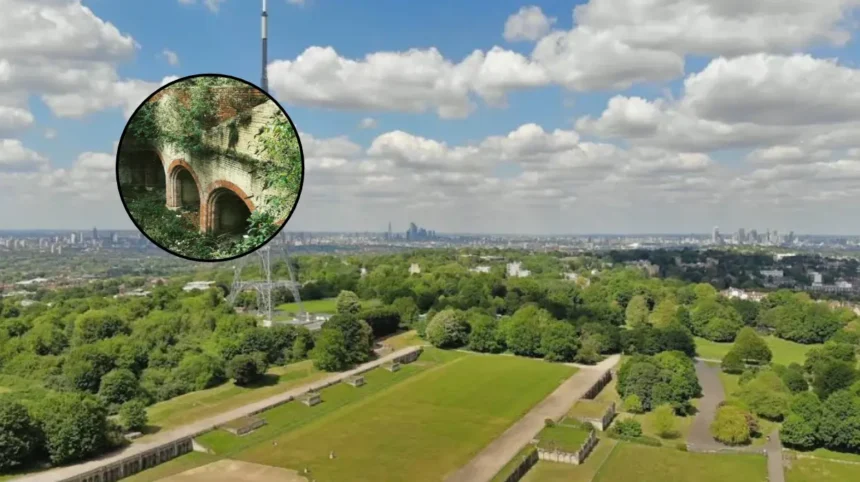
Historical reality provides a distinct framework for how these tales developed. In 1864, the Crystal Palace Pneumatic Railway was constructed within the park grounds under the supervision of executive engineer Thomas Webster Rammell. The experimental line ran for approximately 600 yards (550 metres) between the Sydenham entrance and the Armor Hill gate, designed to showcase how compressed air technology could propel passenger cars through tight underground brick tunnels.
How Did Thomas Webster Rammell’s Atmospheric Railway Operate?
The technical operation of the pneumatic railway relied upon atmospheric pressure differential rather than traditional steam locomotives. A large steam engine drove a 22-foot (6.7-metre) fan developed by Messrs Rammell and Jackson, creating a vacuum that sucked the carriage through a brick tunnel measuring 10 feet in diameter. On the return trip, the fan’s operation was reversed to push the car back to the terminus.
The passenger vehicle was fitted with a collar of bristles around its outer frame to form an airtight seal against the brick lining of the tunnel. This design permitted smooth travel at speeds reaching up to 20 miles per hour. The line opened for public demonstration in August 1864, attracting thousands of visitors who paid a fare of sixpence to experience the novel mode of transport.
Despite the initial technical success demonstrated at the park, the operational lifespan of the demonstration project was notably brief. Public demonstrations ceased by late 1864 or early 1865, as the primary objective of the line was to demonstrate the feasibility of the concept for larger urban transport networks, such as the proposed Waterloo and Whitehall Railway.
Why Did the Railway Close and What Happened to the Tunnel?
The closure of the pneumatic railway line coincided with the financial difficulties of its parent enterprise and the broader economic downturns affecting speculative railway construction in the late 1860s. Once the demonstration period concluded, the mechanical equipment was dismantled, the engine house was removed, and access points to the tunnel were backfilled to restore the park surface.
Over subsequent decades, public recollection of the exact tunnel alignment faded, while physical evidence of the subterranean structure vanished from the surface landscape. The sealing of the brick portals led to local speculation regarding what remained inside the subterranean vault.
How Did the Legend of Victorian Skeletons Originate?
The transformation of an engineering trial into a ghost story involving entombed corpses developed through several compounding factors during the twentieth century:
- Sensationalist Gothic Tales: Local storytellers combined the subterranean nature of the disused tunnel with Victorian burial practices, creating narratives of a train caught in a landslide while transporting funeral parties or cholera victims.
- Subterranean Sealed Entrances: The presence of sealed brickwork along the railway cuttings adjacent to the former Crystal Palace High Level Station fueled rumors of hidden chambers containing rolling stock.
- The 1936 Crystal Palace Fire: Following the catastrophic destruction of the main Crystal Palace building in 1936, massive amounts of debris were cleared into subterranean spaces, further obscuring historical access points and feeding rumors of lost structures.
What Have Modern Explorations and Investigations Revealed?
Repeated architectural surveys, archaeological digs, and urban exploration attempts throughout the late twentieth and early twenty-first centuries have sought to locate the precise path of Rammell’s pneumatic tunnel.
In 1975, an extensive investigation conducted by the London Transport Railway Society utilised geological surveys and historical mapping to trace the path of the 1864 line. The findings indicated that large portions of the shallow brick tunnel had either collapsed naturally due to root intrusion and ground movements or were systematically demolished during subsequent redevelopment projects within the park grounds.
Subsequent investigations using ground-penetrating radar (GPR) conducted by industrial archaeologists confirmed the presence of disturbed ground and brick fragments consistent with backfilled trenches, but produced no structural signatures matching an intact passenger car, locomotive, or human remains. The consensus among industrial historians remains that all rolling stock was extracted prior to the sealing of the line.
Background of the Crystal Palace Railway Infrastructure
The area of Crystal Palace Park has hosted multiple distinct rail transport developments since the relocation of the Great Exhibition building from Hyde Park to Sydenham Hill in 1854. To accommodate millions of visitors arriving at the venue, two major railway stations were constructed: Crystal Palace Low Level (opened 1854) and Crystal Palace High Level (opened 1865).
The High Level station, designed by architect Edward Middleton Barry, featured extensive subterranean brick vaults, grand vaulted arcades, and a subway beneath the Crystal Palace Parade. This intricate underground brick architecture created an expansive network of tunnels beneath the park landscape.
When the High Level line was decommissioned and dismantled by British Railways in 1954, many of these brick structures were sealed or repurposed. The presence of these extensive, inaccessible Victorian subway structures provided a physical canvas for urban myths regarding hidden trains and sealed underground spaces to take root in South London’s collective imagination.
Potential Impact of Subterranean Heritage Tourism on Local Communities
The enduring fascination with the subterranean mysteries of Crystal Palace Park has direct implications for local authorities, heritage organizations, and urban planners managing the area.
| Impact Area | Direct Consequences for Stakeholders |
| Heritage Tourism & Local Economy | Restoration of verified sites like the Crystal Palace Subway attracts visitors, driving revenue for local businesses and cultural trust programs. |
| Park Management & Public Safety | Persistent ghost train myths lead to unauthorized urban exploration, requiring capital expenditure on security and structural sealing. |
| Planning & Conservation | Infrastructure projects must balance ground investigation costs with historical preservation mandates from local councils. |
Continued public interest in the site’s underground history directly benefits the local economy by driving engagement with formal heritage initiatives. The ongoing restoration of the nearby Grade II* listed Crystal Palace Subway demonstrates how historical subterranean infrastructure can be safely reopened for public access and community events.
Conversely, the persistence of urban legends regarding entombed tunnels presents ongoing site safety and security challenges for London borough councils. Speculation regarding hidden chambers frequently encourages unauthorized trespassing and urban exploration into derelict railway structures, requiring local authorities to dedicate resources toward perimeter maintenance, structural monitoring, and public hazard awareness.