Key Points
- Fourth consecutive year at number one: The London Cycling Campaign has ranked Upper Tooting Road in the London Borough of Wandsworth—specifically the cluster of side roads including Ansell Road, Derinton Road, Lessingham Avenue, and Price Close—as the most dangerous junction cluster for cyclists in London for the fourth year in a row.
- Collision figures: Across the 2021 to 2025 collision data period, Upper Tooting Road recorded eight serious cyclist collisions and 19 slight cyclist collisions, with reporting also highlighting eight serious cyclist injuries over the past year.
- Criticism of Wandsworth Council and TfL: Simon Munk of the London Cycling Campaign criticised Wandsworth Council as “absolutely shocking” and “disgusted” with its inaction, arguing that side-street rat runs can be addressed cheaply and quickly without waiting to overhaul massive junctions.
- Top ten rankings: The 10 highest-ranking danger spots for cyclists span boroughs including Wandsworth, Haringey, Hackney, Hammersmith and Fulham, Newham, Southwark, and the City of London, with danger scores ranging from 8.54 at Upper Tooting Road down to 6.47 at Old Kent Road and St James’s Road.
- Proposed engineering fixes: Campaigners highlight all-round protected signalised junctions—often known outside London as CYCLOPS junctions—and modal filters such as bollards, planters, or cameras to stop cut-through motor traffic.
- Journey time versus safety debate: London Cycling Campaign Chief Executive Tom Fyans warned that minor delays for drivers frequently take priority over preventing fatal and serious injuries among people cycling, walking, and wheeling.
Tooting (South London News) November 28, 2026 – London cycling campaigners have criticised Wandsworth Council over ongoing collision risks at Upper Tooting Road after the south London route was named the capital’s most dangerous junction cluster for cyclists for the fourth consecutive year, with eight serious cyclist injuries reported over the past year and 27 total cycling collisions recorded between 2021 and 2025.
Why Has Upper Tooting Road Remained London’s Most Dangerous Junction for Cyclists?
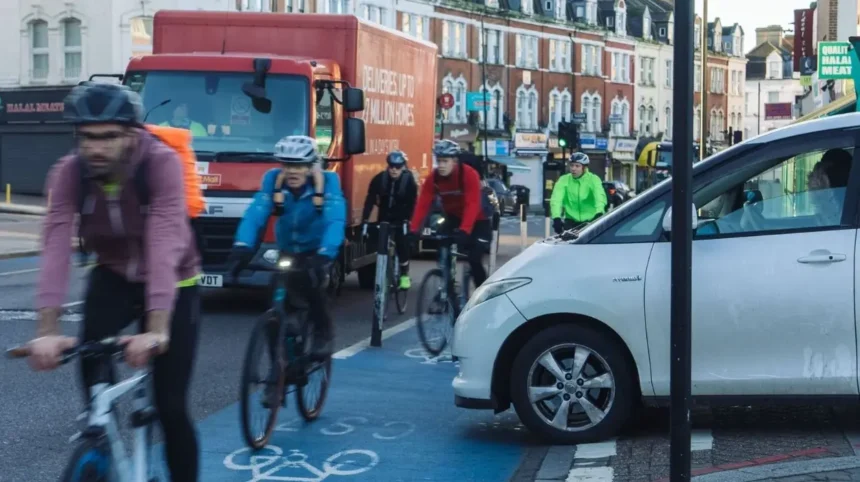
The London Cycling Campaign’s annual danger mapping places the cluster of side turn-offs off Upper Tooting Road—comprising Ansell Road, Derinton Road, Lessingham Avenue, and Price Close—at the top of the capital’s cyclist danger list with a danger metric of 8.54. Those side streets cross Cycle Superhighway 7 along the main corridor, where campaigners say drivers use residential streets as rat runs to bypass congestion.
As reported by Luke Donnelly of MyLondon, Simon Munk, from the London Cycling Campaign, stated:
“Upper Tooting Road could be fixed tomorrow; it’s cheap and is way easier than improving massive junctions which are dangerous for cyclists.”
As reported by Luke Donnelly of MyLondon, Simon Munk, from the London Cycling Campaign, also stated:
“Year after year Wandsworth Council is sitting on a situation where people are getting injured, some seriously, and they’re pretending like it’s not happening.”
As reported by Luke Donnelly of MyLondon, Simon Munk, from the London Cycling Campaign, further stated:
“I cannot say how disgusted I am with them; they could do so much better.”
As reported by Luke Donnelly of MyLondon, Simon Munk, from the London Cycling Campaign, added:
“Londoners should not have to wait for yet another serious collision before action is taken. TfL needs to prioritise people’s safety, invest in these junctions and finally do its part to look after cyclists in Wandsworth.”
According to reporting by Luke Donnelly of MyLondon, Simon Munk said the absence of traffic-calming measures on Ansell Road, Lessingham Avenue, and neighbouring streets encourages drivers to speed recklessly to save one or two minutes on journey times. Coverage by road.cc similarly noted that junctions alongside Cycle Superhighway 7 on Upper Tooting Road can create visibility and blind-spot challenges where drivers pull across cycle routes or overlook oncoming riders.
Which Other Junctions Made London’s Top 10 Most Dangerous List for Cyclists?
Across the London Cycling Campaign’s top ten list for cyclists—compiled from Stats19 emergency services collision data covering 2021 to 2025 and weighted by severity and recency—several major arterial and town-centre junctions recorded high numbers of serious and fatal collisions.
| Rank | Junction / Cluster | Borough / Area | Danger Metric | Recorded Cyclist Collisions (2021–2025) |
| 1 | Upper Tooting Road (Ansell Road, Derinton Road, Lessingham Avenue, Price Close) | Wandsworth | 8.54 | 0 fatal, 8 serious, 19 slight |
| 2 | Tottenham High Road (Broad Lane, West Green Road) | Haringey | 8.43 | 0 fatal, 8 serious, 10 slight |
| 3 | Curtain Road (Great Eastern Street, Gatesborough Street, St Leonard Street, New Inn Yard, Phipp Street) | Hackney | 8.35 | 0 fatal, 9 serious, 9 slight |
| 4 | King Street (Weltje Road) | Hammersmith and Fulham | 7.68 | 0 fatal, 7 serious, 16 slight |
| 5 | Carpenters Road (Stratford High Street, Jupp Road West, Wise Road) | Newham | 7.44 | 1 fatal, 2 serious, 9 slight |
| 6 | Borough High Street (Duke Street Hill, King William Street, London Bridge Street, Railway Approach) | Southwark | 7.41 | 0 fatal, 6 serious, 18 slight |
| 7 | Old Kent Road (Dunton Road, Kinglake Street, Madron Street, Mina Road) | Southwark | 7.40 | 1 fatal, 2 serious, 7 slight |
| 8 | Westway (Wood Lane) | Hammersmith and Fulham | 6.94 | 1 fatal, 3 serious, 2 slight |
| 9 | New Bridge Street (Apothecary Street, Bridewell Place, New Bridge Street) | City of London | 6.67 | 0 fatal, 7 serious, 3 slight |
| 10 | Old Kent Road (St James’s Road) | Southwark | 6.47 | 1 fatal, 2 serious, 3 slight |
Reporting by MyLondon also highlighted that nine cyclists suffered serious injuries in collisions around the Great Eastern Street and Curtain Road cluster in Shoreditch over the past year, while EC1Echo reported that the Wood Lane and A40 junction—where 21-year-old scientist Chuijiang “Christina” Kong was killed by a turning lorry—is lined up for improvements.
What Changes Are Campaigners and Transport Authorities Pursuing?
Campaigners note that seven of the ten worst cycling junctions feature traffic signals, while three could be largely addressed using modal filters. The London Cycling Campaign advocates two primary measures:
- All-round protected junctions: Signalised layouts that hold people walking, wheeling, and cycling on red while motor vehicles move, then release cycles on green alongside pedestrian signals. Known outside London as CYCLOPS junctions, these designs operate at more than 20 locations outside the capital; in London, Waltham Forest has around ten with two more planned, Newham has begun building the first of seven, and Camden and Islington have designs ready, whereas Transport for London has not yet delivered one.
- Modal filters: Measures such as bollards, planters, or cameras that prevent through-traffic from cutting across cycle routes along residential side streets, including a trial started by Hammersmith and Fulham at Weltje Road to stop non-resident drivers cutting across Cycleway 9 on King Street.
As reported by Marc Hobbins of Highways & Construction News, Tom Fyans, Chief Executive of the London Cycling Campaign, stated:
“Concerns over drivers facing a few seconds more on journey times all too often seems to trump dealing with fatal and serious collisions for those cycling, walking and wheeling.”
Transport for London’s consultation material for Monument—ranked second on the campaign’s pedestrian danger list behind Brixton Hill at Coldharbour Lane in Lambeth—states that the authority must balance needs across all road users and limit impacts on buses and other vehicles. For Monument, Transport for London outlines wand-separated cycle lanes, advance stop lines, and early cycle release, projecting peak journey-time increases of up to three minutes with construction targeted for 2029 if proposals proceed. For Great Eastern Street at Curtain Road in Hackney, where Transport for London previously consulted on left-turn bans for motor traffic and 7.5-metre-deep advance stop lines after counting 14 collisions and 15 injured people in the three years to 30 June 2024, campaigners say they are awaiting next steps and argue that measures must go beyond advance stop lines and early release signals.
Background
The London Cycling Campaign compiles its annual dangerous junctions mapping using Stats19 emergency services collision records across Greater London to identify locations with concentrated harm to people cycling and walking. Upper Tooting Road in Wandsworth has occupied the number-one spot for four consecutive years, having also topped the campaign’s 2025 release. Campaigners state that addressing the top ten cycling junctions could save roughly one cyclist’s life per year and prevent more than ten serious injuries. Alongside cycling rankings, the 2026 mapping evaluates pedestrian danger hotspots, with Brixton Hill at Coldharbour Lane in Lambeth ranked first after one fatal, eight serious, and ten slight collisions.
Prediction
For London cyclists and commuters—particularly riders using Cycle Superhighway 7 through Tooting and Wandsworth—the renewed focus on the 2021 to 2025 collision rankings is likely to keep pressure on Wandsworth Council and Transport for London to introduce side-street modal filters and safer junction layouts. Because side-street restrictions such as bollards, planters, or cameras can be installed more quickly than major signal reconstructions, riders along Upper Tooting Road could see targeted trials or consultations on cut-through traffic ahead of longer-term junction upgrades. At the same time, major schemes such as Monument—projected for 2029 if approved—and contested debates over minor journey-time increases for drivers and buses mean full physical transformation across all ten top-ranked junctions will likely unfold gradually rather than immediately.