You object by submitting written comments to Lambeth Council during the public consultation period for the planning application. Comments must be sent via the Lambeth planning portal, by email to planning@lambeth.gov.uk, or in letter format, quoting the application reference and your name and address. Objections must focus on material planning considerations such as design, density, affordable housing, and impact on local infrastructure, not on personal dislikes or property values.
- What counts as a valid objection to luxury flats in Brixton?
- Which planning policies in Lambeth protect Brixton from excessive luxury flats?
- How do I find and track planning applications for luxury flats in Brixton?
- What steps should I follow to write an effective objection letter?
- How can community groups strengthen objections to luxury flat schemes in Brixton?
- What happens after I submit an objection to a Brixton luxury flat application?
Brixton is within the London Borough of Lambeth, where all new residential developments, including luxury flats, require planning permission under the Town and Country Planning Act 1990. When a developer submits a planning application for a new block of flats, Lambeth Council must consult the public before deciding. This consultation normally lasts 21 days from the date the application is published on the council’s website.
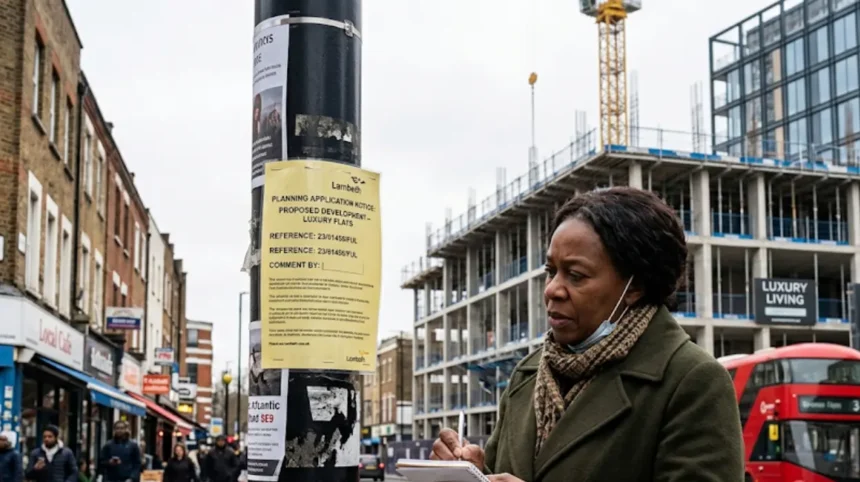
To object, you must identify the specific planning application. You can do this by searching the Lambeth planning portal using the Brixton postcode (for example, SE9 or SE24 depending on the exact location) or by checking local site notices, which are often posted on lamp posts near the development site. Once you have the application reference number (such as 23/01234/FUL), you can submit your objection.
Objections can be submitted:
- Online through the Lambeth planning application database
- By email to planning@lambeth.gov.uk, including the application reference, your full name, and address
- By letter to the Planning Department at Lambeth’s Civic Centre, 51 Northumberland Road, London SE1 9SD
Anonymous comments are not accepted and will be disregarded. All comments, including objections, become part of the public planning file and may be viewed by the applicant and other residents.
What counts as a valid objection to luxury flats in Brixton?
A valid objection must be based on material planning considerations recognised under national and local planning policy, such as design quality, housing density, impact on heritage assets, lack of affordable housing, insufficient transport capacity, or inadequate amenity space. Statements that focus only on opposition to the developer, expected loss of property value, noise during construction, or general dislike of “luxury” housing are not valid planning objections.
Lambeth Council can only take into account comments that concern “relevant material planning considerations”. These are issues that the planning system is designed to regulate. The National Planning Policy Framework (NPPF) and the Lambeth Local Plan 2020–2035 define the scope of these considerations.
Common valid objections to luxury flat developments in Brixton include:
- Design and scale: The building is too tall, too bulky, or poorly designed relative to the street frontage and surrounding architecture. This relates to policies such as Q7 (Urban design: new development) and Q26 (Tall buildings) in the Lambeth Local Plan.
- Density and housing mix: The scheme provides too many large, high-value units and fails to meet Local Plan requirements for housing size mix (Policy H4) or affordable housing (Policy H2).
- Affordable housing: The developer claims “viability” to reduce or remove affordable housing contributions, contrary to Policy H2 and the London Plan’s 50% affordable housing target for Lambeth.
- Heritage impact: The development affects a listed building, a conservation area, or a non-designated heritage asset such as a locally listed pub or historic facade. This engages Policies Q20 (Statutory listed buildings), Q22 (Conservation areas), and Q23 (Local heritage list).
- Amenity and overshadowing: Future residents or neighbouring homes will suffer from severe loss of light, privacy, or outdoor space. This relates to Policy Q2 (Amenity) and Q14 (Development in gardens and amenity spaces).
- Transport and infrastructure: The number of new homes exceeds the capacity of local roads, bus services, or stations such as Brixton Overground and Victoria Line, without adequate mitigation. This engages Policy T1 (Sustainable travel) and transport evidence in the Local Plan.
- Gentrification and social impact: While “opposition to business competition” or general anti-gentrification sentiment is not itself a material consideration, specific impacts such as loss of community facilities, reduction in socially rented housing, or displacement of existing residents can be framed in planning terms under Policies H3 (Safeguarding existing housing) and H11 (Estate regeneration).
Invalid objections include:
- Claims that the development will reduce your property value
- Loss of a private view
- Noise, disturbance, or inconvenience during construction (covered by the Control of Pollution Act, not planning)
- Boundary disputes, rights to light, or restrictive covenants
- Opposition to the principle of development where outline permission already exists
- General dislike of the developer or of “luxury” housing as a concept
These points are explicitly listed as non-planning objections by Lambeth Council.
Which planning policies in Lambeth protect Brixton from excessive luxury flats?
The Lambeth Local Plan 2020–2035 and the London Plan 2021 set binding rules on housing density, affordable housing, design quality, heritage protection, and tall buildings. Policies such as H2 (affordable housing), H4 (housing size mix), Q7 (new development design), Q26 (tall buildings), and PN3 (Brixton) are used to assess whether luxury flat schemes are acceptable in Brixton.
The statutory development plan for Lambeth consists of the London Plan and the Lambeth Local Plan. All planning decisions, including those on luxury flats in Brixton, must be made in accordance with these documents unless material considerations indicate otherwise.
Key policies relevant to luxury flat builds in Brixton include:
- Policy H2: Delivering affordable housing
Requires new residential developments to provide a minimum proportion of affordable housing, with a target of 50% in line with the London Plan. Developers may apply for viability-based reductions, but these must be justified with robust evidence. Objectors can argue that a luxury scheme fails to meet this requirement or that the viability argument is not supported. - Policy H4: Housing size mix in new developments
Sets targets for the proportion of one-bedroom, two-bedroom, and larger homes. Luxury developments often concentrate on large, high-value units, which can conflict with these mix requirements and reduce the range of homes available to local families. - Policy H3: Safeguarding existing housing
Prevents the loss of existing residential stock through demolition or conversion to non-residential uses without replacement. In Brixton, this can be used to challenge schemes that remove existing affordable or social housing without adequate replacement. - Policy Q7: Urban design: new development
Requires new buildings to be well-designed, reflect local character, and provide high-quality public and private spaces. Poorly scaled or overly glossy “luxury” blocks that ignore Brixton’s street pattern, materials, or historic context can be challenged under this policy. - Policy Q26: Tall buildings
Controls where tall buildings are acceptable. Annex 10 of the Local Plan identifies specific zones in Brixton where tall buildings may be considered. A luxury tower outside these zones, or one that harms strategic views or heritage assets, can be objected to under this policy. - Policy PN3: Brixton
This neighbourhood policy sets out the vision and specific controls for Brixton as a Major Town Centre. It balances growth with protection of Brixton’s cultural identity, public spaces, and existing community uses. Objectors can argue that a luxury flat scheme undermines the PN3 vision by prioritising high-end housing over local needs. - Policy Q20–Q23: Heritage
These policies protect listed buildings, conservation areas, and locally listed assets. Brixton has several historic pubs, cinemas, and shop fronts that may be affected by new flats. Heritage objections must show how the development harms the asset’s significance, not just that it looks “modern”.
The London Plan also sets strategic housing targets for Lambeth, including at least 1,335 net additional homes per year between 2019/20 and 2028/29, and requires general conformity with its affordable housing and design policies. Objectors can reference both the London Plan and Lambeth Local Plan to show that a luxury scheme breaches multiple layers of planning control.
How do I find and track planning applications for luxury flats in Brixton?
You find applications by searching the Lambeth Council planning portal using Brixton postcodes, street names, or application references, and by checking site notices near the development. You track them by regularly reviewing the portal, signing up for email alerts if available, and monitoring local news sources such as Brixton Blog or The Brixton Society.
Lambeth Council publishes all planning applications on its online planning database. To search for luxury flat applications in Brixton:
- Go to the Lambeth planning applications page and select “Search and comment on applications”.
- Use the map search or postcode search, entering Brixton postcodes (for example, SE9 for parts of Brixton Hill, or SE24 for Brixton waterline areas).
- Filter by “Residential” or “Blocks of flats” if options are available.
- Review the list of applications, noting:
- Application reference (e.g., 23/01234/FUL)
- Site address
- Description (e.g., “Demolition of existing building and construction of 4-storey block of 12 luxury flats”)
- Status (e.g., “New application”, “Under consideration”, “Decision made”)
Each application page includes:
- Drawings and floor plans
- Design and access statements
- Officer reports (once the application is progressed)
- A comments section where you can submit objections.
Site notices are often posted on lamp posts or fences near the site and include:
- The application reference
- A short description of the proposal
- The consultation deadline (usually 21 days)
- A link or instruction to view full details online.
To track applications over time:
- Revisit the portal regularly, especially for sites you are concerned about.
- Note the “last updated” date on each application page.
- Check the “Weekly planning lists” published by Lambeth, which summarise new applications and decisions.
- Follow local outlets such as Brixton Blog, The Brixton Society, and Brixton Buzz, which often report on significant developments and include links to planning files.
Some campaigns, such as the George IV Campaign and anti-gentrification groups, also summarise active applications and provide advice on how to object.
What steps should I follow to write an effective objection letter?
Start by clearly stating your name, address, and the application reference. Then explain, in short factual paragraphs, which specific policies the scheme breaches and how it harms Brixton. Use precise language, avoid emotional attacks on the developer, and focus on design, density, affordable housing, heritage, and infrastructure impacts. End by formally requesting that Lambeth Council refuse permission.
An effective objection letter for a luxury flat development in Brixton follows a clear structure:
- Header
- Your full name and address (including postcode)
- The date
- The application reference number (e.g., 23/01234/FUL)
- The site address
- Opening statement
- State that you are objecting to the application.
- Mention that you reside in Brixton or South London and are affected by the development.
- Policy-based arguments
- Identify the specific Lambeth Local Plan and London Plan policies the scheme breaches.
- For each policy, explain:
- What the policy requires
- How the proposal fails to meet it
- The impact on Brixton (e.g., loss of affordable housing, poor design, heritage harm)
- “Policy H2 requires 50% affordable housing. The applicant claims viability but provides no independent evidence. This scheme would deliver 0% affordable housing, reducing the borough’s ability to meet local needs.”
- “Policy Q7 requires new development to respect local character. The proposed glossy glass tower is out of scale with the surrounding three-storey buildings and damages Brixton’s historic street pattern.”
- Specific impacts
- Describe tangible impacts such as:
- Loss of light to neighbouring homes
- Overshadowing of public spaces
- Increased pressure on Brixton station and bus routes
- Harm to a listed pub or historic facade
- Describe tangible impacts such as:
- Conclusion
- Summarise your main points briefly.
- State clearly that you request Lambeth Council to refuse planning permission.
- Contact details
- Provide your email and telephone number if you are willing to be contacted for further discussion.
Avoid:
- Emotional language (“disgusting”, “greedy developer”)
- General statements about “luxury flats” without linking to policy breaches
- Repeated identical comments from multiple people (the council discounts duplicate copies).
Each objection should be unique and fact-specific. If you are part of a campaign group, coordinate so that each supporter raises different policy points or impacts.
Explore More Help & Resources
How to report missed bin collections in Croydon
How to apply for Lewisham Council social housing
How can community groups strengthen objections to luxury flat schemes in Brixton?
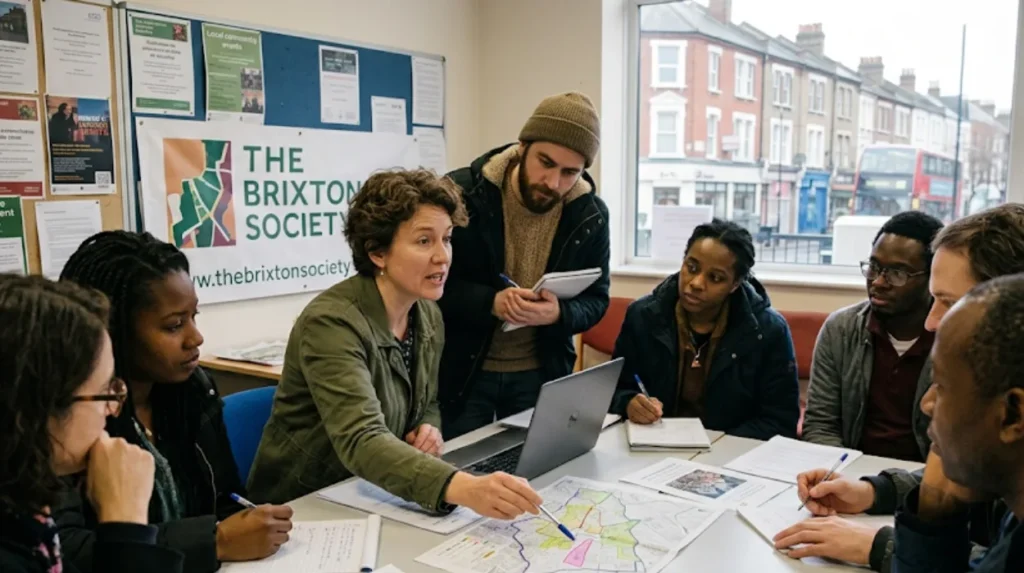
Community groups strengthen objections by coordinating multiple residents to raise distinct, policy-based arguments, providing evidence such as surveys or heritage assessments, and engaging local councillors and media. Campaigns should focus on breaches of the Lambeth Local Plan and London Plan, and on demonstrating widespread local concern through varied, detailed objections rather than mass identical comments.
Campaigns such as the George IV Campaign and anti-gentrification groups have shown that coordinated community action can influence planning outcomes in Brixton. Key strategies include:
- Diverse, policy-focused objections
Instead of many identical emails, campaign organisers encourage residents to:- Focus on different policies (e.g., one on affordable housing, another on heritage, another on transport).
- Provide specific examples of harm, such as impact on particular streets or buildings.
This ensures the council sees a broad range of material concerns rather than a single repeated point.
- Evidence and expert input
Groups may commission:- Heritage reports showing how a scheme harms a listed building or local heritage asset.
- Transport studies arguing that Brixton station and bus interchanges cannot absorb additional residents without mitigation.
- Housing need analyses demonstrating local demand for affordable and family-sized homes.
Such evidence can be referenced in individual objections and in formal representations by the campaign.
- Engagement with councillors and officials
Campaigners often:- Inform local Lambeth councillors about the application and request that they raise concerns at planning committee meetings.
- Submit formal letters of representation to the Planning Department, summarising community concerns and policy breaches.
- Attend planning committee hearings where major applications are decided.
- Media and public awareness
Local media such as Brixton Blog, Brixton Buzz, and The Brixton Society publish articles on significant developments, explaining the planning issues and how to object. This:- Increases the number of people aware of the application.
- Frames objections in policy terms rather than purely emotional terms.
- Creates a public record of community opposition that can be referenced later.
- Legal and pre-action routes
In some cases, campaigns have considered:- Pre-action correspondence to the council or Mayor of London, highlighting potential breaches of planning law or procedural errors.
- Potential judicial review if the council grants permission despite clear policy breaches.
For example, the Mayor of London has previously quashed Lambeth’s early decision to accept a 20-storey tower in Brixton after campaign organisations advanced further evidence and representations.
Community groups should ensure that all objections remain within planning law, focusing on material considerations and policy breaches, rather than purely anti-development sentiment. This approach increases the likelihood that objections will be considered seriously by planners and, if necessary, by inspectors or courts.
What happens after I submit an objection to a Brixton luxury flat application?
After you submit an objection, Lambeth Council records it on the planning file, considers it alongside all other comments and the developer’s responses, and then makes a decision based on the Local Plan and London Plan. If permission is granted despite strong objections, you may have limited rights to challenge the decision through judicial review or, in some cases, the Mayor of London may intervene if the scheme is tall or strategic.
Once comments are submitted:
- Recording and transparency
- Your objection is added to the public planning file on the Lambeth portal.
- The applicant and other interested parties can see your comments (but not your private contact details unless you included them voluntarily).
- Anonymous comments are disregarded.
- Assessment by planning officers
- Officers review all comments and assess whether objections raise valid material planning considerations.
- They consider whether the proposal complies with the Lambeth Local Plan and London Plan.
- Officers prepare a report recommending approval or refusal, which is published before the decision.
- Decision-making
- Most applications are decided by council officers under delegated powers.
- Major or controversial applications may be referred to the Planning Committee, where councillors vote.
- The decision notice states whether permission is granted or refused and lists any conditions.
- Post-decision options
If permission is granted:- You cannot appeal the decision as a third party; only the applicant can appeal to the Planning Inspectorate if permission is refused.
- You may seek a judicial review in the High Court if you believe the council acted unlawfully (for example, ignored binding policies or failed to follow proper procedure). Judicial review is time-limited, usually to six weeks from the decision.
- For certain tall or strategic developments, the Mayor of London has a separate role. In Brixton, the Mayor has previously quashed a decision to accept a 20-storey tower after campaign groups provided further representations, showing that mayorial intervention can occur where procedural or policy errors are identified.
- Enforcement and monitoring
- If the developer builds contrary to the permission or conditions, you can report this as a breach of planning control to Lambeth’s enforcement team.
- Enforcement actions are separate from the original objection process but relate to the same development.
How do I object to a luxury flats planning application in Brixton?
Submit your objection during the public consultation period through the Lambeth planning portal, by emailing planning@lambeth.gov.uk, or by sending a letter quoting the planning application reference, your name, and your address.