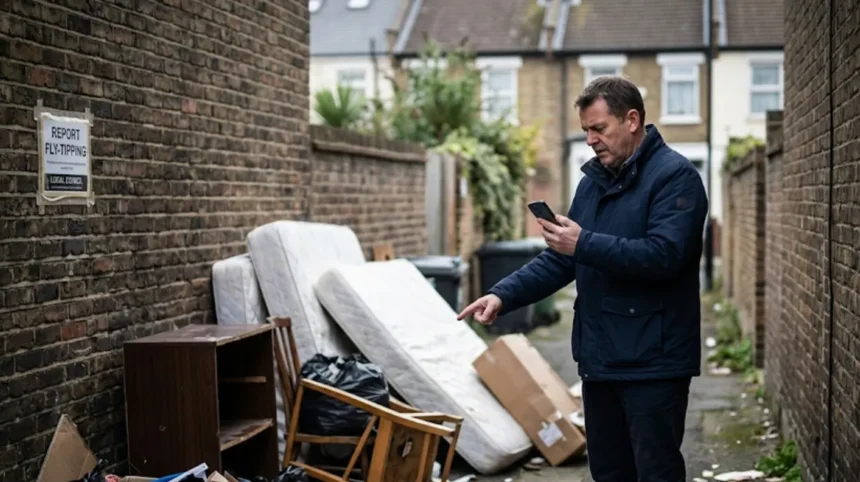
Fly-tipping in a South London alleyway is a criminal waste offence that must be reported to the responsible local authority, Transport for London (if the alley is on a red route), or the Environment Agency if it is large-scale or hazardous. Residents, workers, and tenants can report it online, by phone, or in some cases via apps such as FixMyStreet or ClearWaste, and should collect evidence including location, date, time, waste type, and vehicle details where possible.
- What is fly-tipping and why does it matter in South London alleyways
- Which authority is responsible for clearing fly-tipping in your alleyway
- How to report fly-tipping in a South London alleyway step by step
- Step 1: Confirm the location and responsible authority
- Step 2: Decide whether the alley is public or private
- Step 3: Collect evidence safely
- Step 4: Make the report
- Step 5: Record your reference number
- What information councils need to investigate and clear fly-tipping
- How councils investigate and enforce against fly-tipping offenders
- What happens after you report fly-tipping in a South London alleyway
- How you can prevent fly-tipping in your South London alleyway
- Why reporting fly-tipping in South London alleyways matters for everyone
What is fly-tipping and why does it matter in South London alleyways
Fly-tipping is the illegal dumping of waste on land without the owner’s permission or without a licensed waste disposal site. In South London alleyways, it creates health risks, blocks access, damages property, and increases local cleaning costs for councils and residents. The practice is a criminal offence under the Environmental Protection Act 1990 and can lead to fines up to £1,000 or imprisonment.
Fly-tipping covers any deliberate dumping of rubbish where it should not be left, from a single black bag of household waste to trailer-loads of commercial or construction materials. Alleyways behind shops, pubs, housing blocks, and industrial premises in South London are frequent targets because they are often poorly lit, less monitored, and used as informal access routes.
In England, fly-tipping incidents reached 1.26 million in 2024–25, a 9% increase from the previous year, with nearly two-thirds involving household waste. Pavements and roads account for 37% of all incidents; alleyways are functionally part of the public highway network in most cases and fall under the same rules. London has the highest per-capita fly-tipping rate in the UK at 53 incidents per 1,000 people, making it a priority area for enforcement.
South London boroughs such as Croydon, Southwark, Lambeth, Wandsworth, Lewisham, and Kingston have all reported rising fly-tipping volumes and have introduced crackdowns, including increased fines and new enforcement officers. The cost of clearing the largest incidents alone across England was £19.3 million in 2024–25, money that ultimately comes from council budgets and local taxpayers.
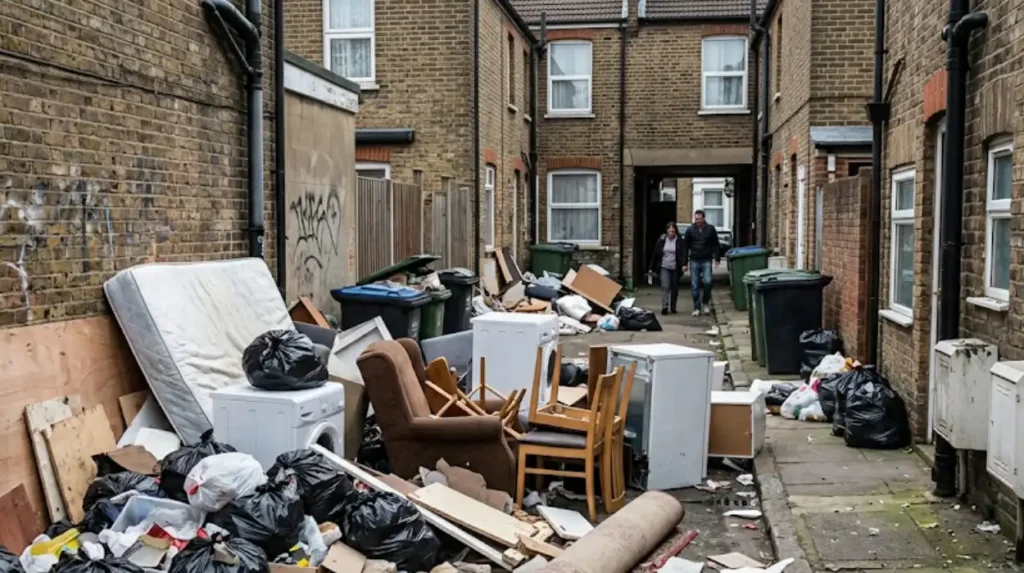
Which authority is responsible for clearing fly-tipping in your alleyway
The local council for the borough where the alleyway is located is usually responsible for clearing fly-tipping on public or council-owned land. If the alley is on a Transport for London red route, you must report it to TfL. Large-scale or hazardous waste must be reported to the Environment Agency or Crimestoppers.
Most alleyways in South London are classified as public highways or council-managed access routes. In these cases, the environmental health or street cleaning team of the relevant borough council is responsible for investigating and removing the waste. Examples include:
- Croydon Council for alleyways in Croydon, Thornton Heath, New Addington
- Southwark Council for alleyways in Southwark, Bermondsey, Walworth
- Lambeth Council for alleyways in Brixton, Kennington, Vauxhall
- Wandsworth Council for alleyways in Battersea, Balham, Tooting
- Lewisham Council for alleyways in Lewisham, Catford, Brockley
- Kingston Council for alleyways in Kingston, Surbiton, New Malden
If the alleyway is on private land, including shared access behind private houses or flats, the landowner or occupier is responsible for clearance. In these cases, residents must contact a licensed waste carrier to remove the waste and ensure the land is secured to prevent further tipping.
Red routes are major roads managed by Transport for London rather than local councils. Some alleyways connect directly to or run alongside red routes and may be classified as part of the TfL network. In such cases, the council will not clear the waste; residents must report it to TfL’s highway team.
Large-scale dumping, such as lorries leaving multiple bags, builders’ rubble, or hazardous materials like asbestos, chemicals, or fuel, must be reported to the Environment Agency incident hotline (0800 80 70 60) or anonymously to Crimestoppers (0800 555 111). These incidents often require specialist handling and investigation beyond the capacity of local street cleaning teams.
How to report fly-tipping in a South London alleyway step by step
To report fly-tipping in a South London alleyway, first confirm the borough and whether the alley is public or private. Then report online via the council’s fly-tipping form, by phone, or via apps. Provide location, date, time, waste type, and any vehicle or person details. Keep your reference number to track progress.
Step 1: Confirm the location and responsible authority
Identify the exact address or nearest landmark for the alleyway, including the street name and postcode. Use the council’s postcode checker or the GOV.UK “Report fly-tipping” service to find the correct local authority. If the alley is on a red route, the council will not accept the report; you must contact TfL.
Step 2: Decide whether the alley is public or private
If the alley is used by the public, has street lighting, or is maintained by the council, it is likely public land. If it is behind a private gate, serves only a single building, or is marked as private access, it is private land. Private land fly-tipping must be reported to the landowner or a licensed waste carrier, not the council.
Step 3: Collect evidence safely
Record the following details:
- Exact location (address, postcode, nearest landmark)
- Date and time the waste was discovered or seen being dumped
- Type and approximate quantity of waste (e.g., household bags, furniture, builders rubble)
- Description of any people seen, including sex, hair colour, height
- Vehicle details if visible: make, model, colour, registration number, any distinguishing features
Do not approach individuals engaged in illegal dumping. If you witness fly-tipping in progress, call the police on 999 or 101 and do not confront the offenders.
Step 4: Make the report
Use one of the following methods:
- Online form: Most South London councils provide a dedicated fly-tipping report form on their website. Examples include Croydon, Southwark, Lambeth, Wandsworth, and Lewisham. The form will ask for location, waste type, date/time, and optional evidence such as photos or videos.
- Phone: Call the council’s environmental crime or street cleaning team. Some councils, such as Royal Greenwich, accept reports by phone at 020 8921 5025.
- Apps and third-party sites: Apps such as ClearWaste and websites like FixMyStreet allow you to report fly-tipping and route it to the correct authority.
Provide all available details and attach photos or videos if the form allows. Confirm that you will be willing to provide evidence for prosecution if requested, as this can strengthen the case.
Step 5: Record your reference number
After reporting, you will receive a confirmation email or reference number (REQ number). Save this number to track the progress of your report. Some councils, such as Barking and Dagenham, allow you to check the status online using this reference. If you need to escalate the report, email the council’s recycling or environmental crime team quoting the reference number.
What information councils need to investigate and clear fly-tipping
Councils require the location, date, time, type of waste, and any evidence of people or vehicles involved. Photos, videos, and vehicle registration numbers significantly improve the chance of identifying offenders and prosecuting them.
Without accurate location details, councils cannot confirm whether the alley is on their land or a red route. A vague description such as “behind the shops on Church Road” is insufficient. The council needs a specific address, postcode, or clear landmark reference.
The date and time help determine whether the waste is recent or has been there for weeks. Recent incidents are more likely to be traced using CCTV, neighbourhood cameras, or witness accounts. Older waste may be treated as general litter rather than a specific fly-tipping incident.
The type and quantity of waste allow the council to assess:
- Whether it is household waste, commercial waste, or hazardous waste
- Whether specialist equipment or licensed carriers are needed
- Whether the Environment Agency should be involved
Evidence of people or vehicles, especially registration numbers, is critical for enforcement. South London councils such as Croydon now actively search dumped waste for addresses and use CCTV to trace offenders. Registration numbers allow them to link multiple incidents to the same vehicle or individual.
Residents who provide high-quality evidence and agree to support prosecutions improve the likelihood of fines or court action. Although only a small fraction of fly-tipping incidents in England lead to court action, stronger evidence increases this probability.
Explore More Help & Resources
How to apply for a South London primary school place
How to find a NHS dentist in South East London
How councils investigate and enforce against fly-tipping offenders
Councils investigate fly-tipping by visiting the site, collecting evidence from waste and surroundings, reviewing CCTV, and tracing vehicle registrations. Offenders caught can receive fixed penalty notices of up to £1,000, unlimited fines, or imprisonment for large-scale or repeated offences.
When a report is received, the council’s environmental crime or street cleaning team visits the alleyway to confirm the quantity and type of waste and to determine whether it is their responsibility. They may photograph the scene and collect items from the waste that could contain identifying information, such as delivery labels, address tags, or shop receipts.
Croydon Council has invested around £1 million in the previous year in removing illegally dumped waste and has deployed new enforcement officers to track offenders. These officers search through rubbish for clues such as addresses, then use CCTV and local networks to identify and prosecute culprits.
Many London boroughs, including Southwark, Wandsworth, Lewisham, and Kensington and Chelsea, have raised fixed penalty notices (FPNs) for fly-tipping to the maximum of £1,000. Failure to pay an FPN, or repeated or large-scale fly-tipping, can lead to prosecution and unlimited fines.
Under the Environmental Protection Act 1990, individuals found fly-tipping on the highway can be sentenced to up to three months in imprisonment. Larger or organised operations may be treated as waste crime and investigated by the Environment Agency, which can lead to longer prison terms and significantly higher fines.
Despite these powers, enforcement remains low. In 2024–25, only 69,000 FPNs were issued nationally and just 1,377 prosecutions were brought, meaning fewer than 0.2% of incidents resulted in court action. The average court fine was £539, well below the maximum £1,000 FPN.
What happens after you report fly-tipping in a South London alleyway
After you report fly-tipping, the council will visit the site to confirm responsibility and remove the waste if it is on public land. You will receive a reference number and, in some cases, updates on progress. Prosecution depends on the strength of evidence and the willingness of witnesses to support court action.
Most councils aim to clear fly-tipped waste within 48 hours of receiving a report, provided it is not hazardous. Hazardous waste, such as asbestos, chemicals, or fuel, may take longer due to specialist handling requirements.
If the alley is private land, the council will not remove the waste. They will inform you that the landowner or occupier is responsible and may suggest contacting a licensed waste carrier. You can still report the incident to help the council track patterns and identify repeat offenders.
You can track the status of your report using the reference number provided. Some councils allow online status checks; others require you to contact the environmental crime team by email or phone. If you need to escalate, quote the reference number in your communication.
Prosecution is not automatic. The council will assess whether there is sufficient evidence to identify an offender and whether witnesses are willing to support court action. If evidence is strong, the council may issue an FPN or pursue court proceedings. If evidence is weak, the case may be closed without further action.
How you can prevent fly-tipping in your South London alleyway
Preventing fly-tipping requires securing access points, improving lighting, installing CCTV or signage, and reporting early incidents. Residents and businesses should cooperate with councils and share evidence to support enforcement.
Simple physical measures can reduce opportunities for fly-tippers:
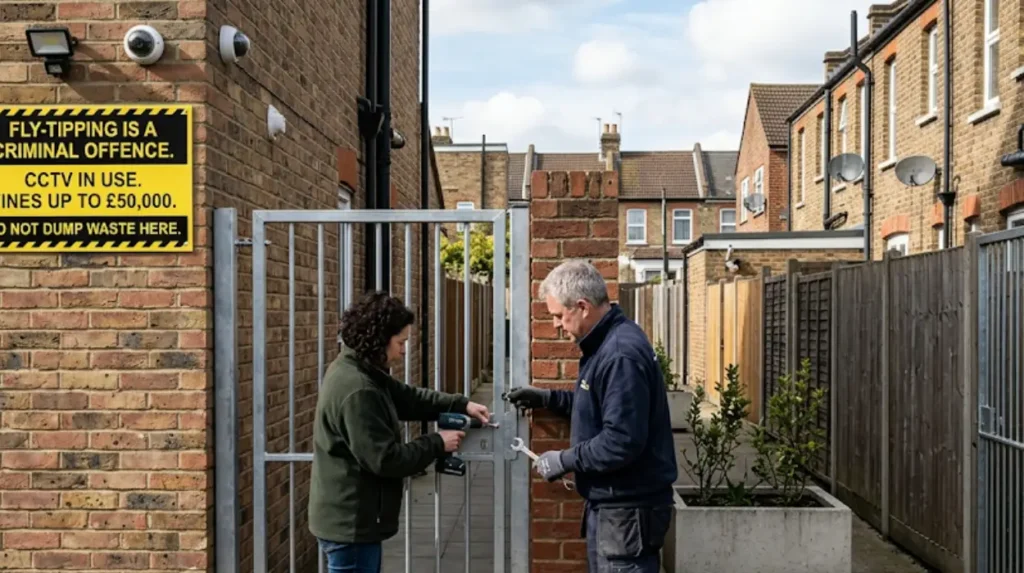
- Install sturdy gates or locks on alley entrances
- Use bollards or planters to block vehicle access where appropriate
- Improve lighting to make the area less attractive for illegal dumping at night
- Fit CCTV cameras or motion-sensor lights that record activity
Signage stating “Fly-tipping is a criminal offence. CCTV in use. Fines up to £1,000” can deter offenders. Many councils offer advice on anti-fly-tipping measures and may support community schemes with grants or equipment.
Early reporting of small incidents helps councils identify patterns and target enforcement. If you notice a single bag or mattress appearing repeatedly in the same alley, report each instance. This builds a record that can be used to trace repeat offenders.
Residents and businesses can share CCTV footage with the council, especially when they suspect a particular vehicle or person is responsible. Croydon Council and other boroughs have used reported incidents and collected evidence to deploy new officers, increase fines, and pursue prosecutions.
Regular communication with the local council’s environmental crime team ensures that the area remains on their radar. Neighbourhood groups, business associations, and community police liaison officers can help coordinate reporting and prevention efforts across multiple alleyways in a South London neighbourhood.
Why reporting fly-tipping in South London alleyways matters for everyone
Reporting fly-tipping protects public health, reduces local cleaning costs, and supports enforcement against waste crime. Every report increases the chance of identifying offenders and reducing the overall volume of illegal dumping in South London.
Fly-tipped waste in alleyways creates health hazards by attracting rats, mice, and insects, and by exposing residents to sharp objects, broken glass, and hazardous materials. Bloated bags leaked with liquid waste can contaminate soil and drainage systems, increasing the risk of disease.
The cost of clearing fly-tipping is borne by local councils and ultimately by local taxpayers. In 2024–25, clearing the largest incidents cost £19.3 million across England, with London having the highest per-capita rate. Every successful prosecution and fine reduces the net cost to the community.
Increased reporting also strengthens the evidence base used by councils to target enforcement. Croydon Council and other South London boroughs have used reported incidents and collected evidence to deploy new officers, increase fines, and pursue prosecutions.
Reporting fly-tipping in alleyways is a direct way for residents and workers to contribute to a cleaner, safer, and more attractive South London. It supports community pride, reduces visible crime, and helps ensure that waste disposal remains a responsible and lawful activity for everyone.
What is fly-tipping in a South London alleyway?
Fly-tipping is the illegal dumping of waste in an alleyway, street, or other location without permission. It can include household rubbish, furniture, garden waste, construction materials, mattresses, electrical items, or commercial waste. Fly-tipping is a criminal offence under the Environmental Protection Act 1990.