Brixton is one of Lambeth’s most distinctive destinations because its markets, Black British heritage, global food culture, music venues, public art, historic buildings and transport connections sit within a compact town centre. Its identity combines Victorian urban development with post-war Caribbean influence and contemporary creative activity.
- Why is Brixton considered a must-visit part of Lambeth?
- What is the history behind Brixton’s distinctive identity?
- How important is Brixton Market to the visitor experience?
- What can visitors eat in Brixton?
- What is Windrush Square and why is it important?
- Which historic buildings should visitors see in Brixton?
- Where can visitors experience Brixton’s Black British heritage?
- Why is Brixton important to London’s music culture?
- What role does David Bowie play in Brixton’s identity?
- What public art can visitors discover in Brixton?
- Is Brixton suitable for visitors interested in independent shopping?
- Can visitors combine Brixton with green space and architecture?
- How accessible is Brixton for tourists and business travellers?
- What makes Brixton different from other parts of Lambeth?
- How is Brixton evolving while preserving its character?
- Why should Brixton be included in a South London itinerary?
Why is Brixton considered a must-visit part of Lambeth?
Brixton is a must-visit because it combines historic markets, Windrush heritage, international food, live music, cinema, public art and independent businesses in one walkable South London destination with strong transport links to central London.
Brixton is a major town centre in the London Borough of Lambeth. Lambeth Council identifies it as an important cultural destination, with indoor and outdoor markets, restaurants, shops and entertainment venues attracting both residents and visitors.
Its appeal comes from the concentration of experiences rather than one single attraction. Visitors can move from Windrush Square to Brixton Market, continue through Brixton Village, explore public art, visit a historic library and finish with food, cinema or live music.
Brixton also has a strong connection with Black British history. The arrival of Caribbean migrants after the Second World War transformed the area’s commercial and cultural life. Brixton’s markets became important spaces for Caribbean communities, while music, food, political activism and community organisations developed around them. Historic England identifies Brixton Market as an important site in the history of Black Britain.
The area is also exceptionally accessible. Brixton Underground station is on the Victoria line, providing a direct connection towards Victoria, Oxford Circus, Euston and King’s Cross St Pancras. Transport for London also lists Brixton on the current London transport network.
This combination makes Brixton suitable for several types of visitor. Tourists find concentrated cultural attractions. Residents find independent businesses and community spaces. Digital nomads find cafés and creative workspaces. Business travellers find a compact leisure district close to central London.
What is the history behind Brixton’s distinctive identity?
Brixton developed from rural open land into a Victorian suburb, then became a major South London town centre shaped by railways, markets, Caribbean migration, music, political activism and successive waves of regeneration.
Brixton’s modern character developed through several major phases. Before large-scale urbanisation, the area included open common land. Rush Common was protected from enclosure by the Rush Common Act 1806, which remains significant to Brixton’s historic landscape.
Transport accelerated development during the nineteenth century. Brixton became an expanding Victorian suburb, while its commercial streets developed into important shopping areas. Brixton Village records the opening of Vauxhall Bridge in 1816 as an important transport development for South London and notes that Brixton had become a major shopping destination by the 1860s.
The railway era transformed the physical structure of the neighbourhood. Historic conservation documentation records substantial development from the mid-1860s following the opening of the railway station. Victorian and Edwardian commercial architecture remains visible around the town centre.
The twentieth century introduced another defining phase. Caribbean migration after the Second World War established Brixton as a major centre of Black Caribbean life in London. Lambeth records that more than 300 passengers from the 1948 Empire Windrush eventually found their way to Lambeth, with some settling in Brixton.
The markets changed alongside the population. Traditional British produce was joined by Caribbean ingredients and prepared food. Later, traders introduced products reflecting African, Asian, European and Latin American communities.
The area’s history also includes political activism and social change. Brixton became associated with Black British activism, community organisations and debates about housing, employment and policing during the twentieth century. This history remains important to understanding why Brixton’s cultural identity is stronger than a conventional shopping district.
As you explore the modern town centre, you are crossing land with a deep heritage. Read about the full [Insert Anchor Text for History Article Here] to understand its origins.
How important is Brixton Market to the visitor experience?
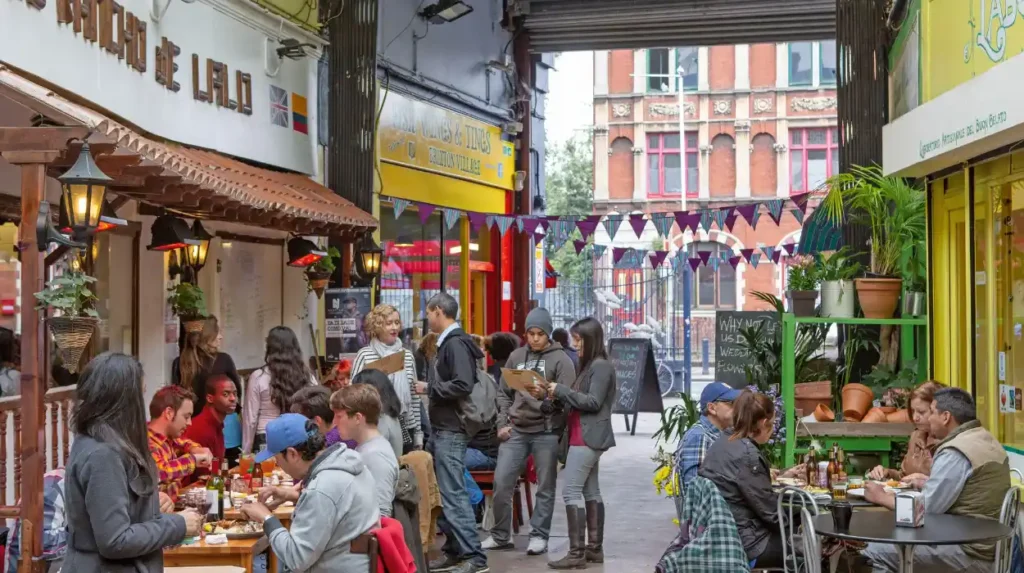
Brixton Market is central to the area’s identity because its indoor arcades and street markets combine food, fresh produce, independent retail and multicultural commerce while preserving a trading tradition that has developed for more than 150 years.
Brixton’s market network is one of its defining attractions. Lambeth Council currently records more than 80 licensed pitches across Electric Avenue, Pope’s Road and Brixton Station Road. These pitches include traditional market goods and hot food.
The market’s history stretches back roughly 150 years. Lambeth’s market masterplan records the long transition from traditional staples to foods associated with Brixton’s increasingly international population, including plantain, patties, rice and peas, mooli, pak choi, ramen and tacos.
Electric Avenue is particularly significant. Built in the 1880s, it became one of the first market streets in Britain illuminated by electric lighting. The name remains a direct reference to that technological development.
Market Row was built in 1928. Granville Arcade followed in 1937 and was designed by Alfred and Vincent Burr. The arcade is now associated with Brixton Village and connects Coldharbour Lane, Atlantic Road and Pope’s Road.
These spaces give visitors different forms of market experience. Street trading provides an open-air environment. Covered markets provide independent shops and restaurants. Traditional food traders provide ingredients associated with Brixton’s long-standing communities.
The markets also demonstrate how local commerce adapts. Brixton does not present multiculturalism as a separate attraction. It is embedded within everyday retail activity.
What can visitors eat in Brixton?
Visitors can experience Caribbean, African, Asian, European and Latin American food in Brixton, with choices ranging from traditional market ingredients and Jamaican dishes to Mexican street food, Ethiopian injera and Japanese-style pancakes.
Food is one of Brixton’s strongest visitor attractions. Brixton Village describes itself as home to more than 100 independent vendors representing more than 50 nationalities. Its food offer includes Jamaican seafood, Mexican street food, Ethiopian injera and Japanese pancakes.
This diversity reflects the history of Brixton’s population. Caribbean food has a particularly strong connection with the neighbourhood because Jamaican and other West Indian communities established businesses and social networks here during the post-war period.
Visitors can also shop for ingredients rather than eating only prepared meals. Traditional traders include fruit and vegetable sellers, fishmongers, butchers and bakeries. Brixton Village states that some independent traders have served the local community for more than 30 years.
The food experience therefore operates at several levels. A visitor can have a quick market meal, sit down for a longer restaurant experience or purchase specialist ingredients to take home.
The range also suits different travel schedules. A tourist can combine lunch with market exploration. A business traveller can eat between meetings. A resident can use the markets for regular grocery shopping.
Brixton’s food culture is also connected to its independent business structure. Small traders create a more varied commercial environment than a conventional chain-dominated shopping centre.
What is Windrush Square and why is it important?
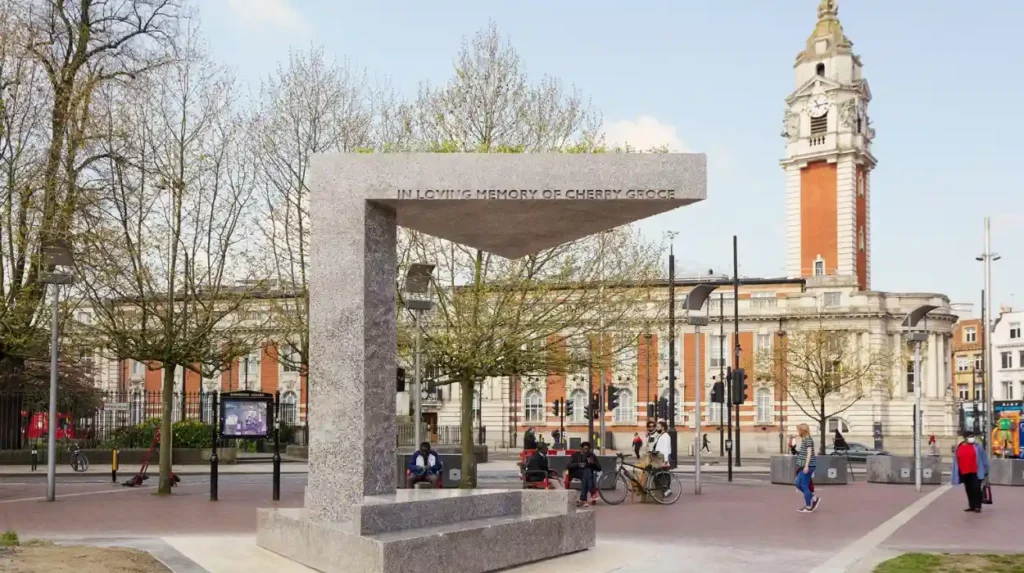
Windrush Square is Brixton’s central public space and an important place for understanding Britain’s Windrush history, connecting the area’s markets, library, civic buildings, cultural venues and public realm in one accessible location.
Windrush Square sits at the heart of Brixton. Lambeth Council describes it as an important meeting point for residents and visitors. The name commemorates the arrival of the MV Empire Windrush at Tilbury on 22 June 1948. The ship carried 492 migrants according to Lambeth’s current information.
The square originally consisted of two separate spaces: Windrush Square and Tate Library Gardens. The areas were brought together as a central public plaza, with the completed scheme opening in 2010.
Its position makes it a practical starting point for exploring Brixton. Visitors can reach Brixton Tate Library, the Ritzy cinema, markets and surrounding streets without needing lengthy journeys between attractions.
Windrush Square also has symbolic importance. The Windrush generation refers to Caribbean people who arrived in Britain during the period beginning with the Empire Windrush in 1948. Their contribution to British society is reflected in Brixton’s food, businesses, music, community institutions and public culture.
Lambeth continues to use Windrush Square as a focal point for Windrush-related events. Its 2026 Windrush Day programme again placed the square at the centre of borough-wide commemorations.
For visitors, this makes the square more than an open space. It provides geographical and historical context for the rest of Brixton.
Which historic buildings should visitors see in Brixton?
Brixton’s historic buildings include the Grade II-listed Brixton Tate Library, Grade II-listed St Matthew’s Church, the Grade II-listed Ritzy cinema and the historic covered markets that define the town centre’s architectural character.*
Brixton has a designated conservation area. Lambeth Council states that Brixton Conservation Area was first designated on 20 October 1980. It includes commercial, civic, residential and retail buildings alongside Brixton Town Hall, Tate Library, the Ritzy Cinema, St Matthew’s Church and the covered markets.
Brixton Tate Library stands on Windrush Square. It is a Grade II-listed building and remains an active public library. The building includes adult and children’s library areas, a gallery room, reference facilities and quiet study space.
St Matthew’s Church provides another important architectural landmark. Historic England lists it at Grade II*. The present church dates from 1822–24 and was designed by Charles Fowler Porden in a Greek Revival style.
The Ritzy adds a different architectural and entertainment dimension. Lambeth Council describes it as a Grade II-listed cinema that has been part of Brixton since 1911. Its 350-seat auditorium retains Edwardian decorative features.
These buildings show why Brixton works well for heritage-focused visitors. The area does not require a dedicated heritage excursion. Historic architecture appears directly within the commercial centre.
Where can visitors experience Brixton’s Black British heritage?
Visitors can experience Black British heritage through Windrush Square, Brixton Market, public art, community institutions, music history and streets shaped by Caribbean migration, making Brixton one of London’s most significant places for understanding modern Black British culture.
Brixton’s Black British heritage is closely connected to post-war Caribbean migration. Historic England identifies the 1950s as a period when Brixton became a hub for the Afro-Caribbean community, with markets developing into commercial and social centres.
The markets were particularly important because they provided culturally familiar foods and goods. Traders sold products such as rice, dried codfish, ackee, mangoes, pineapples and avocados. This commercial activity helped establish a distinctive Caribbean presence within South London.
The physical geography also matters. Lambeth records that streets around Coldharbour Lane became an important nucleus of London’s Jamaican community after the arrival of Caribbean migrants. By the 1960s, Somerleyton Road and Geneva Road had particularly high levels of West Indian home occupation and ownership.
The Black Cultural Archives is another important institution associated with Brixton. Its purpose is to preserve and interpret the history of African and Caribbean people in Britain. Its presence strengthens Brixton’s role as a place where visitors can connect everyday urban life with national history.
Public art adds another layer. Brixton has murals, memorials and artworks linked to Black history, music and local figures. Lambeth has previously organised heritage walks covering more than 17 public artworks across the area.
This heritage is not confined to museums. It is visible in the markets, street names, food businesses, music venues and public spaces.
Why is Brixton important to London’s music culture?
Brixton is a major London music destination because its history connects Caribbean sound-system culture, reggae, punk, soul, electronic music and international touring acts with established venues and independent cultural spaces.
Music is fundamental to Brixton’s modern identity. Brixton Village records the area’s development as a nucleus of South London’s sound-system scene from the 1960s. That culture influenced later forms of British dance and popular music.
The O2 Academy Brixton is the area’s best-known large music venue. The building opened as the Astoria in 1929. Brixton Academy began operating at the site in 1983, with reggae artist Eek-A-Mouse among the early performers.
The venue has hosted major international artists including Madonna, Rihanna, Lady Gaga, Coldplay, Blur, Florence and the Machine and The Strokes.
This gives Brixton an important role in London’s live music economy. The area supports both major touring performances and smaller independent cultural activity.
Music history also overlaps with Brixton’s political and social history. Sound-system culture developed alongside Caribbean migration and community life, while punk and later genres reflected different forms of youth culture and social change.
Visitors interested in music therefore find more than concert listings. Brixton provides physical places connected to the development of British music culture.
What role does David Bowie play in Brixton’s identity?
David Bowie remains one of Brixton’s most recognisable cultural figures because he was born locally, lived in the area during childhood and is commemorated by a major mural that became a public place of remembrance.
David Bowie was born at 40 Stansfield Road in Brixton on 8 January 1947. Lambeth Council records that he lived in Brixton and attended Stockwell Primary School until 1953.
His connection with the neighbourhood remains visible through the David Bowie mural near Morley’s department store. The mural was created by Australian artist James Cochran in 2013 and was inspired by Bowie’s 1973 Aladdin Sane album cover.
After Bowie’s death in 2016, the mural became a place where fans and local residents left flowers and messages. Lambeth subsequently recognised its local significance.
The Bowie connection adds another dimension to Brixton’s cultural geography. Visitors can connect the neighbourhood’s music history with a specific local figure rather than experiencing music solely through concert venues.
Bowie is also one of several artists associated with Brixton. Brixton Village’s historical account notes that Vincent van Gogh lived in Brixton during the 1870s before becoming a major artist, while Charlie Chaplin lived there in 1908.
What public art can visitors discover in Brixton?
Brixton’s public art includes murals, memorials, statues and community artworks that reflect music, Black British history, local personalities and social movements across streets, squares and commercial buildings.
Public art is integrated into Brixton’s everyday environment. Visitors encounter artworks while walking between markets, transport stations, restaurants and historic buildings.
The David Bowie mural is the most internationally recognisable example. Other artworks address local history, Caribbean heritage, political activism and community identity.
Lambeth Council’s Brixton Art Tour demonstrates the scale of this cultural landscape. A council-organised 90-minute heritage walk covered more than 17 public artworks dating from the 1970s to the present.
This makes Brixton particularly suitable for walking-based exploration. Visitors do not need to enter a gallery to encounter art.
The public-art environment also connects different periods. Older murals and memorials document previous political and cultural movements. More recent works reflect contemporary community identity.
For photographers and culture-focused travellers, these works provide visual landmarks throughout the town centre.
Is Brixton suitable for visitors interested in independent shopping?
Brixton suits independent shoppers because its commercial centre combines street markets, covered arcades, specialist food shops, fashion businesses, record shops, booksellers, jewellery traders and lifestyle retailers.
Brixton Village currently describes more than 100 independent vendors across its market environment. The traders include restaurants, bars, cafés, fishmongers, butchers, greengrocers, fashion businesses and lifestyle shops.
This commercial variety differs from a conventional high street. Shopping is concentrated across market streets and arcades rather than being dominated by large national chains.
Traditional food retail is particularly important. Visitors can purchase specialist ingredients alongside ready-to-eat food. This creates a practical link between Brixton’s historic market economy and its modern food culture.
Independent retail also includes records, books, jewellery, clothing and homeware. These categories provide opportunities for visitors seeking locally distinctive purchases.
The market environment is therefore useful for souvenir shopping without relying solely on conventional tourist merchandise.
Can visitors combine Brixton with green space and architecture?
Visitors can combine Brixton’s markets and cultural attractions with green spaces including Windrush Square, St Matthew’s Peace Gardens, Brixton Orchard and sections of Rush Common, creating a varied walking experience.
Brixton is strongly urban but includes several public green spaces. Rush Common forms a green corridor between Brixton and Streatham, running along the eastern side of Brixton Hill. Lambeth Council identifies four main sections maintained as public open space.
Brixton Orchard is the northernmost section of this wider green corridor. It was created through collaboration involving Brixton Village and Market Row, Brixton BID and Urban Growth London.
Windrush Square also provides seating, planting, open space and pedestrian areas. Its design incorporates different surfaces, grassed areas, lighting and seating around a mature London Plane tree.
These spaces make it easier to build a flexible itinerary. A visitor can spend time in the market, walk through the central public realm, explore historic buildings and continue towards Brixton Hill.
The combination is particularly useful for travellers who want an urban cultural experience without spending the entire day indoors.
How accessible is Brixton for tourists and business travellers?
Brixton is highly accessible because its Underground station sits on the Victoria line, while the surrounding town centre concentrates markets, restaurants, cultural venues, shops and public spaces within practical walking distance.
Brixton Underground station provides a direct Victoria line connection. Current TfL information places Brixton on the Victoria line, linking the district with central London destinations including Victoria, Green Park, Oxford Circus, Warren Street, Euston and King’s Cross St Pancras.
TfL’s published Victoria line information also records Night Tube services between Brixton and Walthamstow Central on Friday and Saturday nights. Visitors should check current service information before travelling because operational arrangements change.
The station’s location is particularly useful because Brixton’s main attractions are concentrated around the town centre.
For business travellers, this means leisure time can be used efficiently. A visitor staying elsewhere in London can reach Brixton, explore the markets, eat, attend a performance and return without requiring a full-day excursion.
For tourists, the transport connection makes Brixton easy to combine with neighbouring South London destinations.
What makes Brixton different from other parts of Lambeth?
Brixton stands apart through the combination of market heritage, Black British history, Caribbean influence, live music, independent commerce, public art and dense cultural activity, all concentrated within one of Lambeth’s best-known town centres.
Lambeth contains many distinct neighbourhoods, each with different identities. Brixton’s defining characteristic is the interaction between commerce and culture.
The markets are not separate from the area’s history. Their development reflects migration, changing consumer demand and community enterprise.
The music venues are not separate from the neighbourhood’s social identity. Sound-system culture, reggae, punk and later music scenes developed alongside broader cultural changes.
The public spaces are not simply decorative. Windrush Square connects the physical town centre with the national history of Caribbean migration.
The historic buildings are not isolated monuments. The library, church, cinema and market structures remain part of everyday Brixton.
This combination creates a dense cultural landscape. Visitors can understand the area’s history through ordinary streets, businesses and public spaces rather than relying exclusively on formal attractions.
Explore More Area Guide
Where to Enjoy Live Music in Lambeth? South London 2026
48 Hours in Lambeth: Best Attractions and Itinerary | South London 2026
How is Brixton evolving while preserving its character?
Brixton continues to change through regeneration, new housing, business development, public-realm improvements and cultural investment while Lambeth Council and local organisations protect historic buildings, markets and community assets.
Regeneration remains an important part of Brixton’s future. Lambeth Council’s current regeneration programme includes Somerleyton Road development, Brixton Central proposals and continued improvements to historic areas around Electric Avenue and Atlantic Road.
The council’s Brixton Townscape Heritage Initiative includes investment in historic areas and buildings around Electric Avenue and Atlantic Road. Lambeth states that £650,000 was committed to the programme, alongside a further £1.95 million awarded through the Heritage Lottery Fund.
Market conservation is equally significant. Brixton Village and Market Row received Grade II listing in 2010 following a local campaign to protect the buildings from redevelopment. Their listing recognised architectural and cultural importance, including their role in the history of London’s Black Caribbean community.
This balance between change and preservation explains why Brixton remains relevant as a visitor destination.
New businesses, food concepts, creative enterprises and cultural events continue to expand the visitor offer. Historic markets, listed buildings and public spaces provide continuity.
Why should Brixton be included in a South London itinerary?
Brixton deserves a place in a South London itinerary because it delivers history, food, markets, music, architecture, public art and community culture in a compact area with direct Underground connections to central London.
A first visit works best when it combines several parts of Brixton rather than focusing on one attraction.
Start around Brixton Underground station and walk towards the market streets. Explore Electric Avenue, Brixton Market, Market Row and Brixton Village. Continue towards Windrush Square to understand the area’s Windrush connection.
From there, visitors can explore Brixton Tate Library, the Ritzy and nearby historic buildings. Public art routes provide another layer of cultural discovery.
Food provides a natural midpoint or conclusion. Brixton Village’s international restaurants and traditional market traders offer choices connected to the area’s multicultural commercial history.
Music enthusiasts can incorporate the O2 Academy Brixton or explore the neighbourhood’s wider musical heritage. Visitors interested in contemporary culture can focus on independent businesses, public art and creative spaces.
The result is a destination that works across different travel purposes. Brixton offers cultural depth for tourists, local discovery for residents, practical leisure options for business travellers and creative environments for digital workers.
Its strongest feature is the relationship between all these elements. The market explains the commercial history. The food reflects migration and community. The music reflects cultural development. The public spaces preserve collective memory. The architecture records urban growth. The transport network connects Brixton to the wider capital.
That combination makes Brixton one of the most distinctive and culturally significant parts of Lambeth to visit.
What is Brixton famous for?
Brixton is famous for its multicultural markets, Caribbean heritage, Black British history, music scene, independent restaurants, street art and strong connection to David Bowie. It is one of South London’s most recognisable cultural destinations.