Lambeth has one of London’s strongest concentrations of publicly accessible art, ranging from major riverside installations and historic sculptures to Brixton murals, station artworks, memorials and community-designed street art. The borough’s public art reflects migration, activism, music, architecture, local history and contemporary cultural life.
- What makes Lambeth one of the best areas for public art in London?
- Why is the Southbank Centre one of the best places for public art in Lambeth?
- What public art can visitors see around Waterloo Bridge and Jubilee Gardens?
- Why is Brixton the best place for murals and community public art?
- Why is Windrush Square important for public art in Lambeth?
- What murals can visitors find on Railton Road and around Brixton?
- Where can visitors see historic murals in Brixton?
- Why is Stockwell Memorial Gardens a good place for public sculpture?
- Where can visitors find public art in Streatham?
- Where can visitors find newer murals across Lambeth?
- What public art can visitors see in Vauxhall?
- How does public art connect Lambeth’s history with contemporary culture?
- What is the best way to explore Lambeth public art?
- Why is Lambeth public art important for visitors in 2026 and beyond?
Public art in Lambeth is not confined to galleries. It appears beside the Thames, on railway and Underground stations, across housing estates, in parks, on community buildings and along everyday streets. This makes the borough particularly suitable for visitors who want to explore art without paying for admission.
The strongest public-art areas are South Bank and the Southbank Centre, Brixton, Stockwell, Vauxhall, Streatham, Kennington and parts of Waterloo. Each area has a distinct artistic character and connects artworks with the history and communities of Lambeth.
What makes Lambeth one of the best areas for public art in London?
Lambeth combines permanent sculptures, historic murals, contemporary commissions, memorials and community artworks across streets, stations, parks and riverside spaces, allowing visitors to experience substantial public art without entering a conventional gallery or paying an admission charge.
Lambeth’s public-art landscape is unusually varied because artworks occupy different types of public space. South Bank provides large-scale contemporary commissions beside major cultural institutions. Brixton is recognised for murals and station commissions connected with Black British history and local identity. Stockwell provides memorial sculpture and community-focused artworks.
The borough also has a strong history of using art to interpret social and political issues. Murals produced in Brixton during the 1970s and 1980s recorded local communities and political conditions. Transport for London’s Brixton Mural Map describes these works as important records of the social context and communities that shaped London mural production.
This relationship between art and place remains visible today. New commissions continue to address migration, representation, identity, community history and the use of public space.
For visitors, the main advantage is accessibility. Many works are visible from pavements, public squares, parks and transport areas. Some locations also provide riverside walking routes, cafés, restaurants and cultural venues, making public-art exploration easy to combine with a wider Lambeth itinerary.
As you explore the modern artworks, you are also crossing places shaped by centuries of development. Read about the full to understand the historical background behind the borough’s streets, neighbourhoods and cultural identity.
Why is the Southbank Centre one of the best places for public art in Lambeth?
The Southbank Centre offers one of Lambeth’s largest concentrations of free public art, combining permanent sculptures, temporary commissions, installations, gardens and riverside artworks across its 11-acre Thames-side cultural complex.
The Southbank Centre is a major arts complex on the South Bank of the River Thames. Its outdoor spaces provide an accessible public-art environment alongside the Royal Festival Hall, Queen Elizabeth Hall and Hayward Gallery.
The centre states that its 11-acre riverside site contains free public artworks as well as seasonal installations and outdoor cultural activity.
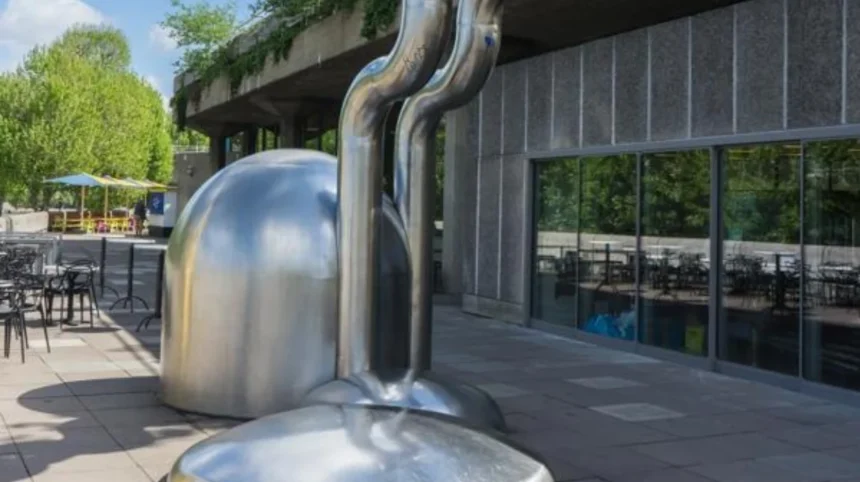
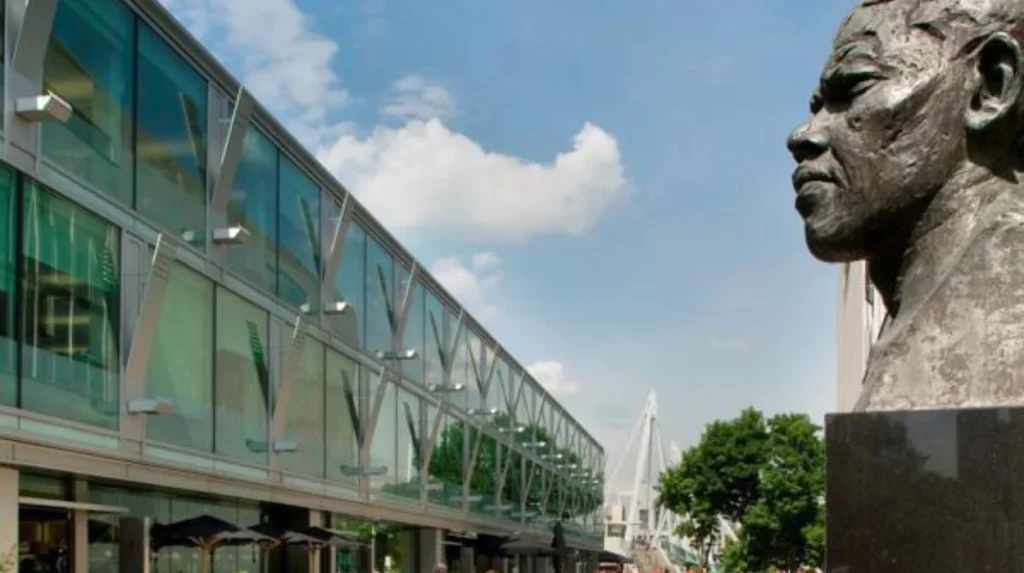
Its permanent collection includes several recognisable works. Zemran, by William Pye, is a Grade II listed sculpture that has been located at the Southbank Centre since 1972. The site also contains Jeppe Hein’s modified benches, Natura Nostra Forest, Ian Walters’ Bust of Nelson Mandela, and a statue of Frédéric Chopin by Bronisław Kubica.
These works demonstrate the range of public art available here. Some pieces function primarily as sculpture. Others interact with seating, architecture, landscaping or movement through the site.
The Southbank Centre also operates a changing programme of outdoor commissions. This means the experience is not completely static. Temporary artworks are added and removed as exhibitions and cultural seasons change.
For a visitor, the Southbank Centre works particularly well as a starting point because several artworks can be seen during one riverside walk.
Which permanent artworks should visitors look for at the Southbank Centre?
Visitors should look for William Pye’s Zemran, Ian Walters’ Bust of Nelson Mandela, Jeppe Hein’s benches, Natura Nostra Forest and the Chopin statue, which together represent sculpture, landscape, seating design and commemorative public art.
William Pye’s Zemran is particularly significant because of its Grade II listing. Its presence demonstrates how public sculpture can become part of the architectural heritage of a cultural complex.
Ian Walters’ Bust of Nelson Mandela provides another important landmark. Mandela was a South African anti-apartheid campaigner who became South Africa’s first democratically elected president in 1994 and received the Nobel Peace Prize in 1993.
Jeppe Hein’s benches introduce an interactive element into the outdoor environment. Rather than functioning only as objects to observe, they alter the familiar design of public seating.
The Southbank Centre also identifies Natura Nostra Forest, installed in 2023, as a pocket of green within the complex.
This mixture makes the Southbank Centre particularly useful for visitors interested in how contemporary art interacts with public architecture and everyday movement.
What public art can visitors see around Waterloo Bridge and Jubilee Gardens?
Waterloo Bridge and Jubilee Gardens connect several public-art locations around South Bank, including riverside installations, memorials and artworks integrated into the public realm between the Thames, Waterloo Bridge and the Southbank cultural complex.
Jubilee Gardens is an important open space beside the London Eye and the Thames. It also contains the International Brigade memorial, which commemorates volunteers who fought for the Republican side during the Spanish Civil War.
The Imperial War Museums’ War Memorials Register records the International Brigade memorial and its associated plaque in Jubilee Gardens, Belvedere Road.
The surrounding South Bank public realm is also undergoing continued investment. Lambeth Council’s Waterloo and South Bank Public Realm Framework identifies areas including Belvedere Road at Jubilee Gardens, Concert Hall Approach and the Waterloo Bridge Undercroft as priority public-realm projects.
This makes the area useful for visitors who want public art combined with architecture and urban design.
Waterloo Bridge itself provides a strong visual connection between the South Bank cultural quarter and the wider central London landscape. Public artworks around the area often respond directly to the bridge, river, buildings and movement of pedestrians.
Why is Brixton the best place for murals and community public art?
Brixton is Lambeth’s strongest destination for murals and community-focused public art, with historic wall paintings, Underground station commissions, statues, memorials and newer installations reflecting migration, activism, music and Black British cultural identity.
Brixton has developed a distinctive public-art tradition since the late twentieth century. Lambeth Council has documented walking tours featuring more than 17 public artworks, including murals, statues and memorials spanning from the 1970s to the present.
The area’s murals are particularly important because they developed alongside major social and political changes in Brixton. Transport for London explains that murals from the 1970s and 1980s represent political conditions, social context and collaborative community activity.
The artwork is spread across streets rather than concentrated in a single gallery. Visitors therefore experience the work as part of the neighbourhood.
Brixton’s public art also continues to evolve. Contemporary commissions have been installed at Brixton Underground station through Art on the Underground, creating a direct connection between historic mural traditions and contemporary visual culture.
What public artworks should visitors see around Brixton Underground Station?
Brixton Underground Station is a major public-art stop because Art on the Underground has commissioned artists including Claudette Johnson, Njideka Akunyili Crosby, Joy Labinjo and Rudy Loewe to create works responding to Brixton’s communities and history.
Claudette Johnson’s Three Women is a major commission associated with Brixton Underground station. The artwork presents three monumental female figures and addresses representation and the public visibility of Black women.
Njideka Akunyili Crosby’s Remain, Thriving was created specifically for the entrance to Brixton Underground station. It explores shared cultural memory and a Black British perspective, drawing on the experiences of the Windrush generation and the local community.
The station’s programme forms part of a longer relationship between London Underground and contemporary art. Art on the Underground describes its broader programme as a continuation of London Underground’s longstanding engagement with artists and public space.
Rudy Loewe’s The Congregation, launched in November 2025, added another major mural to Brixton Underground station. The work was scheduled to remain on view for a year and uses text and imagery to amplify voices often excluded from dominant historical narratives.
This makes Brixton Underground one of the most useful locations for visitors seeking contemporary public art connected directly with local identity.
Why is Windrush Square important for public art in Lambeth?
Windrush Square is one of Brixton’s most important public spaces for cultural interpretation, combining open-air artwork, public design and commemorative features with the history of the Windrush generation and modern multicultural Britain.
Windrush Square sits at the heart of Brixton and functions as a major meeting place. Lambeth Council records the square as a 24-hour public open space.
Its name commemorates the MV Empire Windrush, which arrived at Tilbury on 22 June 1948 carrying 492 passengers from the Caribbean and other places. The arrival became an important symbol of post-war migration and the development of modern multicultural Britain.
The square is therefore important for visitors interested in public art as cultural interpretation rather than decoration alone.
Its position also makes it a practical starting point for exploring Brixton’s wider public-art network. From here, visitors can continue towards Brixton Underground Station, local streets, murals, community spaces and cultural institutions.
The square also demonstrates how public spaces can combine landscape, memorialisation and visual communication.
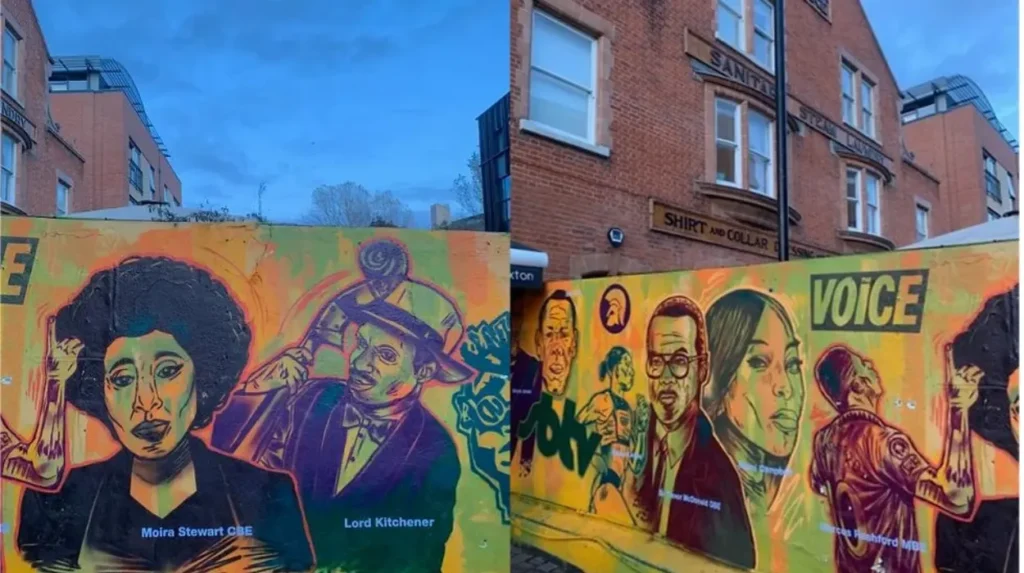
What murals can visitors find on Railton Road and around Brixton?
Railton Road and surrounding Brixton streets contain public artworks connected with activism, local history and community identity, including murals, poetry installations and projects developed with residents, artists and heritage organisations.
Railton Road has become an important location for public art connected with Brixton’s history of political activism.
Lambeth Council describes poetry installations on Railton Road and Shakespeare Road as part of a heritage trail. The installations feature poems by Ty, Bries and Malika Booker and form part of the 81 Acts of Exuberant Defiance programme.
The programme connects public art with the history of activism in Brixton. Instead of placing historical information solely inside a museum, the installations place it directly within streets used by residents.
Another important project is Play Futures, created at the former Dexters Adventure Playground on Railton Road. The project was developed with young people supported by BIGKID Foundation and artist Krish Nathaniel.
This area is therefore particularly relevant to visitors interested in socially engaged public art.
Where can visitors see historic murals in Brixton?
Historic Brixton murals include works associated with the 1980s mural movement, with surviving artworks documenting community life, racial harmony, political issues and the social conditions that shaped Brixton’s modern cultural identity.
One of the best-known examples is Children at Play, painted by Stephen Pusey in 1981–82 at the rear of Brixton Academy. The mural was commissioned after the 1981 Brixton uprising and was designed to represent racial harmony among local schoolchildren.
The mural measures approximately 32 metres by 9 metres and was restored in 2011.
Brixton also contains the Nuclear Dawn mural on Coldharbour Lane, created by Brian Barnes and Dale McCrea with assistance from Christine Thomas. It addresses nuclear warfare and political power.
Transport for London’s Brixton Mural Map provides historical context for the area’s murals and explains why surviving examples are valuable records of London’s changing social and political landscape.
Visitors should treat these works as heritage objects as well as street art. Their locations, themes and surviving condition are part of the story.
Why is Stockwell Memorial Gardens a good place for public sculpture?
Stockwell Memorial Gardens combines war memorials, a commemorative mural and the Bronze Woman statue, creating a compact public-art destination that connects local history, remembrance and the cultural contribution of Black Caribbean women.
Stockwell Memorial Gardens is next to Stockwell Underground Station and is open to the public 24 hours a day.
Lambeth Council identifies several important works at the site. These include a white stone memorial to residents who died in the First World War, a mural commemorating Violette Szabó and other Stockwell residents who died during the Second World War, and the Bronze Woman statue.
The Bronze Woman was sculpted by Aleix Barbat and inspired by the poem Bronze Woman by Cecile Nobrega. It was unveiled on 8 October 2008 as a tribute to Black Caribbean women.
The gardens demonstrate how public art can function simultaneously as sculpture, remembrance and community representation.
Because the site is compact, it is also suitable for visitors with limited time between Underground connections.
Where can visitors find public art in Streatham?
Streatham provides community-scale public art in gardens, estates and neighbourhood spaces, including murals, painted street furniture and environmental projects that combine visual art with biodiversity and local participation.
One notable example is Huggins Corner Bee Road in Streatham Hill. Lambeth Council describes the site as a public garden of almost 400 square metres beside the A205 South Circular.
The project includes a 55-metre mural on the rear wall and traffic bollards painted by children from Streatham Wells Primary School. Residents helped develop the project after identifying the neglected corner as an area for improvement.
The artwork is therefore integrated with environmental improvements. The garden contains wildflowers and provides habitat and food for pollinators including bees and butterflies.
This type of public art differs from the major sculptures of South Bank. It demonstrates how artwork can be incorporated into local environmental projects and community spaces.
Where can visitors find newer murals across Lambeth?
Newer Lambeth murals are distributed across neighbourhoods including Oval, Clapham, Brixton, Streatham Hill and West Norwood, with recent projects showing how contemporary street art continues to expand beyond traditional cultural centres.
The London Mural Festival has played an important role in this expansion. In 2024, Lambeth Council reported seven participating estates across the borough.
The participating locations included South Lambeth Estate, Fenwick Estate in Clapham, Brighton Terrace estate in Brixton, Streatham Hill Estate, Notre Dame Estate in Clapham, Gaskell Street estate in Clapham and Woodvale Estate in West Norwood.
The 2024 festival programme involved 100 new murals across London, adding to 75 murals produced during its first edition in 2020.
The Lambeth installations demonstrate the importance of residential neighbourhoods within the borough’s public-art network.
Visitors should recognise that some estate artworks sit within residential environments. Respectful photography, pedestrian access and consideration for residents are essential when viewing them.
What public art can visitors see in Vauxhall?
Vauxhall has public art that reflects local community identity and the changing character of its commercial and night-time economy, including a mural celebrating Portuguese-speaking communities and their contribution to Lambeth.
A notable Vauxhall artwork was unveiled opposite Tate South Lambeth Library in November 2023. Lambeth Council describes it as the borough’s first public artwork specifically celebrating Portuguese-speaking communities.
The mural was created by artists Eduarda Craveiro and Alex Bowie in collaboration with the Brixton Project. More than 100 residents from nine countries participated in the co-design process.
The project forms part of the Vauxhall Night Time Enterprise Zone and connects public art with local businesses, cultural representation and evening activity.
For visitors, this provides an example of public art functioning as a community marker within a commercial neighbourhood rather than as a standalone monument.
How does public art connect Lambeth’s history with contemporary culture?
Lambeth’s public art connects historic events with contemporary cultural life by placing murals, memorials, sculptures and installations in the locations where migration, activism, war, community organisation and urban change shaped the borough.
This historical connection is one of the defining characteristics of public art in Lambeth.
Brixton’s mural tradition reflects political and social changes from the late twentieth century. Windrush Square connects contemporary public space with post-war Caribbean migration. Stockwell Memorial Gardens combines remembrance with a monument to Black Caribbean women.
South Bank provides another historical layer. The Southbank Centre’s current cultural landscape developed from the Festival of Britain era, while later commissions have continued to reinterpret the area.
The Southbank Centre’s 2026 programme demonstrates how temporary public art continues to use the site for cultural interpretation. The centre has introduced new installations alongside permanent artworks, including large-scale commissions and outdoor works.
Public art therefore provides a practical way to understand Lambeth as both a historic borough and a contemporary cultural destination.
Explore More Area Guide
Where to Experience Contemporary Art in Lambeth
Best Theatre Experiences in Lambeth: National Theatre & Old Vic
What is the best way to explore Lambeth public art?
The most effective approach is to explore Lambeth by neighbourhood, starting with South Bank for major installations, Brixton for murals and station art, Stockwell for memorial sculpture, and Streatham or Vauxhall for community-designed works.
A South Bank route works well for visitors interested in sculpture and contemporary installation. Start around the Southbank Centre, explore its permanent artworks, continue towards Jubilee Gardens and follow the Thames.
A Brixton route provides a different experience. Start at Brixton Underground Station, explore its commissioned artworks, continue towards Windrush Square and then walk through the surrounding streets and Railton Road area.
Stockwell offers a shorter art stop around the Underground station. Stockwell Memorial Gardens contains several distinct works within a small area.
Streatham and Vauxhall provide examples of community-based public art. These locations work particularly well for visitors who want to see how artworks operate within everyday neighbourhood environments.
The key principle is to treat Lambeth’s public art as a connected cultural landscape rather than a collection of isolated objects.
Why is Lambeth public art important for visitors in 2026 and beyond?
Lambeth’s public art remains important because new commissions continue to appear alongside historic works, ensuring that streets, stations, parks and cultural spaces remain active locations for representation, heritage, environmental improvement and contemporary artistic practice.
Public art in Lambeth is an evolving system. Permanent sculptures provide continuity, while temporary commissions introduce new subjects and artistic approaches.
The Southbank Centre continues to commission outdoor works, while Brixton Underground remains an active site for Art on the Underground projects. Lambeth Council also continues to support public-space improvements and neighbourhood-based creative projects.
The borough’s mural culture demonstrates another important development. Contemporary festivals and community projects have expanded public art into estates and residential areas, rather than concentrating it around major tourist attractions.
For tourists, this creates a broad choice of experiences. Visitors can see internationally recognised artists, historic community murals, memorials, station commissions and environmental artworks during the same London trip.
For residents, digital nomads and business travellers, public art provides accessible cultural activity without requiring a full museum visit or a long scheduled excursion.
Lambeth’s strongest public-art destinations therefore combine accessibility, historical context, cultural representation and changing contemporary commissions. The result is a borough where art remains visible as part of everyday public life.
What are the best places to see public art in Lambeth?
The best places include the Southbank Centre, Brixton, Windrush Square, Brixton Underground Station, Railton Road, Stockwell Memorial Gardens, Vauxhall and Streatham. These areas feature sculptures, murals, memorials and contemporary installations.