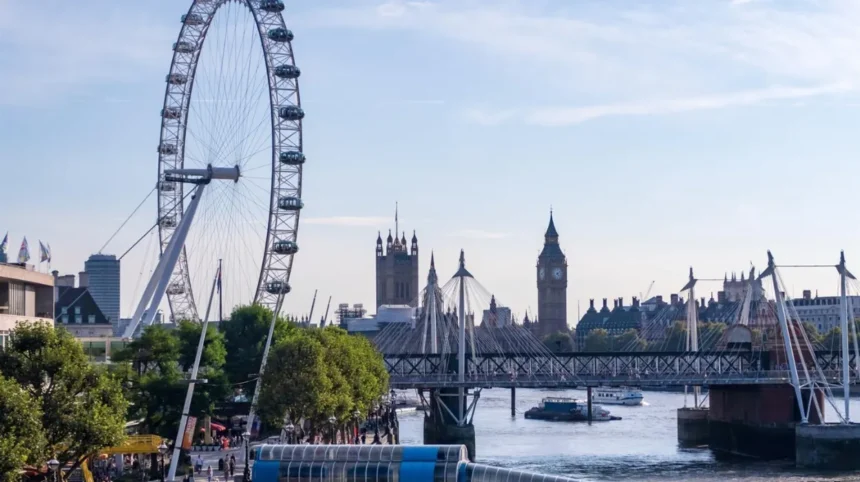
Lambeth occupies a significant stretch of the River Thames in central London. Its waterfront connects South Bank, Waterloo, Lambeth Palace, Vauxhall and Albert Embankment. The area combines major visitor attractions, public gardens, theatres, historic architecture, riverside promenades and panoramic views.
- Which Riverside Attractions Are the Best in Lambeth?
- What Can Visitors See Along the South Bank Riverside?
- How Important Is the London Eye for Riverside Sightseeing in Lambeth?
- Why Are Jubilee Gardens and the Southbank Centre Important Riverside Attractions?
- What Historic Riverside Sites Should Visitors Explore in Lambeth?
- Which Riverside Walks Are Best for Exploring Lambeth on Foot?
- What Can Families, Leisure Travellers and Business Visitors Do Beside the Thames?
- How Should Visitors Plan a Riverside Day in Lambeth?
- Why Does Lambeth’s Riverside Remain Important for London Tourism?
- What Are the Best Riverside Attractions in Lambeth for Different Interests?
- How Can Visitors Experience the Thames Without Missing Lambeth’s Main Landmarks?
For tourists, Lambeth’s Thames frontage provides a concentrated sightseeing area where several internationally recognised London landmarks sit within walking distance. The riverside route also works well for short visits, longer walking itineraries, family days out, cultural trips and business travellers using spare time between appointments.
Visit London identifies South Bank as the riverside district between Lambeth Bridge and Blackfriars Bridge. Its attractions include the London Eye, National Theatre, Southbank Centre, SEA LIFE London Aquarium, London Dungeon and BFI Southbank.
The wider Lambeth waterfront extends beyond the busiest South Bank attractions. Albert Embankment provides a quieter riverside environment with landscaped open spaces, while Lambeth Palace adds an important historic and religious landmark beside the Thames.
Which Riverside Attractions Are the Best in Lambeth?
Lambeth’s best riverside attractions combine major landmarks, cultural venues, public gardens, historic sites and Thames views. The strongest cluster runs through South Bank and Albert Embankment, linking the London Eye, Jubilee Gardens, Southbank Centre, National Theatre, Lambeth Palace and waterfront.
The London Eye is the most recognisable riverside landmark in this part of London. It stands beside Westminster Bridge and provides elevated views across the Thames and central London. A full rotation takes approximately 30 minutes.
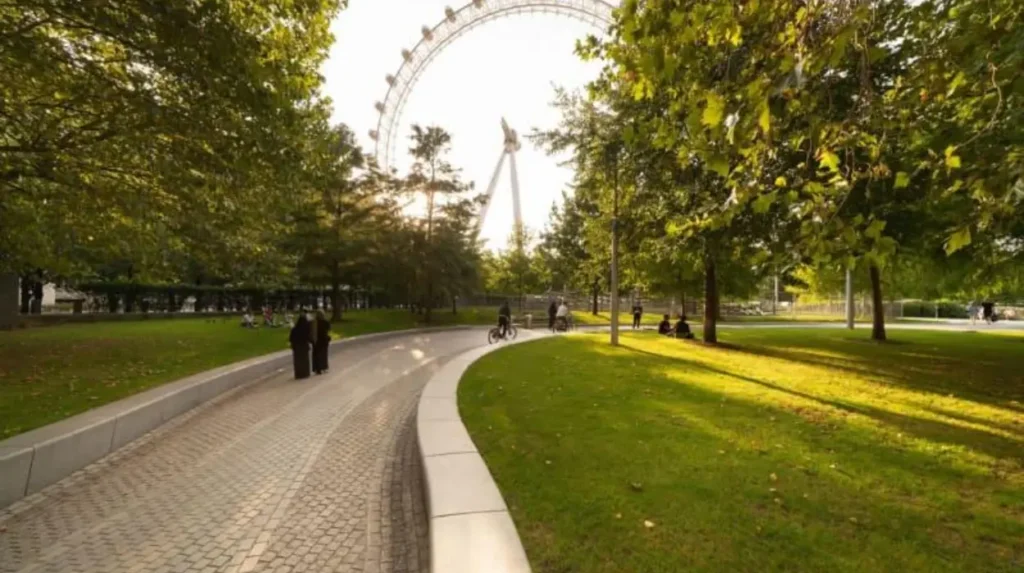
Jubilee Gardens sits directly beside the London Eye. The landscaped public garden provides open space, seating, planting and an adventure playground. It is free to enter and remains open 24 hours a day.
The Southbank Centre provides a major cultural component. Its complex includes Royal Festival Hall, Queen Elizabeth Hall and Hayward Gallery. Visitors encounter concerts, exhibitions, performances, public events, food outlets and riverside terraces throughout the year.
The National Theatre occupies another important position on the Thames. Its South Bank building opened in 1976 and forms part of the architectural identity of the riverside.
Lambeth Palace provides a contrasting experience. It has served as the London residence of the Archbishop of Canterbury since the 13th century. Selected tours and open days provide access to historic rooms and spaces.
Albert Embankment adds another dimension. Its chain of small open spaces follows the Thames between Vauxhall and Waterloo. The area also contains historic embankment infrastructure and important views towards Westminster.
What Can Visitors See Along the South Bank Riverside?
The South Bank riverside presents a continuous sequence of attractions between Lambeth Bridge and Blackfriars Bridge, including the London Eye, County Hall, Jubilee Gardens, Southbank Centre, National Theatre, riverside cafés, public art and panoramic Thames viewpoints.
South Bank is particularly effective for visitors who want to experience several attractions without extensive transport changes. The riverside promenade connects major destinations along the Thames, creating a straightforward walking route.
The London Eye stands near Westminster Bridge at the western end of the main attraction cluster. Its glass capsules provide views towards the Palace of Westminster, St Paul’s Cathedral, The Shard and other London landmarks. Visit London states that visitors can identify more than 55 notable London landmarks from the attraction.
County Hall forms another major architectural landmark. The former headquarters of the London County Council and Greater London Council occupies a prominent position beside Westminster Bridge. Its location places visitors close to the London Eye, Jubilee Gardens and the Thames.
Jubilee Gardens provides an immediate transition from built attractions to open public space. The garden was officially opened in 1977 during Queen Elizabeth II’s Silver Jubilee. Its history reaches further back to the 1951 Festival of Britain, when the site hosted the Dome of Discovery.
The riverside then continues towards the Southbank Centre. Royal Festival Hall opened in 1951 as part of the Festival of Britain and remains the only surviving building from that festival. The Grade I listed building has a fixed raked seating capacity of 2,500.
The National Theatre follows further east. Its distinctive modernist architecture was designed by Denys Lasdun. The building opened on the South Bank in 1976 and became a major part of the district’s cultural landscape.
This section of the Thames also provides direct views towards Westminster, the Palace of Westminster and the bridges crossing the river. The combination of architecture, open space and water makes the route suitable for photography and walking.
How Important Is the London Eye for Riverside Sightseeing in Lambeth?
The London Eye is Lambeth’s most prominent riverside observation attraction, positioned beside Westminster Bridge on the Thames. Its approximately 30-minute rotation provides elevated views across central London, making it a major starting point for first-time visitors exploring South Bank.
The London Eye opened in 2000 and became one of London’s most recognisable modern landmarks. Its position on the south bank gives visitors an elevated perspective over the River Thames.
Each capsule provides a broad field of vision through floor-to-ceiling glazing. The attraction operates as a slow-moving observation wheel, allowing passengers to remain inside the capsule throughout the rotation.
The riverside location is central to the experience. Westminster Bridge connects the attraction directly with the Palace of Westminster and Big Ben on the opposite bank. Visitors therefore encounter several major London landmarks within a compact area.
The London Eye also works as part of a wider riverside itinerary. Visitors can combine the observation wheel with Jubilee Gardens, County Hall, Southbank Centre and a walk towards the National Theatre.
A separate London Eye River Cruise departs from the London Eye Pier. The approximately 40-minute cruise provides views of landmarks including Big Ben, the Palace of Westminster, St Paul’s Cathedral, Shakespeare’s Globe, Tower Bridge, Tate Modern, The Shard and HMS Belfast.
For accessibility, the London Eye provides step-free and assisted wheelchair access, ramps and automatic doors. Visitors should check current operating arrangements and ticket information before travelling because attraction schedules and prices change.
The attraction is particularly useful for visitors with limited time. A London Eye visit followed by a riverside walk covers several major central London viewpoints without requiring a long journey across the capital.
Why Are Jubilee Gardens and the Southbank Centre Important Riverside Attractions?
Jubilee Gardens and the Southbank Centre combine green space, cultural activity and Thames views. Jubilee Gardens provides free public recreation beside the London Eye, while the Southbank Centre delivers performances, exhibitions, food, architecture and riverside public spaces throughout the year.
Jubilee Gardens is one of the most useful open spaces for visitors exploring Lambeth’s Thames frontage. The garden occupies the area immediately behind the London Eye and provides direct views towards the river and surrounding landmarks.
The site has undergone major transformation since the 1951 Festival of Britain. After the festival, the area became a car park before being converted into public gardens. A substantial redevelopment in 2012 introduced new planting, granite pathways, seating areas and an adventure playground.
The garden remains free to enter. Its 24-hour opening arrangement makes it suitable for visitors seeking outdoor space outside attraction operating hours.
The Southbank Centre occupies the cultural heart of the riverside. Royal Festival Hall, Queen Elizabeth Hall and Hayward Gallery form the principal components of the complex. The organisation presents music, theatre, dance, literature, visual art and public events.
More than half of Southbank Centre events are free, according to Visit London. Visitors can also enter and explore much of the site without purchasing a performance ticket.
The Royal Festival Hall provides another strong architectural attraction. The building opened during the 1951 Festival of Britain and is Grade I listed. Its riverside position provides views towards the Thames, Westminster and surrounding central London architecture.
The Southbank Centre also supports food and leisure activity. Riverside cafés, bars, terraces, shops and seasonal markets create additional reasons to spend time in the area.
For digital nomads and business travellers, these facilities provide practical places to pause between appointments. However, individual cafés and venues have their own seating, connectivity and access policies, so visitors should check current arrangements before planning extended work sessions.
What Historic Riverside Sites Should Visitors Explore in Lambeth?
Lambeth’s historic riverside sites include Lambeth Palace, Albert Embankment, Westminster Bridge, Waterloo Bridge and the post-war South Bank landscape. These locations reveal the Thames frontage’s development from medieval religious territory and industrial land into a major cultural destination.
Lambeth Palace is the strongest historic attraction directly beside the Thames. The palace has served as the London residence of the Archbishop of Canterbury since the 13th century. Its position between Westminster Bridge and Lambeth Bridge gives it a direct relationship with the river.
Selected tours and open days provide access to areas including the Great Hall, Chapel and Guard Room. The palace also hosts concerts within its historic surroundings.
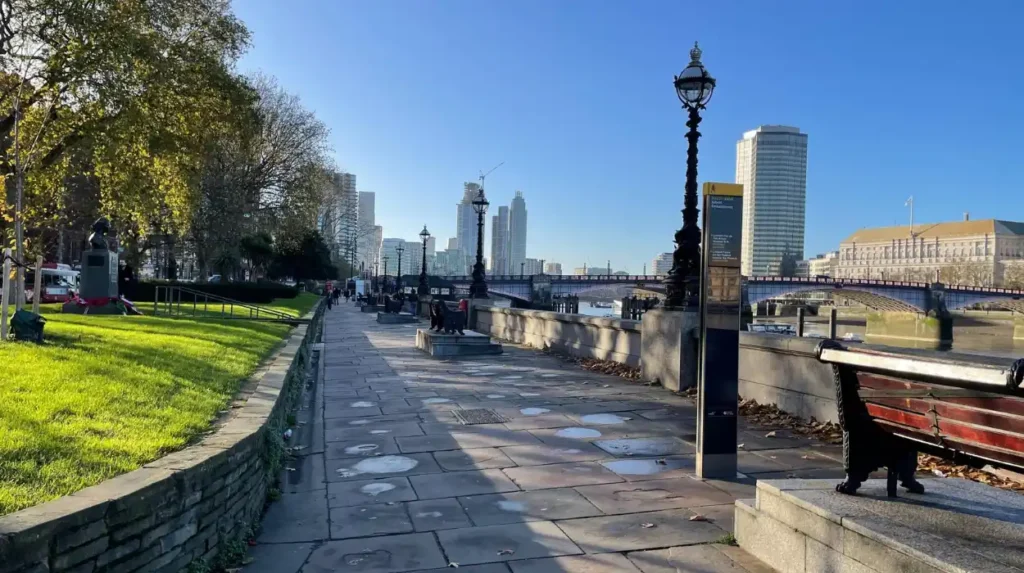
Albert Embankment provides a different historical perspective. Lambeth Council identifies the area as a conservation area first designated in 2001. The conservation area extends along Lambeth’s Thames frontage from the boundary with Wandsworth to Westminster Bridge.
Its historic character includes embankment walls, lamp standards and benches dating from the 19th century, alongside later developments. St Thomas’ Hospital is the most significant large complex within the conservation area.
The area also provides some of the strongest public vantage points towards the Westminster World Heritage Site. This makes Albert Embankment relevant for visitors interested in architecture and urban history as well as riverside walking.
The South Bank itself has a substantial post-war history. The 1951 Festival of Britain transformed a heavily damaged and industrial riverside into a major cultural district. The Royal Festival Hall remains the surviving architectural legacy of the festival.
As you explore the modern waterfront, you are crossing land shaped by centuries of development. Read about the full to understand its origins.
The historical context explains why Lambeth’s riverside contains such different architectural periods within a relatively short walking distance. Medieval ecclesiastical heritage, Victorian infrastructure, post-war modernism and contemporary visitor attractions all occupy the same Thames corridor.
Which Riverside Walks Are Best for Exploring Lambeth on Foot?
The most effective Lambeth riverside walk follows the Thames through Westminster Bridge, Jubilee Gardens, Southbank Centre, National Theatre, Oxo Tower and towards Blackfriars Bridge, with Albert Embankment providing a second route towards Lambeth Bridge and Vauxhall.
South Bank is particularly accessible on foot. Visit London describes the riverside promenade as step-free and extending from Lambeth Bridge and the National Covid Memorial Wall through the South Bank district towards Blackfriars Bridge.
A visitor starting at Westminster Bridge can follow the Thames eastwards. The first major attractions include the London Eye, Jubilee Gardens and County Hall. The route then reaches the Southbank Centre and Royal Festival Hall.
Continuing east brings visitors towards the National Theatre, Hayward Gallery and BFI Southbank. The riverside environment remains active with cafés, restaurants, cultural venues and public spaces.
The walk can continue towards Waterloo Bridge and the Oxo Tower. These landmarks provide additional architectural and photographic interest before the route approaches Blackfriars Bridge.
A second route follows the Thames westwards from Lambeth Bridge towards Albert Embankment. This section provides a quieter alternative to the busiest South Bank promenade.
Albert Embankment Gardens forms part of a chain of open spaces running between Vauxhall and Waterloo. Lambeth Council confirms that the gardens are open 24 hours a day.
Visitors interested in architecture should pay attention to changes in building form along the route. The South Bank contains modernist cultural buildings, while Albert Embankment retains elements of Victorian riverside infrastructure.
The route also works for different travel schedules. A short walk between Westminster Bridge and Waterloo Bridge provides concentrated sightseeing. A longer itinerary can continue eastwards towards Blackfriars Bridge or westwards towards Lambeth Bridge and Vauxhall.
Visitors should follow signed pedestrian routes and remain alert around crossings, cycle traffic and busy public areas. Thames-side conditions also change with weather, events and temporary works.
What Can Families, Leisure Travellers and Business Visitors Do Beside the Thames?
Families have access to gardens, playgrounds, attractions and pedestrian routes, while leisure travellers benefit from museums, theatres, cruises and restaurants. Business visitors gain convenient cultural and outdoor options between meetings because major venues and transport connections cluster around South Bank.
Families benefit from the concentration of attractions. Jubilee Gardens includes an adventure playground designed for children and incorporates sensory experiences alongside climbing and play features.
The London Eye provides a family-friendly observation experience. SEA LIFE London Aquarium and the London Dungeon are also located within the South Bank and Waterloo visitor district. Visit London lists these attractions alongside the London Eye and Southbank Centre.
Cultural visitors have extensive options. The National Theatre presents stage productions, while Southbank Centre venues cover music, dance, literature and visual arts. The BFI Southbank adds cinema and film-related programming.
Leisure travellers seeking free experiences have several choices. Walking the Thames promenade costs nothing, and Jubilee Gardens is free to enter. Much of the Southbank Centre is also freely accessible, although individual performances and exhibitions have separate arrangements.
Food is another major part of the riverside experience. Restaurants, cafés, bars and food markets operate around South Bank. The Southbank Centre also hosts its own food market and seasonal food and drink activity.
Business travellers benefit from the area’s central location. Waterloo station provides access to national rail and Underground services, while nearby Underground stations connect the district with wider London. Southbank Centre identifies Waterloo, Embankment, Charing Cross and Westminster as nearby transport options.
The riverside is therefore useful for short breaks between professional commitments. A visitor can walk along the Thames, visit a garden, enter a cultural venue or use a nearby café without travelling far from central London.
Digital nomads should distinguish between public leisure space and designated work environments. Outdoor seating is not automatically intended for prolonged laptop use. Café policies, charging facilities and Wi-Fi availability vary by venue.
How Should Visitors Plan a Riverside Day in Lambeth?
A practical Lambeth riverside day starts around Westminster Bridge or Lambeth Bridge, continues through the London Eye and Jubilee Gardens, follows the South Bank promenade past major cultural venues, and finishes with dining, theatre, a cruise or an evening Thames walk.
A morning itinerary can begin at Westminster Bridge. Visitors immediately gain views towards the Palace of Westminster and the London Eye. Walking across the bridge also provides a clear introduction to the relationship between Lambeth and the wider central London landscape.
The London Eye works well as an early scheduled attraction. Its full rotation takes approximately 30 minutes, although visitors should allow additional time for entry procedures and queues.
Jubilee Gardens provides an easy outdoor stop afterwards. Visitors can use the landscaped space for rest, photography or family recreation.
The next section should follow the riverside towards Southbank Centre. Royal Festival Hall and the surrounding cultural buildings provide architectural and cultural stops without requiring a major detour.
Visitors with a theatre or concert booking should allow sufficient time for venue entry. Royal Festival Hall, for example, contains multiple public facilities, including cafés, bars and performance spaces.
An afternoon itinerary can continue eastwards towards the National Theatre, Hayward Gallery and BFI Southbank. Each venue offers a different cultural focus.
For a quieter alternative, visitors can cross towards Albert Embankment and explore the landscaped spaces between Lambeth Bridge and Vauxhall. This route provides a more residential and architectural atmosphere than the central South Bank promenade.
An evening itinerary works particularly well beside the Thames because illuminated buildings and bridges become part of the visual environment. The riverside also provides direct views towards Westminster and other central London landmarks.
Visitors should check attraction opening times, ticket availability and temporary closures before travelling. These details change throughout the year, particularly during major events and seasonal programmes.
Why Does Lambeth’s Riverside Remain Important for London Tourism?
Lambeth’s riverside remains important because it concentrates landmark attractions, cultural institutions, public open space, transport connections and historic architecture along the Thames. Its established visitor infrastructure supports tourism while the waterfront continues to evolve through cultural programming and public-realm investment.
The South Bank has developed into one of London’s major cultural destinations. Its identity is closely connected to the 1951 Festival of Britain, which established the Royal Festival Hall and helped transform the wider riverside landscape.
The significance of the Festival of Britain remains visible in 2026. South Bank is marking its 75th anniversary with exhibitions, events and cultural programming. The district also continues to use its architecture and public spaces as part of its visitor identity.
The National Theatre adds a second major cultural layer. Its South Bank building opened in 1976 and continues to operate as one of the defining performing arts institutions beside the Thames.
The riverside also has an important public-space function. Jubilee Gardens provides free green space in a densely developed central London district. Albert Embankment Gardens creates another sequence of public open spaces along the waterfront.
Historic conservation is another important factor. Lambeth Council’s Albert Embankment conservation area protects a riverside landscape containing historic walls, infrastructure and buildings alongside major modern developments.
The future relevance of Lambeth’s waterfront rests on this combination of functions. It is simultaneously a tourism destination, cultural district, public promenade, transport-accessible urban space and historic environment.
For visitors, this means the best way to understand Lambeth’s riverside is not to treat each attraction as an isolated destination. The Thames provides the organising feature that connects landmarks, gardens, architecture, culture and history.
The result is a compact sightseeing environment with strong relevance for first-time London visitors and repeat travellers. A visitor can experience internationally recognised landmarks and quieter public spaces within the same riverside itinerary.
Explore More Area Guide
What to Discover Around Waterloo in Lambeth, London 2026
Best Festivals and Events in Lambeth 2026
What Are the Best Riverside Attractions in Lambeth for Different Interests?
The London Eye suits panoramic sightseeing, Jubilee Gardens suits families and free outdoor time, Southbank Centre suits culture, the National Theatre suits performing arts, Lambeth Palace suits history, and Albert Embankment suits architecture, walking and quieter Thames views.
For panoramic views, the London Eye is the clearest choice. Its elevated capsules provide a perspective that ground-level walking cannot replicate.
For free outdoor space, Jubilee Gardens is the strongest option. Its landscaped setting, river views and children’s playground make it useful for families and visitors needing a rest stop.
For performing arts, the National Theatre and Southbank Centre provide the strongest concentration. Their buildings also contribute substantially to the architectural character of the Thames frontage.
For history, Lambeth Palace provides the deepest connection with London’s medieval and ecclesiastical past. Its long association with the Archbishop of Canterbury distinguishes it from the predominantly modern attractions around South Bank.
For architecture, visitors should combine Royal Festival Hall, National Theatre and Albert Embankment. These sites demonstrate different periods of London’s development, from Victorian infrastructure to post-war modernism and contemporary regeneration.
For walking, the Thames promenade provides the most efficient route because it connects several attractions without requiring repeated transport journeys. The South Bank stretch between Lambeth Bridge and Blackfriars Bridge is especially suitable for visitors seeking a concentrated itinerary.
For families, the London Eye, Jubilee Gardens, SEA LIFE London Aquarium and other South Bank attractions create a broad range of activities.
For business travellers, the combination of transport access, public spaces, cafés, restaurants and cultural venues makes South Bank practical for short periods of downtime.
For repeat visitors, Albert Embankment and Lambeth Palace provide alternatives to the busiest tourist locations. These sites reveal a quieter side of Lambeth while retaining direct connections with the Thames.
How Can Visitors Experience the Thames Without Missing Lambeth’s Main Landmarks?
Visitors can cover Lambeth’s main riverside landmarks by combining a Thames-side walk with one major ticketed attraction, one cultural venue, a public garden and a historic site. This approach reduces unnecessary travel while covering the area’s strongest architectural and cultural highlights.
A focused itinerary should begin with the Thames itself. The river provides continuous orientation and makes it easier to understand how Lambeth’s attractions relate to Westminster and the wider central London area.
Start near Westminster Bridge and visit the London Eye. Continue through Jubilee Gardens before reaching the Southbank Centre. From there, follow the promenade towards the National Theatre and the eastern South Bank.
A separate historical section should begin around Lambeth Palace. The palace stands between Lambeth Bridge and Westminster Bridge and provides a direct connection between the modern tourist district and centuries of religious history.
Visitors who prioritise architecture should include Albert Embankment. Lambeth Council identifies its conservation area as extending along the Thames frontage towards Westminster Bridge and containing significant historic features.
Those seeking an experience on the river itself can use the London Eye River Cruise. The cruise offers views of multiple central London landmarks and provides a different perspective on the South Bank waterfront.
The strongest overall approach is therefore a combination of walking, observation, culture and public space. Lambeth’s riverside works particularly well because these experiences sit close together.
The Thames is the central geographical feature. South Bank supplies the highest concentration of major attractions. Lambeth Palace supplies historical depth. Albert Embankment supplies conservation and quieter walking. Together, these areas create a comprehensive riverside experience within one London borough.
For visitors planning a full day, the route supports a simple sequence: landmark views, garden space, cultural attractions, riverside walking, historic exploration and evening dining. For shorter visits, the London Eye, Jubilee Gardens and Southbank Centre provide the highest concentration of attractions in the smallest area.
Lambeth’s riverside is therefore more than a collection of individual tourist sites. It is a connected waterfront landscape where London’s history, culture, architecture, public space and tourism infrastructure meet along the River Thames.
What are the best riverside attractions in Lambeth?
The best riverside attractions in Lambeth include the London Eye, Jubilee Gardens, Southbank Centre, National Theatre, Lambeth Palace and Albert Embankment. Together, they offer sightseeing, culture, history, green space and Thames views.