Lambeth occupies a distinctive stretch of the River Thames in central London. The borough has around two miles of river frontage, running from the South Bank and Westminster area through Lambeth Bridge towards Vauxhall. This riverside position creates several viewpoints for photographing historic bridges, landmark buildings, river traffic and the changing London skyline.
- Which Thames bridges can you photograph from Lambeth?
- Where is the best place in Lambeth to photograph Westminster Bridge?
- Is Lambeth Bridge a good subject for photography?
- Where can you photograph Vauxhall Bridge from Lambeth?
- Which Lambeth riverside viewpoints create the widest bridge photographs?
- What time of day is best for photographing Lambeth’s Thames bridges?
- How should photographers plan a Thames bridge photography walk in Lambeth?
- What photography rules apply around Westminster and Lambeth bridges?
- Why are Lambeth’s Thames bridges historically important photography subjects?
- What makes Lambeth one of London’s strongest areas for bridge photography?
The strongest photography opportunities come from three principal bridges: Westminster Bridge, Lambeth Bridge and Vauxhall Bridge. Each has a different architectural character and creates different compositions from the Lambeth side of the Thames.
Westminster Bridge provides views of the Palace of Westminster and Elizabeth Tower, commonly known as Big Ben. Lambeth Bridge provides a closer architectural subject with its red-painted steel arches and granite details. Vauxhall Bridge provides a more decorative composition, particularly because of its monumental bronze sculptures.
The riverside also contains important historic buildings and public spaces. Lambeth Palace, the Palace of Westminster, Albert Embankment and the South Bank form part of the wider visual setting.
Photography from Lambeth therefore involves more than photographing bridges themselves. The best viewpoints combine bridge structures with the Thames, historic architecture, riverside paths, boats, reflections and London’s urban skyline.
Which Thames bridges can you photograph from Lambeth?
Lambeth provides direct views of Westminster Bridge, Lambeth Bridge and Vauxhall Bridge, with each crossing offering a different architectural subject. Westminster Bridge connects Lambeth with Westminster, Lambeth Bridge crosses between Lambeth and Millbank, and Vauxhall Bridge links Vauxhall with Pimlico.
These three bridges form the main photographic sequence along Lambeth’s Thames frontage.
Westminster Bridge is immediately north-east of the central Lambeth riverside and connects the South Bank with Westminster. Historic England lists the structure at Grade II* and records its construction in 1862 to designs by Thomas Page. The bridge contains seven metal spans supported by stone piers and has Gothic detailing associated with the architectural character of the Palace of Westminster.
Lambeth Bridge lies upstream from Westminster Bridge. The present bridge opened in 1932 and replaced an earlier 1862 suspension bridge. Historic England records the current structure as a five-span steel arch bridge with granite-faced reinforced-concrete piers and a total length of approximately 236.5 metres.
Vauxhall Bridge lies further upstream. The present bridge opened in 1906 and is a five-span steel arch structure. Its most distinctive feature is its series of monumental bronze figures positioned on the bridge piers. Historic England identifies the sculptures as works by Frederick Pomeroy and Alfred Drury and gives the bridge Grade II* status.
The three crossings therefore provide different photographic subjects. Westminster Bridge emphasises Gothic architecture and the parliamentary skyline. Lambeth Bridge emphasises steel arches, granite and river geometry. Vauxhall Bridge adds sculpture, engineering and decorative detail.
Their proximity also makes it possible to photograph more than one bridge during a single riverside walk.
Where is the best place in Lambeth to photograph Westminster Bridge?
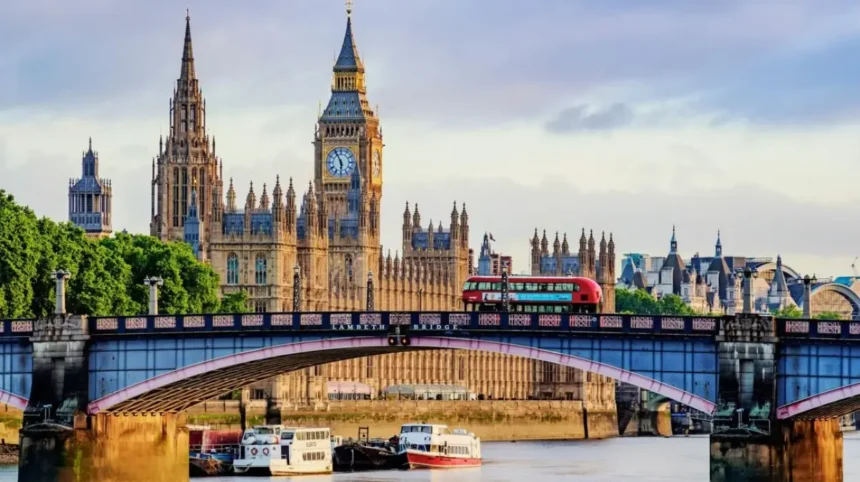
The South Bank and riverside areas around the Westminster Bridge approach provide direct views of the bridge, Palace of Westminster and Elizabeth Tower. Lambeth’s river frontage creates compositions that place the bridge across the Thames while keeping major Westminster landmarks within the same frame.
Westminster Bridge is particularly important for photographers because the bridge and the Palace of Westminster form a visually connected historic group.
The bridge was completed in 1862. Historic England records its seven graduated metal spans, stone piers, Gothic detailing and decorative elements. The eastern half of Westminster Bridge lies within the London Borough of Lambeth.
From the Lambeth side, photographers can work with several layers of visual depth. The foreground can contain the Thames or riverside pavement. Westminster Bridge forms the middle layer. The Palace of Westminster and Elizabeth Tower provide the background.
This arrangement is particularly useful for wide-angle architectural photography.
The relationship between Westminster Bridge and the Palace of Westminster is also historically documented. The Parliamentary Art Collection contains historical views of Westminster Bridge, including an 18th-century print showing Westminster Bridge, Westminster Abbey, Lambeth Palace and other buildings along the Thames.
The bridge has therefore been a recognisable part of London’s riverside visual landscape for centuries.
For a historical context article, [Insert Anchor Text for History Article Here] provides the appropriate background to the development of Lambeth, its river crossings and the surrounding historic landscape.
What should you include in a Westminster Bridge photograph?
A strong composition can include the bridge deck, Gothic ironwork, the River Thames and the Palace of Westminster. Elizabeth Tower provides a vertical architectural element that balances the horizontal line of the bridge.
Photographers should also consider river traffic. Boats moving beneath or beside the bridge create additional depth and indicate the active role of the Thames as a transport corridor.
The bridge is also highly recognisable because of its relationship with the Palace of Westminster. Lambeth Council describes Westminster Bridge as an important public vantage point for appreciating the eastern façade of the Palace of Westminster.
This makes the surrounding Lambeth riverside particularly suitable for architectural and cityscape photography.
Is Lambeth Bridge a good subject for photography?
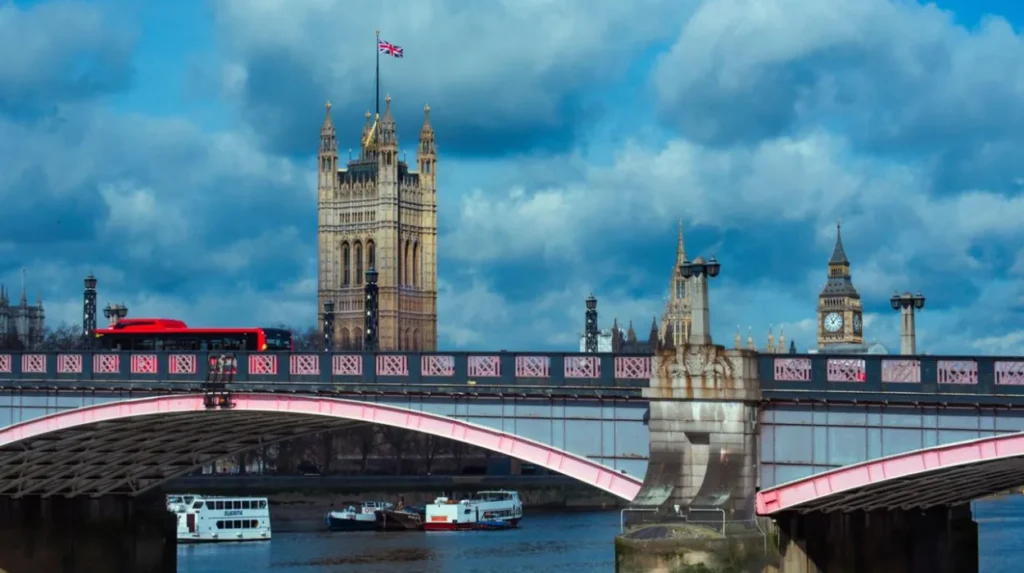
Lambeth Bridge is a strong architectural photography subject because its 1932 structure combines five steel arches, granite-faced piers, decorative lighting and a distinctive red colour. Its setting beside Lambeth Palace and the Thames creates several layers of historic and modern visual detail.
The present Lambeth Bridge opened on 12 July 1932. It was designed by Sir George William Humphreys with Sir Reginald Blomfield and George Topham Forrest as consulting architects. Historic England lists it at Grade II.
The bridge has a total length of approximately 236.5 metres. Its steel superstructure contains five spans, including a central span of about 50.3 metres. Granite-faced reinforced-concrete piers support the structure.
Its red colour is one of its most recognisable photographic characteristics. Historic England records that the colour references the red benches of the House of Lords, while Westminster Bridge is green in reference to the House of Commons benches.
This colour relationship creates an interesting visual distinction between the two neighbouring crossings.
Lambeth Bridge also has strong historical associations. The site functioned as a landing stage from at least the 13th century, and a horse ferry operated between Lambeth and Millbank before the modern bridge system developed. The name Horseferry Road preserves part of that history.
The first bridge at the site opened in 1862. It was a stiffened suspension bridge designed by Peter W Barlow. Structural deterioration eventually led to its closure to vehicular traffic in 1910, followed by construction of the present bridge.
Which details are worth photographing on Lambeth Bridge?
The bridge’s shallow steel arches provide repeated geometric lines. The granite piers provide contrasting textures. The lamp standards and latticework create smaller architectural details within wider compositions.
The obelisks at the bridge approaches are another distinctive feature. Historic England records that they are topped with stone pinecones, traditionally associated with hospitality and also linked with the historical story of John Tradescant.
The surrounding landscape adds further subjects. Lambeth Palace stands close to the bridge and is a Grade I listed building. The Palace of Westminster is also part of the wider historic group associated with the bridge.
A photographer can therefore create both close architectural images and broader Thames landscapes without moving far from the bridge.
Where can you photograph Vauxhall Bridge from Lambeth?
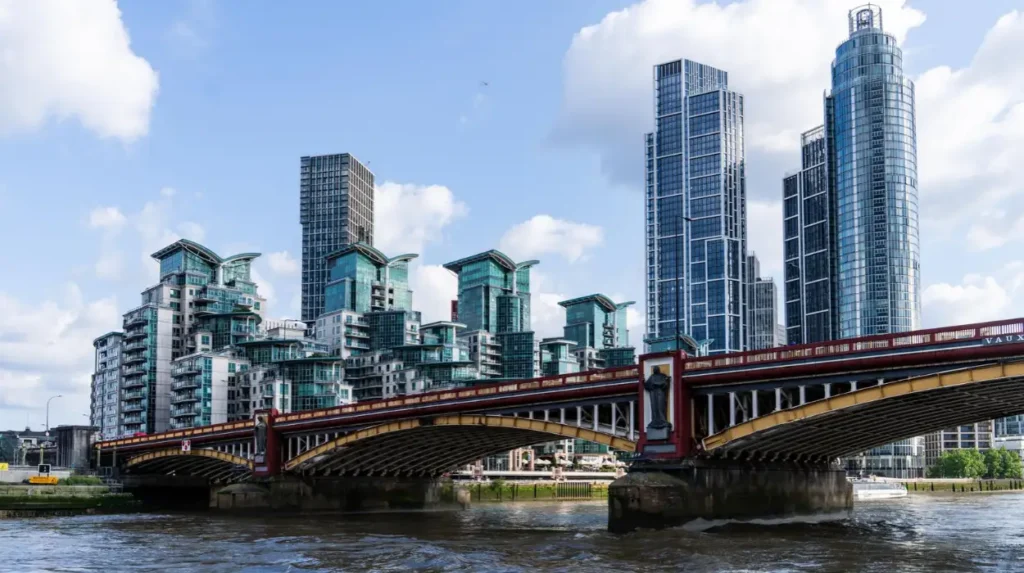
Albert Embankment provides an established riverside viewpoint for photographing Vauxhall Bridge from Lambeth. The area offers views towards the bridge’s five arches, granite piers and monumental sculptures, while the Thames and surrounding architecture create additional foreground and background layers.
Vauxhall Bridge is one of the most architecturally distinctive crossings in this section of the Thames.
The current bridge dates from 1904–06 and was designed by Sir Alexander Binnie and his successor Sir Maurice Fitzmaurice. Historic England lists it at Grade II*.
The structure measures approximately 231.6 metres and contains five steel arches. Granite-faced concrete piers support the bridge, while two footways flank the carriageway.
The major photographic feature is its sculpture.
Eight monumental bronze figures decorate the piers. They represent themes including Government, Education, Fine Art, Science, Agriculture, Architecture, Engineering and Pottery. The sculptures were produced by Frederick Pomeroy and Alfred Drury.
This makes Vauxhall Bridge particularly suitable for detailed architectural photography.
Lambeth Council’s Albert Embankment conservation documentation identifies the riverside walk as a place from which Vauxhall Bridge can be appreciated. It records the bridge’s five arches, granite piers and eight monumental bronze figures.
Why are Vauxhall Bridge sculptures important for photographers?
The sculptures provide a subject that differs from the bridge’s engineering structure. A photographer can frame individual figures, combine sculptures with the arches or use the entire bridge as a wide architectural composition.
The bridge is also historically unusual. Historic England identifies its sculptural decoration as unique among British river crossings, giving the structure an additional architectural distinction.
The bridge replaced an earlier crossing known as Regent’s Bridge. The earlier bridge opened in 1816 and was London’s first iron bridge over the Thames. The present structure therefore represents a later stage in the development of river engineering.
The surroundings have also changed significantly. Vauxhall forms part of an active regeneration area extending between Lambeth Bridge and Battersea Power Station. Lambeth Council identifies ongoing improvements to public space along the Thames corridor, including work associated with the Thames Tideway Tunnel.
These changes add contemporary architectural elements to the historic bridge setting.
Which Lambeth riverside viewpoints create the widest bridge photographs?
The Thames-side walks around the South Bank, Lambeth Bridge and Albert Embankment provide the broadest opportunities for bridge photography. These locations allow photographers to move between foreground, side-on and distant compositions while following the river between Westminster and Vauxhall.
The riverside is important because bridge photography depends heavily on viewing angle.
A position close to the bridge produces structural detail. A position farther along the embankment reveals the complete span. A side-on position emphasises the relationship between the bridge deck and the river.
Lambeth Council describes the borough as having approximately two miles of river frontage from the South Bank to Vauxhall.
This continuous river edge creates a practical sequence of photography locations.
South Bank and Westminster area
The South Bank section provides the strongest relationship between Westminster Bridge and the Palace of Westminster. The bridge itself becomes a framing element for the historic parliamentary complex.
The Palace of Westminster contains the House of Commons and House of Lords and remains a working parliamentary building. UK Parliament provides visitor information and identifies Westminster Bridge as the closest bridge to the parliamentary estate, while also noting that the bridge can become very busy.
Lambeth Bridge and the riverside
The area around Lambeth Bridge provides closer views of the bridge’s red-painted structure. The riverbank and surrounding historic buildings create opportunities for wide photographs and architectural details.
Lambeth Palace is particularly important because of its proximity to the bridge. The combination of palace architecture, bridge engineering and the Thames creates a dense historic composition.
Albert Embankment
Albert Embankment provides the main riverside approach towards Vauxhall Bridge. Lambeth Council records that the riverside walk dates from 1868 and includes views across the Thames towards Westminster.
This makes the area useful for photographers who want to move between Westminster-facing views and Vauxhall-facing views during the same walk.
What time of day is best for photographing Lambeth’s Thames bridges?
Morning, afternoon and evening produce different photographic conditions along Lambeth’s Thames frontage. Morning provides softer directional light, daytime provides clearer architectural detail, and evening provides illuminated bridges, buildings and reflections across the River Thames.
Light direction is more important than a fixed photography hour because the Thames runs broadly east-west through central London.
Morning light can provide strong illumination across structures facing east. Later daylight produces different contrast across the bridge arches and riverside buildings.
Evening photography introduces artificial lighting. Westminster, Lambeth and Vauxhall bridges each have distinctive structural forms that remain visible after daylight fades.
Reflections are also important. The River Thames is tidal, so its water level and surface conditions change throughout the day. A photographer should therefore consider both the light and the tide when planning a specific composition.
Cloud cover affects contrast as well. Bright overcast conditions reduce harsh shadows and reveal architectural details across large structures. Clear conditions produce stronger highlights and deeper shadows.
Weather also changes the character of the Thames. Wet pavements create additional reflections around riverside viewpoints, while mist and low cloud alter the visibility of distant landmarks.
These conditions make repeat visits useful for photographers who want different interpretations of the same bridge.
How should photographers plan a Thames bridge photography walk in Lambeth?
A practical Lambeth bridge photography walk follows the Thames between Westminster Bridge, Lambeth Bridge and Vauxhall Bridge. The route connects major architectural subjects with riverside paths, historic buildings and public spaces, allowing photographers to change viewpoint without relying on private access.
Starting around Westminster Bridge provides immediate access to one of London’s most recognisable architectural compositions.
From there, photographers can continue along the Lambeth riverside towards Lambeth Bridge. The journey shifts the visual emphasis from Gothic Westminster architecture towards the steel and granite structure of the 1932 bridge.
Continuing towards Albert Embankment brings Vauxhall Bridge into the sequence.
The three bridges are close enough to form a coherent photography itinerary rather than three isolated destinations.
The route also passes important historic locations. Lambeth Palace provides architectural context near Lambeth Bridge, while the Westminster area provides views towards the Palace of Westminster and Westminster Abbey.
The riverside environment also supports short photography sessions for visitors with limited time. A domestic business traveller staying in central London can focus on one bridge. A leisure traveller can follow the wider sequence.
Digital nomads working nearby can use the riverside as a walking break between work sessions, subject to the practical limitations of outdoor weather and workspace availability.
Lambeth Council also operates Film Lambeth, which manages professional filming and photography on council land and public roads. The council states that professional filming and photography on council land or public roads is licensed through its film office.
This distinction matters for commercial photography. Casual personal photography is different from organised professional shoots requiring equipment, crew, permissions or road management.
What photography rules apply around Westminster and Lambeth bridges?
Personal photography in public riverside areas is generally straightforward, but professional filming, photography on council-controlled land and photography within the Parliamentary Estate have specific requirements. Commercial photographers should check the relevant authority before using tripods, crews, equipment or restricted locations.
The Parliamentary Estate has its own photography rules.
UK Parliament states that photography for personal, non-commercial purposes is permitted in specified visitor areas, including Westminster Hall, St Stephen’s Hall and New Palace Yard. Photography is restricted in other parts of the Parliamentary Estate, and tripods are not permitted.
Photography for wider publication requires additional consideration. UK Parliament directs people seeking wider publication or filming permissions to the relevant parliamentary teams.
These rules apply inside the Parliamentary Estate rather than automatically prohibiting ordinary photography from public riverside locations.
Lambeth also has specific procedures for professional photography and filming. Film Lambeth states that professional filming and photography on council land or public roads is licensed by the council.
Photographers should therefore distinguish between three situations.
Personal photography from a public riverside location involves normal public access and safety considerations. Professional photography using significant equipment can require permission. Photography within controlled sites such as Parliament follows the site’s own rules.
Tripods also require practical awareness. Narrow pavements, busy bridge approaches and pedestrian traffic can make large equipment difficult to use safely even where photography itself is permitted.
Explore More Area Guide
Where to Take a Break During Lambeth Sightseeing
Best Places for a Slow Day in Lambeth, South London
Why are Lambeth’s Thames bridges historically important photography subjects?
Lambeth’s Thames bridges document successive phases of London’s engineering and urban development. Westminster Bridge dates from 1862, Vauxhall Bridge from 1906 and the present Lambeth Bridge from 1932, creating a concentrated visual record of changing bridge design.
The three bridges represent different periods of London’s infrastructure history.
Westminster Bridge reflects Victorian engineering and Gothic architectural design. Its relationship with the Palace of Westminster gives it a strong connection with the political architecture of the nineteenth century.
Vauxhall Bridge represents early twentieth-century steel engineering combined with monumental public sculpture. Its construction involved engineers and artists working together on a major transport crossing.
Lambeth Bridge represents the inter-war period. Its classical treatment, steel arches, granite piers and decorative features reflect the design priorities of the London County Council era.
The historical sequence becomes particularly clear when the bridges are photographed together as part of one Thames journey.
Their surroundings also preserve evidence of earlier river use. Vauxhall Bridge’s site has archaeological significance, with Historic England recording evidence of an oak crossing dating to approximately 1500 BC identified through the Thames Archaeological Survey.
Lambeth Bridge also occupies a long-established crossing location. Historic England records river activity at the site since at least the 13th century, including a ferry associated with Lambeth Palace.
Photography therefore captures more than modern transport infrastructure. The bridges occupy sites shaped by centuries of movement, settlement, engineering and river use.
What makes Lambeth one of London’s strongest areas for bridge photography?
Lambeth combines three major historic Thames crossings with long riverside paths, protected heritage buildings and views towards Westminster. The concentration of Westminster Bridge, Lambeth Bridge and Vauxhall Bridge creates a compact photography area with architectural, historical and landscape subjects.
The main strength of Lambeth is its concentration of subjects.
A photographer does not need to travel across London to photograph different bridge styles. Westminster Bridge offers Gothic Victorian detailing. Lambeth Bridge provides inter-war steel engineering. Vauxhall Bridge combines steel arches with monumental bronze sculpture.
The river itself connects these subjects.
The Thames provides leading lines, reflections, moving boats and changing light. The embankments provide accessible positions from which to vary distance and perspective.
Historic buildings provide additional context. Lambeth Palace stands close to Lambeth Bridge, while the Palace of Westminster dominates views around Westminster Bridge.
Lambeth Council’s planning and heritage documents also recognise the importance of riverside viewpoints. Its assessment of the Westminster area identifies the riverside as an important viewing location for the Palace of Westminster, while its Albert Embankment documentation identifies views towards Vauxhall Bridge.
The area therefore works for several photography purposes.
Architectural photographers can concentrate on bridge structures and listed buildings. Landscape photographers can include the Thames and skyline. Travel photographers can document London’s historic riverside. Visitors with limited time can focus on Westminster Bridge or Lambeth Bridge without completing the entire route.
For a longer photography walk, the sequence from Westminster Bridge through Lambeth Bridge to Vauxhall Bridge provides a logical route through central Lambeth’s Thames landscape.
The result is a compact section of London where historic engineering, river transport, public space and nationally significant architecture appear together.
For visitors photographing Lambeth, the most useful approach is to treat the Thames as the connecting subject. Westminster Bridge, Lambeth Bridge and Vauxhall Bridge each have a separate identity, but their historical relationship becomes clearer when viewed as part of the same riverside landscape.
Lambeth’s bridges therefore provide photography opportunities throughout the day and across different photographic styles. The area’s historic structures remain fixed, while light, weather, water level, river traffic and seasonal conditions continuously change the appearance of each viewpoint.
What are the best Thames bridges to photograph from Lambeth?
The main Thames bridges to photograph from Lambeth are Westminster Bridge, Lambeth Bridge and Vauxhall Bridge. Each offers a different architectural subject, from Westminster’s Gothic design to Vauxhall’s monumental sculptures.