Knowing whether your car is ULEZ compliant matters in South London because the Ultra Low Emission Zone covers all London boroughs, and non-compliant vehicles face a daily charge when driven inside it. The fastest and most reliable check is to use the official vehicle checker with your registration number.
- What does ULEZ compliance mean?
- How do you check your car?
- Where do you find emissions details?
- Which cars are usually compliant?
- What if your car is not compliant?
- How does ULEZ affect South London drivers?
- What paperwork should you check?
- What are the main checks in order?
- Why does the 2026 label matter?
- What mistakes do drivers make?
- What should buyers look for?
- How should you use this information?
- Why is this topic evergreen?
- Final check for drivers
What does ULEZ compliance mean?
ULEZ compliance means a vehicle meets London’s minimum emissions standards for nitrogen oxides and particulate matter, so it can enter the Ultra Low Emission Zone without paying the daily charge. Petrol cars usually need to meet Euro 4 standards, and diesel cars usually need Euro 6 standards.
The ULEZ is part of London’s air-quality policy, designed to reduce harmful vehicle emissions in one of the world’s most densely used road networks. Compliance is based on a vehicle’s emissions standard, not its age alone, although age often gives a strong clue.
For most drivers, the decision comes down to whether the car is classified as compliant by the official checker. That result is more important than assumptions based on model year, because some vehicles follow different emissions rules depending on engine type, build date, and registration details.
How do you check your car?
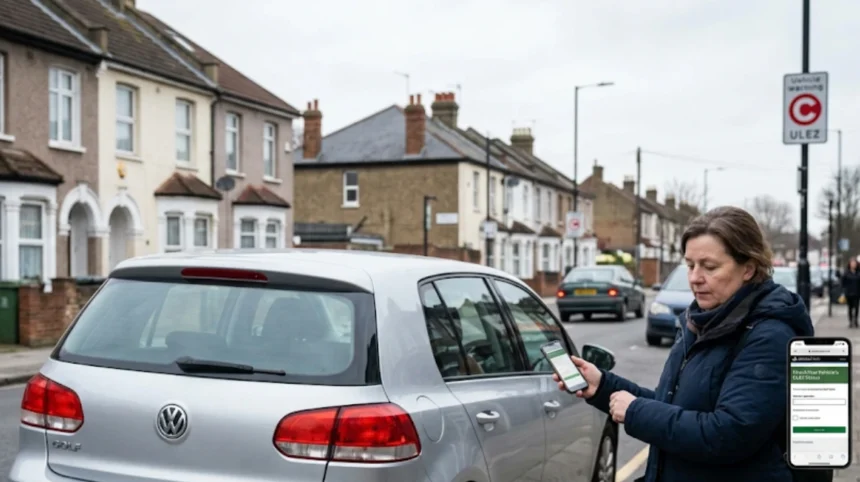
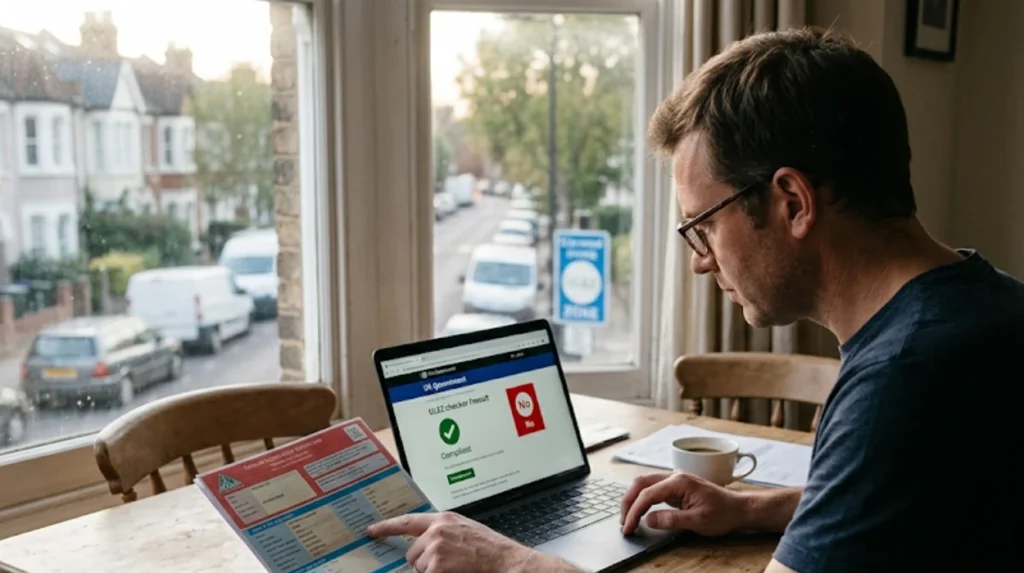
Enter your number plate into the official checker, confirm the vehicle’s registration country if asked, and read the compliance result. If the result says your car meets the standards, it is ULEZ compliant; if not, the daily charge applies when you drive in the zone.
The official TfL checker is the most reliable method because it uses vehicle records rather than guesses. The checker can also guide users with non-UK vehicles by asking for the country of registration before giving a result.
If your car is already on the road in the UK, the process is simple. Open the checker, type the registration number, and review the result for ULEZ status. This is the best starting point for South London drivers who travel through boroughs such as Lambeth, Southwark, Lewisham, Croydon, Greenwich, Wandsworth, or Bromley and need certainty before driving into central or inner London routes.
Where do you find emissions details?
You can find emissions details on the V5C logbook, especially for newer vehicles, and if the standard is missing there, you can use the first registration date and the official vehicle enquiry service to confirm compliance.
The V5C vehicle registration document sometimes lists the Euro emissions standard directly. In newer vehicles, that standard may appear in the document, which helps confirm whether the car meets ULEZ rules without needing a separate lookup.
If the emissions standard is not obvious, the first registration date on the V5C gives a strong clue. TfL also advises checking the government vehicle enquiry service after finding the vehicle’s details, which adds another layer of verification.
A practical example is a petrol car first registered after January 2006, which often meets Euro 4 and is usually compliant, while a diesel car first registered after September 2015 often meets Euro 6 and is usually compliant. That pattern is useful, but the official checker still gives the final answer.
Which cars are usually compliant?
Petrol cars registered after January 2006 are usually compliant because they generally meet Euro 4 standards, while diesel cars registered after September 2015 are usually compliant because they generally meet Euro 6 standards.
These dates matter because Euro standards are the formal emissions benchmarks used in ULEZ rules. Vehicle age is only a shortcut, not the rule itself, because the actual requirement depends on the emissions category recorded for the vehicle.
Electric cars are compliant because they produce no tailpipe emissions, which is the main pollution source targeted by ULEZ. Many newer hybrid vehicles are also compliant, but the exact result still depends on the specific model and engine configuration, so the checker remains essential.
A useful rule for drivers in South London is this: use the age guide as a first estimate, then confirm with the official checker before planning a journey. That avoids unexpected charges on commuter routes, shopping trips, school runs, and hospital visits across London.
What if your car is not compliant?
If your car is not compliant, driving it inside the ULEZ triggers the daily charge unless you qualify for an exemption or another specific vehicle rule applies.
The charge exists to discourage higher-emission vehicles from entering the zone and to improve air quality across London. The cost is separate from parking fees, congestion charges, and any other local road charges.
For regular drivers, the financial impact can be significant if the vehicle is used frequently inside the zone. That is why many owners check compliance before taking a job in central London, planning a hospital appointment, or buying a used car.
Non-compliance does not always mean a vehicle cannot be driven in London. It means the driver needs to understand the charge, the route, and any available exemption before entering the zone. This distinction is important for South London residents who travel across borough boundaries every day.
How does ULEZ affect South London drivers?
South London drivers are affected because ULEZ covers London broadly, so many routine journeys across boroughs, town centres, and ring-road connections fall within the charge rules.
The zone is relevant to commuting, deliveries, school travel, and local errands because South London has frequent cross-borough journeys. Drivers who live outside the central area still need compliance if their route enters the ULEZ boundary.
This matters for older vehicles, second cars, and work vans used for local business. A vehicle that seems fine for short local trips can still trigger the daily charge when driven into compliant-check locations or through roads inside the zone.
Checking ahead is especially useful when buying a used car in South London. A low purchase price does not guarantee low running costs if the vehicle is not ULEZ compliant.
What paperwork should you check?
The main documents are the V5C logbook, which shows registration details, and any manufacturer or vehicle history information that confirms the emissions standard.
The V5C is the most useful document because it contains the first registration date and, in some cases, the Euro emissions standard. Those details help you estimate compliance before using the official checker.
If you bought the car used, the seller’s advert may mention the Euro standard, but that should not replace a formal check. Listings can be incomplete or inaccurate, while the official database is designed to give the correct result for enforcement purposes.
A simple workflow works best: review the V5C, note the first registration date, use the official checker, then keep the result for your records. That sequence reduces mistakes and is easy to repeat for every vehicle in a household or small business fleet.
What are the main checks in order?
The main checks are registration lookup, V5C review, emissions standard confirmation, and route planning before entering London’s ULEZ.
Start with the registration number because that is the quickest and most reliable method. Then review the V5C if you want a document-based backup.
Next, check whether the vehicle is petrol, diesel, hybrid, or electric, because engine type affects the emissions standard that applies. Finally, plan the route so you know whether the journey actually enters the zone.
This order works well for busy South London drivers because it is fast and repeatable. It also reduces the risk of last-minute surprises when crossing into areas where the ULEZ charge applies.
Why does the 2026 label matter?
The 2026 label matters because drivers search for current ULEZ rules when planning travel, buying cars, and checking whether older vehicles still meet London’s standards in the present year.
The underlying rules are based on emissions standards, not the calendar year alone. Still, people search by year because they want current guidance that reflects today’s enforcement and vehicle-check process.
For an evergreen guide, the year in the title helps users understand that the information is current and practical. It also helps search engines match the page to users who want up-to-date compliance advice rather than older archived explanations.
The core process does not change much from year to year: identify the vehicle, verify the emissions standard, then confirm it through the official checker. That stability makes the topic ideal for evergreen SEO content.
What mistakes do drivers make?
Drivers often rely on age alone, trust seller claims without checking, or assume all petrol and diesel cars follow the same rules, but ULEZ compliance depends on the specific vehicle record and emissions standard.
A common mistake is assuming a car is compliant because it looks modern or was registered around the right year. Another mistake is assuming a vehicle is non-compliant because it is older, even though some older vehicles still meet the required standard.
Drivers also sometimes forget to check the exact registration plate when a car has been transferred, cloned, or entered incorrectly in documents. The checker works best when the vehicle details match the records exactly.
The safest habit is to recheck before every major trip or purchase decision. That is especially important for South London motorists who use a mix of local roads, orbital routes, and central London connections.
Explore More Help & Resources
How to report a dead or leaning tree to Croydon Council
How to use Bromley’s map to report a fallen street tree
What should buyers look for?
Used-car buyers should look for the emissions standard, fuel type, first registration date, and a verified compliance result before purchase.
Buying a car that is cheap to purchase but expensive to run defeats the purpose of choosing a practical vehicle for London use. A compliance check gives you a clearer view of ownership costs before money changes hands.
This is especially important for families, commuters, and small businesses in South London that rely on cars for daily movement. A compliant car reduces planning friction and avoids repeated charge decisions. Non-compliant vehicles can still have value, but only when the buyer understands the ongoing cost.
The simplest buying rule is to verify first, negotiate second, and complete the purchase only after the compliance result is confirmed. That avoids later disputes and keeps the decision based on facts instead of assumptions.
How should you use this information?
Use the official checker first, then cross-check the V5C and registration date if you want a document-based explanation for the result.
This approach gives you both speed and certainty. The checker answers the main question immediately, while the logbook and registration date help explain why the result appears as it does.
For South London readers, the best routine is simple: check before commuting, check before buying, and check again if the vehicle details change. That habit works for private cars, family vehicles, and work vehicles alike.
ULEZ compliance is a clear rule-based process, not a judgment call. Once you know the emissions standard and the official result, you know exactly where your vehicle stands.
Why is this topic evergreen?
This topic stays relevant because London’s ULEZ rules affect daily travel, vehicle buying, and route planning year after year, while the official check process remains simple and consistent.
Evergreen content works best when it answers a repeated real-world problem in a stable way. ULEZ compliance fits that model because drivers keep needing a fast, trustworthy method to confirm their vehicle’s status.
The most durable version of this topic explains the rule, the check, the documents, the likely standards, and the consequences of non-compliance. That creates a complete guide for readers and a clear structure for search engines and AI systems to extract.
For South London, the subject also remains locally useful because daily travel patterns keep crossing the zone boundary. The practical question does not fade, even when vehicles, models, and travel habits change.
Final check for drivers
The final check is straightforward: use the registration number, confirm the result, review the V5C if needed, and only then drive into London’s ULEZ with confidence.
A compliant vehicle saves time and avoids unnecessary charges. A non-compliant vehicle still has options, but those options require planning before the journey starts.
For South London drivers, that planning is the difference between a routine trip and an expensive surprise. The official checker gives the fastest answer, and the V5C gives the supporting details.
The process is simple enough to repeat whenever you change vehicles, buy a used car, or plan a trip across London. That makes ULEZ compliance one of the easiest driving checks to keep under control.
What does ULEZ compliant mean?
A ULEZ-compliant vehicle meets Transport for London’s minimum emissions standards and can be driven within the Ultra Low Emission Zone without paying the daily ULEZ charge.