The River Thames is central to the visitor experience in Lambeth. The borough occupies a significant stretch of the river’s south bank, including Albert Embankment, Lambeth Bridge, the South Bank and the riverside around the London Eye.
- What can visitors do along the Thames in Lambeth?
- Where can visitors walk beside the River Thames in Lambeth?
- Can visitors take a boat along the Thames from Lambeth?
- Is the London Eye one of the best Thames experiences in Lambeth?
- What cultural activities can visitors enjoy beside the Thames in Lambeth?
- Where can visitors enjoy Thames views and gardens in Lambeth?
- Where are the best places for Thames photography in Lambeth?
- Can visitors explore the Thames foreshore in Lambeth?
- How can visitors build a Thames itinerary around Lambeth?
- What works for a short visit?
- What works for a longer visit?
- What works for business travellers?
- What works for repeat visitors?
- Why is the Thames important to Lambeth’s visitor experience?
- What should visitors know before planning Thames activities in Lambeth?
Lambeth’s Thames frontage combines recreation, culture, transport, heritage, architecture and public space. Visitors can walk beside the water, use river services, photograph Westminster, visit major cultural institutions, experience the London Eye, explore riverside gardens and stop at cafés and food venues.
The Lambeth section of the tidal Thames covers about 43 hectares, according to Lambeth Council’s biodiversity information. The river frontage contains major visitor destinations as well as ecological and archaeological features.
The riverside also forms part of important conservation areas. Albert Embankment Conservation Area extends along Lambeth’s Thames frontage from the Wandsworth borough boundary towards Westminster Bridge. Lambeth Council identifies the embankment walk, retaining walls, open spaces and views towards Westminster as important characteristics of the area.
For visitors, this creates a compact destination where a riverside walk can connect directly with attractions, food, culture and transport.
What can visitors do along the Thames in Lambeth?
Visitors can combine riverside walking, landmark views, cultural venues, river travel, photography, gardens and food beside the Thames in Lambeth. The South Bank and Albert Embankment provide accessible routes linking major attractions with historic bridges, public spaces and transport connections.
The most straightforward way to experience the Thames in Lambeth is to treat the riverfront as an interconnected visitor area rather than a single attraction.
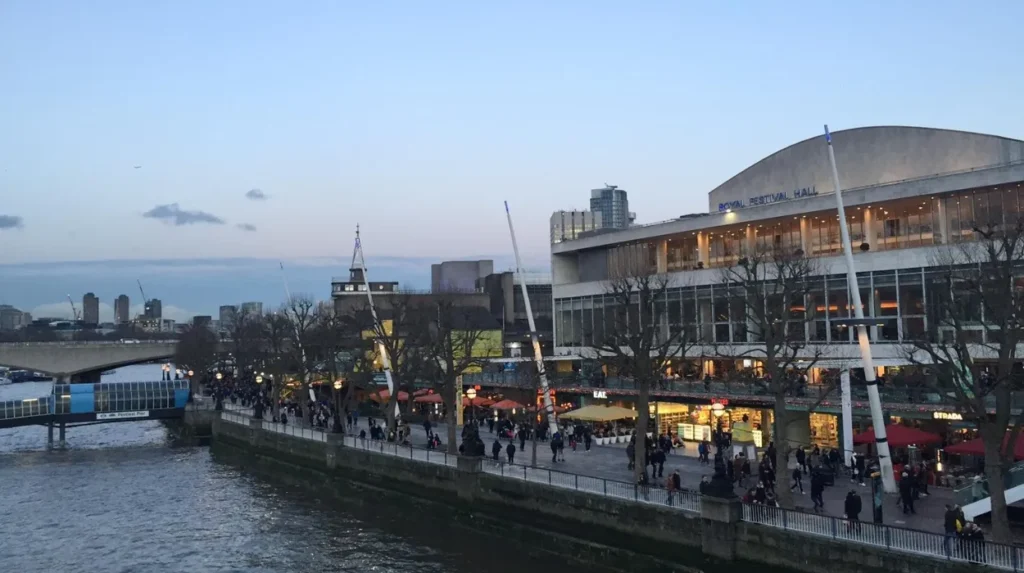
The South Bank provides a dense concentration of visitor facilities. The London Eye, Southbank Centre and National Theatre sit close to the river. The Queen’s Walk provides a riverside pedestrian route through this part of central London.
Further south, Albert Embankment provides a different environment. The riverside has open views, gardens, historic structures and long views towards Westminster.
The river itself also functions as a transport route. Uber Boat by Thames Clippers operates River Bus services along the Thames, connecting central London with destinations farther east and west. Its current network covers 24 piers.
This combination makes Lambeth suitable for several visitor purposes. A tourist can walk between landmarks. A business traveller can use the river as part of a short sightseeing break. A resident can use the riverside for a short walk, cultural visit or meal.
Where can visitors walk beside the River Thames in Lambeth?
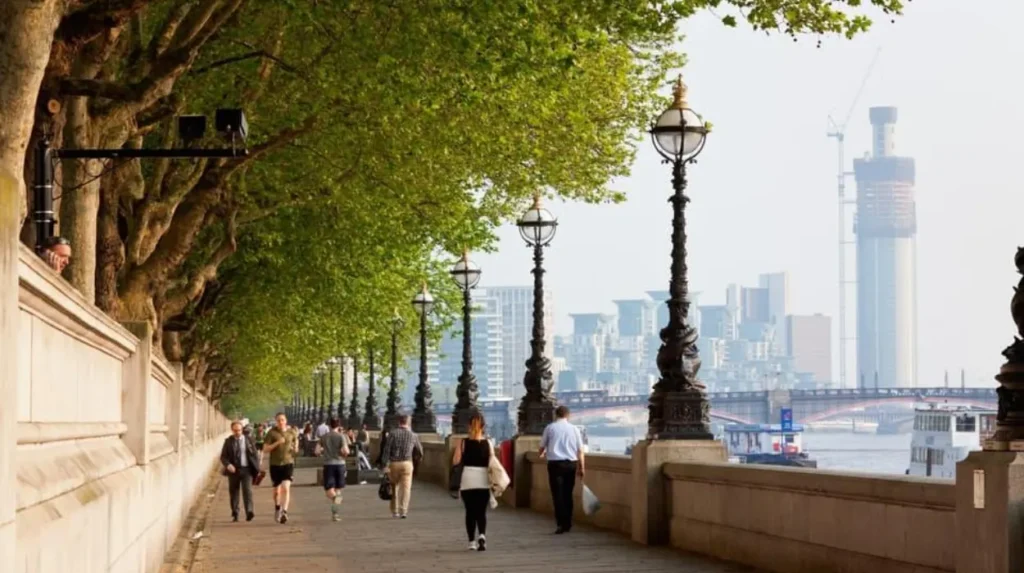
The Thames Path provides a continuous riverside walking experience through Lambeth, with the South Bank and Albert Embankment offering direct access to landmarks, bridges, gardens and cultural venues. Walkers can combine sightseeing with photography, public art, cafés and riverside views.
The Thames Path is the main walking concept for visitors exploring the river. It follows the River Thames through London and provides access to a wide range of riverside landscapes.
In Lambeth, the South Bank section is particularly useful for sightseeing because attractions sit immediately beside the pedestrian route. Visitors can walk past the London Eye, Southbank Centre and National Theatre while maintaining views across the river towards Westminster.
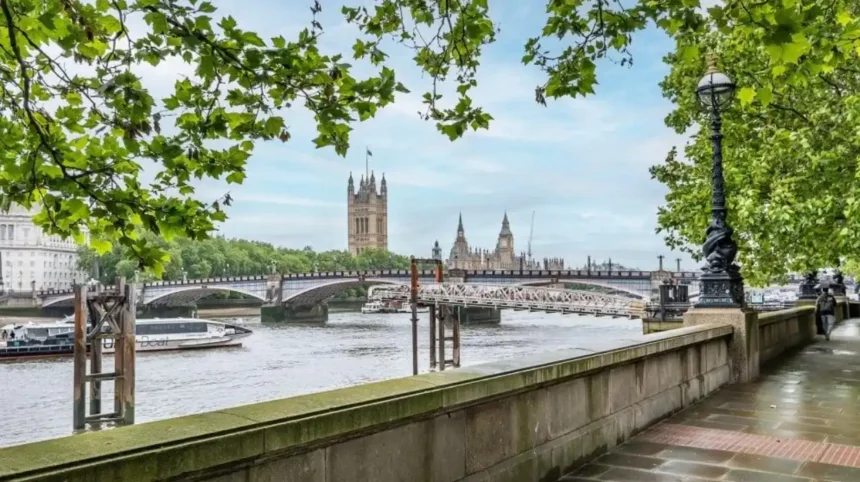
The Albert Embankment section provides a different walking environment. Lambeth Council describes Albert Embankment as a Thames frontage containing an embankment walk, retaining walls and open spaces. The area provides public viewpoints towards the Westminster World Heritage Site.
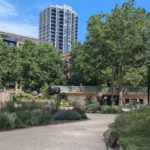
Albert Embankment Gardens also provide a riverside open-space option. Lambeth Council describes the gardens as a chain of small open spaces running between Vauxhall and Waterloo along the River Thames. They are open 24 hours a day.
Walking also provides the easiest way to compare the character of different parts of Lambeth’s Thames frontage. The South Bank has a strong concentration of entertainment and cultural facilities. Albert Embankment has more emphasis on architecture, gardens, views and the relationship between the river and Westminster.
For visitors interested in history, the riverfront is also a route through centuries of development.
As you explore the modern riverside, you are crossing land with deep heritage. Read about the full to understand its origins.
The historical relationship between Lambeth and the Thames is particularly visible around Lambeth Palace. Historic England records that the site has been occupied by the Archbishops of Canterbury since 1197 and that the palace developed close to the river and Westminster.
Can visitors take a boat along the Thames from Lambeth?
Uber Boat by Thames Clippers provides river travel from central London piers, with London Eye Waterloo Pier serving the South Bank. Visitors can use single, return or hop-on hop-off tickets to connect sightseeing with river views and convenient journeys overall.
A Thames boat journey provides a different way to experience Lambeth. Instead of viewing the river from the embankment, visitors travel directly on the water while seeing bridges, historic buildings and London landmarks from a changing perspective.
The London Eye Waterloo Pier is positioned on the South Bank underneath the London Eye. Thames Clippers describes it as a Central Zone pier with access to nearby attractions and views towards the Houses of Parliament and Big Ben.
Uber Boat by Thames Clippers operates services from early morning until late at night, seven days a week, although exact departure patterns vary by pier and timetable. Visitors should check the current timetable before travelling.
The service offers different ticket structures. Visitors can purchase single journeys, returns and hop-on hop-off tickets. The operator also offers one-day and two-day options for visitors planning several river journeys.
How does a Thames River Bus journey work?
River Bus services operate through West, Central and East fare zones. The Central Zone includes piers between Battersea Power Station and Canary Wharf. Visitors travelling across different zones need a ticket covering the zones used.
Contactless payment and Oyster are available on the service. Each passenger needs a separate payment card when using contactless or Oyster. The standard TfL daily travel cap does not apply to River services.
For accessibility, Thames Clippers states that its boats are accessible by ramp. Most piers are also accessible, although some exceptions apply. Current accessibility information should be checked before travel.
This makes river travel useful as both an activity and a transport option. A visitor can travel from the London Eye area towards other central London destinations without returning to the Underground.
Is the London Eye one of the best Thames experiences in Lambeth?
The London Eye provides an elevated Thames experience from the South Bank. The 135-metre observation wheel opened in 2000 and completes a rotation in about 30 minutes, giving visitors panoramic views towards Westminster, St Paul’s Cathedral and London landmarks citywide.
The London Eye is one of the defining attractions on Lambeth’s Thames frontage.
The observation wheel stands 135 metres high and has 32 pods. A complete rotation takes approximately 30 minutes. It opened in 2000 and was designed by Marks Barfield Architects.
The attraction provides a vertical perspective on the Thames. Visitors can see the river below while looking across central London towards landmarks such as the Palace of Westminster, St Paul’s Cathedral and Buckingham Palace.
The London Eye also provides a useful starting point for exploring the wider riverside. The attraction sits beside County Hall and close to Southbank Centre, the National Theatre and the Queen’s Walk.
The location allows visitors to combine an observation experience with a walking route. A typical riverside visit can begin at the London Eye, continue towards the National Theatre and Southbank Centre, then extend along the Thames towards other central London landmarks.
The London Eye is also directly connected with river experiences. Its official ticketing service offers a London Eye and River Cruise combination, allowing visitors to experience the skyline from above and the river from the water.
The attraction therefore fits several visitor itineraries. It works as a standalone sightseeing activity, part of a South Bank day, or a combined land-and-river experience.
What cultural activities can visitors enjoy beside the Thames in Lambeth?
Southbank Centre and the National Theatre provide cultural activities directly beside the Thames. Visitors can combine performances, exhibitions, public spaces, food markets, cafés and riverside walking, creating an activity base that works during daytime visits and evening plans for visitors.
The Thames in Lambeth is not limited to outdoor recreation. The South Bank is also an important cultural district.
The Southbank Centre occupies a major riverside site beside the Thames. Its buildings and public areas host performances, exhibitions, food venues, markets and cultural activities. Visit London states that the centre is free to enter and that more than half of its events are completely free.
The Royal Festival Hall forms part of the Southbank Centre. It is a major concert hall for orchestral performances and has public foyer spaces that visitors can enter without purchasing a performance ticket.
The National Theatre is another major riverside cultural venue. It presents plays, musicals, family productions and stage adaptations across three auditoriums. The building also offers guided tours that explain its production facilities and theatre spaces.
This makes the South Bank particularly practical when weather changes. Visitors can begin with an outdoor riverside walk and move into a cultural venue without leaving the area.
The cultural infrastructure also supports evening visits. A visitor can combine a Thames walk with a theatre performance, concert, meal or café stop.
The relationship between culture and the river is important to Lambeth’s visitor identity. The Thames provides the physical setting, while the South Bank institutions provide structured indoor and outdoor activities.
Where can visitors enjoy Thames views and gardens in Lambeth?
Albert Embankment provides a quieter riverside setting with public gardens, open views and historic architecture. The conservation area extends along Lambeth’s Thames frontage and includes viewpoints towards Westminster, while the gardens provide an accessible place for walking and short breaks.
Albert Embankment provides an alternative to the busier South Bank.
The area stretches along the River Thames and forms part of a designated conservation area. Lambeth Council first designated the Albert Embankment Conservation Area on 26 November 2001, with the boundary last changed on 18 July 2016.
The conservation area contains the river frontage between the borough boundary with Wandsworth and Westminster Bridge. It includes the embankment walk, retaining walls, open spaces and major developments such as the St Thomas’ Hospital complex.
The river provides particularly strong views towards Westminster from this section. Lambeth Council identifies these viewpoints as an important feature of the conservation area.
Albert Embankment Gardens add green space to the riverside route. Their position between Vauxhall and Waterloo provides visitors with a place to pause without leaving the Thames corridor.
The area also connects naturally with Lambeth Bridge. The bridge crosses the Thames between Lambeth and Westminster and provides another viewpoint for observing the river, bridges and surrounding architecture.
Visitors interested in architecture can therefore treat Albert Embankment as an open-air viewing route. The river, bridges, embankment structures, hospital complex and Westminster skyline create a dense concentration of built heritage.
Where are the best places for Thames photography in Lambeth?
Photography is a major Thames activity in Lambeth because the river creates direct views towards Westminster, bridges, landmarks and changing light. Albert Embankment, Westminster Bridge and the South Bank provide distinct viewpoints for architecture, skyline, river traffic and public spaces.
The Thames creates strong photographic opportunities because Lambeth faces several nationally recognised London landmarks.
Albert Embankment provides views across the river towards Westminster. Lambeth Council specifically identifies the area as providing some of the best public vantage points for appreciating the Westminster World Heritage Site.
Westminster Bridge creates another important viewpoint. From the Lambeth side, visitors can frame the Palace of Westminster, the Elizabeth Tower and the Thames within the same scene.
The London Eye creates a contrasting photographic subject. Its scale and position beside the river make it a recognisable part of the South Bank skyline.
The South Bank also provides views towards the north bank. River traffic adds movement to photographs, while bridges provide strong architectural structures.
Photography works throughout the day because the relationship between light and water changes continuously. Morning light, daytime visibility and evening illumination create different conditions without requiring visitors to travel far.
Visitors should remain on designated public areas when taking photographs. The tidal foreshore is not a conventional beach or unrestricted recreational space. The Port of London Authority identifies several hazards and advises visitors to enjoy the river safely from dry land at embankment level.
Can visitors explore the Thames foreshore in Lambeth?
Visitors should treat the Thames as a tidal working river, not a swimming or recreational waterway. The Port of London Authority warns about strong currents, rapidly changing tides, slippery access points and foreshore hazards, making dry-land riverside activities safer overall.
The Thames foreshore has historical, ecological and archaeological significance, but it requires particular care.
Lambeth Council’s biodiversity information identifies exposed areas of mud, gravel and shingle along the tidal Thames. These areas have ecological and archaeological importance. At low tide, substantial sections of foreshore become exposed.
The presence of exposed foreshore does not make the area suitable for casual beach activities.
The Port of London Authority, which regulates navigation on the tidal Thames, states that the foreshore contains hazards that are not always immediately visible. These include fast currents, cold water, slippery steps, raw sewage and debris. The river can rise and fall by more than seven metres.
Searching the tidal Thames foreshore also has specific rules. The Port of London Authority requires a current Foreshore Permit for searching activities such as metal detecting, beachcombing, scraping and digging. Magnet fishing is not permitted.
Visitors should therefore distinguish between viewing the foreshore and entering or searching it.
The safest general approach is to remain on the public embankment and riverside paths. Visitors should never enter the Thames casually. The river is tidal, deep and used by vessels.
This distinction is important for visitors who search for “Thames activities in Lambeth”. Walking, photography, cultural visits, river travel and sightseeing provide direct river experiences without requiring contact with the water.
How can visitors build a Thames itinerary around Lambeth?
Visitors can structure a Lambeth Thames itinerary around a riverside walk, London Eye visit, cultural stop, river journey and meal. The compact South Bank area supports short visits, while Albert Embankment extends the experience towards Lambeth Bridge and Vauxhall.
The strongest feature of Lambeth’s Thames offer is its concentration.
A visitor starting near Waterloo Station can walk towards the London Eye and continue along the South Bank. The route provides immediate access to the river, cultural venues, food outlets and public spaces.
The London Eye can form the main paid attraction. Its 135-metre height provides a broad overview of central London.
The Southbank Centre provides an option for visitors interested in music, performance, food and public cultural spaces. The National Theatre provides another cultural destination directly beside the river.
A visitor can then continue along the Thames towards Westminster Bridge. This section provides direct views of the Palace of Westminster and the river.
For a longer riverside experience, the route can continue south towards Lambeth Bridge and Albert Embankment.
Another option is to use the river as transport. The London Eye Waterloo Pier provides access to Uber Boat by Thames Clippers, allowing visitors to continue their London exploration by boat.
What works for a short visit?
A short visit is suited to the London Eye, Queen’s Walk, Westminster views and a Southbank Centre stop.
What works for a longer visit?
A longer visit allows time for Albert Embankment, Lambeth Bridge, cultural venues, food stops and a River Bus journey.
What works for business travellers?
Business travellers can use the Thames frontage for a structured downtime itinerary. The riverside walk requires no booking, while cultural venues and river services provide defined activities around existing schedules.
What works for repeat visitors?
Repeat visitors can move beyond the London Eye and explore Albert Embankment, public gardens, architectural viewpoints and river transport.
Explore More Area Guide
Lambeth Cycling Routes: Where Visitors Can Cycle
Best Birdwatching Spots in Lambeth: Parks, Wildlife and Nature
Why is the Thames important to Lambeth’s visitor experience?
The Thames connects Lambeth’s historic identity with its modern visitor economy. Its riverfront brings together heritage, public space, cultural institutions, transport, tourism attractions and ecological features, making the Thames a defining part of how visitors experience central Lambeth today.
The river has shaped Lambeth for centuries.
Historic England records that the Archbishops of Canterbury occupied the Lambeth Palace site from 1197. The location was important because of its proximity to Westminster and the Thames. Historic records also describe a historic horse ferry connecting Lambeth Palace with Westminster.
The modern riverfront has a different function, but the geographical relationship remains.
Today, the Thames supports tourism, public recreation and transport. The London Eye uses the riverfront as the setting for an observation attraction. Southbank Centre and the National Theatre use the riverside as a cultural environment. River Bus services use the Thames as a transport corridor. Albert Embankment uses the river as a public landscape.
The river also retains environmental significance. Lambeth Council identifies the tidal Thames as an important ecological area, with exposed mud, gravel and shingle providing habitat and archaeological interest.
This combination gives the Lambeth Thames frontage several layers of visitor value.
It is a walking route.
It is a transport corridor.
It is a cultural destination.
It is a viewing platform.
It is a historic landscape.
It is an ecological environment.
For visitors, the most practical approach is to experience these functions from the public riverside rather than treating the Thames solely as a water-based attraction.
The area also remains relevant as London’s visitor economy evolves. River transport provides an alternative way to move through central London, while cultural venues and public spaces continue to support day and evening visits. Thames Clippers reports that its River Bus service has carried its 50 millionth passenger and operates across a network linking more than 20 London piers.
The future relevance of Thames activities in Lambeth therefore rests on the combination of access, heritage, culture and public space.
Visitors do not need to choose between sightseeing and recreation. The Thames frontage allows these experiences to overlap within a compact part of South London.
What should visitors know before planning Thames activities in Lambeth?
Visitors should check attraction opening times, river timetables, accessibility information and weather conditions before travelling. River services operate to published schedules, while the tidal foreshore has specific safety requirements. Public embankments provide the simplest year-round Thames experience.
Planning is straightforward when activities are separated into fixed and flexible elements.
The London Eye, theatre performances and organised river journeys have scheduled operating times. Visitors should check the relevant operator before travelling because opening hours, ticket arrangements and service patterns change.
The riverside walk is more flexible. Albert Embankment Gardens are open 24 hours a day, although individual facilities and attractions have separate operating arrangements.
Accessibility also requires planning. Thames Clippers states that its boats are ramp accessible, while most piers are accessible. The operator identifies exceptions, including London Bridge City Pier, so visitors should check the specific pier before travelling.
Weather also affects the experience. The Thames is an exposed environment. Wind, rain and low temperatures can change walking conditions.
Most importantly, visitors should respect the tidal nature of the river. The Port of London Authority advises against treating the foreshore as a pleasure beach and highlights rapid water-level changes, strong currents and hazards near access points.
For most visitors, the most dependable Thames experience is therefore a combination of public riverside walking, landmark viewing, cultural attractions, gardens, photography and regulated river transport.
Lambeth provides all of these within a concentrated central London area.
What are the best Thames activities for visitors in Lambeth?
The best Thames activities include walking along the South Bank, visiting the London Eye, exploring Albert Embankment, enjoying riverside views, visiting Southbank Centre, taking a Thames River Bus and photographing London landmarks.